Showing posts with label AMCA. Show all posts

Friday, June 26, 2026

Should India Pause the AMCA Programme?


Copyright Vijainder K Thakur


In 2019, DRDO and ADA projected that the AMCA would be ready for operational induction by 2035.


It is now mid-2026. DRDO and ADA have yet to achieve a major programme milestone on the path from the design board to operational induction. Nevertheless, both organisations continue to adhere to the original timeline. 


The projected timeline was viewed with considerable scepticism within sections of the IAF when it was first presented. Whether that scepticism has diminished, with only nine years remaining to the planned induction date, is difficult to judge.  


Rather than speculate, I will confine myself to the available facts. 


According to the current timeline, AMCA's maiden flight is projected to take place in the middle of 2029. That gives ADA and its private sector development partner just 6 years of test flying to qualify the aircraft for initial operational clearance. 


By comparison, the F-22 required approximately eight years from first flight to operational service, the F-35 around nine years, and the Su-57 roughly ten years. China, however, fielded the J-20 in about six years.


One important distinction is that China was not attempting to field the aircraft with an interim foreign engine while simultaneously planning an indigenous replacement. 


We will talk about the "interim" engine later. Let's first remind ourselves that the J-20 was developed by China’s Chengdu Aircraft Corporation (CAC), part of AVIC. 


Before developing the J-20, CAC had designed and produced the J-7 (a MiG-21 derivative) and, crucially, the J-10 — China’s first indigenous fourth-generation multirole fighter (first flight 1998, entered service around 2005). 


ADA and its private sector partner will not have the experience of CAC when they start building the AMCA. 


The GE F414 Engine Issue


The AMCA has been designed around the General Electric F414 engine. The F414 is a 98 kN thrust class engine. The IAF wants the AMCA to be powered by a 110-kN class engine. Consequently, F414 has been publicly described as an interim AMCA powerplant. The long-term intention is to replace it with a more powerful indigenous engine that is yet to be developed. The follow-up variant with the more powerful indigenous engine is to be called AMCA Mk.2


India, which currently does not have the technology to build a 110-kN class turbofan engine, intends to develop the engine in partnership with Safran or Rolls-Royce. 


India intends to procure GE F414 engines not just as an interim powerplant for the AMCA but also as the powerplant for the under development LCA Mk.2 and the Twin Engine Deck Based Fighter (TEDBF) which is still at an early stage of development. 


Negotiations for the F414 have reportedly slowed amid disagreements over pricing. Some reports place the cost at over ₹200 crore per engine—nearly three times earlier estimates of ₹70–80 crore—with additional discussions concerning the approximately ₹6,000 crore cost of establishing a dedicated manufacturing line.

The Risks of an Interim Engine Strategy

Designing an airframe around an engine that is acknowledged to be below the aircraft's intended long-term thrust requirement introduces significant technical and programme risk. HAL did this in the past with the Marut HF-24 and the outcome was very disappointing for the IAF. HAL could neither develop nor acquire an aeroengine powerful enough to achieve the airframe's Mach 2 capability that the IAF so desperately coveted. Three squadrons of the Marut were operationally inducted and then prematurely phased out. The author has the dubious distinction of having flown his last sortie on the Marut ferrying an aircraft, with just 60 airframe hours, into retirement storage. 


The AMCA programme appears to risk repeating a development approach that produced disappointing results with the HF-24 Marut some six decades ago.


The central concern discussed here is not whether India should develop the AMCA—there is broad agreement that it should—but whether the present development strategy is technically sound and likely to achieve its objectives within a realistic timeframe.


Traditionally, combat aircraft are designed around their engines. The engine is not merely a source of thrust; it is the heart of the aircraft, determining numerous aspects of the overall design. It influences weight distribution, intake and exhaust geometry, cooling requirements, hydraulic capacity, electrical power generation, fuel consumption, centre of gravity, and maintenance philosophy. The engine also determines how much electrical power is available for sophisticated systems such as active electronically scanned array (AESA) radar, electronic warfare equipment, sensors, and future directed-energy or high-power electronic systems.


With the AMCA program India proposes to design and certify an aircraft around one engine and subsequently redesign significant portions of the aircraft to accommodate another. Such an approach introduces substantial technical and programme risks.


Engine Replacement Challenges


ADA has stated that the AMCA airframe incorporates provisions for a future 110-kN-class engine. (The Marut airframe similarly provisioned for a higher thrust reheated engine.) 


The question is whether designing and certifying an aircraft around one engine before integrating another introduces unnecessary technical and programme risk.


Replacing an engine is not simply a matter of installing a more powerful unit. Changes in airflow requirements, mounting arrangements, cooling systems, hydraulic pumps, electrical generators, fuel systems, engine controls, software integration, and flight characteristics may all require redesign. Even relatively small differences in engine dimensions, mass flow, or power extraction can affect the aircraft’s overall performance and certification.


From an engineering perspective, developing a new engine to suit an already frozen airframe can also be highly restrictive. Engine designers may find themselves forced to meet constraints imposed by an existing aircraft rather than optimising the engine for performance, reliability, maintainability, and future growth. This creates risks for both the engine programme and the aircraft programme simultaneously.


Alternative Strategy


Rather than committing to an interim airframe, an alternative strategy may reduce technical risk while preserving India’s significant technological gains.


ADA and DRDO have invested heavily in developing many of the enabling technologies that define a fifth-generation fighter. These include radar-absorbent materials, stealth shaping techniques, sensor fusion, avionics architecture, flight-control software, advanced mission computers, and low-observable manufacturing processes. These achievements represent valuable national capabilities irrespective of the final aircraft configuration.


Instead of finalizing an aircraft design around an interim engine, these technologies could continue to mature through incremental integration into existing and developmental platforms.


For example, stealth technologies, autonomous mission systems, and sensor fusion could be demonstrated aboard unmanned combat aircraft such as the Ghatak UCAV currently under development. Other technologies could be progressively integrated into operational platforms such as the Su-30MKI, Mirage 2000, or the LCA Tejas, allowing engineers to validate hardware, software, reliability, and operational concepts under real flying conditions.


Such an incremental approach would continue to advance India’s technological competence while reducing programme risk. Each successful demonstration would increase confidence in individual technologies before integrating them into a completely new aircraft.


Meanwhile, efforts could focus on developing the indigenous engine to the maturity required for operational service. Once that engine is available and its characteristics are fully understood, engineers could design the AMCA airframe around its actual capabilities rather than estimated future specifications.


By that stage, most of the enabling technologies would already have been demonstrated and refined, allowing designers to concentrate on optimising the airframe itself. This could produce a more coherent, better-integrated fighter while avoiding extensive redesign after the aircraft enters development.


Conclusion


This proposal does not advocate slowing India’s fifth-generation ambitions. Rather, it recommends sequencing development in a manner that aligns more closely with established aerospace engineering practice. The objective would be to reduce technical risk, improve system integration, and ultimately produce a more capable aircraft with fewer compromises.


India has already made substantial investments in the technologies required for a fifth-generation fighter. Allowing these technologies to mature independently while bringing the indigenous engine to operational readiness before finalising the aircraft design may provide a more robust path to achieving the AMCA's long-term objectives.


Copyright © Vijainder K Thakur. First published on Thumkar.

Tuesday, January 6, 2026

AMCA Timeline Slips Again: DRDO’s Projections Face Another Reality Check


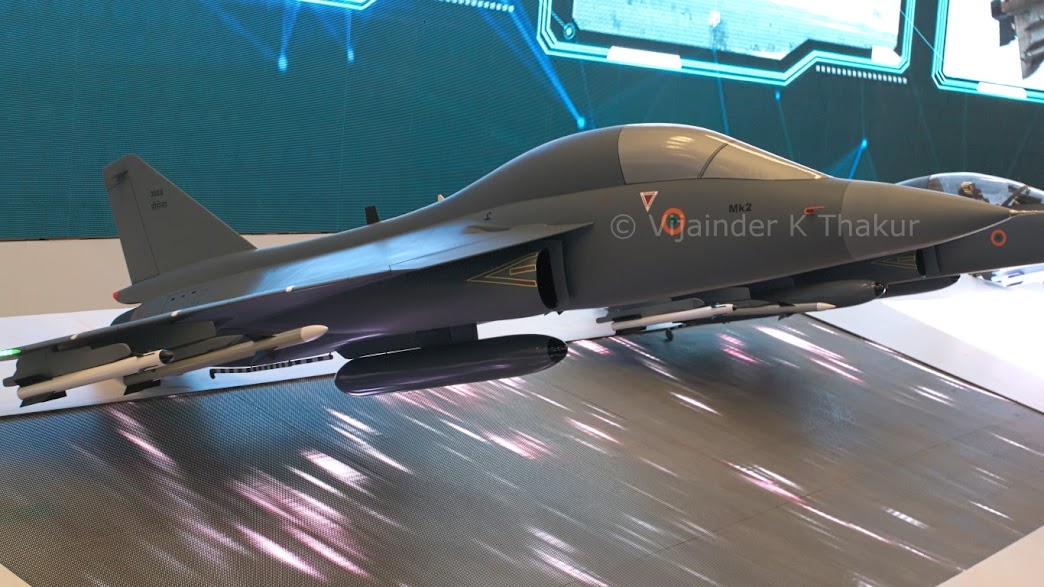
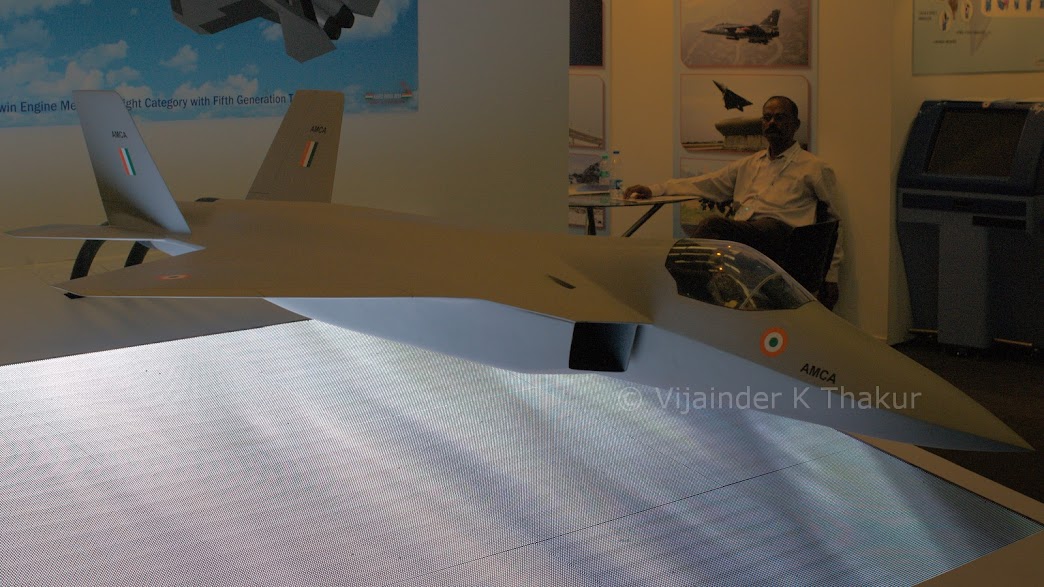
A scale model of the AMCA on display at AI 2019


Speaking on the sidelines of an event marking 25 years of the LCA Tejas flight programme, DRDO Chief Samir V. Kamat reportedly said that the AMCA is likely to be rolled out by the end of 2028. The aircraft’s first flight may take place in early 2029.

Let us look back at HAL/DRDO’s AMCA rollout projections since 2019.

In January 2021, the Chairman and Managing Director of Hindustan Aeronautics Ltd, R. Madhavan, said, “The prototype of the aircraft is likely to be ready by 2026, and its production could start by 2030.”

In September 2021, Girish S. Deodhare, Programme Director (Combat Aircraft) and Director, ADA, upped the ante by projecting a first flight in 2025.

He said, “We are moving to a critical design review by the middle of next year, with the roll-out planned in 2024 and the first flight planned in 2025.”

Dr A. K. Ghosh, Project Director of AMCA, stated during DefExpo 2022, “Once the project sanction is received, the first prototype can be rolled out in three years, and the first flight can take place one to one-and-a-half years after that.”

Considering that the AMCA project received its go-ahead in 2024, the timeline projected by Dr Ghosh would translate to a first flight by the end of 2028.

Now, the first flight is being projected in 2029.

The IAF, which has had a long association with DRDO and HAL, has remained sceptical.

When DRDO first projected the AMCA development timeline to the Indian Air Force (IAF) in 2019, it assured operational induction by 2035.

The IAF’s top leadership, despite its enthusiasm and wholehearted support for a home-grown stealth fighter, considered the timeline ambitious. In July 2020, the IAF euphemistically described the timeline as “very tight.”

However, senior DRDO and HAL officials ignored the IAF’s reservations.

In November 2022, the Chief of the Air Staff (CAS), Air Chief Marshal V. R. Chaudhari, advised “prudence.” He recommended foreign tie-ups as a fallback for developing “alternative systems and sensors” in case indigenous development slipped off the timeline.

The IAF has projected to the MoD a requirement for 2-3 squadrons of an interim stealth fighter to plug the operational gap due to the absence of stealth fighters in IAF inventory. 

It's time for the government to act, because the writing is on the wall 

Wednesday, November 20, 2019

There is room & time for Su-57 and AMCA in IAF Inventory


    Speaking on the sidelines of the Dubai Airshow 2019 in the UAE on November 18, 2019,  Sergey Chemezov, head of  Russia's Rostec, indicated that India and the UAE "have been considering and discussing buying the Su-57 "for a long time, though no decision has been delivered yet."

“The Russian side proposed to localize the production of individual components of the export version of the Su-57 in countries [that are interested,] we are talking about India, the United Arab Emirates, Turkey”

"Localization [has been offered] ... It does not matter whether it is [the] United Arab Emirates, India or Turkey, we will rely on what they can do"

Elaborating on his statement, Chemezov explained that the extent of the localization would be dictated by the industrial capability of the buyer nation. Russia would source local components if the buyer could manufacture them, but would not assist in setting up the supply chain. In the absence of an existing supply chain, localization would not be possible.

“If there are simply no such technological capabilities in the country, then it is simply impossible to do this,” S. Chemezov noted.


During his visit to Russia in July 2019, the former Chief of Air Staff (CAS) Air Chief Marshal Birender Singh Dhanoa had stated that the IAF will have a look at the Su-57 only after it joins active service with the Russian Air Force. Russian Aerospace Force has ordered 76 Su-57 jets, the first of which is scheduled to be delivered by the end of 2019.

During the annual press conference on October 5, 2019, ahead of the Air Force Day on October 8, 2019, the current CAS, Air Chief Marshal RKS Bhaduria said in response to a question from the press, “On the fifth generation (requirement), the AMCA has been given a go ahead and we have given it our whole support and are putting in our energies there. No import is planned in the foreseeable future.”

The remarks  were widely interpreted as ruling out import of any 5th gen fighter. However, they could also be interpreted as reiterating what the former CAS said - that at the appropriate time acquisition of the Su-57 could be considered.

It's likely that the IAF and the government are keeping their options open on the issue. Since Russia is unlikely to export the Su-57 before its own requirement of 76 aircraft is fulfilled there is no reason for India to commit at this stage.

AMCA Challenge

The AMCA is projected to enter operational service in 2035, if ADA and HAL stick to their timelines. Whether or not the IAF can fulfill its mandated role for the next 15 years without 5th gen fighter technology would depend on how threat perceptions play out. Here it's relevant to note that ADA / HAL have yet to demonstrate any of the critical technologies that would be required for the AMCA - LO shaping with super maneuverability, sensor fusion, super cruise, secure low probability of intercept high bandwidth data link and the ability to function as command center for other aircraft, including attack drones, when performing joint operations. As such, the ADA / HAL projected timeline looks overly optimistic.

IAF Options

Over the next 15 years, there are likely to be just two operational 5th generation fighters - Lockheed Martin's F-35 Lightening 2 and Su-57. The F-35 is unlikely to find favor with the IAF because Lockheed retains control over the stealth fighter's software even when selling it to the USAF. 

The choice before the IAF is to wait for the AMCA, or to acquire some Su-57s while it waits for the AMCA! There following are some factors that the IAF would well to keep in mind while exercising its choice.


Sergey Chemezov's statements at Dubai seem to suggest that Russia has drawn a clear line as to the extent and type of localization that it will agree to. If India were to purchase the Su-57, Russia would be willing to source any Su-57 component that India is in a position to manufacture and supply. It will not transfer technology to India to help make components locally as part of the deal!

Here it is relevant to point out that unlike the F-35, which relies primarily on its radar frequency low observability (RF LO) to safely operate in contested airspace, the Su-57 uses a combination of RF LO, electronic warfare (EW), supermaneuverability, and laser blinding of missile seekers to remain safe in contested airspace. As a result, the Su-57 features a powerful defensive suite laden with sensors, jammers and laser emitters that are not well known to the West. Under the circumstances, Russia's desire to limit localization is reasonable.

The Su-57 has generated a lot of interest in the middle east with Turkey and UAE openly negotiating and Saudi Arabia a future prospect. The reason for the interest is simple to understand - the US will not sell the F-35 to these countries because of the threat such sales would pose to Israel. Russia is keen to seize the opportunity and fill the gap not just to increase its arms sales but also to increase its clout in the Middle East. Under the circumstances, it wouldn't in India's long term strategic interests to play coy for too long.

Sunday, March 5, 2017

Should ADA Push LCA Navy Mk.2 Against IN Wishes, or Focus on the AMCA?


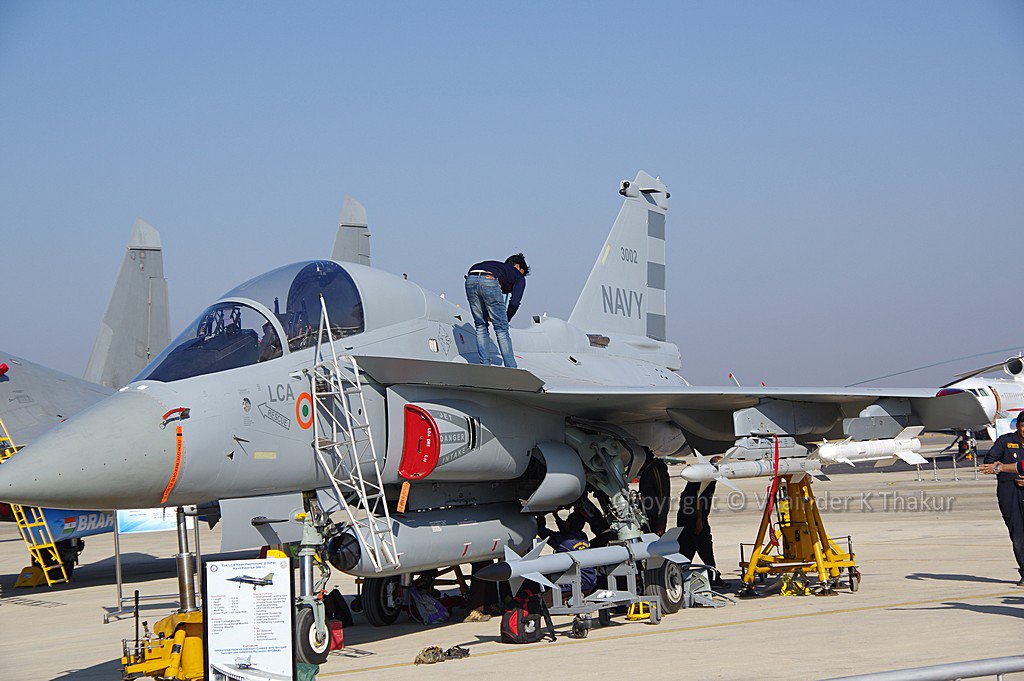
LCA Navy Mk.1 at Aero India 2017

On December 2, 2017, the Chief of Naval Staff Admiral Sunil Lanba told the press that the Indian Navy is scouting for another carrier operations compatible fighter besides the MiG-29, since LCA Navy lacks the payload required to be effective when operating from a carrier.

“The present LCA Navy does not meet the carrier capability which is required by the Navy. We will continue to support the Defense Research and Development Organization (DRDO) and Aeronautical Development Agency (ADA) in their efforts to develop a carrier-based fighter aircraft. At the same time we will seek aircraft elsewhere which can operate on the aircraft carrier,” said Admiral Lanba.

On January 24, 2017 the Indian Navy went ahead and released a RFI for procurement of approximately 57 Multi role carrier borne fighters (MRCBF) for aircraft carriers of the Indian Navy (IN).

However, speaking to the press in February 2017, ADA Director Commodore C D Balaji (Retd.) said that the Navy Chief's December remark that the LCA Navy lacked adequate payload was restricted to LCA Navy Mark I.

"...We knew (it) was a heavier platform upfront and it was basically a technology demonstrator and that is how it is intended," he said.

Recalling the development testing underway since 2016, Balaji said "....we will convert this project into a product and that will happen once we do an arrested recovery (by mid of this year), the moment we do that we will carry the learning into Mark II which has already been designed."

Clearly, the IN and ADA are not on the same page on the future of LCA Navy. The Navy wants to support LCA Navy as a technology development project, but ADA wants to see LCA Navy Mk.2 operationally embarked on IN aircraft carriers.

ADA is reported to have vigorously lobbied with RM Manohar Parrikar to keep the LCA Navy Mk.2 project alive. ADA's desire is well intentioned and widely supported by defense enthusiasts who believe that in order to become a great power India must equip its forces with home made weapon systems.

However ADA's attempt to arm twist the IN through the RM to eventually accept LCA Navy Mk.2 for embarkation makes little sense because despite a more powerful engine (LCA Mk.2's F414 has 10% greater thrust than the Mk.1's F404 engine) and optimized design, LCA Navy Mk.2 will fall woefully short of IN requirements specified in its MRCBF RFI.

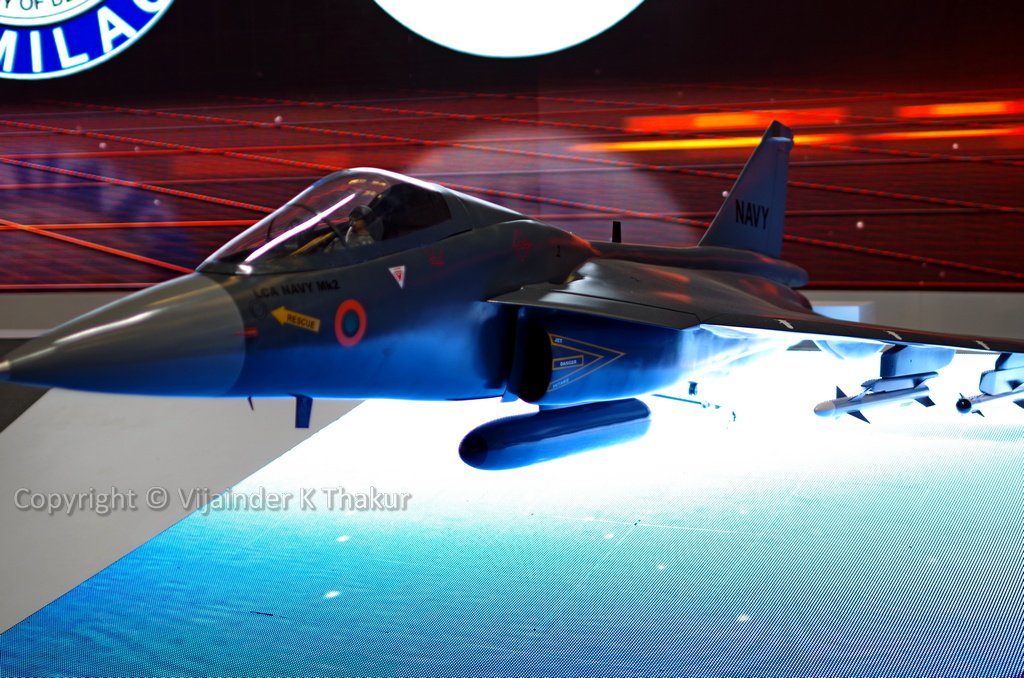
Scale model of LCA Navy Mk.2 armed with 4 air-to-air missiles at Aero India 2015


LCA Navy Mk.2 Limitations

ADA's aggressive plugging of LCA Navy Mk.2 suggests that the Mk.2 is as capable as the MRCBF that the navy is seeking. This is far from the truth. The extra thrust of the F414 engine would make the LCA Navy Mk.2 more maneuverable but will not significantly increase its weapon load, which the IN considers inadequate. The extra thrust would come at the cost of higher fuel consumption, particularly close to max power setting, negating some of the benefits accruing from the 700 liter extra fuel that the Mk.2 would carry.

LCA Navy Mk.2 will be a more capable air defense (AD) fighter than the Mk.1 but will continue to lack credibility as a strike aircraft. It's range and weapon load carrying capacity would be limited even when operating from 3000m runways, let alone when conducting STOBAR operations from a 200m carrier deck.

It's worth noting that the ADA itself plugs LCA Navy Mk.2 as an AD fighter that would provide cover to a carrier group against fighter and cruise missile threats, not as a strike fighter. Scale models of LCA Navy Mk.2 displayed at Aero India 2015 and Aero India 2017 were shown carrying just four air to air missiles (two on each wing) with a center-line drop tank.

Ironically, the IN RFI defines operationally clean configuration (OCC) for the MRCBF to imply that it's carrying four Beyond Visual Range (BVR) missiles and two All Aspect Air-to-Air Missiles (A4M). A total of six missiles, two more than the LCA Navy Mk.2 would carry!

Scale model of LCA Navy Mk.2 at Aero India 2017


Understanding IN Requirement

Carrier groups are primarily strike groups, capable of delivering sustained fire power while operating at considerable distance from home shores. Typically, an aircraft carrier embarks only one fighter type to minimize logistics and maintenance overheads. The primary role of the embarked fighter is strike, so it must features good weapon load and range. Since strike missions often require escort fighters and escort jammers, embarked fighters must also be capable of undertaking these roles.

An embarked multi-role fighter allows mission planners to change the force mix - strike, escorts, jammer - based on how heavily adversary airspace is contested. The single embarked aircraft type is reconfigured for its assigned task.

The US F/A-18E/F, the French Rafale-M, and the Chinese J-11 are examples reconfigurable, multi-role carrier borne fighters with good weapon load and range.

The IN wants a MRCBF - Multi Role Carrier Borne Fighter, and the LCA Navy Mk.2's credentials as a multi-role fighter are weak.

It would not be a good idea to embark LCA Navy Mk.2 aircraft on INS Vikramaditya or INS Vikrant alongside MiG-29Ks, as ADA seems to suggest in its brochures and presentations. Having two fighter types on board, would dramatically push up maintenance and logistics infrastructure requirements. More importantly, it would constraint mission planners, deprive them of the flexibility in selecting force mix. Mission force mix would become dependent on embarked force mix! For example, when operating in uncontested airspace LCA Navy Mk.2s would have little to do.

The USN does not embark two fighter types on its super carriers capable of hosting 60 fighters. IN carriers are much smaller and embark around 20 fighters. Operating constraints will become severe. With 60% serviceability and even split of embarked types - INS Vikramaditya would be able to field just 6 MiG-29Ks and 6 LCA Navy Mk.2s at a time, hardly a credible strike force!

Other RFI Shortfalls

Besides limited range and weapon load, LCA Navy Mk.2 would fall short on many other requirements specified in the Navy RFI.

Radar and EW Suite

The RFI specifies a radar capable of engaging airborne and surface target, preferably in a interleaved mode. The aircraft should be equipped with a Radar Warning Receiver (RWR) capable cuing an on-board Airborne Self Protection Jammer (ASPJ), Counter measures dispensing suite (CMDS), Missile Approach Warning System (MAWS) and towed decoy for handling threats?

Interchangeability / Modularity

The Navy RFI also stipulates high degree of interchangeability / modularity - all major airframes components / parts / panels, sub-assemblies, including the canopy should be fully interchangeable between aircraft. Hot and cold engine sections should swapable. It should be possible to change the engine of an aircraft on the carrier itself.

These requirements are easily understood considering that an aircraft carrier could be operating hundreds of miles from home shores. Interchangeability allows recourse to cannibalization to keep more aircraft airworthy. To achieve interchangeability, ADA as the design agency and HAL as the production agency would need to achieve better design and production standards.

Conclusion

Clearly, when drafting the RFI the IN was visualizing Chinese carriers and nuclear submarines in the Indian Oceans, perhaps adversary beachheads on several Andaman and Nicobar group islands. The Navy was probably thinking Super Hornet and Rafale-M, both twin engined medium fighters. Competing against the Super Hornet, the LCA Navy Mk.2 with just one of the two engines fitted on the US Navy fighter would be clearly out of league.

LCA Navy equipped IN carriers aren't going to be enough to deter PLAN forays into the Indian Ocean, so should the IN still procure them to help India achieve self sufficiency in arms production?

Rather than pushing the LCA Navy Mk.2 as the right MRCBF for the IN, ADA would better serve the nation's interest by focusing on AMCA development. ADA certainly doesn't have the infrastructure and talent to pursue both projects simultaneously.

But ADA should continue to pursue LCA Navy as a technology demonstrator, something the Navy wants it to do. After ADA masters arrested landing, as it plans to do later this year, the agency should pursue auto-landing on deck and other relevant technologies, so that when the AMCA project gets a green light, ADA has all that it needs to develop the AMCA Naval variant.


Wednesday, October 21, 2015

Indo-US Partnership for Developing Aircraft Carrier, Hot Engines - AMCA Go Ahead Likely?

AMCA Wind Tunnel Test Model at Aero India 2015

Following an in principle agreement between India and the US to cooperate in jet engine and aircraft carrier design and construction under DTTI, arrived at during US President Obama’s visit to India in January 2015, the two nations have been discussing the scope and modalities of the cooperation.

Two rounds of discussions are known to have been held already, more are planned.

Surprisingly, US Assistant Secretary of State for South and Central Asia Nisha Desai Biswal, in her recent address to the annual meeting of Association of the US Army, said, "We're now helping India develop aircraft carrier and jet engine technology as part of our Defense Technology and Trade Initiative, which Secretary Carter launched back in 2012."

Her statement suggests that cooperation has already started. If it has, it's probably based on a level of agreement already reached.

While the Aircraft Carrier development cooperation would focus on EMALS, the agreement on jet engine technology would focus on a hot engine power plant for the AMCA based on the F414 Enhanced Performance Engine (EPE).

If the Assistant Secretary's statement is indeed true, it is possible that the Indian government will soon sanction and fund the AMCA project, clearing the way for preliminary design of the aircraft to commence.

The AMCA configuration has been frozen in consultation with the IAF. The project was awaiting choice of an engine.

The finalization of the AMCA power-plant would explain the IAF Chief's optimism on the AMCA, evident during his recent press conference.

Monday, July 6, 2015

News Roundup: AMCA Project Stranded without Engine, Army Clears Dhanush 155mm/45cal Gun Production and More

Dhanush at DefExpo 2014

Army grants OFB Bulk Production Clearance for 144 Dhanush 155-mm/45-cal guns 


The Indian Express reported on July 6, 2015 that the Indian Army has granted OFB (Ordnance Factory Board) Bulk Production Clearance for 144 Dhanush guns.

Gun Carriage Factory, Jabalpur has already started production of the gun; it plans to supply 6 guns within 6 months, another 12 within 12 months and another 36 guns within 24 months.

Army had hoped to get all the 144 guns in 3 years!

The MoD announced on April 27, 2015 that Dhanush has met all tech parameters in Winter and Summer Trials.

The TOI reported on October 13, 2014 that field trials of the gun have been completed and OFB is currently waiting for the DGQA report on the trials.

IDP Sentinel members can read more at the link below:
Dhanush 155 mm/45 Caliber Upgraded Bofors Howitzer - IDP Sentinel

Hawk AJT Flight Safety Record

On July 6, 2015 the TOI reported that the recent Hawk AJT crash was attributed to quill shaft failure, leading to concerns about HAL production quality.

A source reportedly told the TOI that Rolls-Royce has reduced the TBO (time between engine overhauls) of HAL produced Hawk AJTs from 2,000 hrs to 1,200 hrs, as a result of production quality concerns. HAL has denied the allegation.

On June 3, 2015, an IAF Hawk crashed about 50 Km west of Kalaikunda airbase. Both pilots ejected safely.

The crash was the second IAF Hawk crash. The first, was attributed to human error.

IDP Sentinel members can read more at the link below:
Hawk Mk.132 AJT - IDP Sentinel

AMCA Powerplant


On July 6, 2015 the Business Standard reported that the US is stonewalling India's request for cooperation on developing hot engine technology - specifically, India's desire to fund residual development of the F414 EPE as AMCA powerplant.

As a result, MoD is issuing a global tender, inviting aero engine majors to co-develop with the DRDO an AMCA powerplant.

The US stonewalling will bring back Eurojet EJ200 as contender for powering the AMCA. Eurojet reportedly convinced the DRDO it can uprate the EJ200 to 110 kN.

One good reason for the US to stonewall joint development of the F414 EPE for AMCA could be concern over Indian plans to fit the AMCA engine with thrust vectoring nozzles developed with assistance from Russia's Klimov.

Russian engine technology lags behind the US state-of-the-art, and the US could be worried that the Russians will get a close look at the F414 EPE. However, Russia claims that its Item 30 engine being developed for the PAK/FA would match contemporary western aero engines. The first prototype of the Item-30 engine is due to be delivered later this year.

IDP Sentinel members can read more at the link below:
Advanced Medium Combat Aircraft (AMCA) (IDP Sentinel)

Pinaka Submunition Warhead Development


Pinaka rockets were successfully tested with submunition warheads, including a thermobaric  warhead, at Pokhran during field firing trials in Rajasthan on June 29, 2015.

The tests were conducted using random Pinaka Mk-1 rockets picked up from a production lot. [via TOI]

The submunition warheads tested are among the eight kinds of warheads for Pinaka. Thermobaric  warheads are deadly against personnel and inflammable targets. Other warheads developed include cluster warheads armed with anti-personnel and anti-tank submunitions., and runway denial penetrating submunition warheads, aimed at neutralizing targets like runways and other complexes.

IDP Sentinel members can read more at the link below:
Pinaka Multi Barrel Rocket Launch System (MBRLS) - IDP Sentinel

Wednesday, July 1, 2015

News Roundup: LCA Mk-2 Maiden Flight in 2018-19, AMCA Development Cost Just Half of 36 Rafale Pricetag, T-50 Product-30 Engine Prototype Ready

AMCA model at Aero India 2015

AMCA Development Cost Just Half of 32 Rafale Price Tag


AMCA development would cost half of 32 Rafale acquisition, estimates outgoing ADA chief.

On June 30, 2015 outgoing ADA director P.S. Subramanyam told Business Standard that the AMCA's configuration is finalized, and preliminary design is about to commence.

While it will be possible to accurately estimate the cost of the project only on completion of preliminary design, Subramanyam says, "I am confident that the AMCA project would cost less than any fifth generation fighter project anywhere. My estimate would be in the region of $4 billion (Rs 25,000 crore)."

Acquisition cost for 36 Rafale aircraft is estimated to be around Rs 8 crore.

IDP Sentinel members can read more at

AMCA Preliminary Design Poised to Commence

LCA Mk-2 First Flight by 2018-19


On June 30, 2015 outgoing ADA Director P.S. Subramanyam told the Business Standard, "The preliminary design of the Tejas Mark II fuselage is already completed, without surprises. The detailed design will not cause delay. The fighter will make its first flight by 2018-19; and will begin joining the IAF fleet by 2021-22."

ADA is scouting for a consultant to validate the detailed design, but is ready to proceed independently if it cannot arrive at a satisfactory consultancy arrangement.

During the visit of MoS for Defense Rao Inderjit Singh to France during PAS 2015, Airbus Industries reportedly offered to provide LCA Mk-2 design consultancy.

IDP Sentinel members can read more at

LCA Mk-2 First Flight by 2018-19, Airbus Industries Offers Design Consultancy

Product-30 (Stage-2 Engine for T-50) Prototype Built


In June 2015 it was reported that United Engine Building Corporation (UEBC) has built a prototype of the new engine. Two prototypes of the engine are scheduled to be built in 2015.

UEBC CEO Vladislav Maslov had earlier said that work on developing the stage-2 will be completed in 2020.

It maybe noted that the IAF is reportedly not happy with the capabilities of the Product 117 engine currently fitted on the T-50 for the stage-1 phase of the aircraft's development.

Moscow-based Salut and NPO Saturn are building a brand new stealthy power-plant for the T-50, which is not a derivative of the AL-41F1 (Product 117) engine that powers it. Called Product 30, the new engine will be 30% lighter than the Product 117 engine and come with 30% lower life-cycle cost.

The new engine is expected to offer about 17.5 tons (171.6 kn) of thrust in full after-burning mode and somewhere in the range of 12 tons (117.7 kn) in dry mode, allowing the aircraft to comfortably super-cruise at around Mach 1.5. The Product-30 engine will compare favorably with fifth generation engines made in the west.

IDP Sentinel members can read more at

Product-30 (Stage-2 Engine for T-50) Prototype Built

Monday, June 1, 2015

News Roundup: AMCA Powerplant, Army's Tactical Communication & Battlefield Management Systems

AMCA Scale Model at Aero India 2015

Carter Visit Crucial for AMCA Development 

US Defense Secretary Ashton Carter's visit to India on Wednesday, June 3, 2015 will be crucial to progress of India's Advanced Medium Combat Aircraft (AMCA). 

According to Business Standard, Indian officials plan to press Carter on sharing US hot engine technology with India under DTTI, as alluded to in the joint statement released during US President Barack Obama's visit to India from January 25 to 27, 2015.

The IAF wants the AMCA to be a 25-ton class aircraft fitted with a 110-kN engine. Currently there is no 110-kN class engine is available in the world market.  However, GE Aviation is developing a 120-kN variant of the F414 called the F414 EPE (Enhanced Performance Engine).

The F414 EPE is a hot engine - its turbine blades are made of new materials and use more efficient cooling, enhancing turbine temperature tolerance by 150 °F (66 °C). The engine produces 18 percent more thrust than the F414, mostly because of increased turbine temperature.

What works well for India is that the LCA Mk-2 and the LCA Navy Mk-2 are to be powered by the F414 which has a thrust of 22,000 lb (98 kn), India placed an order for 100 F414 engines in 2011.A few would be delivered off the shelf, and the rest produced in India.

ADA wants to build prototypes of AMCA using F414 engine, and use the F414 EPE for series production aircraft.  The hope is, India would fund development of a F414 EPE variant for the AMCA under DTTI and in the process gain access to hot engine technology. US readiness to part with the technology or otherwise would prove crucial to the AMCA project. 

IDP Sentinel members can read more details at the link below


Indian Army Tactical Communication System (TCS) RFP Expected in 6 months


BEL Chairperson & Managing Director S.K. Sharma in his first media interview on May 31, 2015 said that he expected a RFP for the project in six months.

Tactical Communications System (TCS) is conceived as a high-bandwidth, mobile, data and voice network that can be rolled out, even in enemy territory during war.

The Army will use TCS to provide a dedicated mobile communication system with anti-jamming and electronic countermeasures capabilities.

IDP Sentinel members can read more details at the link below.


Indian Army Battlefield Management System (BMS) RFP Expected Next Year


BEL Chairperson & Managing Director S.K. Sharma also said that he expected a RFP for the Battlefield Management System (BMS) next year. 

The BMS is conceived as a wireless network that links digital devices carried by combat soldiers, interlinking them, their commanders and a range of battlefield sensors. This provides a common battle picture to each individual. 

The system will integrate all combat units - armored, artillery and infantry regiments, infantry battalions and helicopter flights - and enables commanders to track every soldier and weapon on the battlefield and exchange reports, photos, data and verbal and written communications. The BMS will also facilitate sharing of data from seismic sensors, surveillance radars, long range optical sensors and thermal imaging devices in the battlefield.

When deployed, BMS will cover more than 70 per cent of soldiers while digitising the tactical battlefield and creating a secure IoT (Internet of Things) for the army.

IDP Sentinel members can read more details at the link below:

Thursday, March 12, 2015

AMCA Stealth Fighter Update from Aero India 2015

AMCA Scale Model at Aero India 2015
The design of the AMCA scale model displayed at Aero India 2015 was identical to the design of the AMCA scale model displayed at Aero India 2013. This wasn't the case during earlier shows - Aero India 2011 AMCA design differed from the 2009 design, and the 2013 design differed from the 2011 design.

As far as the ADA is concerned, the current AMCA design is final, having been tested to full satisfaction in a supersonic wind tunnel in the US. (At the time of Aero India 2013, the design had only been tested in a subsonic wind tunnel in India.)

Going by the displayed design, AMCA will


  1. Feature two engines without thrust vectoring, relying exclusively on high power to weight ratio for super-maneuverability.
  2. Not have all aspect stealth - engine nozzles are not shaped, though ADA intends to minimize IR signature of the engine exhaust.
  3. Be a single seat fighter.


ADA is all set to roll with the AMCA project, but the IAF isn't impressed with the aircraft's current feature set. The service has drawn up very detailed and ambitious PQSR which includes all aspect stealth, super-maneuverability through thrust vectoring and twin seats.

ADA is confident that it can redesign the AMCA for all aspect stealth, twin-seats and thrust vectoring, but points out that these capabilities would push up costs and stretch timelines. ADA is in the process of responding to the IAF PSQRs with feature wise cost and time frame implications.

(No twin seat stealth fighter has been developed so far because adding a second seat reduces stealth.)

Thrust vectoring is likely to be conditional on Russian willingness to transfer technology.

In view of the differences between ADA and the IAF, it maybe a while before AMCA staff requirements are finalized. Hopefully, the IAF will challenge ADA with realistic performance and timeline requirements, not doom the project by asking for the moon as it sometimes tends to do.

Meanwhile, IDP sentinel has learn't that LRDE has been tasked with developing a conformal X-band AESA for the AMCA, which means that the pilot will be able to track and engage threats not just in the front quarter, but also on either side.

Clearly, it's not just the IAF that needs a reality check.

ADA Details Stealth AMCA Engine Plans

IDP Sentinel members can read more about the AMCA project at the link below.

Advanced Medium Combat Aircraft (AMCA) - IDP Sentinel


Thursday, February 12, 2015

ADA Details Stealth AMCA Engine Plans

AMCA model at Aero India 2013

ADA seems to have refined and narrowed its AMCA powerplant options. The 25-tonne class AMCA is to be fitted with a 110-kN engine. However, currently no 110-kN class engine is available in the world market.  

So ADA will design the fighter around a 110-kN engine, but use a 90-kN off-the-shelf engine to power prototypes of the aircraft, giving itself time to develop a 110-kN engine.

ADA Director PS Subramanyam told The Hindu that it would be prudent to procure and integrate an available 90-kN engine into the aircraft so to ensure that the project was not held up. 

“Since the fighter has been designed to take on an engine with a higher thrust, we can integrate it as and when such an engine is available. This is what has been done by Dassault in the Rafael development program,” he says.

Elaborating on AMCA powerplant options, K. Tamilmani, Director-General (Aero R&D) told the press that since no 110-kN engine is available off the shelf, GTRE will partner with a US or Russian engine manufacturer to develop such an engine - mostly within India - to power AMCA production variants.

“We have asked for their proposals [and will go ahead with] whoever has a better offer, time frame and cost," he said. The goal is to integrate the new engine into the aircraft by 2020-21.

DRDO and IAF officials will hold talks with two manufacturers during Aero India 2015 - General Electric of US and Klimo of Russia. 

Interestingly, Tamilmani didn't mention French Snecma and early front runner for co-producing an AMCA engine with GTRE.

It may be noted that the joint statement released during US President Barack Obama's visit to India from January 25 to 27, 2015 referred to US - Indian collaboration in developing a hot engine (A reference to a jet engine with high turbine temperatures and greater thrust.)

It was earlier reported that the AMCA will be powered by a new engine that GTRE plans to develop with the help of one or more foreign consultants, Snecma being one of them.

On January 8, 2015 the TOI reported that five to six global aero-engine manufacturers have made presentation to ADA for the AMCA engine. It is likely that ADA has now narrowed down its options based on the presentations.

IDP Sentinel members can read more about the AMCA project at the link below.

Wednesday, November 12, 2014

FGFA License Production Preferable, Hints Russian Official?

FGFA scale model at Aero India 2013.

An official of Russia's UAC, the group that owns Sukhoi, hinted that license production of FGFA maybe a better option for India than co-production. He cited the success of the Su-30MKI program.

UAC's Mikhail Pogosyan told Russian news agency TASS on Tuesday that no timeline could be projected for finalization of the FGFA contract between India and Russia because of differences.

"There are several issues related to the organization of the work, the terms, the cost and technical details. This requires certain time and the corresponding coordination procedure at the level of governments of both countries,” Pogosyan said.

He then referred to the licensed production of the Su-30MKI in India and said, “In general, the program of licensed production of the aircraft develops successfully.”

It could be the translation. Or it could be a hint!.

Anyway, as is the case with Brahmos, labeling FGFA as co-development is a farce. It's unreasonable for India to expect Russia to part with stealth technology for just $5.5 billion. Paying them more would not help either.

What would really help is stepping up funding for the AMCA!

Saturday, November 8, 2014

IAF: Boldly Securing India's Future

IAF Su-30MKI and IL-78 tanker

Parts of the following article appeared in the October 2014 issue of Geopolitics marking Air Force Day.

Air Force is a technology driven service, much more so than the Navy or the Army. The last century saw rapid advances in military aviation technology, and the current century is seeing the trend continue.

Since independence, the IAF has continually adapted to technological breakthroughs  - jet propulsion, supersonic flight, airborne radars, electronic warfare, Precision Guided Munition (PGM), thrust vectoring, phased array multifunction radars, AESA radars, Network centric warfare, Optical Sensors, Stealth and UAVs.

The IAF has absorbed and embraced these technologies and re-oriented its tactics to use them.

Opinion is divided on how effectively and rapidly the IAF coped with past technological changes. Admittedly, there was a phase (mid sixties to early eighties) when the IAF appeared to go into slumber. It remained isolated from western Air Forces, despite being modeled after them. It didn't interact with the Soviet Air Force, despite the close geopolitical alignment of India and the Soviet Union because it shared very little with the Soviet Air Force other than aircraft and air combat weapon systems.

The IAF's isolation ended with the acquisition of the Jaguars in the early 1980s, and the Mirage-2000 later in the decade.

The 1991 unraveling of the Soviet Union proved to be a turning point for the IAF. A mixed blessing, the breakup disrupted supply of spares for the IAF's Soviet origin weapons, but the end of the Cold War and consequent thawing of Indo-US relations allowed India to source its weapons from Israel, a close US ally.

India found itself in a unique position - A country that could source its weapons from the best arms manufacturers in the world -  from Russia, a time tested friend; from the US, a natural ally; and from Israel, a friend with bonds deeply rooted in history.

The IAF took full advantage of India's unique positioning, perhaps more so than the Army and the Navy, blending Russian engineering with western electronics to come up with cost effective and potent marvels such as the Su-30MKI.

The service started exercising with friendly countries across the spectrum - USA, UK, France, South Africa, Singapore - to imbibe best practices and improve interoperability. The IAF's recent exercise with the Russian Air Force - AviaIndra-2014-  illustrates how far the IAF has travelled.

The 1998 Pokhran nuclear tests and the resultant cooling of India's relations with the US forced the IAF to remain heavily dependent on Russia for its aircraft and missile requirements. However the setback in Indo-US relations proved short lived.

Over the past 15 years, large scale induction of Su-30MKIs, upgrades to the IAF's MiG-21, MiG-27 and MiG-29 fleets; introduction of net centric warfare through AFNET and data links; induction of force multipliers like tankers and AWACS aircraft; and regular exercise with foreign air forces have added considerably to the IAF's punch. Acquisition of the MMRCA, planned upgrades to the IAF's Mirage 2000 and Jaguar fleets, and modernization of airfield infrastructure (MAFI) would continue the trend.

The IAF still has a long way to go in areas such as ISR, UAS and UCAVs. Also, more challenging technological advances in military aviation are around the corner - Cooperative engagements, Optionally manned fighters, and hypersonic flight, to name a few.

Resting on the oars, is not an option for the artistes of the sky! The IAF needs to press on with its new found nimbleness in adapting to changes.

The service is now uniquely positioned to become the world's leading air force - an effective deterrent for our adversaries.

The proverbial elephant in the room is financial constraint. China's GDP is three times larger than ours, a sobering handicap around which the IAF must draw its future plans.

A close look at IAF's re-equipping plans over the the next 20 years proves to be reassuring - with Rafale, Tejas LCA, LCA Mk-2, FGFA, and AMCA fighters; Phalcon AWACS, EMB-145 AEW&C and Airbus A330 MRTTS force multipliers; and additional C-17s and C-130J transports in the pipeline.

Too much perhaps has been written about the status of the Rafale project, so we will focus on the less talked about future fighter acquisitions.

Tejas LCA at Aero India

Tejas LCA


The Tejas LCA Mk-1 is just months away from FOC and induction into the IAF.

In November 2001, while sanctioning Full Scale Engineering Development (FSED) of the aircraft, MoD stipulated December 2008 as project completion date. The date has since been revised to March 2015.

(An 8 year long delay in a 7 year long project is difficult to condone, but it must be kept in mind that the LCA was initially sanctioned as a technology demonstrator project and its two prototypes were not built to production standards. They were built to be serviced by ADA engineers; as a result, many components were not fitted to be line replaceable. Post FSED sanction, the aircraft needed much internal re engineering to facilitate flight line servicing by IAF personnel. HAL was to progressively bring the Tejas to production standards while building the 8 Limited Service Production aircraft, but senior IAF officers connected with the project say that early LSP aircraft were no different from the prototype!)

The IAF has placed orders on HAL for 40 Series Production (SP) aircraft to equip two squadrons. The first SP aircraft is close to delivery; another two are scheduled to be delivered before the year end.

Priced around $30 million, the Tejas is a very cost effective solution to the IAF's need for a lightweight air defense fighter with a credible strike capability; much easier to fly and far more lethal than the MiG-21 Bis / MiG-21 Bison aircraft that it's set to replace in the IAF.

HAL plans to initially produce eight aircraft per year and later ramp up production to 16. It has signed Long Time Business Agreements (LTBAs) of 3-5 years with its sub-vendors to keep prices low, assuring vendors of production orders for up to 40-50 aircraft at a time.

If HAL production of Tejas SP aircraft meets IAF's quality expectations, and the aircraft lives up to its promise in squadron service, the IAF would likely place additional orders for Tejas, especially in view of the delay in the LCA Mk-2 project.

Despite the current IAF order for just 40, HAL has plans to meet a requirement of 200 Tejas LCA aircraft in the next decade!

Though a cost effective fighter, the Tejas LCA powered by the  GE-F404-IN20 engine, doesn't measure up to IAF Qualitative Requirements, because durIng its development lifecycle, the aircraft ended up being nearly 1.5 ton heavier than its designed weight.

It was initially hoped that the weight gain would be compensated by fitting the more powerful GTRE developed Kaveri engine. However, in September 2008, it was conceded that the Kaveri wouldn't be ready in time.

LCA Mk-2


The decision to develop the LCA Mk-2 was taken when it became evident to the IAF while testing LSP Tejas LCAs that the aircraft performance was short on certain key Air Staff Requirements including


  1. Power to Weight Ratio
  2. Sustained Turn Rate
  3. Maximum speeds at low altitudes
  4. AOA range
  5. Weapon delivery profiles


Performance shortfall like sustained turn rate and maximum low level speed could only be remedied through the use of a more powerful engine, so it was decided to develop a new variant of the aircraft powered by the more powerful GE-F414-INS6 engine.

LCA Mk-2 at Aero India 2011

Minor modifications are being made to the LCA Tejas Mk1 airframe to accommodate the slightly lengthier engine. The fuselage is being extended by 500mm. (The stretching of fuselage would eliminate the need for the dead weight lead plates fitted on the LCA Mk-1 in order to ensure stability of the aircraft.)

Besides a more powerful engine, LCA Mk-2 will feature


  1. Structural Weight Reduction
  2. Aerodynamic Improvements
  3. Upgraded Flight Control Computer
  4. Electronic Warfare Suite
  5. Upgraded Avionics
  6. Retractable probe for inflight refueling
  7. On board oxygen generation system
  8. Increased fuel capacity.


In a sense, the LCA Mk-2 is the aircraft that the IAF really wanted, not the Tejas LCA.

Project Progress

Preliminary design of the LCA Mk-2 by HAL and ADA was to be completed by March 2014;  detailed design was to start immediately thereafter. There is no confirmation that this has happened.

ADA-HAL are designing LCA Mk-2 using DFMA (Design for Manufacturing and Assembly) methodology, which ensures that aircraft components are designed for easy manufacture, without adversely impacting the ease with which they can be fitted on the aircraft. The first time use of DFMA methodology in designing an aircraft would ensure better quality and quick ramp up of serial production after IOC.

LCA Mk.2 was to make its first flight in 2014, with full-rate production to follow two years later. However, it is now evident that first flight is more than two years away.

Despite the delay, if the LCA Mk-2 project delivers on its promise, it would prove to be a turning point in the evolution of the IAF. With air-to-air refueling, it would add significantly to the IAF's strike punch, besides boosting the IAF's air defense capability.

Perspective Multi-role Fighter (PMF) / FGFA

India and Russia plan to jointly develop a version of the Russian T-50 aircraft customized for IAF requirements. The Indian version would use the T-50's airframe, engines and main systems, but differ in its avionics and weapon suite. The FGFA would use more composite and electronics developed in collaboration with Israel.

Russia is planning to use the jointly-developed 5G fighter as an export variant of the T-50. The fighter is expected to enter IAF service by 2020.

India's HAL and Russia's Rosoboronexport and Sukhoi signed a contract worth $295 million for Preliminary Design (PD) of the FGFA in December 2010.

Under the PD contract, Indian engineers underwent 20 courses to familiarize themselves with the aircraft. The training was completed in July, 2011.

FGFA Scale Model at Aero India 2013


The Russians provided Indian professionals with the original data and the software to create a single working environment. A group of Indian experts worked in Russia in January October 2012, and a group of Russian specialists in India.

By April 2013, HAL and Sukhoi had finalized the design and technical specs of the aircraft and agreed on a work share for the research and development (R&D) phase.

A contract for the aircraft's full-scale development, worth $11 billion,  is expected to be signed during President Putin's scheduled visit to India in December 2014.

The IAF was to evaluate the T-50 before signing a full scale development contract with Russia. At the time of going to the press, it's not clear if this evaluation has taken place.

In September 2014, it was reported that the IAF isn't satisfied with the AL-41F1 (Product 117) engines that currently power the T-50, as also the aircraft's stealth features and weapons carriage system.

Moscow-based Salut and NPO Saturn are building a brand new stealthy powerplant for the T-50, which is not a derivative of the AL-41F1 (Product 117) engine currently fitted on the aircraft. Called Product 30, the new engine will be 30% lighter and feature 30% lower life-cycle cost.

Apparently, the R&D contract drawn up the the Russian partners doesn't cover fitting of the Product 30 engine.

Additionally, there are differences between the two partners over the operational capability of the Tikhomirov-NIIP N036 Byelka AESA radar of the aircraft  and the IAF is concerned about the overall development cost, maintainability and safety features of the aircraft.

Difference between India and Russia at this stage of the program are not surprising, and certainly not alarming. The in-fashion 'joint production' labelling in reality clothes what is essentially a buyer seller relationship and  buyers-sellers squabbles over the price and usefulness of a new product are only to be expected!

Meanwhile in Russia, state testing of the T-50 started in May 2014 and deliveries of the aircraft to the Russian Air Force are scheduled to start in 2016.

In other words, once the FGFA development contract is inked, its success would be assured with timely deliveries, as was the case with the Su-30MKI program.

During Aero India 2013, the then CAS told journalists that the first prototype of the aircraft would arrive in India in 2015, the second in 2017, and the third in 2018.

India plans to acquire 214 aircraft by the end of 2030., but could well end up buying over 400.
Neutralizing the PLAAF Stealth Threat with FGFA

China is developing two stealth fighters - J-20 and J-31. Like the US F-22 Raptor and the F-35 Lightening-2, the J-20 and J-31 are designed to evade detection by ground based radars.

China also has VHF AESA ground based radars that can detect Low Observable (LO) aircraft like the US Raptor and Lightening-2.

Unlike the US and Chinese LO aircraft, the T-50 isn't designed and equipped as much to evade detection by ground based radar, as to detect the Raptor earlier and engage it in close combat to assert its superior maneuverability.

The T-50 / FGFA would have a similar advantage over the two Chinese stealth fighters.

The IAF has done well in choosing the T-50/FGFA over the F-35 Lightening-2. The FGFA would make a worthy successor to the venerable Su-30MKI and secure the future of our country till the middle of this century.

AMCA

The Advanced Medium Combat Aircraft (AMCA) is conceived to be a 20-ton category fifth generation LO fighter featuring super maneuverability, super cruise, and sensor fusion.

The project is currently in the design phase. Feasibility study was completed by end of FY 2011.

The AMCA is being designed as an affordable fighter with swing role capability to meet the requirements of the IAF post 2020. It would carry 5 tons of weapons and be able to release them at supersonic speeds.

As a 20-ton fighter with a 1,000km range, the AMCA will cover the gap between the 10-ton, 500km range Tejas LCA, and the 30-ton, 1,500km range FGFA.

AMCA Scale Model at Aero India 2013

A single seat fighter, the AMCA would replace IAF's MiG-29 and Mirage-2000 aircraft. A two seat version would be developed, but primarily as a trainer, since an additional cockpit compromises LO of a stealth fighter. (The Radar Cross Section of a fighter can be optimized for either single or twin seat configuration, with a single seater likely to be the stealthier design.)

ADA is hopeful that it will be able to incorporate some sixth generation fighter features.

Some of the new technologies that ADA wishes to incorporate in the AMCA include a FBW control system with photonic interface to reduce the length of wires (fly-by-light).

Sixth Generation features include improved range, persistence, situational awareness, human-system integration and weapon fit to counter enemy anti-access/area-denial measures such as electronic attack, passive detection, cyber attack and directed energy weapons.

Stealth Characteristics

The AMCA design is optimized for reduced signature, not maximized stealth. The aircraft is not shaped for all aspect stealth, like the US Raptor (F-22) or the Chinese Chengdu J-20. Instead, shaping is optimized to  minimize frontal Radar Cross Section (RCS), as is the case with the T-50/FGFA.

The AMCA will feature "serpentine-shaped" air intakes, internal weapons bays, and advanced radomes to increase stealth. Radar-absorbing composites and paints will supplement the design.

AMCA blends stealth with maneuverability, while keeping costs affordable.

AMCA Powerplant

The aircraft will be powered by a new engine that the GTRE plans to develop with the help of one or more foreign consultants, Snecma being one of them.

Like the Lightening-2, Rafale and Eurofighter, AMCA will achieve supermaneuverability by using a powerful engine. However, if the IAF prefers thrust vectoring based supermaneuverability, ADA will tweak the aircraft design accordingly.

Wednesday, June 18, 2014

DRDO to Fast Track Advanced Medium Combat Aircraft (AMCA) Development

Scale model of AMCA on display at Aero India 2013 in Bengaluru

DRDO Chief Avinash Chander recently told the press that the AMCA project would be fast tracked.

He said DRDO has identified certain key areas to focus upon, including UAVs and AMCA.

“We are giving UAVs a push in a big way. That is one of the key areas along with Advanced Medium Combat Aircraft, ammunition etc.,” he said.

The GOI has yet to sanction development of prototypes, so the tenor of the DRDO chief's statement could well indicate that a nod from the Modi government would be forthcoming.

In 2013, there were press reports that the AMCA project had been shelved.

On May 17, 2013, DRDO Chief VK Saraswat refuted the reports telling PTI, "Currently, it is in the design stage. A good work is being done. After this we will go to government which will take a year's time'. There are three major technologies along with lot of associated technologies which have to be developed. DRDO was developing this."

He added that no decision had been taken so far on shelving the project by DRDO, HAL or Defense ministry.

Some of the new technologies that ADA wishes to incorporate in the AMCA include a FBW control system with photonic interface to reduce the length of wires (fly-by-light).

DRDO also plans to develop a completely new engine with foreign collaboration for the AMCA.

IDP Sentinel members can read more at the link below

Advanced Medium Combat Aircraft (AMCA) (IDP Sentinel)