Showing posts with label Stealth. Show all posts

Wednesday, June 3, 2026

Not Just for Export: Russia Advances the Su-75 for Its Own Air Force


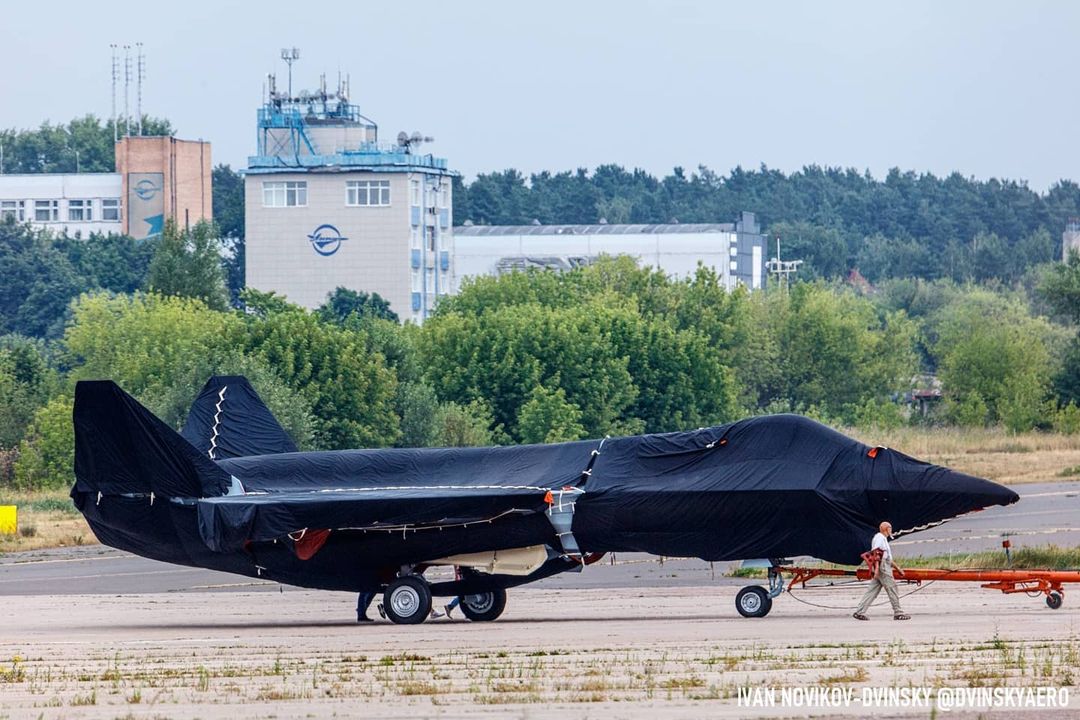
Su-75 Prototype? at Zhukovsky

Vadim Badekha, General Director of the United Aircraft Corporation (UAC), told TASS on June 2, "The work on Checkmate is already at the stage of building a prototype."

According to Badekha, Russia is developing the medium-weight fifth-generation fighter both for use by Russian forces and for international customers.

Badekha noted that the single-engine Checkmate has a cost advantage over heavy twin-engine fighters such as the Su-57.

Earlier, in January, the Izvestia newspaper reported that the first flight of the Russian fifth-generation Su-75 single-engine fighter could take place in 2026.

On November 18, 2025, during an interview on Russia's state-run Channel One television station, Sukhoi chief test pilot Sergei Bogdan stated that the first flight of the Su-75 would take place in 2026.

"The aircraft is already on the shop floor, it is already being finalized, and there are already certain timelines. Therefore, with God's help, it should take place soon enough."

Su-75 Journey So Far

Russia's Sukhoi company first unveiled the company-funded, low-observable (LO), supermaneuverable, optionally manned, single-engine, lightweight (18-tonne), Mach 2 fighter at MAKS 2021.

The Checkmate was reportedly developed based on an analysis of the use of strike aircraft in Syria, which revealed that, for most tasks, the capabilities of heavy twin-engine aircraft are excessive.

The aircraft is reportedly being developed using digital-twin technology, reducing development time by five years.

The USPs of the fighter, designed using electronic modelling, include:

  1. Low acquisition and operating costs
  2. AI assistance for single-pilot operations
  3. Ease of maintenance

Timeline Slippages Due to Redesign

On the eve of Dubai Airshow 2023, Rostec told RIA Novosti that preparations had begun in Russia for the production of the first examples of the light stealth fighter.

As per the timeline announced at Dubai Airshow 2021, the first prototype of the aircraft was expected to fly by the end of 2023.

A statement released by Rostec's press service explained that the timeline had slipped to accommodate design changes. The redesign, it said, "has significantly increased the competitiveness and commercial attractiveness of the domestic single-engine aircraft and reduced the technical risks of its development."

First Deputy Chairman of the Federation Council Defence and Security Committee, Viktor Bondarev, confirmed that, following the redesign, the documentation for the Checkmate fighter had been transferred to the manufacturing plant and preparations for the production of the first examples had begun.

"The pilot batch of Checkmate fighters is planned to be produced in 2026," he said.

Deputy Prime Minister and Minister of Industry and Trade Denis Manturov said: "I can say that over these two years we have collected requests, including making certain adjustments to the project so that it is maximally adapted to the requirements of customers interested in a single-engine aircraft. This applies to the layout, control systems, and aviation weapons. A great deal of work was done on the basis of the Checkmate originally presented here."

In February 2024, Rostec stated in a statement to TASS: "Under the Checkmate program, the United Aircraft Corporation of Rostec received feedback from potential customers. In addition to collecting additional requirements expressed by potential buyers, work was also carried out to optimize costs and analyze individual technical solutions. This made it possible to significantly increase competitiveness and commercial attractiveness, while also reducing technical risks in the creation of a domestic single-engine aircraft."

Su-75 at Zhuhai


Prototype Development

In February 2025, Russian media reported that KnAAZ (Komsomolsk-on-Amur Aviation Plant named after Y.A. Gagarin) planned to assemble two prototypes of the Su-75 Checkmate light tactical aircraft (LTA), one for static testing and one for flight testing.

Three Variants

At Dubai Airshow 2025, as if to reiterate its commitment to the Su-75 project despite the war in Ukraine and unconfirmed interest from potential foreign customers, Sukhoi unveiled a model of an unmanned variant of the fighter alongside the model of the manned variant.

The unmanned variant featured a reworked wing and a revised rear fuselage.

As of now, the Su-75 is proposed in three variants: single-seat, twin-seat, and unmanned.

In the past, Russian media, quoting the Federal Service for Military-Technical Cooperation (FSMTC), reported that Russia and Belarus were working together on the Checkmate project.

The approximate cost of the Checkmate has been estimated at $30 million. For comparison, the basic version of the F-35 costs $80 million or more.

Indian Interest?

In February 2026, responding to a query from TASS, a HAL official said the company was ready to work with Russia to produce new warplane models.

"We are very comfortable working with Russia. There are no problems on our part," said the HAL representative.

In the past, HAL collaborated with Russian aircraft manufacturers to assemble and locally produce fighter aircraft for the IAF, including the MiG-21, MiG-27, and Su-30MKI. However, joint development had never previously been considered.

Joint development offers the advantage of Indian ownership. Beyond securing IPR for the weapon system and fostering self-reliance, it ensures that projects are not subject to import restrictions arising from sanctions.

However, it may now be too late for HAL to participate in the design and initial production of the aircraft. The design is frozen and Russian officials have confirmed that the initial batch of Su-75 fighters will be manufactured in Russia to meet the requirement of Russian forces. 

The Su-75 Checkmate Option

The TASS report was non-specific in nature, but it may have alluded to a specific project such as the development of the Su-75 stealth fighter. Russia has previously indicated that it is open to joint-venture production of the Su-75 in a partner country. Such a venture would align perfectly with India's Make in India and Atmanirbhar Bharat initiatives.

Alongside helping to plug the emerging stealth gap, local manufacture of the Su-75 in India could generate billions of dollars in export revenue, much like the BrahMos missile program and potentially the Su-30MKI modernization program.

India's manufacture of the Su-75 would in no way compromise the AMCA program. The AMCA is a twin-engine medium-weight stealth fighter, whereas the Su-75 is a single-engine lightweight stealth fighter. The two serve distinct operational roles. A single-engine fighter is cheaper to acquire and operate, and the Su-75 would remain relevant to the IAF's requirements well beyond the induction of the AMCA.

Copyright © Vijainder K Thakur. First published on Thumkar.

Friday, July 16, 2021

Russia's LO Checkmate! No One Saw it Coming!


Via Twitter


Introduction

Russia's Sukhoi is company funding development of a LO supermaneuverable optionally manned single engine lightweight (18 t) Mach 2 fighter that will be unveiled at MAKS 2021

On July 12, 2021, days ahead of MAKS 2021, Russia's Rostec announced:


“The United Aircraft Corporation will present a fundamentally new military aircraft on July 20 - on the first day of the MAKS-2021 International Aviation and Space Salon in the city of Zhukovsky


Rostec also released the following teaser video 


Ростех представит на МАКС-2021 принципиально новый военный самолет ОАК - YouTube


The video suggested that the new fighter was pitched at countries like India, Vietnam, Argentina and the UAE.


( I believe a LO short range super maneuverable fighter better meets IAF's defensive requirements that fighters such as F-22, F-35 or Su-57).


A day later, photographs of the fighter (or its mockup?) being towed ensconced in a shroud appeared on the web.


Features

Going by the photograph above and the teaser video on YouTube, Russia's "Checkmate" features a LO V-tail that would provide some degree of yaw and pitch control. Additional yaw and pitch control required for super maneuverability would likely be provided by thrust vectoring.


Surprisingly, based on the photograph above, the fighter does not feature stealthy shaped exhaust. The S-70 Okhotnik was shown at MAKS 2019 with shaped exhausts.

History

Russian aviation industry officials have alluded to a new LO fighter since 2017 (with development having started in 2015), yet western media, inclined to be in denial of Russian advances in aviation technology, was completely surprised by the new Russian stealth fighter. It's likely, Western intelligence too was caught off guard. As such, Russia's chosen name for the fighter - Checkmate - is doubly apt.

On May 26, 2021, TASS reported quoting an industry source that Russia is developing its first single-engine low-observable light tactical fighter aircraft.

"The Sukhoi company is developing a single-engine light tactical plane with the takeoff weight of up to 18 tonnes. The plane’s maximum speed will be above 2 Mach. It will also have super-maneuverability and improved takeoff and landing performance, thanks to a thrust vector control engine. The plane’s thrust-to-weight ratio will be above 1," the source said.

In December 2020, Rostec CEO Sergei Chemezov told reporters that the company was working on the concept of an advanced, optionally manned, single-engine light-and medium-class.

"Work is underway to develop a combat aviation system of the future in its light and medium classes. Under the design, this may be a universal platform in the manned and unmanned versions. The company is working on the concept and the operational requirements for such a platform. We are doing this on our own initiative so far, without [federal] budget funds," the Rostec chief said.

In a news report on May 25, 2020, Pravda reported that Russia started development of a multi-purpose stealth fighter - MiG LMFS - in 2015.  The fighter is conceived as a replacement for the MiG-29 and MiG-35 aircraft and will be based on the technology used for the development of the Soviet MiG-1.44, which was far ahead of its time.


"MiG-LMFS" is designed with front horizontal stabilizers. They will be placed just above the wing to stabilize air flow in front of it. As it is believed, the aircraft should have a triangular wing and a V-tail. With a takeoff mass of about 15 tons, it will be able to take up to 5 tons of payload, for example, medium-range K-77M missiles.


The airplane will be armed with a 30 mm caliber cannon. The fighter is to be equipped with two VK-10M turbojet units with a total thrust of 20 tons. In the future, a single Product-30 engine with the afterburner power of 18 tons can be used. This engine was developed for the Sukhoi Su-57 fighter and currently undergoes flight tests.


The MiG-LMFS would feature internal carriage of weapons, have a range of 4,000 km and a top speed of 2,500 kph.


Earlier in 2017, Sergey Chemezov, the head of Rostec, told reporters about plans to develop a 5th gen fighter based on the MiG-29 with the United Arab Emirates. 


Kravchenko confirmed MiG was involved on three major development programs — a “prospective plane,” a long-range interceptor and a UAV — but would not elaborate on activities related to a potential fifth-gen jet. [source]


Saturday, September 5, 2015

Russia Displays Innovative Asymmetric Counter Stealth Systems at MAKS-2015

KRET EW Systems on display at MAKS-2015

Russian EW systems displayed at MAKS 2015 suggest that Russia has adopted a low cost, asymmetric approach to counter the threat posed by the soon to be deployed F-35 fighters, which features low observability (LO)  and sensor fusion.

A low observable (LO) fighter can escape detection only if it keeps its radar switched off, or under emission control (EMCON). To penetrate contested airspace and attack targets, the LO fighter relies on an AWACS positioned in the rear, which streams the air and ground situation over a directional and encrypted data link. The LO fighter uses its sensor fusion capability to fuse the information obtained from the AWACS sensors with the information obtained through its own passive (ESM, EO) sensors to track and engage adversary targets.

An F-35 strike force under AWACS cover would be able to detect and engage non stealthy  Russian fighters -  MiG-35, Su-30, Su-35 - well before the Russian fighters detected the presence of the strike force. The F-35s would detect the Russian fighter radar emissions from as far away as 300-nm. Non emitting Russian fighters would be picked up by the F-35 strike force support AWACS from 150-nm.

Even if the Russian fighters were also supported with AWACS, the F-35s LO would delay detection till around 90-nm.

The challenge to Russia from US LO fighters is formidable, but it's noteworthy that LO is fundamentally an ECM technique. LO fighters deflect radar emissions away from the transmitter, instead of bouncing them back to the transmitter.

If LO is ECM then common wisdom hold that every ECM has a ECCM!

The Russians have chosen to negate US advantage, not by building analogs, but by reverting to fundamentals.

A stealthy F-35 strike force threatens ground targets so why oppose it from the air? Putting powerful jammers and passive locators on the ground in the proximity of high value targets that the adversary fears and wants to target would be a logical. Ground based systems have practically no size and weight constraints, as long as mobility is ensured.


What the Russians appear to be doing is:

  1. Fielding powerful ground based jammers to degrade AWACS sensors, data links, RF missile sensors.
  2. Fielding ground based passive emission locating systems that constrain enemy use of radar. 
  3. Developing UAVs featuring UHF, L, S radars to unmask LO fighter aircraft
  4. Fielding more sensitive Electro Optical Targeting System (EOTS) on their fighters.


The following are some of the new weapon systems displayed at MAKS 2015 that are focused on mitigating the threat posed by the advent of F-35s in large number along Russian borders.

Krasukha Jammer at KRET pavilion at MAKS-2015

Krasukha EW System


The Krasukha is a mobile, ground-based broadband multi-functional jamming station and spoofing system developed by KRET. The system analyzes the type of signal and responds by jamming it with a powerful, smart interfering emission, preventing adversary radar sensors from detecting targets and guiding weapons to them.

There are two variants of the system: Krasukha-2 and Krasukha-4, the latter being a higher power longer range system.

Krasukha is effective against the entire spectrum of RF dependent weapon systems. It can jam radars (ground, low orbit satellite, AWACS, Fighter, UAV, Missile), data links and satellite links. Krasukha RF suppression makes PGM guidance impossible.

The system can vary jamming intensity to extremes and is capable of damaging electronics through brute force pumping of RF energy into enemy system. Krasukha can also be subtle; for example, it can generate false targets to spoof missile RF sensors.

Jamming range for AWACS is claimed to be 300-km for the Krasukha-2 system, and 400-km for the Krasukha-4 system.

Krasukha systems were developed to protect high value targets on the move, such as the Russian tactical missile Iskander (SS-26), while on the move.


LO UAV to Detect LO Fighters


Russia's UAC is reportedly developing a LO UAV designed to detect stealth aircraft using X-band and UHF radars. The project is an analog of China’s “Divine Eagle” project.

The Russian UAV would detect LO aircraft such as as Lockheed Martin F-22 and F-35 and Northrop Grumman B-2.

KRET is developing a deeply-integrated electronic warfare system that would create a protective electromagnetic sphere around the UAV to counter air-to-air missiles and cloak it from radars.

Avtovaza-M


The Avtovaza-M is a Emitter Location System (ELS) that can passively detect and track adversary aircraft facilitating engagement by AD missiles. The system comprises five vehicles spread over tens of kilometer, interconnected over low-power, low-probability-of-intercept  communication link using antennas mounted on tall masts.

Avtobaza-M uses time-difference-of-arrival (TDOA) processing to locate targets with a precision that is about 2% of detection range, and operates from 200 MHz to 18 GHz and has a range of up to 150-km.

In its basic configuration, Avtovaza-M includes four autonomous SOP (Stantsiya obnaruzheniya i pelengovaniya) detection and direction finding stations and one SOI (Stantsiya obrabotki informatsii) information processing station (ESM), mounted on Kamaz-63501 four-axle military trucks.

TDOA systems can locate targets with three stations, but the Avtovaza system uses up to five, to provide redundancy and resolve ambiguities.

The system can detect, analyze and track IFF, TACAN, pulse and continuous onboard radar emissions, and determine radar types for air and sea surface targets, and then disseminate all of this data up the air defense chain.

The whole system can be set up or made ready to redeploy in 45 minutes, with just 3 to 5 minutes to bring it into combat readiness.

The Avtobaz system is believed to have been used by Iran to bring down an American RQ-170.

The usefulness of an ELS system is often underrated because it cannot detect or track a non emitting aircraft - for example, an adversary fighter with its radar, IFF and JTIDS/Link-16 switched off. The point overlooked is that with  its radar or data link offline, the adversary fighter wouldn't be able to engage  targets!

Moscow-1

The Moscow-1, the successor to the Avtobaza-M ELS, can detect targets at a distance of 400 km, as against Avtovaza's maximum range of 150 km. 

Moscow-1 system is operated by a crew of 4 and consists of three trucks including an ESM vehicle (IL265E) and an airborne radar jammer (IL2663). The station is able to provide 360-degree visibility and can be deployed in 45 minutes.

You can see more pictures of the Krasukha system at this AW&ST link.

Analysis

If the above logic behind powerful ground based EW systems is sound, why has the US not developed such weapon systems. 

Bill Sweetman in his audio-interview (link below) attributes it to the expeditionary nature of US forces. US ground troops are loathe to carry around anything larger than a Humvee sized vehicle, says Sweetman.

A KRET official confirms as much in a more recent interview, excerpted below from a Google translation.

Apparently this is explained by the history of US involvement in military conflicts. They are known in their territory do not fight, and are mainly involved in any global or local military conflicts far from their borders. Therefore, the terrestrial EW they never paid as much attention as we do. Perhaps this is also dictated by the current military doctrine there. We have a different doctrine, is defensive in nature, so the means of electronic intelligence and management of land-based we have developed very well. We can say - as anywhere in the world. 

Bill Sweetman on how Russia is countering US Advantages
Russian EW Systems - IDP Sentinel members only link


Thursday, February 12, 2015

ADA Details Stealth AMCA Engine Plans

AMCA model at Aero India 2013

ADA seems to have refined and narrowed its AMCA powerplant options. The 25-tonne class AMCA is to be fitted with a 110-kN engine. However, currently no 110-kN class engine is available in the world market.  

So ADA will design the fighter around a 110-kN engine, but use a 90-kN off-the-shelf engine to power prototypes of the aircraft, giving itself time to develop a 110-kN engine.

ADA Director PS Subramanyam told The Hindu that it would be prudent to procure and integrate an available 90-kN engine into the aircraft so to ensure that the project was not held up. 

“Since the fighter has been designed to take on an engine with a higher thrust, we can integrate it as and when such an engine is available. This is what has been done by Dassault in the Rafael development program,” he says.

Elaborating on AMCA powerplant options, K. Tamilmani, Director-General (Aero R&D) told the press that since no 110-kN engine is available off the shelf, GTRE will partner with a US or Russian engine manufacturer to develop such an engine - mostly within India - to power AMCA production variants.

“We have asked for their proposals [and will go ahead with] whoever has a better offer, time frame and cost," he said. The goal is to integrate the new engine into the aircraft by 2020-21.

DRDO and IAF officials will hold talks with two manufacturers during Aero India 2015 - General Electric of US and Klimo of Russia. 

Interestingly, Tamilmani didn't mention French Snecma and early front runner for co-producing an AMCA engine with GTRE.

It may be noted that the joint statement released during US President Barack Obama's visit to India from January 25 to 27, 2015 referred to US - Indian collaboration in developing a hot engine (A reference to a jet engine with high turbine temperatures and greater thrust.)

It was earlier reported that the AMCA will be powered by a new engine that GTRE plans to develop with the help of one or more foreign consultants, Snecma being one of them.

On January 8, 2015 the TOI reported that five to six global aero-engine manufacturers have made presentation to ADA for the AMCA engine. It is likely that ADA has now narrowed down its options based on the presentations.

IDP Sentinel members can read more about the AMCA project at the link below.

Friday, December 12, 2014

Beating the Stealth Threat: IAF's Quest for Passive Surveillance System

Shenyang J-31 (F60) at the 2014 Zhuhai Air Show.jpg
"Shenyang J-31 (F60) at the 2014 Zhuhai Air Show" by wc - http://www.airliners.net/photo/Untitled-(AVIC)/Shenyang-J-31-(F60)/2542713/L/. Licensed under CC BY-SA 4.0 via Wikimedia Commons.

China is developing two stealth fighters - the J-20, an analog of the US F-22 Raptor for use by the PLAAF and PLAN; and the J-31, a US F-35 analog, for export customers.

The J-20 first flew in January 2011 and is expected to enter service sometimes after 2018. The J-31 first flew in October 2012 and was showcased during the recent Zhuhai Airshow indicating that its development is on track.

Putting it bluntly, it is likely that the J-31 could enter PAF service by 2020!

As things stand, IAF air defense systems would not be able to track and engage PLAAF J-20 fighters; they could enter and exit Indian airspace with impunity!

PAF J-31s would be somewhat easier to track, but our fighters would not be able to track and engage them in head on mode using their radars.

To make matters worse, the Putin visit is over with nary a word on the FGFA. The AMCA is tottering at the edge of oblivion with ADA still struggling to firm up the design of LCA Mk-2! (ADA won't have time to seriously take on the AMCA for another 10 years!) Under the circumstances, the future must look grim to IAF planners.

Time is running out. In order to meet the looming threat, the IAF has to do things more substantive then release a new version of their 3D combat game. Yeah, I know I am being mean. I am just venting, because guess what? It turns out that the IAF is indeed ahead of the curve.

Passive Surveillance System

The IAF on December 2, 2014 released a RFI for development of a Passive Surveillance System (PSS) - a ground based system to be deployed in field areas for generation of 3D Air Situation Picture (ASP), by detecting and processing chance RF spectrum emissions and EM reflections of other transmissions in the vicinity of airborne platforms.

Here are the deets excerpted from the RFI.

Overview

The PSS will intercept, process, analyze and generate all types of Radar transmissions across the complete band of Radar Operation Radio Frequency bands (30 MHz to 18 GHz).

It will provide location and dynamic tracking of airborne, surface (ground and marine), mobile and fixed targets. The system would be capable of detection, location, identification and tracking of active and passive targets within its area of coverage. The system will comprise of a cluster of sensor stations all reporting their detections simultaneously to the Master Receiving and Processing Centre which will process the information for detection of targets and formation of tracks. The system should be highly mobile, vehicle mounted with very less deployment time.
Components

The PSS system will comprise the following two systems


  1. Passive Coherent Location Based Surveillance System to detect presence of targets using reflected RF emissions available in the environment. 
  2. Elint Based Surveillance System to detect, track, locate, correlate and identify intercepted RF emissions of the airborne platform in the area of deployment and process this information for generation of 3D Air situation picture.


Air situation picture generated in both the systems would be integrated to form a comprehensive air situation picture. The output is to be in user defined format for integration in command and control system of IAF.
Passive Coherent Location Based Surveillance System
The system would consist of a network of receivers and a master station and will generate its own 3D air situation picture without any active transmission of its own.

System capabilities required include:-


  1. Detection of 2 sq-m RCS target at more than 300 Km of range.
  2. Detection of targets from low level to very high altitude. 
  3. Estimating target coordinates in space namely range, azimuth, height and Doppler. 
  4. 360-deg azimuth coverage. 
  5. Radar Finger Printing (RFPS) through correlation and identification of emitter with data library.
  6. Remote operations including switching ON/OFF and operations of BITE, from an ops shelter located upto a distance of min 5 kms from system through OFC /radio link/ Satcom. 

Deployment Considerations.


  1. The system should be vehicle mounted and capable of deployed in all types of terrain including mountainous region.
  2. Deployment of the system should be quick and mechanized requiring minimum manual intervention. 
  3. The system should be self sufficient to meet camouflaging requirements(internal camouflage).


Elint Based Surveillance System

Elint based passive system should comprise of multiple sensor stations and a control station. The system is to be capable of generating a real time 3D air situation picture based on intercepted data of airborne emitters. The system should have very high DF accuracy in terms of degree RMS for various frequency ranges.

Required system capabilities include

  1. Large surveillance area coverage around its deployment
  2. Capability to intercept signals from all types of radars (pulse, pulse Doppler, CW), TACAN/DME interrogator, SIF/IFF interrogator and transponder, jammers, Data link and any other electromagnetic pulse and CW emitters on airborne platform.
  3. Very wide instantaneous Band Width (BW)
  4. High Probability of Intercept (POI)
  5. 360-deg instantaneous Azimuth coverage

Conclusion

A passive air surveillance system like the one contemplated by the IAF isn't a complete solution to the emerging stealth threat, but it's an essential first step.

The PSS would give the IAF an ability to detect the presence of stealth aircraft, but not track and engage them using SAMs.

A well executed PSS would allow IAF fighters to be vectored to the general area of intruding stealth fighters. allowing them to use their EO for further detection, tracking and engagement of enemy stealth fighters. 

Let's be clear, its early days for counter stealth technology.

PS

If IAF's PSS plans are news to you, its because you aren't a IDP Sentinel members. The RFI details were published on IDP Sentinel nearly a week ago!


Thursday, February 6, 2014

Tacit Blue - Stealth Aircraft Developed at Area 51

Tacit Blue Stealth Observation Aircraft at National Museum of the U.S. Air Force, near Dayton Ohio. Photo Credit: Vijainder K Thakur
CNN recently published a news report on the Tacit Blue stealth aircraft which was developed and tested at the super-secretive Area 51 in Nevada from 1978 to 1985.

The program aimed to develop a single-seat jet for battlefield surveillance was declassified in 1996. (I took the photo above in 2004 during a visit to the AF Museum with my family. My wife and daughter can be seen on the far right in the foreground.)

Only one and a half copies of the aircraft were built, the half being a backup that could be built upon if the one were to crash. The aircraft flew 135 sorties.

The rather odd shape of the aircraft, which resembled an inverted bath tub, earned it the nickname of Whale.

One of the test pilots who flew the aircraft, Ken Dyson, told CNN, "The airplane flew pretty solid, I'd say."

Tacit Blue was used to validate the ability of curved surfaces to deflect radar waves and facilitated development of the B-2 Spirit Bomber.

Friday, October 18, 2013

India Unhappy with FGFA Research & Design Workshare

PMF / FGFA model on display at Aero India 2013. Photo Credit: Vijainder K Thakur

On October 18, 2013, The Economic Times reported that the IAF is unhappy that India, despite bankrolling 50% of the development cost of the FGFA, is being allocated just 15% of the research and development work for the aircraft by Russia.

The IAF expressed its disappointment at a CII event on energizing aerospace sector in India.

"We have a major opportunity in the FGFA program. At the moment it is not very much in favor of Indian development. We are flagging it through the Government. It should be much more focused towards indigenous development capability," IAF Deputy Chief Air Marshal S Sukumar said here.

The Raksha Mantri is expected to take up the issue during his visit to Russia starting November 15, 2013.

India and Russia are currently negotiating the Research and Development work share of the FGFA program. The negotiations are expected to take another year!

What is difficult to understand is how can India realistically expect a larger work share. The PMF / FGFA is based on the PAK-FA / T-50, an aircraft that is expected to start state acceptance trials in early 2014.

The FGFA will feature the same airframe, engines and main systems as the T-50, but differ in its avionics and weapon suite. Clearly, the residual R&D work is limited. What is it that India wants to research and develop?

Friday, September 20, 2013

Japan to Develop Radar Capable of Detecting Stealth Aircraft

Sukhoi T-50 Stealth Fighter


Japan has initiated a $3.7 billion project to develop a radar that can detect contemporary stealth fighters within 10 years according to a news report.

Japan estimates that China would be in a position to deploy around 200 J-20 stealth fighters by 2025. Similarly, the Russian T-50 would be extensively deployed. Japan's relations with both the countries are strained over territorial disputes.

Japan has opted for a "defensive defense" posture to counter the stealth capabilities of the two aircraft by building a radar that is capable of "vigilant monitoring."

Current radar technology can detect stealth aircraft using longer wavelengths, but cannot track them accurately for missile engagement, since the longer radar wavelength makes it difficult to pinpoint the position of the aircraft.

So what is "vigilant monitorying?" A Google translation artifact? An innocent non technical statement? Or new technology that uses smart realtime extrapolation to pinpoint a stealth target?