Showing posts with label T-50. Show all posts

Sunday, January 20, 2019

Is Russia Adding Formidable 6th Gen Capability to its Su-57 fighter?

via Twitter
Recently, the T-50-3 was observed in new pixelated camouflage pattern with an insignia on the tail depicting a Okhotnik UCAV radio linked to a T-50. (See above)

The T-50-3 featured three new protrusions on the fuselage - A under fuselage sensor slightly ahead of the cockpit, an over the fuselage antenna just behind the cockpit, and an antenna on the underside of the tail boom in between the exhaust nozzles.

The insignia and the protrusions have fueled social media speculation that the aircraft has been upgraded to control and guide LO drones capable of penetrating contested airspace to attack targets or relay targeting data

The ability to control stealthy drones for penetrating heavily contested airspace, or legacy aircraft operating as loyal wing-man weapon trucks is a sixth generation fighter features. For example, the Franco - German - Spanish FCAS, which is planned to enter operational service in 2040, will feature this ability.

Okhotnik (Hunter) UCAV

A see through model of the Sukhoi Okhotnik (Hunter) UCAV was first unveiled by KRET at MAKS-2015. The UAV model closely resembled Northrop’s carrier-based X-47B demonstrator, but added two lift fans on each wing and vertical stabilizers.
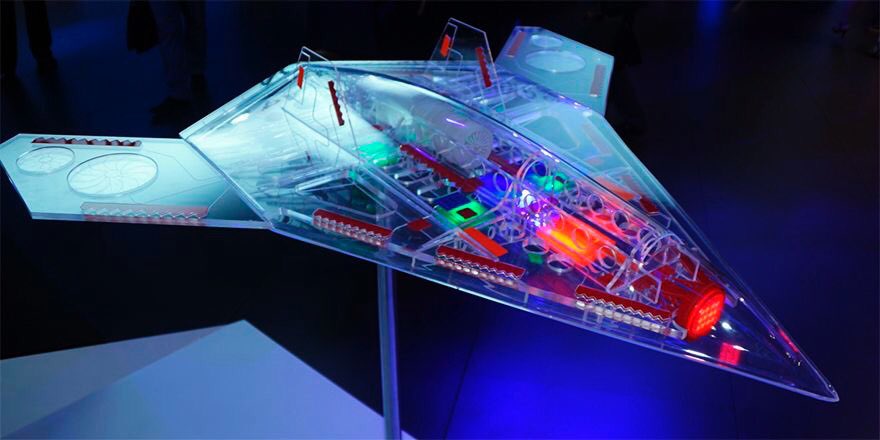
See through Okhotnik model at MAKS 2015 [via Twitter]


The heavy (20t)  UAV, reportedly capable of flying at 1000 kph, performed its first T/O run trial at the Novosibirsk Aircraft Production Plant in November 2018 reaching a speed of 200 kph.

Compensating for the Su-57's Lack of All Aspect Stealth

The Su-57 features good front aspect stealth, but not so good side and rear aspect stealth making it a capable head on interceptor, but not such a capable offensive platform. Ground based radars and AWACS would pick up a Su-57 much more easily than they would a F-22 Raptor which features good all aspect stealth.

Good front aspect stealth in combination with L-band leading edge AESA radar and good front sector optronics make the Su-57 a formidable interceptor of LO observable attack aircraft such as the F-22 Raptor, F-35 Lightening 2, and the J-20. In order to keep the aircraft affordable, an economically stretched Russia initially concentrated on the defensive capabilities of the Su-57.
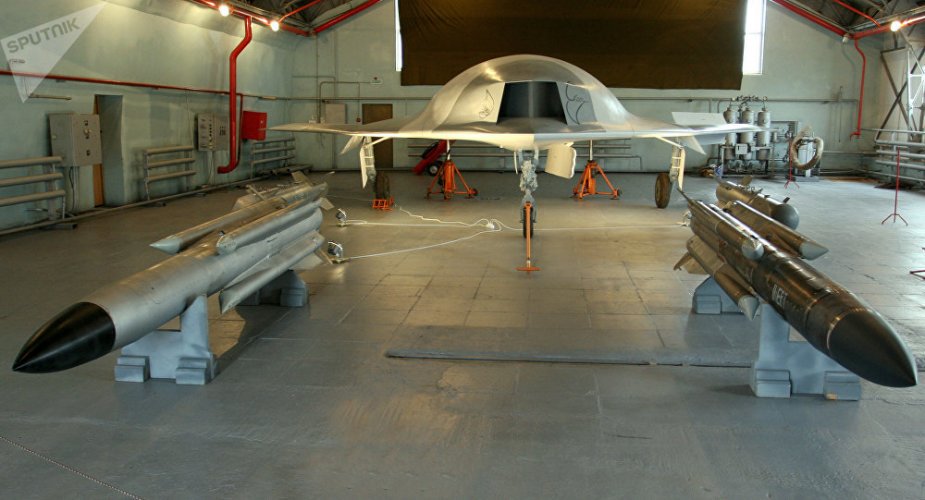
Sukkhoi Okhotnik UCAV (via Twitter)

The ability to guide a LO sensor / attack platform into contested adversary airspace to obtain targeting data would now give the Su-57 formidable attack capability. It would also explain why Russia has invested heavily in developing long range stealthy cruise missiles such as the Kh-59MK2  for internal carriage on the T-50.

The limited weapon load of the very stealthy F-22 Raptor is its greatest shortcoming. By opting for differently-abled stealth platforms specialized for different roles with the ability to work as a single system, Russia may be poised to once again score with its asymmetric approach to countering American economic and technical prowess. 

Wednesday, October 7, 2015

IAF's FGA Project Entering a Death Spiral?

FGFA

The list of the IAF's reservations over the PMF/FGFA project is growing longer by the day, and is probably long enough to put the project in serious jeopardy. What is more disturbing, the list is starting to include inane items! Also, items on the list are now being leaked to the press by senior IAF officials, something that was not heard of in the past. Leaks, unlawful as they are, were earlier the prerogative of MoD babus who are apparently above the law.

Here is the list of IAF reservation against the FGFAm in reverse chronological order of leaks


  1. Russia has not been given a tentative per unit production cost for the aircraft and the IAF is wary that the cost may turn out to be exorbitant. 
  2. Russia has still not been able to develop the Product 30 engine that will power the FGFA. Without the engine, the aircraft cannot super cruise.
  3. Russia has not offered any weapons developed specifically for the FGFA. The weapons offered so far were developed for 4th gen fighters like the Su-30M and Su-34. These weapons are too large for the internal weapon bay of the PAK-FA and would need to be carried externally compromising the aircraft's low observability.
  4. Russia has so far not allowed IAF test pilots to test fly the PAK-FA.
  5. India has sought 27 technical clarifications on the joint project, but Russia has reverted only on 19.
  6. IAF wants Russia to commence delivery of the FGFA within 36 months of signing the development contract for the customized variant of the PAK-FA, instead of 94 months agreed to by Russia.
  7. India wants a larger work share in developing the FGFA.

I will let the reader decide which of these points, if any, are inane; and which possibly serious show stoppers. For example, is the IAF request to test fly the aircraft at this stage of its development reasonably? Would the US or France meet such an IAF request?

The IAF Chief in his press conference on October 4, 2015 stated, " "There are some issues which have cropped up in terms of the work share, in terms of the present technological and technical aspects of the PAK-FA, and of course the cost visibility. So these are the issues we are looking at and they have been taken up at the highest level."


Facts Check


I present here some public domain facts that the reader may like to factor in before making a call on the relevance of IAF concerns.

Cost Visibility


The PAF-FA is under development and is unlikely to be ready for export till 2020. The Rafale has been operational for over a decade and India has committed to purchase 36 Rafales. There is no cost visibility on the Rafale yet, but ironically the Air Chief says the IAF wants to buy 100 more Rafales!

Weapons for Internal Bay


Russia is in the process of developing air-to-ground weapons small enough to fit into the T-50's internal bomb bay.

At MAKS-2015 Russia's Tactical Missiles Corporation (TMC) unveiled three new or derivative weapons developed specifically to fit the internal weapon bays of the T-50:


  1. GROM E1/E2 guided, standoff weapon
  2. X-59Mk2 cruise missile  
  3. X-58USHKE/IIR stand-off anti-radiation attack missile


The H-59MK2 Grom is a stealthy turbofan engine powered cruise missile, a heavily upgraded version of the H-59 family missiles.

All three are advanced weapon systems that the western world would like to know more about. Is it realistic for the IAF to expect Russia to share weapon details and cost at this stage? Would the IAF expect the same from the US or France?

FGFA Powerplant


The initial batch of the T-50 fighters will be powered by the 14.5 tons thrust NPO Saturn AL-41F1 (Product 117) engines, the upgraded version of AL-41F1S engine developed for Su-35, which in turn is a derivative of the NPO Saturn's AL-31F series that power the Su-27/Su-30 family of fighters.

Moscow-based Salut and NPO Saturn are building a brand new stealthy powerplant for the T-50, which is not a derivative of the AL-41F1 (Product 117) engine that powers it. Called Product 30, the new engine will be 30% lighter than the Product 117 engine and come with 30% lower life-cycle cost.

The new engine is expected to offer about 17.5 tons (171.6 kn) of thrust in full after burning mode and somewhere in the range of 12 tons (117.7 kn) in dry mode, allowing the aircraft to comfortably super-cruise at around Mach 1.5.

In June 2015 it was reported that United Engine Building Corporation (UEBC) has built a prototype of the new engine. Two prototypes of the engine are scheduled to be built in 2015.

UEBC CEO Vladislav Maslov had earlier said that work on developing the stage-2 will be completed in 2020.

Is Russia really the problem in the unraveling FGFA deal?

Wednesday, July 1, 2015

News Roundup: LCA Mk-2 Maiden Flight in 2018-19, AMCA Development Cost Just Half of 36 Rafale Pricetag, T-50 Product-30 Engine Prototype Ready

AMCA model at Aero India 2015

AMCA Development Cost Just Half of 32 Rafale Price Tag


AMCA development would cost half of 32 Rafale acquisition, estimates outgoing ADA chief.

On June 30, 2015 outgoing ADA director P.S. Subramanyam told Business Standard that the AMCA's configuration is finalized, and preliminary design is about to commence.

While it will be possible to accurately estimate the cost of the project only on completion of preliminary design, Subramanyam says, "I am confident that the AMCA project would cost less than any fifth generation fighter project anywhere. My estimate would be in the region of $4 billion (Rs 25,000 crore)."

Acquisition cost for 36 Rafale aircraft is estimated to be around Rs 8 crore.

IDP Sentinel members can read more at

AMCA Preliminary Design Poised to Commence

LCA Mk-2 First Flight by 2018-19


On June 30, 2015 outgoing ADA Director P.S. Subramanyam told the Business Standard, "The preliminary design of the Tejas Mark II fuselage is already completed, without surprises. The detailed design will not cause delay. The fighter will make its first flight by 2018-19; and will begin joining the IAF fleet by 2021-22."

ADA is scouting for a consultant to validate the detailed design, but is ready to proceed independently if it cannot arrive at a satisfactory consultancy arrangement.

During the visit of MoS for Defense Rao Inderjit Singh to France during PAS 2015, Airbus Industries reportedly offered to provide LCA Mk-2 design consultancy.

IDP Sentinel members can read more at

LCA Mk-2 First Flight by 2018-19, Airbus Industries Offers Design Consultancy

Product-30 (Stage-2 Engine for T-50) Prototype Built


In June 2015 it was reported that United Engine Building Corporation (UEBC) has built a prototype of the new engine. Two prototypes of the engine are scheduled to be built in 2015.

UEBC CEO Vladislav Maslov had earlier said that work on developing the stage-2 will be completed in 2020.

It maybe noted that the IAF is reportedly not happy with the capabilities of the Product 117 engine currently fitted on the T-50 for the stage-1 phase of the aircraft's development.

Moscow-based Salut and NPO Saturn are building a brand new stealthy power-plant for the T-50, which is not a derivative of the AL-41F1 (Product 117) engine that powers it. Called Product 30, the new engine will be 30% lighter than the Product 117 engine and come with 30% lower life-cycle cost.

The new engine is expected to offer about 17.5 tons (171.6 kn) of thrust in full after-burning mode and somewhere in the range of 12 tons (117.7 kn) in dry mode, allowing the aircraft to comfortably super-cruise at around Mach 1.5. The Product-30 engine will compare favorably with fifth generation engines made in the west.

IDP Sentinel members can read more at

Product-30 (Stage-2 Engine for T-50) Prototype Built

Saturday, May 24, 2014

Russia's New Air-to-Air Missile for T-50 to be Ready by 2016, Hypersonic Cruise Missile by 2020

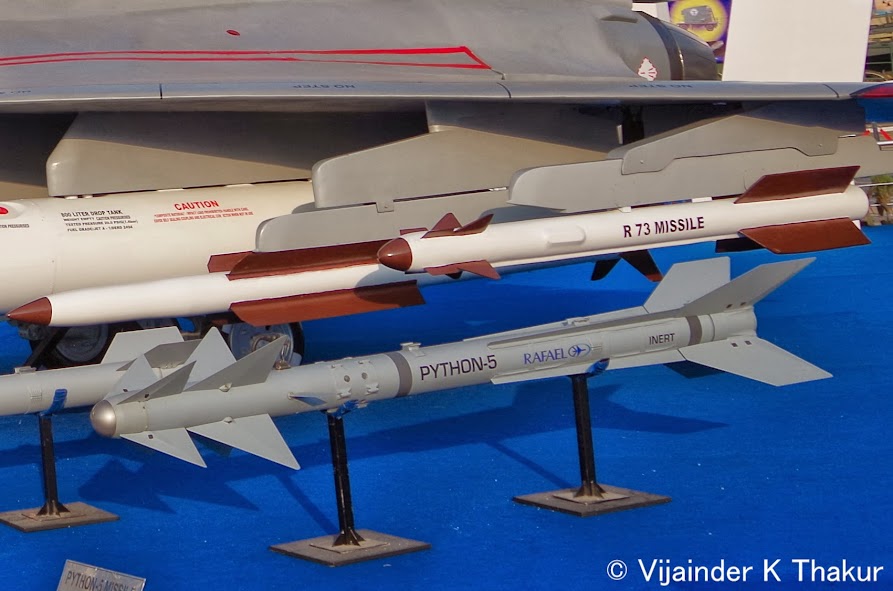
A Russian R-73 missile on Tejas LCA at Aero India 2013


On May 23, 2014 Boris Obnosov, the head of the Tactical Missiles Corporation (KTRV), told the press at the Kadex 2014 that KTRV would complete development of the new air-to-air missile, X-74M2, by 2016.

The X-74M2 is likely an improved version of the R-74M, which in turn was a R-73 (AA-11 Archer) missile derivative featuring fully digital and re-programmable systems. The X designation of the new missile likely refers to its development status.

The R-73 has a cryogenic cooled (MK-80) seeker and uses thrust vectoring for maneuvering giving it a substantial (45 deg either side) off-boresight capability.

"We have established close contact with the Sukhoi design office. A permanent working group is formed. All the protocols of informational cooperation are agreed on. Models are made according to schedule. Everything must be done by 2016," Obnosov said.

Obnosov added that the Tactical Missiles Corporation also planned to develop the first model of a hypersonic missile by 2020. The Defense Ministry and the Ministry of Industry and Trade had already approved the program.

Russia is developing tactical air-to-ground missiles and air-to-air missiles for use with the T-50

In April 2012, Obnosov told RIA Novosti that the missiles are undergoing tests.

“The development of Kh-35UE (AS-20 Kayak), Kh-38ME, Kh-58UShKE (AS-11 Kilter), and RVV-MD (AA-11 Archer) class missiles will be completed in 2012-2013,” Obnosov said.

Some of the missiles that will arm the T-50 have already been proven with other fighters.

The Kh-31PD (AS-17 Mod 2) class missiles, for example, have already been tested using Sukhoi Su-34 and put into serial production, he added.

According to KTRV, the Kh-35UE tactical anti-ship missile has a maximum range of 260 kilometers; the supersonic Kh-31PD anti-radiation missile for use against air defense systems, can fly up to 250 kilometers; the Kh-58UShKE missile, designed to destroy pulse radars, can hit targets within 245 kilometers, and the short-range RVV-MD air-to-air missile has a maximum range of 40 kilometers.

IDP Sentinel members can read more details about the PAK-FA / T-50 project at the link below

PAK-FA / T-50 (IDP Sentinel)