Showing posts with label PInaka. Show all posts

Tuesday, December 30, 2025

Long-Range Fires and Counter-Drone Defences Mark the Indian Army’s Transition to Modern Warfare


Maiden Test of Pinaka LRGR (Long Range Guided Rocket). Photo: DRDO


DRDO successfully conducted the maiden flight test of the Pinaka Long Range Guided Rocket (LRGR) on December 29, 2025, at the Integrated Test Range, Chandipur.

The rocket was tested for its maximum range of 120 km and its in-flight maneuvering capability.

The PIB press release covering the launch states that “the LRGR impacted the target with textbook precision.”

Also on December 29, 2025, the Defence Acquisition Council (DAC), chaired by Raksha Mantri Shri Rajnath Singh, accorded Acceptance of Necessity (AoN) for the procurement of LRGR for the Pinaka Multiple Launch Rocket System (MRLS). According to the PIB press release, the LRGR “will enhance the range and accuracy of Pinaka MRLS for effective engagement of high-value targets.”

In January 2025, the Indian Army had given DRDO an unofficial go-ahead to develop the 120 km range LRGR for the Pinaka MRLS, as well as a 300 km range rocket. (With 300 km range rockets, Pinaka would transition from classical rocket artillery to a quasi-tactical strike system.)

The Chief of the Army Staff (CAS), General Upendra Dwivedi, during his annual press briefing, confirmed that the DRDO, which had developed Pinaka unguided rockets with an extended 45 km range and Pinaka guided rockets with a 75 km range, has now been tasked with further extending MRLS rocket range, first to 120 km and then to 300 km.

He indicated that the Army would drop plans for other longer-range weapons if the DRDO was able to deliver longer-range Pinaka rockets.

General Dwivedi said, “As soon as we get longer ranges, we might drop plans for other alternate long-range weapons we are looking at and concentrate on it (Pinaka 3).”

The IA has also expressed interest in acquiring long-range kamikaze drones. It is likely that General Dwivedi was referring to them when he alluded to dropping other alternate long-range weapons.

The Indian Army is aggressively moving to upgrade the Pinaka MRLS with long-range guided rockets, likely driven by the effectiveness of long-range fires from MLRS systems such as Russia’s Tornado-S and the US HIMARS during the Ukraine war. It is heartening to see the DRDO responding proactively and moving aggressively to meet the Indian Army’s evolving requirements.

Current Pinaka System

The most advanced Pinaka MRLS variant currently operated by the Indian Army—the Pinaka Mk.2 Guided Pinaka Rocket System—can engage targets from 20 km to 80 km range with an accuracy of 30 m.


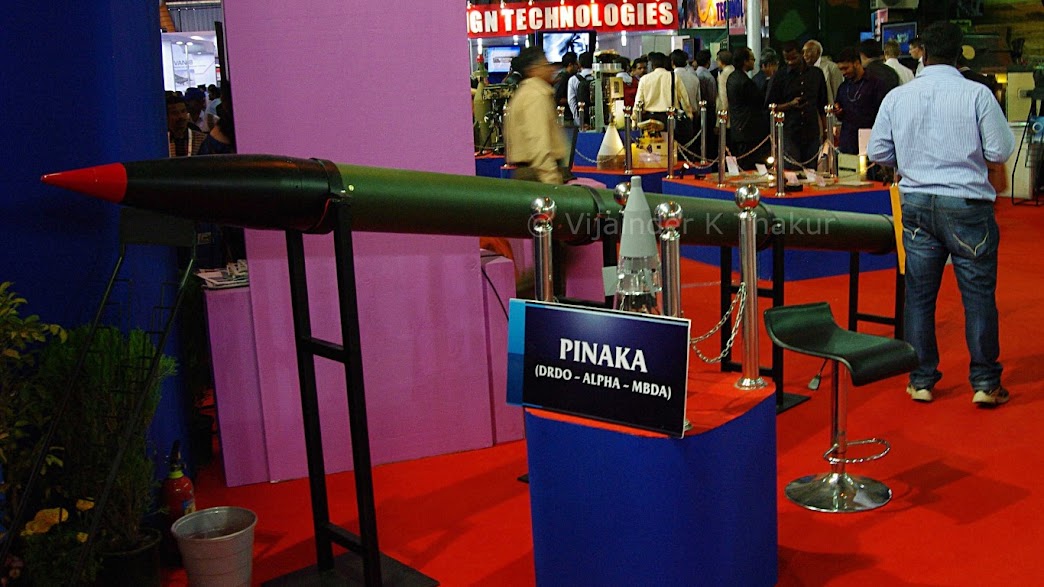
The Pinaka Mk.2 is a 214 mm calibre system. It can launch unguided rockets with a maximum range of either 40 km or 60 km, as well as Guided Pinaka rockets with a maximum range of 80 km.

Guided Pinaka rockets, also known as Enhanced Pinaka rockets, feature a 250 kg warhead, canard-based aerodynamic control, and guidance using a combination of Inertial Navigation System (INS) and Satellite Navigation (SATNAV).

The rocket’s SATNAV has been integrated with the Indian Regional Navigation Satellite System (IRNSS)—the Indian version of the US Global Positioning System (GPS).

With the help of trajectory lofting and aerodynamic glide provided by the canards, the Guided Pinaka rocket can achieve a range of 80 km.

The Pinaka system capable of launching the LRGR is referred to as Pinaka Mk.3.

Pinaka Accuracy

DRDO claims that during trials, Guided Pinaka rockets have demonstrated an accuracy of as much as 10 m.

The claimed accuracy and range of the Guided Pinaka place it in the league of the US Army’s M270 Multiple Launch Rocket System (M270 MLRS).

The LRGR Pinaka rockets conform to the 214 mm calibre. The proposed 300 km range Pinaka rockets are expected to use a 300 mm calibre format to accommodate a larger propellant mass.

Additional IA Procurements

Besides LRGR, the DAC additionally accorded AoN for the procurement of Loiter Munition Systems for Artillery Regiments, Low Level Light Weight Radars, and the Integrated Drone Detection & Interdiction System Mk-II for the Indian Army.

Low Level Light Weight Radar (LLLWR)

Low Level Light Weight Radars (LLLWRs) are used in mountainous areas to plug gaps in defence against adversary aircraft, helicopters, UAVs, and cruise missiles. The radar can detect a small fighter target at a range of around 50 km.

The MoD initially procured 19 Elta 2160 radars from Israel under the LLLWR requirement. A variant of the Elta 2160 is used with the SpyDer SAM system inducted into the IAF.

LLLWR 3D Aslesha is a DRDO-developed replacement for the Elta 2160.

Integrated Drone Defence System

The Integrated Drone Detection and Interdiction System (IDDIS) Mk-II is a mobile, rapid-deployment system intended for the defence of vital points (VPs) such as ammunition depots.

The system was developed by DRDO’s Centre for High Energy Systems & Sciences (CHESS), in collaboration with the Armed Forces.

It comprises a sensor suite (radar, EO/IR, and passive RF detection) to detect and track drones, and directed energy weapons (DEWs) and RF jammers to neutralize them. The DEW reportedly has a range of 2 km.

The radar used in the sensor suite is an adaptation of the Dutch Flycatcher I/J/K-band fire-control radar used with CIWS and locally manufactured by BEL.

The DEW, developed by the Laser Science and Technology Centre (LASTEC), uses a gas-dynamic high-power laser developed under LASTEC’s Aditya project.

Conclusion

It is good to see the IA wholeheartedly embracing technology that the DRDO has been developing over the years.

Long-range rockets with a 120 km range, such as the US M270 MLRS and Russian Tornado-S, have proven to be very effective for interdiction and area denial. MLRS systems with 300 km range rockets, capable of striking airbases, industrial plants, and infrastructure deeper in the interior, possess strategic capabilities.

However, there are challenges associated with developing long-range MLRS systems that the DRDO would need to adequately address during development. These include:

1. Target detection and geolocation

2. Accurate and EW-resilient guidance

3. Evasion of counter-battery fire

Target detection and location require persistent surveillance using drones and satellites. India’s Ministry of Defence would need to acquire these in larger numbers than are currently available.

Adversary EW systems can compromise the accuracy of both SATNAV and INS. The INS on the rockets needs to be hardened against EW, and SATNAV needs to be made more resilient through the use of multiple antennas.

Finally, to evade counter-battery fire, MLRS systems need to be highly agile and capable of changing location very quickly after launching rockets. The IA would need high-mobility vehicles similar to those used with the US ATACMS system.

Copyright © Vijainder K Thakur. First published on Thumkar.

Saturday, December 13, 2025

From 120 km to 300 km: Can DRDO Deliver the Army’s Long-Range MLRS Vision?


Pinaka Mk.2

India Today, quoting senior defence officials, reports that the Indian Army (IA) has initiated a procurement proposal worth around Rs 2,500 crore to induct 120-km strike-range Pinaka rockets. The proposal will be considered for approval by the Defence Acquisition Council (DAC) soon.

Jane's reported in January 2025, quoting a source in Munitions India Limited (MIL), that the Indian Army has given DRDO a go ahead to developed of advanced rockets for its Pinaka Multi‐Barrel Rocket Launcher System (MBRLS) with maximum strike ranges of 120 km and 300 km respectively.

DRDO's Armament Research and Development Establishment (ARDE) will develop the rockets and MIL will manufacture them under a transfer of technology (ToT) agreement with the DRDO.

The Chief of the Army Staff (COAS), Upendra Dwivedi, during his annual press briefing, confirmed that the DRDO, which had developed Pinaka unguided rockets with extended 45-km range, and Pinaka guided rockets with 75 - 80 km range, has now been tasked with further extending MBRLS rocket range, first to 120-km and then to 300-km.

He indicated that the Army would drop plans for other longer range weapons if the DRDO was able to deliver longer range Pinaka rockets.

General Dwivedi said, "As soon as we get longer ranges, we might drop plans for other alternate long-range weapons we are looking at and concentrate on it (Pinaka 3)."

The IA has also expressed interest in acquiring long range kamikaze drones. It is likely that General Dwivedi was referring to them when he alluded to dropping other alternate long-range weapons.

Current Pinaka System

The most advanced Pinaka MBRLS variant currently operated by the Indian Army - Pinaka Mk. 2 Guided Pinaka Rocket System - can engage targets from 20 km to 80 km range with an accuracy of 30 m. 

The Pinaks Mk.2 is a 214 mm calibre system. It can launch unguided rockets with max range of either 40 kms or 60 kms, as well as Guided Pinka rockets with max range of 80 km.

Guided Pinaka rockets, aka Enhanced Pinaka rockets,  feature a 250 kg warhead, canard-based aerodynamic control and guidance using a combination of Inertial Navigation System (INS) and Satellite Navigation (SATNAV).  

The rocket’s SATNAV has been integrated with the Indian Regional Navigation Satellite System (IRNSS) – the Indian version of the US Global Positioning System (GPS).

With the help of trajectory lofting and aerodynamic glide provided by the canards, Guided Pinaka rocket can achieve a range of 80-km.

The Guided Pinaka was developed jointly by ARDE Pune, RCI Hyderabad and DRDL Hyderabad.

Pinaka Accuracy


DRDO claims that during trials, Guided Pinaka rockets have shown an accuracy of as much as 10m. 


The claimed accuracy and range for the Guided Pinaka, puts it in the league of US Army’s GMLRS rockets fired from the M270 MLRS or HIMARS.

The proposed 120-km range Pinaka rockets will reportedly conform to the 214 calibre. The Pinaka system capable of launching the 120-km range rockets is referred to as Pinaka Mk.3.

300-km Range Rocket Pinaka System

The proposed 300-km-range Pinaka rockets are expected to use a 300-mm calibre format to accommodate a larger propellant mass. 

The IA already operates a 300 mm caliber MLRS (Multiple Launch Rocket System), the BM-30 Smerch-M,acquired from Russia through a $500 million deal signed in the mid-2000s. These systems have a max range of 90 km.

Besides Smerch, Russia has a 120-km range 300mm MLRS known as Tornado-S which employ precision-guided rockets that use a combination of strapdown inertial navigation systems (INS) and GLONASS satellite navigation for terminal guidance to achieve high accuracy. 

Recent videos of the Tornado-S striking bridges suggest that it may have terminal guidance - optical or SALH. 

Conclusion

Long range rockets with 120 km range, such as the US M270 MLRS and Russian Tornado-S have proven to be very effective for interdiction and area denial. MLRS systems with 300 km range rockets, capable of striking airbases, industrial plants and infrastructure deeper in the interior, have strategic capabilities. 

However, there are challenges associated with developing long range MLRS systems that the DRDO would need to adequately address during development. These include:

1. Target detection and geo location 

2. Accurate and EW resilient guidance

3. Evasion of counter battery fire


Target detection and location require persistent surveillance using drones and satellites. India's Ministry of Defence would need to acquire them in larger numbers than currently available. 


Long range rockets must be able to accurately strike bridges and hardened shelters. Typically this requires accuracies of less than 10 m CEP. The combination of INS + SATNAV based terminal guidance is usually not enough. Rockets need to be equipped with semi active laser homing with an overhead drone marking the strike point with a laser. Another option is optical terminal guidance. 


Adversary EW systems can compromise the accuracy of both SATNAV and INS. The INS system on the  rockets needs to be hardened against EW and SATNAV needs to be made more resilient through the use of multiple antennas. 

Finally, in order to evade counter battery fire, the MLRS systems need to be very agile and capable of changing location very quickly after launching rockets. The IA would need high mobility vehicles such as the one used with the US ATACMS system. 

The IA's move to acquire longer range MLRS systems needs to be commended. Indigenous manufacture of the MLRS systems and rockets will ensure that IA is able to sustain its operational capabilities through a prolonged conflict. Also, it would benefit from technological advances through periodic upgrades.

In the future, MLRS systems are expected to be able to launch rockets that can deploy reconnaissance drones for laser target marking enabling the use of semi active laser homing (SALH) guidance on rockets. 

Copyright © Vijainder K Thakur. First published on Thumkar.

Monday, July 6, 2015

News Roundup: AMCA Project Stranded without Engine, Army Clears Dhanush 155mm/45cal Gun Production and More

Dhanush at DefExpo 2014

Army grants OFB Bulk Production Clearance for 144 Dhanush 155-mm/45-cal guns 


The Indian Express reported on July 6, 2015 that the Indian Army has granted OFB (Ordnance Factory Board) Bulk Production Clearance for 144 Dhanush guns.

Gun Carriage Factory, Jabalpur has already started production of the gun; it plans to supply 6 guns within 6 months, another 12 within 12 months and another 36 guns within 24 months.

Army had hoped to get all the 144 guns in 3 years!

The MoD announced on April 27, 2015 that Dhanush has met all tech parameters in Winter and Summer Trials.

The TOI reported on October 13, 2014 that field trials of the gun have been completed and OFB is currently waiting for the DGQA report on the trials.

IDP Sentinel members can read more at the link below:
Dhanush 155 mm/45 Caliber Upgraded Bofors Howitzer - IDP Sentinel

Hawk AJT Flight Safety Record

On July 6, 2015 the TOI reported that the recent Hawk AJT crash was attributed to quill shaft failure, leading to concerns about HAL production quality.

A source reportedly told the TOI that Rolls-Royce has reduced the TBO (time between engine overhauls) of HAL produced Hawk AJTs from 2,000 hrs to 1,200 hrs, as a result of production quality concerns. HAL has denied the allegation.

On June 3, 2015, an IAF Hawk crashed about 50 Km west of Kalaikunda airbase. Both pilots ejected safely.

The crash was the second IAF Hawk crash. The first, was attributed to human error.

IDP Sentinel members can read more at the link below:
Hawk Mk.132 AJT - IDP Sentinel

AMCA Powerplant


On July 6, 2015 the Business Standard reported that the US is stonewalling India's request for cooperation on developing hot engine technology - specifically, India's desire to fund residual development of the F414 EPE as AMCA powerplant.

As a result, MoD is issuing a global tender, inviting aero engine majors to co-develop with the DRDO an AMCA powerplant.

The US stonewalling will bring back Eurojet EJ200 as contender for powering the AMCA. Eurojet reportedly convinced the DRDO it can uprate the EJ200 to 110 kN.

One good reason for the US to stonewall joint development of the F414 EPE for AMCA could be concern over Indian plans to fit the AMCA engine with thrust vectoring nozzles developed with assistance from Russia's Klimov.

Russian engine technology lags behind the US state-of-the-art, and the US could be worried that the Russians will get a close look at the F414 EPE. However, Russia claims that its Item 30 engine being developed for the PAK/FA would match contemporary western aero engines. The first prototype of the Item-30 engine is due to be delivered later this year.

IDP Sentinel members can read more at the link below:
Advanced Medium Combat Aircraft (AMCA) (IDP Sentinel)

Pinaka Submunition Warhead Development


Pinaka rockets were successfully tested with submunition warheads, including a thermobaric  warhead, at Pokhran during field firing trials in Rajasthan on June 29, 2015.

The tests were conducted using random Pinaka Mk-1 rockets picked up from a production lot. [via TOI]

The submunition warheads tested are among the eight kinds of warheads for Pinaka. Thermobaric  warheads are deadly against personnel and inflammable targets. Other warheads developed include cluster warheads armed with anti-personnel and anti-tank submunitions., and runway denial penetrating submunition warheads, aimed at neutralizing targets like runways and other complexes.

IDP Sentinel members can read more at the link below:
Pinaka Multi Barrel Rocket Launch System (MBRLS) - IDP Sentinel

Sunday, May 31, 2015

News Roundup: INS Vikrant Undocking Push Back and Pinaka Mk-2 Trial

IAC-1 Bridge under construction in April 2015. Photo Courtesy: MoD

INS Vikrant Undocking Pushed Back to Monday June 1, 2015


Undocking of INS Vikrant (IAC-1) has been pushed back to Monday, June 1, 2015. The aircraft carrier was to have undocked on Saturday, May 30 on completion of phase 2 structural build up. In preparation, the carrier - which will displace 40,000 ton on completion, but currently weighs just 26,000 tons - was loaded with ballast and flooding of the bay dock initiated on Friday, May 29, 2015.  However, undocking had to be pushed back to Monday due to unfavorable tide, unforeseen accumulation of silt, and a problem with lowering the building bay dock gate, which was last operated when the ship was brought in a year-and-a-half ago.

All major equipment has been fitted into the vessel, which has now acquired the shape of an aircraft carrier, with a finished hull.

Following undocking, for the next year-and-a-half INS Vikrant would be fitted with abling, piping, accommodation facility, air conditioning and ventilation systems as part of Phase-2 construction.

The equipment fitted on the carrier will be operated only towards the end of Phase-2 construction. Basin trials will commence in 2017 for eventual delivery in end-2018.

IAC-1 was officially launched on August 12, 2013 with over 80% of the structure completed; the ship was fitted with its two LM2500 Gas Turbines developing a total power of 80 MW, diesel alternators capable of producing about 24 MW and main gear box.

Following launch, the ship was moved out of the building dock and positioned in the refitting dock for the next Phase of outfitting. (The building dock cannot accommodate over 20,000 ton displacement)

IDP Sentinel members can read more about IAC-1 at the link below.

Indian Aircraft Carrier (IAC) Project 71 (INS Vikrant) - IDP Sentinel

Pinaka Mk-2 User Field Trial


During a user field trial at Pokhran range near Jaisalmer on May 30, 2015 six Pinaka Mk-2 rockets successfully hit a target at 53-km range.

More trials are planned.

Pinaka rocket at Aero India 2015


Earlier, DRDO's Armament Research & Development Establishment (ARDE) completed development of Pinaka Mk-2 following trials at the Chandipur range in Odisha from December 9 to December 12, 2014. A total of 20 rockets were fired in the four-day-long trial to ranges of 20-60 km.

Extended Range (ER) Rocket Ammunition for 122 MM Grad BM-21 MBRLS

On an aside, Indian Army is planning to procure Extended Range Rockets for 122mm GRAD BM-21 Multi Barrel Rocket Launcher System (MBRLS).

On May 21, 2015, the Army released a RFI to identify probable Indian vendors who can undertake the above project. Closing date for vendor response is July 1, 2015.

IDP Sentinel members can read more about the Pinaka MBRLS see link below

Pinaka Multi Barrel Rocket Launch System (MBRLS) (IDP Sentinel)