Showing posts with label Fighters. Show all posts

Wednesday, June 18, 2014

DRDO to Fast Track Advanced Medium Combat Aircraft (AMCA) Development

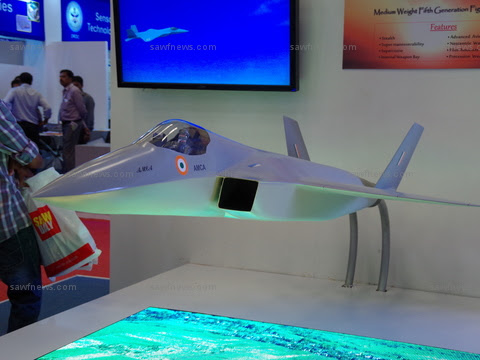
Scale model of AMCA on display at Aero India 2013 in Bengaluru

DRDO Chief Avinash Chander recently told the press that the AMCA project would be fast tracked.

He said DRDO has identified certain key areas to focus upon, including UAVs and AMCA.

“We are giving UAVs a push in a big way. That is one of the key areas along with Advanced Medium Combat Aircraft, ammunition etc.,” he said.

The GOI has yet to sanction development of prototypes, so the tenor of the DRDO chief's statement could well indicate that a nod from the Modi government would be forthcoming.

In 2013, there were press reports that the AMCA project had been shelved.

On May 17, 2013, DRDO Chief VK Saraswat refuted the reports telling PTI, "Currently, it is in the design stage. A good work is being done. After this we will go to government which will take a year's time'. There are three major technologies along with lot of associated technologies which have to be developed. DRDO was developing this."

He added that no decision had been taken so far on shelving the project by DRDO, HAL or Defense ministry.

Some of the new technologies that ADA wishes to incorporate in the AMCA include a FBW control system with photonic interface to reduce the length of wires (fly-by-light).

DRDO also plans to develop a completely new engine with foreign collaboration for the AMCA.

IDP Sentinel members can read more at the link below

Advanced Medium Combat Aircraft (AMCA) (IDP Sentinel)

Thursday, April 24, 2014

Six IAF MiG-29s Being Upgraded to MiG-29(UPG) Standard in Nashik

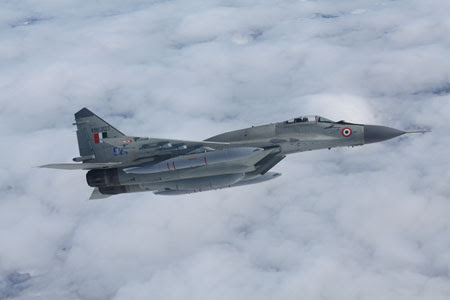
MiG-29 UPG. Photo Credit: RAC MiG


Upgrade of the IAF's fleet of 62 MiG-29 aircraft to MiG-29(UPG) standard is underway at Nashik, India with six aircraft currently being upgraded using kits supplied by RAC MiG.

The upgrade of the IAF's MiG-29  fleet started in Russia in 2012. It moved to India this year, after RAC MiG delivered six MiG-29(UPG) aircraft to the IAF, 3 in 2012 and 3 in 2013. The company has also supplied kits for upgrading the remaining aircraft to India fulfilling its contractual obligations.

MiG Director General Sergei Korotkov told reporters recently, "In 2012 and 2013 we had delivered three planes each. We also delivered the technological kits that are needed for the assembly, repair and modernization of planes of the Indian Air Force. So, we have fully met all our obligations."

He added that the first six planes "are already at a good stage of repair and modernization” at Indian facilities. “These works continue. A large group of the MiG corporation experts are there. They, along with our subcontractors that participate in the project, transfer these aircraft and train the Indian colleagues to assemble planes.”

In March 2008 Russia's RAC-MiG signed a $964 million contract with MOD for modernization of 62 MiG-29 fighters (54 fighters and 8 trainers).  The project was expected to be completed by 2013, but is now expected to be completed by 2016.

Upgrade Support Contracts

During MAKS-2013, RAC MiG and India’s Basant Aerospace Private Limited signed two contracts worth $55 million as part of a general offset contract with India.

The first contract, worth $43 million, is for establishing a service center in India for servicing and repair of the Zhuk-ME airborne radar produced by Fazotron-NIIP.

The second contract, worth $12 million, is for creation of a service center in India for repair of equipment specific to MiG-29 (UPG) and MiG-29K/KUB aircraft spanning Avionics, Radar, Hydraulic System and  Structural Parts.

As part of the agreement, RAC MiG will train IAF technical staff to service and repair assemblies and provide equipment to setup the centers.

In April 2014, Sergei Korotkov, chief executive officer of Russian Aircraft Corporation (RSK) MiG told reporters that the service center would be operational from next year.

“This year we have already provided equipment for this onsite service center, which was built as part of the agreement, and, starting next year, this service center should operate in accordance with the contractual obligations that were taken by both sides,” Korotkov said.

A MiG representative said the next step calls for the creation of a warehouse in India for MiG-29K Aircraft spare parts.

The first lot of the 62 upgraded Russian-built aircraft will be deployed at Adampur air base in the border state of Punjab.

IDP Sentinel members can read more about the MiG-29UPG project at the link below

MiG-29 Upgrade (MiG-29UPG) (IDP Sentinel)

Tuesday, April 22, 2014

Indian Navy to Receive 6 MiG-29K/KUB Aircraft in 2014


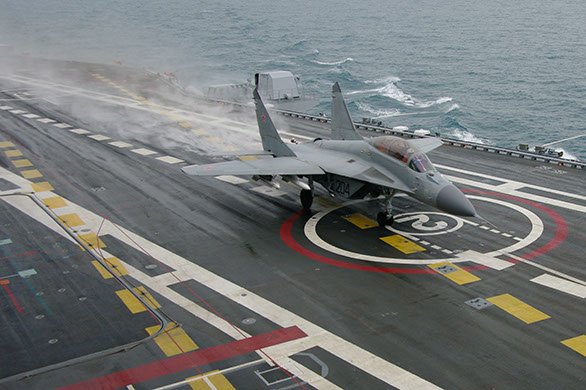
MiG-29KUB on INS Vikramaditya during sea trials. Photo Credit Sevmash

The Indian Navy will receive six MiG-29K/KUB aircraft in 2014 bringing to 13 the total number of aircraft delivered against a $1.5-billion contract for the supply of additional 29 MiG-29Ks singed on March 12, 2010.

Director General of RAC "MiG" Sergei Korotkov, told the press in April 2014 that the company had delivered 7 MiG-29K/KUB to the Indian Navy by end 2013 and would deliver 6 more aircraft in 2014.

On December 29, 2012, RIA Novosti reported that MiG had delivered in December a batch of four MiG-29K/KUB shipborne fighters against the second order for 29 aircraft, fulfilling its contractual obligation for the year 2012.

RAC MiG completed delivery of 16 aircraft against the initial order for 12 MiG-29Ks and 4 MiG-29KUBs in September 2011.

MiG is currently producing 16 aircraft per year. The remaining 10 aircraft to be produced in 2014 are earmarked for the Russian Navy, which placed an order for 20 aircraft (16 MiG-29Ks and 4 MiG29KUBs) in February 2012.

MiG plans to nearly double production rate to 30 aircraft per year by 2017. In the past, the company has said it expects the Indian Navy to sign a third contract for 24 MiG-29K/MiG-29KUB aircraft.

The Russian Navy will base its MiG-29 aircraft on its lone aircraft carrier Admiral Kuznetzov. The heavy Su-33 aircraft (a navalized Su-27) currently based on the carrier are expected to complete their residual lives in 2015.

IDP Sentinel members can view additional details on the MiG-29K aircraft at the link below.

MiG-29K (IDP Sentinel)

Friday, February 21, 2014

IAF's Su-30 MKI Acquisition Progress

IAF Su-30 MKI 

Acquisition Details

Of the initial 50 aircraft procured, 8 were basic Su-30MKs, 10 Su-30Ks, 10 Su-30MKIs with canards, and the remaining 22 Su-30MKIs with canards and AL-31FP engines, the thrust vectoring version of AL-31 engines fitted on the earlier aircraft.

The first batch of Su-30MKIs were delivered to the IAF in the beginning of 2002.

The AL-31FP engine is 110 kg heavier and 0.4m longer than the AL-31F but retains the same thrust.


HAL had assembled 42 MKIs from the total order of 140 to be assembled by the end of 2012.

As of December 2009, the IAF was operating five Su-30MKI squadrons, with two squadrons flying HAL assembled aircraft.

As of June 2010


HAL had delivered 74 of of the 140 aircraft on order. It delivered 23 Su-30MKI in 2009 and is expected to deliver 28 in 2010.

Three aircraft from the follow-up order for 40 placed on Russia had been delivered by December 7, 2009. Delivery of the remaining is expected to be completed by 2011-12.

A total of two aircraft were lost in crashes on 30 April 2009 and 30 November 2009.

As of March 2011


Out of the total 180 aircraft, 99 aircraft have been delivered till 2010-11.

As of December 2012


In a press release on December 24, 2012, HAL stated that it had delivered 119 aircraft to the IAF till date.

As of February 2014


In a press release on February 21, 2014, HAL stated that it had delivered 134 aircraft to the IAF. HAL manufactures around 43000 components for airframe, 6300 for engine, and 9600 for accessories. HAL makes 72% of the components in India with 100% technology absorption as per the scope defined in the contract.

Sunday, January 12, 2014

Tejas LCA: Brilliant, but not cheap!


Tejas LCA at Aero India 2013

HAL has reportedly priced the first 20 Tejas LCA, now under production in Bengaluru, at Rs 162 crore each. ($25 million at current exchange rate.) The price tag looks very impressive when compared with the reported price tags for the upgrades of IAF Mirage 2000 ($45 million ea.) and MiG-29 (Rs 87 crore ea.) per aircraft.

One reason why the Tejas is priced so low is because HAL is not including development costs in the price tag. HAL didn't develop the aircraft, ADA did and the Indian government footed the development costs. On the contrary, Mirage 2000 and MiG-29 manufacturers are upgrading the aircraft on India's request and exclusively for India; the unit price of the upgrades reflects a hefty development cost.

Considering India's limited industrial base and consequent need to import many of the critical components featured on a fighter like the Tejas, lower production cost for Indian developed weapon systems is a myth; it defies logic.

At comparable skill levels, the cost of an employee in India isn't significantly lower than in developed western countries. If you factor in the inefficiency and the perks associated with employees working in the public sector, employee cost is likely at par.

Also, foreign help in developing a weapon system like the Tejas (ADA sought foreign assistance for overcoming slow speed handling issues, obtaining IOC and strengthening the undercarriage for the Naval variant.) doesn't come cheap even after the pound of flesh implicit in such assistance.

Friday, October 18, 2013

India Unhappy with FGFA Research & Design Workshare

PMF / FGFA model on display at Aero India 2013. Photo Credit: Vijainder K Thakur

On October 18, 2013, The Economic Times reported that the IAF is unhappy that India, despite bankrolling 50% of the development cost of the FGFA, is being allocated just 15% of the research and development work for the aircraft by Russia.

The IAF expressed its disappointment at a CII event on energizing aerospace sector in India.

"We have a major opportunity in the FGFA program. At the moment it is not very much in favor of Indian development. We are flagging it through the Government. It should be much more focused towards indigenous development capability," IAF Deputy Chief Air Marshal S Sukumar said here.

The Raksha Mantri is expected to take up the issue during his visit to Russia starting November 15, 2013.

India and Russia are currently negotiating the Research and Development work share of the FGFA program. The negotiations are expected to take another year!

What is difficult to understand is how can India realistically expect a larger work share. The PMF / FGFA is based on the PAK-FA / T-50, an aircraft that is expected to start state acceptance trials in early 2014.

The FGFA will feature the same airframe, engines and main systems as the T-50, but differ in its avionics and weapon suite. Clearly, the residual R&D work is limited. What is it that India wants to research and develop?

Wednesday, October 2, 2013

GTRE Pushes Ahead with Kaveri as USAV Power Plant

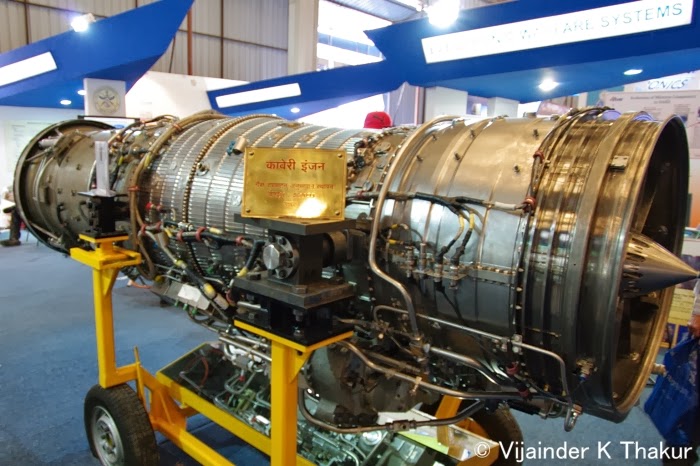
Kaveri engine at Aero India 2011. Photo © Copyright: Vijainder K Thakur
GTRE has submitted a revised proposal to the GOI to warp development of Kaveri engine.

DRDO Director General (Aero) K. Tamilmani and Director, Gas Turbine Research Establishment (GTRE) C.P. Ramanarayanan told The Hindu in October 2013 that GTRE will resolve the five issues that came up during airborne testing of the Kaveri engine in 2011 using an IL-76 testbed at Gromov Flight Research Institute (GFRI), Russia

Next year, the tweaked engine would be fitted first on an IL-76 testbed and then a MiG-29 fighter for trials and eventual certification.

“When we do that, we will have the first indigenous engine with proven and certified performance for exploitation,” Dr. Ramanarayanan said.

GTRE had earlier planned to obtain certification using an LCA testbed. (The LCA PV-1 was built to support the Kaveri engine.)

GTRE has sought sanction from MoD for developing the "dry thrust only" versions of the Kaveri engines. The money will be utilized to build two prototypes and send them to Russia for flight testing.

Dr. Ramnarayanan had earlier told the press, “We will take 48 months from the date we get clearance from the government, for completing 50 hours of testing the Kaveri on the Tejas LCA. During the last 12 months, we will actually fly the Tejas with the Kaveri.”


The testing will now presumably be done on a MiG-29.

According to Dr. Ramanarayanan, in future India would endeavor to build aircraft around a proven engine, a model followed worldwide.

During testing at the Gramov Flight Test Center, the Kaveri had demonstrated a dry thrust of 49.2 KN against a designed 51KN. With reheat the thrust deficit was substantial; 70.4 KN against the designed 81 KN.

Due to the thrust deficit with reheat, Kaveri was dropped as a prospective LCA powerplant.

Since Kaveri's dry thrust performance comes close the design values, DRDO has taken a decision to develop Kaveri as a UCAV powerplant.

UCAVs use un-reheated engines to minimize their heat and noise signatures. Also, the thrust requirement for the USAV is more modest.

DRDO has embarked on the development of a UCAV matching the capabilities of the X-47B and nEuron. The Indian analog is called Unmanned Strike Air Vehicle (USAV).

The USAV cannot use an imported engine on account of the MTCR regime which prohibits sale to another country of technology that maybe used in a missile or unmanned vehicle exceeding 300 km in range.

Removing the reheat from the Kaveri would lighten the engine considerably.

"Since the USAV will weigh less than 10 tonnes, the Kaveri’s 50 KN will suffice. And, with the afterburner removed, we would significantly reduce the weight of the Kaveri," a top DRDO scientist told the Business Standard earlier this year.

Along the way, GTRE will need to tweak the Kaveri dry for use on low RCS aircraft. Typically, stealth aircraft powerplants use shaped intakes to prevent enemy radar from reflecting off their compressor blades. Also, the engines are designed to operate with shaped exhausts to reduce stern radar and heat signature 

In addition to the Kaveri, GTRE is co-developing a powerplant for the AMCA with a foreign vendor to be selected through open tendering.

Meanwhile, HAL is independently developing aircraft engines for use on drones, helicopters and trainer aircraft by 2018.

Details about the Kaveri project are at Kaveri Jet Engine - IDP Sentinel.
You can read more about the India USAV a Unmanned Strike Air Vehicle (USAV) / AURA UCAV