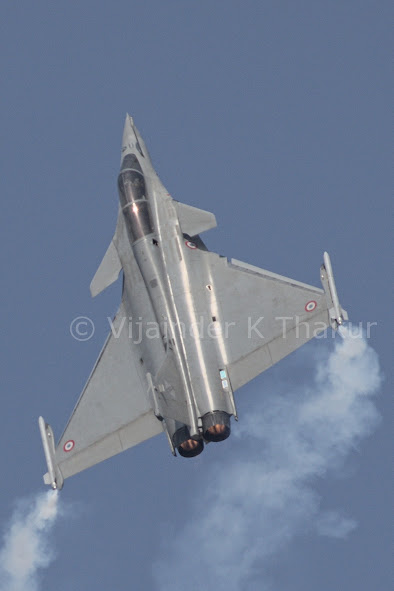
Showing posts with label Rafale. Show all posts

Tuesday, May 12, 2026

MBDA and IAF Sign MRO Agreement for MICA Missiles

Image by @Grok


MBDA and the IAF have signed an agreement to set up MRO facilities for the MICA missile in India.


Currently, MICA missiles need to be shipped to MBDA for refurbishment. An indigenous capability will save time and reduce costs.


The IAF will operate the MICA MRO facility, undertaking inspection, repair, component replacement, and mid-life upgrades throughout the missiles’ service life, with MBDA providing tools, data packages, training, and support.


Mid-life work on an air-to-air missile typically involves software upgrades, seeker enhancements, renewal of pyrotechnic elements (especially solid rocket propellant), batteries, electronics, and other aging components.


At the 2025 Paris Air Show, MBDA and the Indian company AXISCADES formalized the creation of an industrial unit in Bengaluru dedicated to the manufacture and integration of missile launch systems. The MICA MRO agreement is a progression of that tie-up.


AXISCADES Technologies is a Bengaluru-based Indian multinational company specializing in high-end engineering solutions and technology services. It focuses primarily on Aerospace, Defence, and ESAI (Electronics, Semiconductor, and Artificial Intelligence), delivering end-to-end product lifecycle support — from design and development to manufacturing, assembly, testing, and R&D.


Its current order book includes over ₹600 crore worth of advanced sub-systems for indigenous platforms.


IAF and MBDA MICA

The IAF has operated MICA missiles since 2016, initially with the Mirage 2000 and later with Rafale fighters as well.


The IAF Rafale fleet, which currently comprises two squadrons (36 aircraft), is set to expand with the induction of an additional 114 Rafale fighters under the MRFA program. The MICA MRO agreement will help ensure cost-effective sustainment of the fleet’s combat capability.


MBDA weapon systems currently in use by the IAF include the MICA, Meteor, ASRAAM, and Mistral.


Copyright © Vijainder K Thakur. First published on Thumkar.

Tuesday, April 21, 2026

IAF’s 5th Gen Need Meets a US 4th Gen Pitch!

Indian Air Force Air Chief Marshal Amar Preet Singh engaged with U.S. Air Force leaders during a visit to Nellis Air Force Base, Nevada, April 9, 2026. The visit focused on joint exercise opportunities and aligning modernization efforts to build a foundation for interoperability.


During his recent weeklong visit to the US starting April 6, the Indian Air Force (IAF) Chief of Air Staff (CAS), Air Chief Marshal (ACM) Amar Preet Singh, flew a familiarisation sortie in a Boeing F-15EX Eagle II fighter jet at Nellis Air Force Base in Nevada.

Routine Visit?


Officially, the CAS was on a routine exchange visit to foster deeper relations between the IAF and the U.S. Air Force (USAF). High-ranking air force officials from both nations routinely visit counterpart nations to discuss interoperability, joint training, shared strategic priorities in the Indo-Pacific, and modernisation.

In the past 15 years, four IAF Chiefs have made official visits to the US, as follows:

1. July 2013: Air Chief Marshal NAK Browne at the invitation of USAF Chief of Staff Gen. Mark A. Welsh III.

2. May 2015: Air Chief Marshal Arup Raha at the invitation of USAF Chief of Staff Gen. Mark A. Welsh III to strengthen bilateral defence cooperation.

3. September 26–28, 2017: Air Chief Marshal Birender Singh Dhanoa to attend the Pacific Air Chiefs Symposium in Hawaii.

4. April 6–13, 2026: Air Chief Marshal Amar Preet Singh to strengthen the India–US defence partnership and deepen cooperation between the two air forces.

The USAF Chief of Staff/Secretary of the Air Force has visited India three times in the same period, as follows:

1. August 2016: Secretary of the Air Force Deborah Lee James to discuss defence and trade cooperation.

2. February 1–7, 2018: Chief of Staff Gen. David L. Goldfein to discuss Indo-Pacific cooperation.

3. March 21, 2023: Secretary of the Air Force Frank Kendall to advance the U.S.–India Major Defense Partnership and bilateral security cooperation.

From the above, it is clear that exchange visits don't take place at predetermined intervals. Instead, they are based on invitations. As such, despite being labelled as routine visits, they are neither routine nor mere optics. There is always a strong undercurrent aimed at adding depth to the partnership. From the US point of view, CAS visits are either aimed at selling US weapons to India, aligning India more sharply with US unipolar global ambitions, or both.

Recent CAS Visit

Based on media reports, the invitation to ACM AP Singh to visit the US was likely aimed at laying down the modalities for surveillance by US MQ-9B SkyGuardian drones being sold to the IAF and the possible sharing of data.

The ACM's familiarisation sortie in a Boeing F-15EX Eagle II fighter jet was likely aimed at softening any IAF resistance to the purchase of the Boeing F-15EX fighter and its weapon systems.


During the MMRCA procurement process, the US had pitched its F-16 and F-18 fighters to the IAF, which ultimately chose the French Rafale fighter. However, due to irreconcilable differences over ToT, France and India could not finalise a contract. In 2018, the MoD placed an interim order for 36 Rafales and terminated further procurement under the MMRCA program.

Multi-Role Fighter Aircraft (MRFA) Program

The MoD then initiated the balance procurement of 110 fighters under the Multi-Role Fighter Aircraft (MRFA) program. On April 6, 2018, it released a fresh RFI stipulating that a maximum of 15 per cent of aircraft were to be procured in flyaway condition and 85 per cent would be manufactured in India based on transfer of technology (ToT) under “Make in India.” The RFI mandated the guarantee of 75 per cent availability of aircraft at all times.

The F-15EX was a late entrant in the MRFA program, which was initially confined to former MMRCA contestants.

New Delhi first showed interest in the F-15EX in October 2020, shortly after the U.S. Air Force awarded Boeing a nearly $1.2 billion contract to build the first lot of eight F-15EX advanced fighter jets to help the service meet its capacity requirements and add capability to its fighter fleet.

“There is a possibility that the F-15EX could be sold on a government-to-government basis,” a top government official familiar with the discussions told Hindustan Times at that time.

However, at that point, Boeing had not yet been licensed to sell the F-15EX abroad.

On January 28, 2021, the US government granted Boeing a marketing licence to offer the F-15EX Eagle II fighter jet directly to the Indian Air Force (IAF) under its MRFA procurement program.

It is not clear if Boeing’s pitch of the F-15EX conformed to the Indian MoD RFI of April 6, 2018, particularly regarding its willingness for ToT and local manufacture in India under “Make in India.”

Notably, the Boeing fighter was never offered for evaluation to the IAF, which raises doubts about the sincerity of the Boeing pitch.

Meanwhile, the IAF, having invested heavily in creating the maintenance and logistics infrastructure for Rafale, continued to display enthusiasm for additional procurement of the French fighter, which had performed creditably in Op Sindoor.

The CAS, in his interaction with the press on October 3, 2025, confirmed the IAF’s interest in acquiring additional Rafale fighter jets under the MRFA programme, stating:

“This is one of the options that is available with us because we had already done our own homework in terms of the earlier MMRCA contract. In that, we found Rafale to be the best aircraft suited for us amongst those candidates.”

However, he acknowledged that a decision in favour of Rafale would depend on French willingness to share manufacturing technology with India.

Alluding to the 2018 RFI that mandates ToT with the guarantee of 75 per cent availability of aircraft at all times, he said, “So whichever design house is ready to come up with the proposal to Make in India, to give us technology, give us more freedom, I think that design house should be chosen,” he added.

Rafale Procurement Go-Ahead

In January 2026, the Defence Procurement Board (DPB) reportedly gave its go-ahead to an Indian Air Force proposal to buy 114 French-origin Rafale jets.

Contract negotiations between India and France are underway. The DPB go-ahead has to be cleared by the DAC, headed by Defence Minister Rajnath Singh. Finally, before the contract is signed, it would need to be approved by the Cabinet Committee on Security.

Source Code Issues

Some unverified media reports suggest that the French government has refused to provide India with the source code for the Rafale’s Thales RBE2 AESA radar, the Modular Data Processing Unit (MDPU), and the SPECTRA electronic warfare suite.

These reports may sound alarming to many defence enthusiasts, but they need not be.

The IAF does not need the full source code of the Rafale. What it needs is programming access to the full source code. In an earlier analysis for the Eurasian Times, I explained in detail the difference.

A programming interface provides access to the underlying code through a layer of abstraction.

There is no reason for France to withhold full programming access to the Rafale source code, just as there is no reason for the IAF to ask for the transfer of the full source code.

It is the author’s belief that good negotiations can adequately seal the deal while safeguarding the interests of both France and India.

MRFA – A Near Done Deal

The IAF has made its choice clear in favour of Rafale. The renewed US pitch for the F-15EX aims to leverage the controversy wittingly or unwittingly created by the media over the source code. The IAF is unlikely to pursue a red-herring offer; notably, however, the US has made one—exposing its insincerity.

Need for Stealth Fighters

The IAF has officially projected to the MoD a need for 2–3 squadrons of a stealth fighter to address an emerging stopgap requirement. Ironically, what the US is ready to offer is not the F-35, but a Su-30MKI substitute that will drain billions from the IAF's capital expenditure over the next few years in acquiring the aircraft, creating a logistics and maintenance infrastructure, and procuring a whole new line of weapon systems.

The loss of four F-15EX fighters during the recent Iran war would be difficult for the IAF leadership to ignore were it inclined to change its mind at this late stage.

According to ANI, during ACM AP Singh’s visit, U.S. Air Force Chief of Staff Gen. Ken Wilsbach welcomed India’s procurement of the MQ-9B SkyGuardian drone. I wonder if the CAS found the endorsement reassuring, considering how easily Iran has been able to shoot down these very expensive drones.

In summary, what the IAF urgently needs is not the F-15EX, but an upgrade to the highly potent BrahMos-wielding Su-30MKI, which can also be adapted for launching Indian-developed hypersonic aeroballistic missiles in the future.

Copyright © Vijainder K Thakur. First published on Thumkar.

Sunday, April 5, 2026

Getting the Rafale on India’s Terms: The Source Code Question


@Grok Generated Image of Rafale Receiving Software Update


The French government’s reported refusal to provide India with the source code for the Rafale’s Thales RBE2 AESA radar, the Modular Data Processing Unit (MDPU), and the SPECTRA electronic warfare suite should prove sobering to the GoI.


Under the circumstances, an emotionally charged debate is raging on social media around the question: should India still go ahead with the Rafale deal?


Ironically, some of the most vociferous participants in the debate don't understand what really is at stake because they don't clearly understand the role of software in a fighter aircraft.


In the following paragraphs, I will try to explain the value and role of software in a fighter aircraft.


Software by Value


Approximately 30–40% of the total cost of a modern fighter like the Rafale is typically attributed to software development/integration. What that means is—if the OEM doesn't supply the source code along with the fighter, you get only 60% of the aircraft despite paying for 100%.


As technology advances, it's likely that the percentage cost representing software will increase well past 50%.


However simplistic it may sound, a nation does get shortchanged when it buys a fighter, and in the future the shortchanging will be even greater.


Dependency on OEM


More importantly, when nations buy modern fighters, they have to keep reverting to the OEM to address any requirements for changes in the software with evolving tactics and weapon systems. In a manner of speaking, the money paid for software changes is money burnt because software alterations have zero tangible value. You pay for the tweak, but physically you return with what you had earlier.


The continued dependency on the OEM may prove crippling, for example, if the OEM does not allow software changes required to integrate third-party weapon systems. For example, if Dassault disallows integration of the Russian R-37M missiles on the Rafale.


No OEM Will Provide Full Source Code


Software in fighter aircraft is built in layers of abstraction. This hierarchical design (often called a "layered architecture") separates concerns, improves reliability, and allows independent certification and upgrades.


Lowest-level software layers


These provide hardware access abstraction and include device-driver layers. They directly interface with sensors (radar, INS, EO/IR), actuators (flight controls, weapons release), data buses (MIL-STD-1553, AFDX), storage devices, and processors. They translate raw sensor signals into usable data.


Medium layers


These include operating system services and common libraries that provide universal, reusable functionality not tied to any single mission. Examples include:


Data read/write services (file systems, database-like buffers, or ARINC 653 partitioning)

Mathematical function libraries (e.g., Kalman filters, coordinate transformations, floating-point math)

Other common services: timing, memory management, communication protocols, and real-time operating system (RTOS) primitives


In fighters, this layer often includes certified middleware that abstracts the underlying RTOS (e.g., VxWorks, INTEGRITY), so higher layers don’t need to know hardware details.


Highest layers


These are the application/mission-specific layers.


They implement operational logic unique to a task (e.g., sensor fusion, target tracking, weapons release sequencing, flight-control laws, electronic warfare response, or cockpit display management).


The highest layers can be thought of as the personality or the potential of the aircraft. The layers define the aircraft's maneuvering and combat capabilities. The layers serve as the interface between the pilot and the aircraft as a whole, including the weapons that it's armed with.


The entire source code of the Rafale will comprise millions of lines. IAF programmers would take years, perhaps decades, to acquaint themselves with the entire code. More importantly, it would serve little purpose because the low-level and medium-level layers are well proven and extensively tested.


Most likely, what the IAF seeks from Dassault is access to the sensor- and hardware-specific lowest layer to fit new sensors and weapon systems, and possibly the highest layers to tweak combat load and maneuvering parameters.


It's important to understand that providing access to a software layer is not the same as transferring the full source code of the layers.


Access to the underlying code can be provided through a layer of abstraction without transferring the code. Coding new functionality through a layer of abstraction entails using a programming interface. When working through such an interface, the user cannot know how the source code actually functions.


The Real Issue


A programming interface provides limited and safe abstract access to limited segments of the internal source code.


It's likely that Dassault is ready to provide an interface to integrate indigenously developed weapons that are currently operational or under development. However, over the years, the interface may not prove adequate for integrating the IAF’s future weapons and other operational requirements because weapon systems are fast evolving, both in terms of technology and concepts.


For example, in the future, the IAF may want to launch drones from the Rafale or launch weapons from an unmanned collaborative combat aircraft (CCA) operating with the Rafale. For such requirements, the IAF would require a more extensive programming interface to the underlying source code.


Accidental / Intentional Limitations


There is another problem with interface-only access to source code. The underlying code may have accidentally or deliberately planted limitations that the operating country is not aware of. These limitations, which could have been coded or escaped detection during testing, may not show up when the aircraft is operating in the OEM country.


In the early 1980s, the IAF acquired Durandal runway-penetration bombs for the Jaguar aircraft. The IAF acquired the Durandals based on their successful integration with French and Royal Air Force Jaguars.


Several years after acquiring the bomb, the IAF realised that its Jaguars could not release the bombs, which had been lying unused as strategic reserves for years, due to a software bug.


A software tweak fixed the issue, but it was fortunate that the issue was discovered during a planned demonstration of the lethality of the Durandal for the Raksha Mantri at the Pokharan range, not during an operation.


So, if and when a requirement emerges, the OEM must be willing to provide a more extensive interface than the one initially provided, at a nominal cost. The IAF must pay for the source code only once.


Conclusion


India should not buy the Rafale unless France commits to providing access to any part of the source code that the IAF needs to access.


The additional access should be provided at a very nominal, pre-negotiated cost. If the OEM declines to provide additional access, it must surrender the source code.


Copyright © Vijainder K Thakur. First published on Thumkar.

Saturday, January 10, 2026

RUSI’s Rafale Downing Story: Big Claims, Zero Forensics


Western Think Tanks Are Now Disinformation Banks Here is a classic example of Western disinformation and deception. In a recent (January 2026) report, the Royal United Services Institute (RUSI), a UK-based defence think tank, relying exclusively on PAF claims, concluded that during Operation Sindoor a PAF J-10CE fighter downed an IAF Rafale using a PL-15 missile fired from approximately 200 km away. The RUSI report also draws on speculation by unnamed US officials, as reported by Reuters, that the IAF underestimated the range of the PL-15, believing the PAF was equipped only with the 140-km-range export variant of the missile. However, just before the start of Operation Sindoor, China had reportedly surreptitiously transferred PL-15 missiles with a 200–300 km range (depending on launch height) from PLAAF inventory to the PAF. The fact is, merely having range does not assure an air-to-air missile of a kill. IAF Rafales are equipped with the SPECTRA self-protection suite, which includes active RF jamming and active cancellation jamming to reduce RCS. One would expect a serious think-tank report to examine how the PL-15 allegedly penetrated the Rafale’s electronic defences. The RUSI report does not mention whether the Rafale took evasive action. Nor does it claim access to PL-15 cockpit displays or supporting radar recordings that would substantiate the PAF’s assertion. An analysis based on a single source, unsupported by evidence and built on speculation, is a bogus analysis—as RUSI itself would know. Yet it is presented as fact. The intent is clear: to seed doubt in Indian minds and sap the confidence of the Indian public.

Copyright © Vijainder K Thakur. First published on Thumkar.

Friday, July 31, 2020

J-20 vs Rafale


Introduction

Comparing the J-20 and the Rafale, to use a cliche, is like comparing oranges and apples. The two fighters were conceived and developed for completely different roles. However, the adversarial deployment of the two fighters in the context of the simmering India - China border dispute has fanned nationalist fervor and clamor for a comparison to such an extent that comparing oranges and apples seems perfectly logical.

Also, the Global Times, piqued by the claim of the former COAS that the Rafale is superior to the  J-20, has, without presenting a shred of evidence, fired a broadside trashing the Rafale as a generation behind the J-20 and claiming that the Rafale will "find it very difficult to confront a stealth-capable" J-20.

Well, it's time for fools to rush in where angels fear to tread. I may be a fool, but not a very verbose one, so I will confine this comparison to the BVR combat capability of the two fighters, because no one in their senses, not even the Global Times, will contend that the J-20 is superior to Rafale in WVR combat.

BVR combat capability is largely dependent on - the extent and capability of AWACS cover, RF signature, sensor suite, self defense suite, Man Machine Interface (MMI), and air-to-air missile range. For the comparison, we will assume a Rafale armed with Meteor and a J-20 armed with PL-15. Both feature dual pulse propulsion (A second stage ramjet in Meteor & a solid fuel rocket sustainer in PL-15) for thrusted end game maneuvering, max range of over 150-km, and an active seeker.

RF Signature


The J-20, which features full extent frontal aspect and limited extent side aspect LO shaping has a significantly lower radar signature than the Rafale which features limited extent frontal aspect LO shaping only. Both aircraft use RAM (Radar Absorption Material) and possibly some classified features to further reduce their RF signature. As far as RF signature goes, it's undoubtedly advantage J-20!

Sensor Suite


Both aircraft feature AESA radar, Optical Detection and Tracking system, and 360-deg FOV IR sensor based situational awareness.

AESA


The J-20 likely has a more powerful radar. Some estimates put the number of T/R modules on the J-20's AESA at 2000–2200. In comparison, the Rafale's RBE2 AESA features 1000 T/R modules. Assuming that the Chinese T/R modules match the efficiencies of the GaAs (Gallium Arsenide) T/R modules on the RBE2, and Chinese software algorithms driving the T/R modules on the J-20 AESA match the sophistication of the algorithms controlling the RBE2 T/R modules, the J-20 would have a much better max detection range and a more formidable EW capability. However, the two assumptions that we have made aren't trivial and are easily questionable by skeptics.

A better max detection range combined with the PL-15 air-to-air missile capable of leveraging the better range would give the J-20 a first to shoot advantage over the Rafale in BVR engagements.

However, the lack of sophistication of LPI (Low Probability of Intercept) features employed in the J-20's AESA radar could possibly negate the longer detection range  advantage. Once switched on, the higher radiating power of the J-20 AESA would be like a more powerful search light in a dark tunnel. It would see longer, but it would also be seen from longer. The Radar would be picked up by the RF sensors on the Raale completely negating the RF low observability of the J-20.

AESA radars leverage their control over individual T/R modules to scan and track while rapidly hopping frequencies over a wide spectrum making it difficult for RF sensors on adversary aircraft to track the radar. Hence the term LPI.  The question here is - how good is the LPI capability of the J-20 AESA? If it's not good enough against Rafale sensors, the longer range of the J-20 could well become a liability that is best avoided by keeping the radar switched off!

It's possible that the J-20 has the advantage with its AESA, however, we cannot be definite.

AWACS Cover


Data linked with and under control of an AWACS the J-20 would pose a formidable challenge to all IAF fighters including Rafale. With the AWACS providing situational awareness and target tracking information, there would be no need for the J-20 to switch on its powerful AESA radar and risk revealing its own position. It's conceivable, even likely, that the J-20 has the ability to relay tracking information obtained from the AWACS providing cover, to the PL-15 missile till it picks up the target on its own little AESA. 

Since J-20 has good RF stealth, IAF AWACS would not be able to obtain a weapon grade track on it to similarly advantage the Rafale. 

Under AWACS cover it would be advantage ++ for the J-20

Optical Detection & Tracking


The J-20 features EOTS-86 electro-optical targeting system and Electro-Optical Distributed Aperture System developed by Beijing A Star Science and Technology. The EOTS-89 reportedly resembles the EOTS of the Lockheed Martin F-35. It combines Forward Looking Infrared (FLIR) and Infrared Search and Track (IRST) capabilities.

The optical detection and tracking system on the Rafale, referred to as OSF-IT, facilitates passive long-distance detection and target identification before engagement. Located ahead of the cockpit on the dorsal section of the front fuselage, it comprises  two sensors -  the main IR detector that serves as FLIR with upto 100-km range on the left and TV/IR sensor/Laser ranger on right which  facilitates optical identification of targets upto 40 km away. Optical identification is considered imperative to rule out friendly fire fratricide.

One of the India Specific Enhancements (ISEs) sought by the IAF on the Rafale is an IRST, an indication perhaps that the existing OSF-IT is somehow constrained by the need for optical recognition and the IAF would prefer an IRST that allows pilots to passively engage targets, including stealth targets, at long ranges. Here it is pertinent to point out that the J-20 doesn't have IR stealth and as such would be prone to easy passive detection using IR, with detection range varying with weather and altitude.

With little or no reliable information available on the capabilities of the EOTS-89 on the J-20, it's moot which aircraft enjoys an advantage over the others.

In all probabilities Rafale has the advantage, but we cannot be definite.

Defensive Suite


It's possible to negate the first shot advantage of an adversary fighter through a very capable defensive suite. The SPECTRA integrated electronic warfare and defensive suit of the Rafale is one such very capable system. It provides  a multi-spectral threat warning capability against hostile radars with long-range detection, identification and accurate localisation of infrared, electromagnetic and laser threats.

The system incorporates radar warning, laser warning and missile warning receivers for threat detection plus a phased array radar jammer and a decoy dispenser for threat countering . It also includes a dedicated management unit for data fusion and reaction decision.

Perhaps the most potent feature of the SPECTRA is its deep integration with Rafale's systems. For example, the SPECTRA can jam or confuse enemy RF emitters using the RBE2 AESA.

The ability of the SPECTRA to automatically jam or seduce an active homing PL-15 would completely negate any advantage accruing to the J-20 from its stealth and more powerful AESA.

The Rafale has other very sophisticated features. For example, its concept of a defensive bubble. Once breached, the Rafale starts its "tandav"  dance that  may include firing its Mica all aspect missile backwards, releasing chaff and flares. Not surprisingly, there is a ISE for a towed decoy system.

 The J-20 can fire a PL-15 but it cannot ensure the missile will hit the Rafale!

Finally, a long shot missile can be evaded by energetic maneuvering, claims of a missile no escape zone notwithstanding. The IAF demonstrated this capability during Operation Swift Resort on February 27, 2019, when Su-30MKIs outmaneuvered PAF F-16 launched AIM-120D AMRAAM missiles. Indeed, the maneuverability and internal EW capability of a Rafale would make it as invulnerable to a missile with a radar seeker  as a Su-30MKI with Khibiny EW wingtip pods.

Rafale easily tops the defensive suite capabilities comparison.

Human Machine Interface (HMI)


Both Rafale and J-20 are single seat fighters with a lot of sensors - active and passive. How effectively a lone pilot can leverage the sensors would depend on the extent of sensor fusion and the effectiveness with which the threat situation is conveyed to the pilot through the HMI.

The J-20 features a glass cockpit, with one primary large color touchscreen LCD with three smaller auxiliary displays, and a wide-angle holographic head-up display (HUD).

The Rafale has a more sophisticated HMI. For short-term actions, it features a wide-field-of-view holographic HUD. For medium and long-term actions, analysis of the tactical situation as a whole (the “big picture”), the Rafale features a multi-image “Head-Level Display” (HLD). The HLD picture is focused at the same distance as the HUD picture to allow for fast eye transitions between head-up and head-down displays and the external world’s view.

In BVR combat, which works on the first to see, first to shoot paradigm, situational awareness is critical. The Rafale with its HLD probably does a better job of facilitating situational awareness.

Once the combat starts, the pilots rely on HUD and HOTAS (Hands on throttle and stick). As far as HMI goes, it's advantage Rafale.

Conclusion


The J-20's is undoubtedly the more stealthy of the two fighters.

Considering how little we know about the J-20's AESA and EOTS-86 Electro-optical Tracking System, it would be wrong to assume they are inferior to their analogs on the Rafale. However, since secrecy is usually employed to hide a weakness, not a strength, it's likely that the J-20 sensors are not at par as those on the Rafale. However, it is also likely that with the passage of time, J-20 sensors will improve.

Flying under AWACS cover, the J-20 would be a dangerous platform best avoided by the Rafale. The problem is, the J-20's front aspect stealth is good that it may not be possible for a Rafale to avoid butting heads with it. 

The Rafale almost certainly enjoys a significant advantage over the J-20 with its more advanced HMI and SPECTRA defensive suite.

Finally, Rafale's better maneuverability gives it a better chance of evading a BVR missile like the JL-15 that comes through its defensive bubble. The J-20's ability to outmaneuver a Meteor would be close to non-existent.

So, which is the better aircraft? Flying under AWACS cover, the answer could be categorical - J-20. 

What if the J-20 is not flying under AWACS cover? I would say, the one with the better pilot. 

What if the pilots are equally capable? I would say, the one with the  pilot who is better rested. 

What if the pilots were equally well rested? I would say - Rafale.

Wednesday, April 15, 2015

Astounding Rafale Performance Detailed

Rafale at Aero India 2015
Indian Defense Minister Manohar Parrikar briefed the press on the Rafale deal on April 13, 2015. During the course of his brief and a subsequent interview with NDTV, Parrikar revealed the following important details about Rafale's performance.

  1. Rafale can carry twice the payload (24 tonnes)  as the Tejas (10-12 tonnes).
  2. Rafale's 1000-km combat radius far exceed the 300-450 km combat radius of existing IAF aircraft.
  3. Rafale has a greater loiter time than any other Indian fighter.
  4. Rafale's weapons are superior to those of competing aircraft. 
  5. Rafale is equipped to penetrate heavily contested airspace without the need for  Suppression of Enemy Air Defences (SEAD) platforms. 

Rafale's integrated defensive-aids system named SPECTRA, developed as a joint venture between Thales and MBDA, protects the aircraft against airborne and ground threats. It features several methods of detection, jamming, and decoying and can be quickly reprogrammed to address new threats and incorporate additional sub-systems in the future.

During Operations over Libya, French Rafales reportedly operated independently of SEAD platforms.

Rafale vs Su-30MKI

The following are some of the features in which Rafale scores over the IAF's venerable Su-30MKI

  1. Rafale is designed for reduced radar cross-section (RCS) and IR signature, though it does not feature all aspect stealth. The aircraft's stealthy features include reduced size of the tail-fin, fuselage shaping, under-wing air intake positioning, extensive use of composites, and serrated patterns for the construction of the trailing edges of the wings and canards. Many RCS reduction features are classified. 
  2. Sensor fusion facilitates single pilot operations and more efficient use of weapons. 
  3. Better WVR combat performance during initial (first 40-s) engagement.
  4. Better range and loiter.

IDP Sentinel members can read more at 

Thursday, June 26, 2014

Rafale: L&T Technology Services forms a Joint Venture with Thales

Rafale at Aero India 2013
On June 26, 2014  Larsen & Toubro Limited (L&T) announced through a press release that its wholly-owned subsidiary, L&T Technology Services, has purchased 74% stake in Thales Software India Pvt. Ltd., the Indian subsidiary of Thales.

MoD is concurrently negotiating the Rafale contract with Dassault Aviation, Thales Avionics and SNECMA Moteurs and all three companies would be required to meet their Offset obligations under the Defense Procurement Policy.

L&T Technology Services will now manage, control, and oversee operations and delivery of services of the new joint venture. By retaining 26% equity stake in Thales Software India Pvt. Ltd., Thales will be able to meet its offset obligations while safeguarding its investments in India.

IDP Sentinel members can read more about the Rafale deal at the link below:

Rafale (IDP Sentinel)

Tuesday, March 4, 2014

Rafale: HAL, Dassault Agree on Workshare for Local Manufacture

Rafale at Aero India 2011. Photo Credit: Vijainder K Thakur

NDTV on March 3, 2014 reported that India and France have agreed on a work share agreement for the manufacture of 108 Rafales in India. HAL will do 70 per cent of the work on the 108 planes that will be manufactured in India. Dassault would do the rest of the work.

The first 18 aircraft ( 12 single-seaters and 6 tandem seaters) would be delivered to India by Dassault in fly-away condition. The IAF will raise its first Rafale squadron in Ambala using the 18 aircraft.

HAL will license manufacture the remaining 108 Rafales comprising 74 single-seaters and 34 tanden-seaters - 11 using semi-knocked down (SKD) kits, 31 using completely knocked down (CKD) kits, and 66 made from indigenously manufactured kits (IMK).

Rafale's radar would be manufactured by Bharat-Electronics Ltd (BEL) in Bangalore, and its radome at a new HAL facility close the BEL facility in Bangalore. 
India is negotiating a sovereign guarantee from France that Dassault will supply, service and maintain the Rafales over the next 40 years. 

In addition to the aircraft, the contract includes supply of two Rafale-specific full-motion tactical simulators, two fixed-base cockpit procedures trainers, two avionics part-task trainers, one aircraft systems maintenance simulator, one navigation-and-attack system maintenance simulator, and one engine maintenance simulator.

IDP Sentinel can view more details at the link Rafale (IDP Sentinel)

Friday, January 24, 2014

Rafale's Heavily Armed Configuration in Indian Context


Rafale in its heavily armed configuration. Photo Credit: Dassault

The Rafale was recently tested for the first time in its heavily-armed configuration, comprising six air-to-ground precision AASM Hammer missiles, four medium and long range air-to-air missiles from the MICA family, two very long range METEOR missiles, as well as three 2,000 liter fuel tanks.

Rafale has 14 hard-points, including 8 under the wings, and is the only fighter capable of carrying a load that is 1.5 times its own weight.

Two Rafale aircraft represent the same potential as six Mirage 2000 aircraft.

Its payload capacity and the mix of weapons that it can carry, give the Rafale a lot of versatility and firepower. From the outset, Dassault pitched the Rafale as a swing role fighter to India capable of performing interdiction and interception during the same sortie.

The question is - How relevant is a swing role fighter to the Indian context. Launching an aircraft heavily armed with air-to-ground and air-to-air weapons is most effective when the airspace is uncontested, as was the case for allies in Libya and Iraq. In a conventional Indian war against Pakistan or China, airspace on both sides of the border is likely to be heavily contested. Attacking aircraft are very likely to be challenged by enemy fighters. A heavily armed swing role aircraft would be forced to jettison its weapon load frequently in such an environment resulting in a lot of wasted missions.

However, a swing role aircraft would come in pretty handy in a Kargil like situation, where the airspace in the area of operation is uncontested, because there is no conventional war underway.

The fact that the IAF has opted for the Rafale could be a pointer to the types of wars that it expects to fight in the future.

Kargil did happen and could happen again. Indeed, another Kargil is more likely to happen than a conventional war across the international border. This is true even in the context of China. Swing role fighters could well save the day in case large portions of Arunachal Pradesh were to fall to the PLA following quick mobilization and attack.