Showing posts with label J-20. Show all posts

Friday, January 16, 2026

Menacing Chinese Stealth Threat : IAF Needs Adversary Sobering Combat Capability, Not Make-in-India!


Nearly eight years after initiating procurement under the Multi-Role Fighter Aircraft (MRFA) programme, the Ministry of Defence (MoD) is finally poised to sign a ₹3.25 lakh crore deal to procure 114 Rafale fighter aircraft for the Indian Air Force (IAF).


Roughly speaking, India currently operates around 600 fighter aircraft and is now poised to acquire 114 more.


In contrast, in 2025 alone, the People’s Liberation Army Air Force (PLAAF) is estimated to have inducted an additional 120 J-20A/J-20S heavy stealth fighters. (The J-20A is the dual-seat variant of the J-20.)


Also in 2025, the PLAAF inducted between 100 and 170 additional fighters, including the J-16/D, J-15/T/DH/DT, and J-10A/B/C.


In other words, the PLAAF may have added up to 300 heavy stealth and non-stealth fighters to its inventory in a single year.


A Royal United Services Institute (RUSI) projection suggests that by 2030, around 1,000 J-20A/S fighters and 900 J-16s will be in service with the PLAAF.


The number of J-20s manufactured increased from around 150 in August 2022 to 208 in November 2023. Production rates likely reached 100 aircraft per year in 2023 and have since stabilised at approximately 120 aircraft annually.


In addition to the projected 1,000 J-20A/S stealth fighters, the PLAAF may also induct several hundred land-based J-35 variants. The J-35 is believed to be in low-rate initial production, but output is expected to ramp up in the coming years. Based on the rapid ramp-up of J-20 production, between 200 and 300 J-35s could be operational by 2030. Notably, the J-35 will field highly capable sensors and weapons derived from systems painstakingly perfected for the J-20.


India's Foolhardy Nonchalance


Oblivious to this burgeoning threat, Indians are hotly debating the need for additional Rafale fighters. Worse still, the Indian government appears to be ignoring the Russian offer, despite the fact that the IAF has projected the need for two to three squadrons of an interim stealth fighter to plug a widening operational gap.


Frankly, the only plausible explanation for India sitting on the Russian offer appears to be deep Central Intelligence Agency (CIA) and United States military–industrial complex (MIC) penetration of Indian corporates, the bureaucracy, and the political leadership. If so, Indian sovereignty is largely illusory. I hope this assessment is wrong—but the issue warrants serious reflection.


Photo Credit: RuMoD


Urgent Need to Delink ToT from Weapon Acquisition


The primary reason for the approximately 30 per cent decline in the IAF’s squadron strength—from 42 to 29 squadrons—has been persistent delays in the delivery of the Tejas fighter and its follow-on variants, including the Tejas Mk-1A and Tejas Mk-2.


Shockingly, the Ministry of Defence and the political leadership never moved beyond superficial tinkering with procurement procedures to address these crippling delays. The outcome was predictable: the process stalled and eventually ran aground. Was this paralysis by analysis? Possibly. More likely, despite the optics, defence has never been more than a desultory priority for the political leadership.


Let us focus on the optics. No one disputes the need—or urgency—of Make in India for defence-related equipment. But where is the logic in allowing defence procurement to collapse because Make in India timelines cannot be met?


The problems with Make in India cannot be addressed through procurement policy changes alone; they are endemic to the current state of India’s industrial base.


For many technologically advanced components used in modern weapon systems—such as aero and marine engines, sensors, and advanced materials—India possesses neither the industrial base nor the technical know-how required for local manufacture. Indeed, the absence of know-how is itself a consequence of the absence of a mature industrial base.


The industrial base of any country evolves in response to market dynamics. When substantial demand emerges, the private sector—driven by profit incentives—moves rapidly to meet it. Firms upgrade industrial capacity, enter technology transfer arrangements, raise capital, hire skilled personnel, and undertake a range of other, often complex, adjustments necessary to compete.


India’s inability to develop several critical weapon-system components is not a failure of intelligence or talent. It stems from the absence of a mature industrial base, which in turn limits engineering excellence, advanced semiconductor fabrication capability, materials science depth, and related competencies. The gap is so fundamental that India is not even positioned to reverse-engineer, let alone replicate, cutting-edge technologies.


Defence Procurement and Make in India Are Parallel Processes


For reasons that remain unexplained, the Ministry of Defence and the Government of India (GoI) have tethered India’s defence preparedness to the Make in India programme. This flawed linkage has allowed national security to be held hostage to industrial policy.


It is a dangerous and indefensible conflation.


A familiar refrain follows: India should not buy Rafales because France has not agreed to transfer technology. This framing is faulty. It is not France but Dassault Aviation that has declined extensive transfer of technology—and understandably so. How can a private design house be expected to part with its core intellectual property when India lacks the industrial base and the pool of trained, experienced personnel required to absorb it? Moreover, Dassault’s very survival depends on intellectual property accumulated painstakingly over decades.


This raises a more fundamental question: why is India insisting on transfer of technology as part of every fighter aircraft procurement deal?


The Defence Research and Development Organisation (DRDO) and Hindustan Aeronautics Limited (HAL) already know how to design and manufacture fighter aircraft. They have done so twice—first with the HF-24 Marut, and later with the Tejas.


What they may need is targeted transfer of technology to plug specific capability gaps—high-temperature engine technology, for instance. Such transfers should be negotiated independently, rather than being tied to acquisitions meant to address urgent operational shortfalls.


Indeed, Safran and the Gas Turbine Research Establishment (GTRE) are reportedly poised to sign a contract to co-develop an engine for India’s Advanced Medium Combat Aircraft (AMCA) stealth fighter. The deal—reportedly cleared by the Ministry of Defence, the National Security Council, and the Finance Ministry—is awaiting final approval from the Cabinet Committee on Security (CCS).


The proposed agreement, valued at over ₹30,000 crore, reportedly involves full transfer of technology for a 120–140 kilonewton thrust-class engine, with joint intellectual property ownership and manufacturing in India.


So why does India need Rafale engine technology at all? After all, HAL has been assembling and partially manufacturing the AL-31F engine for the Su-30MKI locally for decades.


The core issue is this: if every fighter aircraft acquisition is made contingent on comprehensive transfer of technology, will India ever acquire fighters from abroad at all? Revisit the opening paragraphs and ask whether India can realistically counter the Chinese threat through local production of the Light Combat Aircraft (LCA) Mk-1A, LCA Mk-2, and Advanced Medium Combat Aircraft (AMCA), supplemented by roughly 150 Rafales and about 270 Su-30MKIs—many of which have not undergone a major upgrade in nearly 25 years.


Conclusion


China’s military build-up has already reached overwhelming proportions.


Indian Air Force light fighters such as the Tejas Mk-1 and Mk-1A lack the range and payload required to effectively defend Indian airspace against the PLAAF—particularly against its stealth fighters (J-20A/S, J-35) and heavy multirole aircraft (J-16/D, J-15/T/DH/DT).


The IAF must urgently rebuild its combat strength to the authorised level of 42 fighter squadrons—and not with just any aircraft, but with platforms capable of credibly countering the PLAAF’s current and emerging threat.


Make in India remains an important long-term objective. It cannot, however, be India’s immediate operational strategy.

 Copyright © Vijainder K Thakur. First published on Thumkar.

Saturday, August 29, 2020

IAF vs PLAAF: Assessing the J-20 Threat


Dual seat variant of the J-20 via Twitter

Introduction


The J-20 is a large and heavy all aspect stealth fighter, sometimes referred to as a light bomber. Based on the geometry of its shape, it likely has a very low front aspect RCS and reasonably low side aspect RCS. However, rear aspect RCS reduction is minimal. 

The J-20 was developed to penetrate undetected airspace in the vicinity of a US Navy Carrier Battle Group to a depth required to track the warships for guiding ballistic missiles such as the DF-26 or to directly attack the ships using anti-shipping cruise missiles in its internal bomb bay.

Suppression of Enemy Air Defense Systems


The size of the J-20 and the lack of rear aspect stealth compromise its overall RCS to a value that is likely significantly more than 0.0015 dBsm RCS of the F-35. However, there can be little doubt that the J-20 would be able to penetrate Indian airspace completely undetected for suppressing our air defense systems including command and control centres, radars and missile sites.

A statement by the former IAF CAS Air Chief Marshal BS Dhanoa (Retd.) that IAF Su-30MKI have been able to detect the J-20 must be taken in the right context. The J-20's lower side aspect stealth would allow such detection at ranges or around 40-50 kms using the Su-30MKI's powerful BARS radar, but the radar would not be able to obtain a weapon grade track. Also, it is likely that PLAAF J-20 fighters flying in close proximity to the LAC would use RF reflectors or lenses to spoof RCS assessment.

Operating undetected in Indian airspace, the J-20 would be able to strike radar and missile sites with its internally carried precision guided LACMs to degrade IAF air defenses. The stealth fighter would also be able to act as a forward penetrating sensor of massive cruise missile attacks launched by PLAAF H-6 bombers. (The PLAAF's cruise missile threat would be covered in a subsequent post.)

Air Dominance


The stealth advantage of the J-20 would give it a first see, first shoot advantage in BVR combat over all IAF fighters except the Rafale and the Su-30MKI. The Rafale would stand a fighting chance against the J-20 with its low RCS, Spectra self protection suite with RF cloaking and Meteor 150-km BVR missile, My earlier Thumkar post J-20 vs Rafale delves into the relative strengths of the two fighters in greater detail.

The Su-30MKI would stand a survival chance against the J-20 with its powerful BARS that could alert it's pilot  to the presence of a J-20, if not provide a weapon grade track. Also, the Su-30MKI with its super maneuverability could outmaneuver a J-20 launched JL-15 air-to-air missile during its end game maneuvering.

Exploiting the J-20's Sensor Fusion Weakness


Recent reports of a dual seat J-20 variant sighting, in the context of China's earlier claim that a dual seat variant is under development, confirms that the J-20's sensor fusion is subpar - otherwise there's no operational reason to put a second seat on a stealth fighter! (Ironically, the dual-seat variant of the J-20 corroborates the assessment that the J-20 stealth shaping is good. Adding a second seat will increase the RCS and the fact that China is doing so suggests that the RCS is low enough to absorb a compromise.) 

Without excellent sensor fusion and cockpit displays interpreting readouts from multiple sensors can easily overwhelm the sharpest of pilots leading to paralysis by analysis of incorrect decisions. The IAF could exploit this weakness of the J-20 to its advantage. For example, by putting multiple threats in the J-20 's vicinity to bait it into WVR combat. 

Basing


The PLAAF has a limited number of operationally deployed J-20 stealth fighters. They are based in Wuhu,  Anhui Province, near the eastern coast. The J-20 is a highly specialized aircraft which likely depends on a lot of support facilities at its home base. It's RAM coating for example would need to be frequently tended. 

It's unlikely that the J-20 can be deployed for extended periods at bases in Tibet.

Also, operating from high altitude air bases on the Tibetan plateau, J-20 fighters would not be able to carry their full weapon / fuel payload. As a result, their combat range or potential would be constrained. Also,The physical displacement of PLAAF air bases from the LAC would result in longer time to target, and restricted fuel load would mean shorter time on target.

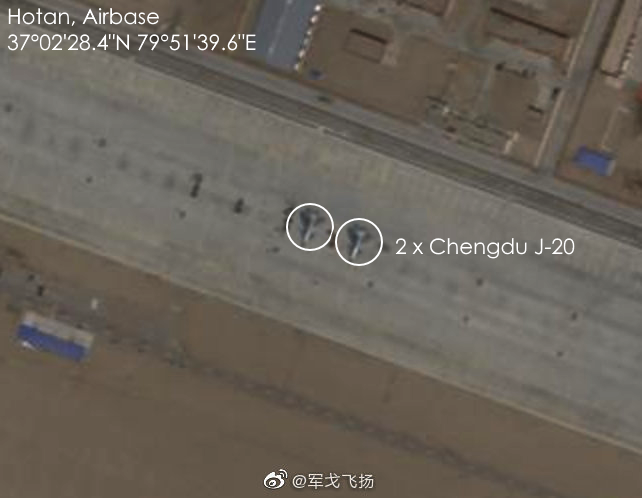
It's unlikely that the J-20 could operate from Hotan (4,672 ft) or Kashghar (4, 529 ft) for operationally significant time. (Ngari (14,022 ft) is likely unsuitable for J-20 operations. Of course, the J-20 could operate from Wuhu and tank up in the air en-route to Ladakh. But then its role would hardly be operationally significant. 

IAF Options

For the IAF, one way of mitigating the J-20 threat would be to acquire a reliable detection capability. We have the time and we have the sources to acquire radars that can obtain non weapon grade tracks on the J-20. 

Deployment of such radars would allow the IAF to detect the presence of J-20s in proximity to the LAC and send a package to exploit the sensor fusion weakness of the aircraft. If not that, detection would allow IAF fighters operating in the vicinity to evade the J-20s

Also, the IAF would be able to use gaps between J-20 patrols for its interdiction and close support missions along the LAC.

Conclusion


In the context of an IAF vs PLAAF faceoff in Ladakh, the J-20s could play a limited but operationally significant role.

Because of their limited number and operational deployment challenges, it's unlikely that the PLAAF would use the aircraft extensively. However, sensational deep penetration of Indian airspace followed by painful strikes would be good publicity for Chinese technology. It's likely that the PLAAF would carry out such strikes with their best trained pilots using the best of their weapons.

The J-20 threat is real and cannot be wished away by loud shouting on television debates. The IAF must move quickly to augment its stealth fighter detection capability to mitigate the threat.

Friday, July 31, 2020

J-20 vs Rafale


Introduction

Comparing the J-20 and the Rafale, to use a cliche, is like comparing oranges and apples. The two fighters were conceived and developed for completely different roles. However, the adversarial deployment of the two fighters in the context of the simmering India - China border dispute has fanned nationalist fervor and clamor for a comparison to such an extent that comparing oranges and apples seems perfectly logical.

Also, the Global Times, piqued by the claim of the former COAS that the Rafale is superior to the  J-20, has, without presenting a shred of evidence, fired a broadside trashing the Rafale as a generation behind the J-20 and claiming that the Rafale will "find it very difficult to confront a stealth-capable" J-20.

Well, it's time for fools to rush in where angels fear to tread. I may be a fool, but not a very verbose one, so I will confine this comparison to the BVR combat capability of the two fighters, because no one in their senses, not even the Global Times, will contend that the J-20 is superior to Rafale in WVR combat.

BVR combat capability is largely dependent on - the extent and capability of AWACS cover, RF signature, sensor suite, self defense suite, Man Machine Interface (MMI), and air-to-air missile range. For the comparison, we will assume a Rafale armed with Meteor and a J-20 armed with PL-15. Both feature dual pulse propulsion (A second stage ramjet in Meteor & a solid fuel rocket sustainer in PL-15) for thrusted end game maneuvering, max range of over 150-km, and an active seeker.

RF Signature


The J-20, which features full extent frontal aspect and limited extent side aspect LO shaping has a significantly lower radar signature than the Rafale which features limited extent frontal aspect LO shaping only. Both aircraft use RAM (Radar Absorption Material) and possibly some classified features to further reduce their RF signature. As far as RF signature goes, it's undoubtedly advantage J-20!

Sensor Suite


Both aircraft feature AESA radar, Optical Detection and Tracking system, and 360-deg FOV IR sensor based situational awareness.

AESA


The J-20 likely has a more powerful radar. Some estimates put the number of T/R modules on the J-20's AESA at 2000–2200. In comparison, the Rafale's RBE2 AESA features 1000 T/R modules. Assuming that the Chinese T/R modules match the efficiencies of the GaAs (Gallium Arsenide) T/R modules on the RBE2, and Chinese software algorithms driving the T/R modules on the J-20 AESA match the sophistication of the algorithms controlling the RBE2 T/R modules, the J-20 would have a much better max detection range and a more formidable EW capability. However, the two assumptions that we have made aren't trivial and are easily questionable by skeptics.

A better max detection range combined with the PL-15 air-to-air missile capable of leveraging the better range would give the J-20 a first to shoot advantage over the Rafale in BVR engagements.

However, the lack of sophistication of LPI (Low Probability of Intercept) features employed in the J-20's AESA radar could possibly negate the longer detection range  advantage. Once switched on, the higher radiating power of the J-20 AESA would be like a more powerful search light in a dark tunnel. It would see longer, but it would also be seen from longer. The Radar would be picked up by the RF sensors on the Raale completely negating the RF low observability of the J-20.

AESA radars leverage their control over individual T/R modules to scan and track while rapidly hopping frequencies over a wide spectrum making it difficult for RF sensors on adversary aircraft to track the radar. Hence the term LPI.  The question here is - how good is the LPI capability of the J-20 AESA? If it's not good enough against Rafale sensors, the longer range of the J-20 could well become a liability that is best avoided by keeping the radar switched off!

It's possible that the J-20 has the advantage with its AESA, however, we cannot be definite.

AWACS Cover


Data linked with and under control of an AWACS the J-20 would pose a formidable challenge to all IAF fighters including Rafale. With the AWACS providing situational awareness and target tracking information, there would be no need for the J-20 to switch on its powerful AESA radar and risk revealing its own position. It's conceivable, even likely, that the J-20 has the ability to relay tracking information obtained from the AWACS providing cover, to the PL-15 missile till it picks up the target on its own little AESA. 

Since J-20 has good RF stealth, IAF AWACS would not be able to obtain a weapon grade track on it to similarly advantage the Rafale. 

Under AWACS cover it would be advantage ++ for the J-20

Optical Detection & Tracking


The J-20 features EOTS-86 electro-optical targeting system and Electro-Optical Distributed Aperture System developed by Beijing A Star Science and Technology. The EOTS-89 reportedly resembles the EOTS of the Lockheed Martin F-35. It combines Forward Looking Infrared (FLIR) and Infrared Search and Track (IRST) capabilities.

The optical detection and tracking system on the Rafale, referred to as OSF-IT, facilitates passive long-distance detection and target identification before engagement. Located ahead of the cockpit on the dorsal section of the front fuselage, it comprises  two sensors -  the main IR detector that serves as FLIR with upto 100-km range on the left and TV/IR sensor/Laser ranger on right which  facilitates optical identification of targets upto 40 km away. Optical identification is considered imperative to rule out friendly fire fratricide.

One of the India Specific Enhancements (ISEs) sought by the IAF on the Rafale is an IRST, an indication perhaps that the existing OSF-IT is somehow constrained by the need for optical recognition and the IAF would prefer an IRST that allows pilots to passively engage targets, including stealth targets, at long ranges. Here it is pertinent to point out that the J-20 doesn't have IR stealth and as such would be prone to easy passive detection using IR, with detection range varying with weather and altitude.

With little or no reliable information available on the capabilities of the EOTS-89 on the J-20, it's moot which aircraft enjoys an advantage over the others.

In all probabilities Rafale has the advantage, but we cannot be definite.

Defensive Suite


It's possible to negate the first shot advantage of an adversary fighter through a very capable defensive suite. The SPECTRA integrated electronic warfare and defensive suit of the Rafale is one such very capable system. It provides  a multi-spectral threat warning capability against hostile radars with long-range detection, identification and accurate localisation of infrared, electromagnetic and laser threats.

The system incorporates radar warning, laser warning and missile warning receivers for threat detection plus a phased array radar jammer and a decoy dispenser for threat countering . It also includes a dedicated management unit for data fusion and reaction decision.

Perhaps the most potent feature of the SPECTRA is its deep integration with Rafale's systems. For example, the SPECTRA can jam or confuse enemy RF emitters using the RBE2 AESA.

The ability of the SPECTRA to automatically jam or seduce an active homing PL-15 would completely negate any advantage accruing to the J-20 from its stealth and more powerful AESA.

The Rafale has other very sophisticated features. For example, its concept of a defensive bubble. Once breached, the Rafale starts its "tandav"  dance that  may include firing its Mica all aspect missile backwards, releasing chaff and flares. Not surprisingly, there is a ISE for a towed decoy system.

 The J-20 can fire a PL-15 but it cannot ensure the missile will hit the Rafale!

Finally, a long shot missile can be evaded by energetic maneuvering, claims of a missile no escape zone notwithstanding. The IAF demonstrated this capability during Operation Swift Resort on February 27, 2019, when Su-30MKIs outmaneuvered PAF F-16 launched AIM-120D AMRAAM missiles. Indeed, the maneuverability and internal EW capability of a Rafale would make it as invulnerable to a missile with a radar seeker  as a Su-30MKI with Khibiny EW wingtip pods.

Rafale easily tops the defensive suite capabilities comparison.

Human Machine Interface (HMI)


Both Rafale and J-20 are single seat fighters with a lot of sensors - active and passive. How effectively a lone pilot can leverage the sensors would depend on the extent of sensor fusion and the effectiveness with which the threat situation is conveyed to the pilot through the HMI.

The J-20 features a glass cockpit, with one primary large color touchscreen LCD with three smaller auxiliary displays, and a wide-angle holographic head-up display (HUD).

The Rafale has a more sophisticated HMI. For short-term actions, it features a wide-field-of-view holographic HUD. For medium and long-term actions, analysis of the tactical situation as a whole (the “big picture”), the Rafale features a multi-image “Head-Level Display” (HLD). The HLD picture is focused at the same distance as the HUD picture to allow for fast eye transitions between head-up and head-down displays and the external world’s view.

In BVR combat, which works on the first to see, first to shoot paradigm, situational awareness is critical. The Rafale with its HLD probably does a better job of facilitating situational awareness.

Once the combat starts, the pilots rely on HUD and HOTAS (Hands on throttle and stick). As far as HMI goes, it's advantage Rafale.

Conclusion


The J-20's is undoubtedly the more stealthy of the two fighters.

Considering how little we know about the J-20's AESA and EOTS-86 Electro-optical Tracking System, it would be wrong to assume they are inferior to their analogs on the Rafale. However, since secrecy is usually employed to hide a weakness, not a strength, it's likely that the J-20 sensors are not at par as those on the Rafale. However, it is also likely that with the passage of time, J-20 sensors will improve.

Flying under AWACS cover, the J-20 would be a dangerous platform best avoided by the Rafale. The problem is, the J-20's front aspect stealth is good that it may not be possible for a Rafale to avoid butting heads with it. 

The Rafale almost certainly enjoys a significant advantage over the J-20 with its more advanced HMI and SPECTRA defensive suite.

Finally, Rafale's better maneuverability gives it a better chance of evading a BVR missile like the JL-15 that comes through its defensive bubble. The J-20's ability to outmaneuver a Meteor would be close to non-existent.

So, which is the better aircraft? Flying under AWACS cover, the answer could be categorical - J-20. 

What if the J-20 is not flying under AWACS cover? I would say, the one with the better pilot. 

What if the pilots are equally capable? I would say, the one with the  pilot who is better rested. 

What if the pilots were equally well rested? I would say - Rafale.

Friday, December 12, 2014

Beating the Stealth Threat: IAF's Quest for Passive Surveillance System

Shenyang J-31 (F60) at the 2014 Zhuhai Air Show.jpg
"Shenyang J-31 (F60) at the 2014 Zhuhai Air Show" by wc - http://www.airliners.net/photo/Untitled-(AVIC)/Shenyang-J-31-(F60)/2542713/L/. Licensed under CC BY-SA 4.0 via Wikimedia Commons.

China is developing two stealth fighters - the J-20, an analog of the US F-22 Raptor for use by the PLAAF and PLAN; and the J-31, a US F-35 analog, for export customers.

The J-20 first flew in January 2011 and is expected to enter service sometimes after 2018. The J-31 first flew in October 2012 and was showcased during the recent Zhuhai Airshow indicating that its development is on track.

Putting it bluntly, it is likely that the J-31 could enter PAF service by 2020!

As things stand, IAF air defense systems would not be able to track and engage PLAAF J-20 fighters; they could enter and exit Indian airspace with impunity!

PAF J-31s would be somewhat easier to track, but our fighters would not be able to track and engage them in head on mode using their radars.

To make matters worse, the Putin visit is over with nary a word on the FGFA. The AMCA is tottering at the edge of oblivion with ADA still struggling to firm up the design of LCA Mk-2! (ADA won't have time to seriously take on the AMCA for another 10 years!) Under the circumstances, the future must look grim to IAF planners.

Time is running out. In order to meet the looming threat, the IAF has to do things more substantive then release a new version of their 3D combat game. Yeah, I know I am being mean. I am just venting, because guess what? It turns out that the IAF is indeed ahead of the curve.

Passive Surveillance System

The IAF on December 2, 2014 released a RFI for development of a Passive Surveillance System (PSS) - a ground based system to be deployed in field areas for generation of 3D Air Situation Picture (ASP), by detecting and processing chance RF spectrum emissions and EM reflections of other transmissions in the vicinity of airborne platforms.

Here are the deets excerpted from the RFI.

Overview

The PSS will intercept, process, analyze and generate all types of Radar transmissions across the complete band of Radar Operation Radio Frequency bands (30 MHz to 18 GHz).

It will provide location and dynamic tracking of airborne, surface (ground and marine), mobile and fixed targets. The system would be capable of detection, location, identification and tracking of active and passive targets within its area of coverage. The system will comprise of a cluster of sensor stations all reporting their detections simultaneously to the Master Receiving and Processing Centre which will process the information for detection of targets and formation of tracks. The system should be highly mobile, vehicle mounted with very less deployment time.
Components

The PSS system will comprise the following two systems


  1. Passive Coherent Location Based Surveillance System to detect presence of targets using reflected RF emissions available in the environment. 
  2. Elint Based Surveillance System to detect, track, locate, correlate and identify intercepted RF emissions of the airborne platform in the area of deployment and process this information for generation of 3D Air situation picture.


Air situation picture generated in both the systems would be integrated to form a comprehensive air situation picture. The output is to be in user defined format for integration in command and control system of IAF.
Passive Coherent Location Based Surveillance System
The system would consist of a network of receivers and a master station and will generate its own 3D air situation picture without any active transmission of its own.

System capabilities required include:-


  1. Detection of 2 sq-m RCS target at more than 300 Km of range.
  2. Detection of targets from low level to very high altitude. 
  3. Estimating target coordinates in space namely range, azimuth, height and Doppler. 
  4. 360-deg azimuth coverage. 
  5. Radar Finger Printing (RFPS) through correlation and identification of emitter with data library.
  6. Remote operations including switching ON/OFF and operations of BITE, from an ops shelter located upto a distance of min 5 kms from system through OFC /radio link/ Satcom. 

Deployment Considerations.


  1. The system should be vehicle mounted and capable of deployed in all types of terrain including mountainous region.
  2. Deployment of the system should be quick and mechanized requiring minimum manual intervention. 
  3. The system should be self sufficient to meet camouflaging requirements(internal camouflage).


Elint Based Surveillance System

Elint based passive system should comprise of multiple sensor stations and a control station. The system is to be capable of generating a real time 3D air situation picture based on intercepted data of airborne emitters. The system should have very high DF accuracy in terms of degree RMS for various frequency ranges.

Required system capabilities include

  1. Large surveillance area coverage around its deployment
  2. Capability to intercept signals from all types of radars (pulse, pulse Doppler, CW), TACAN/DME interrogator, SIF/IFF interrogator and transponder, jammers, Data link and any other electromagnetic pulse and CW emitters on airborne platform.
  3. Very wide instantaneous Band Width (BW)
  4. High Probability of Intercept (POI)
  5. 360-deg instantaneous Azimuth coverage

Conclusion

A passive air surveillance system like the one contemplated by the IAF isn't a complete solution to the emerging stealth threat, but it's an essential first step.

The PSS would give the IAF an ability to detect the presence of stealth aircraft, but not track and engage them using SAMs.

A well executed PSS would allow IAF fighters to be vectored to the general area of intruding stealth fighters. allowing them to use their EO for further detection, tracking and engagement of enemy stealth fighters. 

Let's be clear, its early days for counter stealth technology.

PS

If IAF's PSS plans are news to you, its because you aren't a IDP Sentinel members. The RFI details were published on IDP Sentinel nearly a week ago!