Thursday, October 29, 2020

Russia Tests Ship Based Missile Launched Rocket Propelled Torpedo


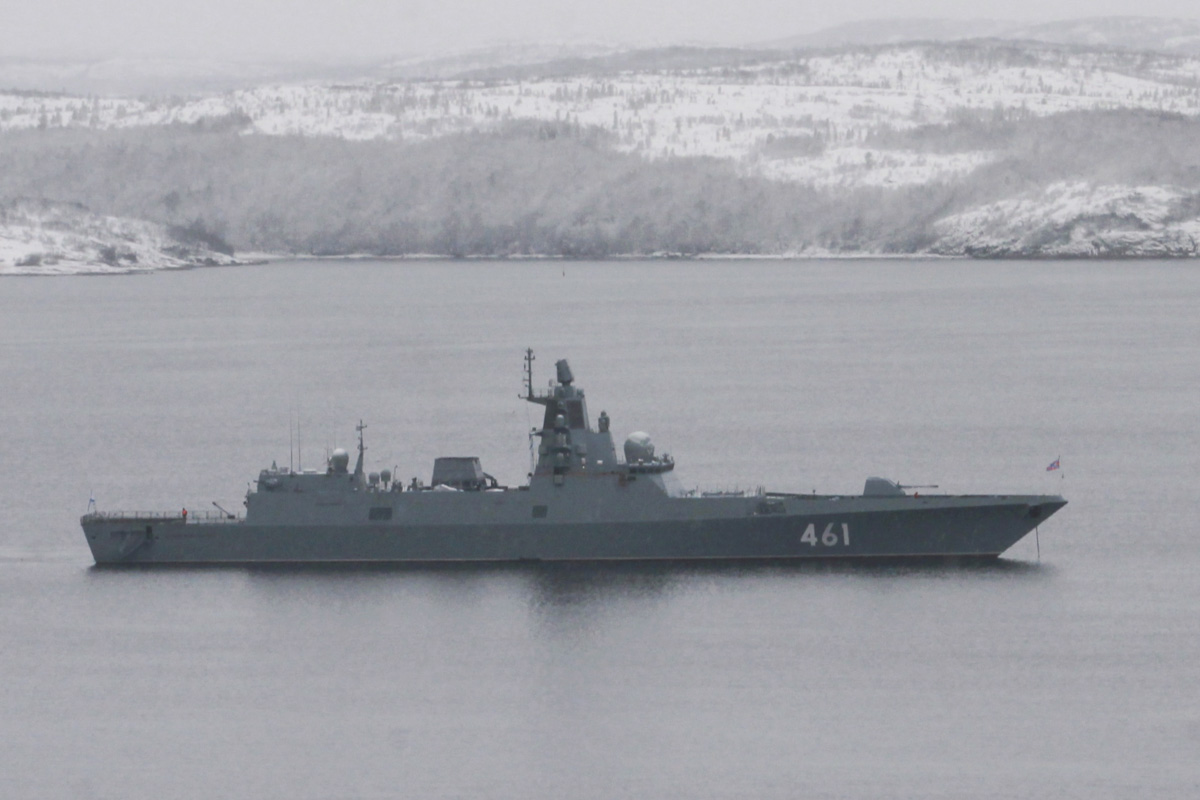
Russian Northern Fleet "Admiral of the Fleet Kasatonov" Project 22350M frigate during recent weapon trials. Photo via RuMoD
 

On October 28, 2020, the RuMoD in a press release announced that the second P-22350M frigate of the Northern Fleet "Admiral of the Fleet Kasatonov" fired a newly developed anti-submarine missile at the training grounds of the fleet in the Barents Sea.

"The shooting was carried out as part of the qualification serial tests of the product and was recognized as successful. One of the nuclear submarines of the Northern Fleet was involved in its support, which monitored the torpedo that had separated from the rocket in the underwater environment. Also, the frigate's rocket fire was provided by the crews of the Il-38 anti-submarine aircraft, the Ka-27 helicopter and the torpedo boat of the Kola flotilla of diverse forces.

"When performing rocket firing, the frigate's combat crews demonstrated confident possession of military equipment, high professionalism and naval training."

The wording of the press release suggests that the frigate may have successfully tested a shipborne missile launched variant of its vaunted air launched rocket propelled APR-3E torpedo, possibly designated APR-3M

APR-3M

The APR-3M is the latest variant of the APR-3 torpedo. 

In May, 2019, the Research and Production Enterprise ‘Region’ (part of Tactical Missiles Corporation) launched serial production of the torpedo. 

Enterprise CEO Igor Krylov told TASS, "All the trials of the APR-3M missile have been completed, the process of its serial production has been organized and its deliveries to the Russian Defense Ministry are underway. In the near future, we will also start promoting this missile for exports. The APR-3M is integrated into the armament of a Ka-27M modernized anti-submarine warfare helicopter." 

APR-3E


The APR-3E anti-submarine warfare torpedo is a follow-up of the APR-1, APR-2 and APR-3 missiles that were in service with the Soviet and Russian Navies. These munitions are among the world’s most effective anti-submarine warfare weapons.

The APR-3E is a rocket propelled light ASW acoustic homing torpedo with waterjet propulsion. It was developed by Russian Tactical Missiles Corporation JSC to engage current and future submarines at depth from the surface down to 800 meters at speed of up to 43+ knots, and it is a replacement for earlier APR-2 light antisubmarine acoustic homing torpedo.

The APR-3E variant of the torpedo is designed to be carried by fixed wing and rotary wing platforms including Tu-142, Il-38, Ka-28 and other aircraft. The torpedo requires at least 100 metres depth of water for the initial air-drop and can be deployed in conditions up to sea state 6.

Upon entering the water, the control surfaces of the torpedo enable the torpedo to travel in a spiral path with the help of gravity without starting the engine. During this stage, the acoustic seeker of the torpedo searches for targets. Once the target is identified, the engine starts and solid propellant rocket engine ensures the target has virtually very little or no time to react, thus increasing the kill probability.

Specifications


The following are the specifications of the torpedo according to the Wikipedia.

Speed: > 56 kn
Range: > 3 km
Diameter: 350 mm
Length: 3.685 m
Weight: 525 kg (another 25 kg for accessory for aircraft deployment)
Propulsion: solid-propellant rocket-powered turbo-waterjet
Fuze: impact and proximity
Warhead: 74 kg
Seeker: acoustic
Seeker range: 1.5 km – 2 km
Maximum target speed: > 43 kn

DRDO's SMART Missile

The DRDO recently successfully flight tested the Supersonic Missile Assisted Release of Torpedo (SMART) from Wheeler Island off the coast of Odisha. 

The DRDO's SMART missile is conceptually similar to the weapon tested by Russia. However, the Russian missile is likely to be much more lethal if it delivers the rocket propelled APR-3E torpedo. Currently, DRDO's SMART delivers the indigenously developed battery powered TAL light torpedo with a max speed of 33 kn

Wednesday, October 28, 2020

All Foundational Agreements Signed , but What about Tech Transfer under DTTI?


The US in 2006 proposed that India sign the following 3 foundational agreements to facilitate increased defense co-operation

  • Logistics Support Agreement (LSA). Now known as  Logistics Exchange Memorandum of Agreement (LEMOA)
  • Communication Interoperability and Security Memorandum Agreement (CISMOA) 
  • Basic Exchange and Cooperation Agreement for Geo-Spatial Cooperation (BECA)

On October 27, 2020, India and the US signed the Basic Exchange and Cooperation Agreement (BECA) for Geo-Spatial Cooperation on October 27, 2020 following the third U.S.-India 2+2 Ministerial Dialogue. Earlier, in 2016, India and the US signed the   LEMOA and in 2018, COMCASA.

India has now fulfilled its end of the bargain in its quest to facilitate increased defense co-operation. How about the US.

In 2012, India and the US signed the Defense Trade and Technology Initiative (DTTI)  aimed at streamlining the approval process for release of US technology to India; removing bureaucratic hurdles with the aim of increasing defense trade and exploiting the potential for co-production/co-development.

Eight years later there has been no release of US technology to India.

The press statement by Raksha Mantri Shri Raj Nath Singh following India- USA 2+2 ministerial dialog in New Delhi on October 27, 2020 states

"In the Defence Industrial Cooperation area, we had a very candid and useful discussion. Recent initiative of 'Atmanirbhar Bharat' in Defence sector was underlined as a key driver and a guiding factor of our Defence Industrial Cooperation. I highlighted the capabilities of Indian Defence Industry and their usefulness in the supply chain of major US platforms and systems. We have identified priority Near-Term projects for joint development between respective agencies, which need to be fast tacked under the DTTI and resolved to work together in Defence R&D more efficiently."

The statement smacks of an underlying desperation on the part of India. As far as Atmanirbhar Bharat goes, India's strategic alliance with the US hasn't met Indian expectations. The alliance, however, has generously met US expectations through multi-billion dollar weapon system deals - P-8I, C-130, C-17, Apache 64E, Chinook Ch-47F - through government to government contracts. 

Despite having signed 3 ironclad agreements that increase its security dependency on the US, India has not been able to win US trust for transfer of defense technology. The fact is, India will never be able to win US trust. I think we all know that.

Not that the US has ever categorically expressed a willingness to transfer US defense technology to India. After eight years of dangling the carrot of technology transfer under DTTI, the US is now offering India a role in its defense systems supply chain through limited private sector partnership under initiatives such as Industrial Security Annex (ISA) and Indian Defence Innovation Organization (DIO-iDEX) and U.S. Defense Innovation Unit (DIU) tieup

While private sector defense supply chain tie-ups could help create jobs in India, they will not help make India self reliant in indigenous weapon system development and manufacture. More likely, such tie-ups would perpetuate Indian dependence on the US. More troublingly, they will give unprecedented leverage to the US over Indian economic and foreign policy. The US is notorious for its sanctions regime and India has been at the receiving end. The spread and granularity of US sanctions would have made Shylock look like an amateur.  

In contrast to the US approach on defense technology transfer, Russia has transferred to India technology for construction of nuclear power reactors for submarines and ships, cryogenic rocket engine, Brahmos missiles and Missile RF seekers without  any leverage.

Today, China is a very credible US adversary because the Soviet Union and then Russia transferred critical defense technology to China which China built upon to not just match but even pull ahead of US technology. India could have done the same; perhaps it can still do so without surrendering its sovereignty and becoming a US vassal. 


Monday, October 26, 2020

Russia Well Prepared for US Hypersonic Weapons

Introduction

When the US withdrew from the ABM treaty in June 2002, Russia indicated that it would develop hypersonic glide vehicle (HGV) warheads to counter any anti ballistic missiles systems that the US deployed to ensure the efficacy of the Russian nuclear deterrent. 

On  March 1, 2018, during a presentation to the Federal Assembly,  President of the Russian Federation, Vladimir Putin, unveiled a hypersonic maneuvering HGV warhead (later named Avangard) capable of penetrating deployed US ABM systems. He also unveiled an air-launched surface attack HGV capable of carrying a nuclear or conventional warhead. The HGV was later named Kinzhal. 

On December 27, 2019, RuMoD announced that the first regiment of Avangard hypersonic missile systems had gone on combat duty.

"Russian Defense Minister Army General Sergei Shoigu reported to Russia’s President Vladimir Putin that the first missile regiment armed with the latest Avangard strategic missile system with the hypersonic boost-glide vehicle assumed combat duty from 10:00 a.m. Moscow time on December 27, 2019," the ministry said in a statement.

In February 2020, Russia's Central MD commander announced that Kh-47M2 Kinzhal ALBMs will be deployed on MiG-31s in the 712th Fighter Aviation Regt at Kansk by 2024. The MOD has said 10 Kinzhal carriers are already on "experimental combat duty.

The two HGVs were among the 6 new strategic weapons unveiled by President Putin which included a nuclear powered torpedo with a thermonuclear warhead (Poseidon), a heavy intercontinental ballistic missile (Sarmat), a high-energy laser weapon (Persevet) and a nuclear powered cruise missile (Burevestnik).

In addition to the two HGVs unveiled on March 1, 2018, Russia is close to deploying a anti shipping hypersonic cruise missile - Tsirkon.

President Putin's March 1, 2018 speech and the subsequent operational deployments was clearly intended to convey the message that Russia has the technical expertise and the political will to maintain the credibility of its nuclear deterrent.

While developing hypersonic weapons to counter growing US anti missile capability, Russia remained aware of the inevitability of its adversaries eventually acquiring the same technology and started to develop technology to counter hypersonic weapons! 

In June 2020, while speaking to Russia-1's Vesti Nedely program on his government's work to gain an edge in the field of new strategic systems, President Putin reportedly said,  "I think that we can pleasantly surprise our partners with the fact that when they [get] these (hypersonic) weapons, with a high degree of probability, we will have a way of combating against them.” 

In the following paragraphs, I present a roundup of the progress made by Russia in countering adversary hypersonic weapons. 

S-300B4

On October 24, 2020, Russian military expert Igor Korotchenko, claimed on Radio Sputnik that the Russian military industry was already testing a missile system capable of shooting down enemy hypersonic missiles.

According to him, during a series of tests conducted a few months ago, the S-300B4 system demonstrated the ability to intercept and shoot down operational-tactical and, most importantly, hypersonic missiles, including those under development around the world.

The capability to engage hypersonic targets was based on a newly developed 400-km range missile of the S-400B4 system developed ammunition, which has a range of up to 400 km. 

Igor Korotchenko claimed on Sputnik radio that the new missile system was presented at the Army 2020 exhibition, which took place this year in Russia. He also said that Russia has already developed an export version of the system, which will be named Abakan. [source]

59N6-TE Mobile Radar

via Twitter


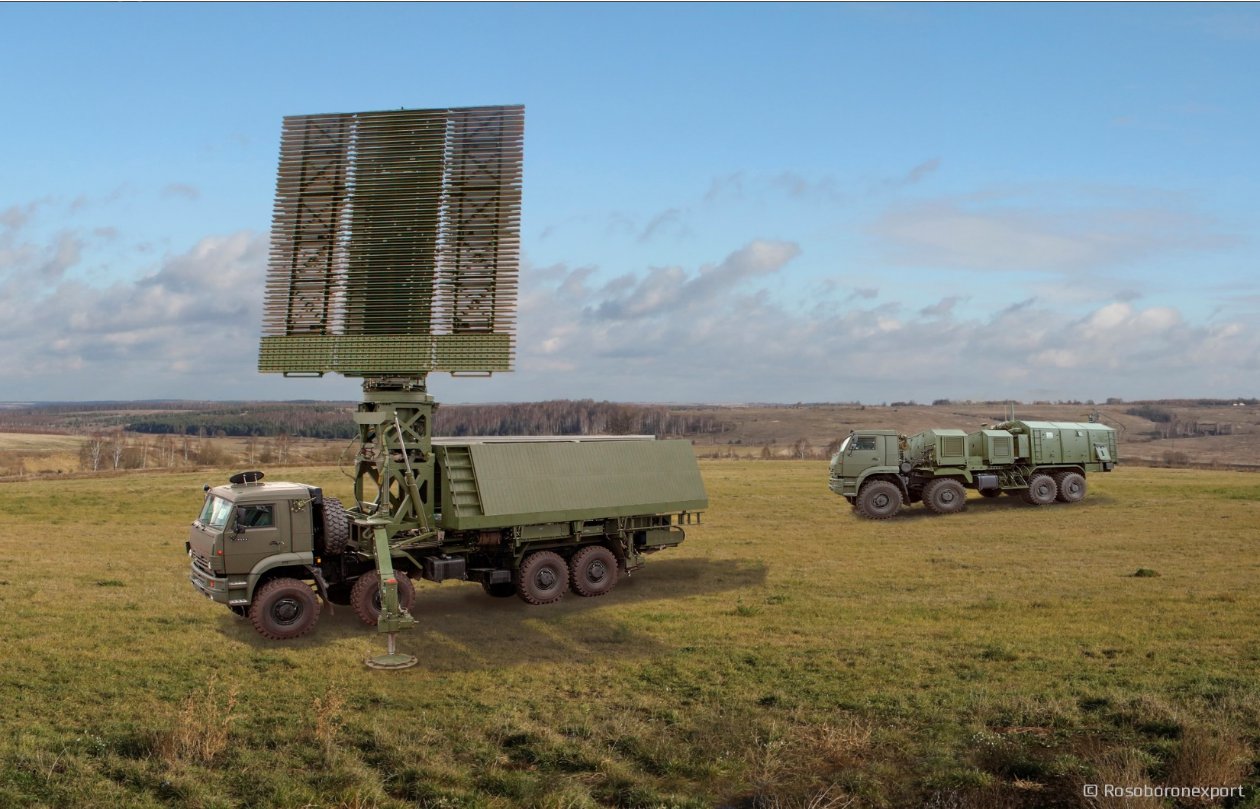
In June 2020, TASS reported that Russia's Rosoboronexport has started promoting on international arms markets the 59N6-TE mobile radar capable of detecting hypersonic targets, the company’s press office reported on Thursday.

"Today Rosoboronexport is bringing to the market the latest radar station capable of effectively detecting a wide range of advanced and future air objects, including hypersonic targets," the company’s press office quoted Rosoboronexport CEO Alexander Mikheyev as saying.

"While developing the export version of the radar, the growing role of air defense systems for the provision of security of states was taken into account, as well as the needs of foreign customers in the expansion of the reconnaissance capabilities of their air defense units," he said.

The 59N6-TE mobile three-dimensional station is an exclusively Russian-made product, which implies present-day Russian hardware components with digital processing and signal generation. It is fully solid-state and has high potential together with enhanced jamming resistance, according to the data posted on the company’s website.

via Twitter


"The 59N6-TE is a radar of medium and high altitude, having a decimeter wavelength range. Apart from hypersonic targets, it also effectively detects aerodynamic and ballistic objects," the statement says.

The 59N6-TE radar provides for the measurement of the range, azimuth and altitude of aerial targets. It is capable of detecting objects flying at a speed of up to 8 000 km/h at a range of up to 450 kilometers and at an altitude of up to 200 kilometers. After detection, it exchanges radar information with C4I systems. It operates in conditions of jamming and carries out direction finding of active noise jammers, Rosoboronexport said.

The station has an automatic and a semi-automatic mode of aerial targets’ acquisition and tracking. "In a real time mode, it can simultaneously track no less than 1 000 objects and recognize 8 classes of targets, which includes selection of anti-radar missiles and warning its own combat crew of the danger of elimination, inter alia, by high precision munitions and homing missiles. The 59N6-TE radar also includes equipment for the recognition of detected aerial targets in international radar recognition systems Mk-XA and ATC RBS," the company said.

The 59N6-TE radar set includes an antenna-hardware complex and an indicator post, placed on a standard vehicle chassis of the “KAMAZ-6560” type. There are also options to place the item on a single vehicle chassis, deploy it in a stationary version or to place the radar antenna system on a high tower support and other installations. Besides, the station is equipped with remote operator’s work stations, which may stay at a distance of up to one kilometer from the indicator post if connected via glass fiber links, and up to 15 kilometers in case of using a radio link.    

Air-to-air Missile with Multiple Homing Heads


In February 2020, Izvestia reported that Russia is designing an ultra-long-range air-based missile capable of intercepting high-speed and maneuvering targets. The weapon is designed to engage hypersonic aircraft and cruise missiles.

The missile is being developed for carriage by MiG-31 interceptor and its planned successor, the MiG-41. According to Izvestia, one of the candidates for the role of submunition is the medium-range missile K-77M.

The heavy long range missile will deliver a warhead with several modern air-to-air missiles over a distance of several hundred kilometers. The submunition missile will then separate from the carrier and begin to search and attack targets on their own using active homing.

Typically, an air-to-air missile has a single warhead and the chances of a lone warhead failing to successfully engage a hypersonic maneuvering target are very high. Using several active homing submunition missiles would increase the chances of a successful head on engagement.

The U.S. uses a similar approach for ballistic missile defense against ICBMs. Interceptor missiles launch “kill vehicles” with multiple warheads, each equipped with sensors as well as thrusters for rapid maneuvering. The submunition missile will disperse at a pre-calculated range to cover a larger area in a head on engagement. 

The use of a single information space would make the interception more effective. Ground-based radars, early warning radars, or an attack warning system could detect aerial targets, cruise or hypersonic missiles and transmit target information to an airborne MiG-31 which could launch an ultra-long-range missile towards the target area while itself staying well out of harm's way. 

Rezonans-NE VHF counter-stealth early warning phased-array radar


The Rezonans-NE VHF counter-stealth early warning phased-array radar is designed to effectively detect a wide range of current and future air targets, including low-observable cruise and ballistic missiles, hypersonic aerial vehicles, as well as stealthy ones, in severe electronic countermeasures (ECM) and clutter environment.

Rezonans radars operate in the meter band and employ the principle of wave resonance, which allows detecting aircraft based on stealth technology and also hypersonic targets flying at a speed of up to Mach 20. The radar is capable of detecting targets and issuing target acquisition on aerodynamic targets at a distance of 600 km and at a range of 1,200 km on ballistic targets, at an altitude of up to 100 km.

Russia's Northern Fleet already has 3 Rezonans-N in service as in February 2020: 2 in Arkhangelsk and 1 on Novaya Zemlya. According to an OPK source, two Rezonans-N radars will be deployed to the Kola Peninsula in the Russian Arctic in 2020.

Sunday, October 25, 2020

INS Vikrant Basin Trials in October 2020: Really?


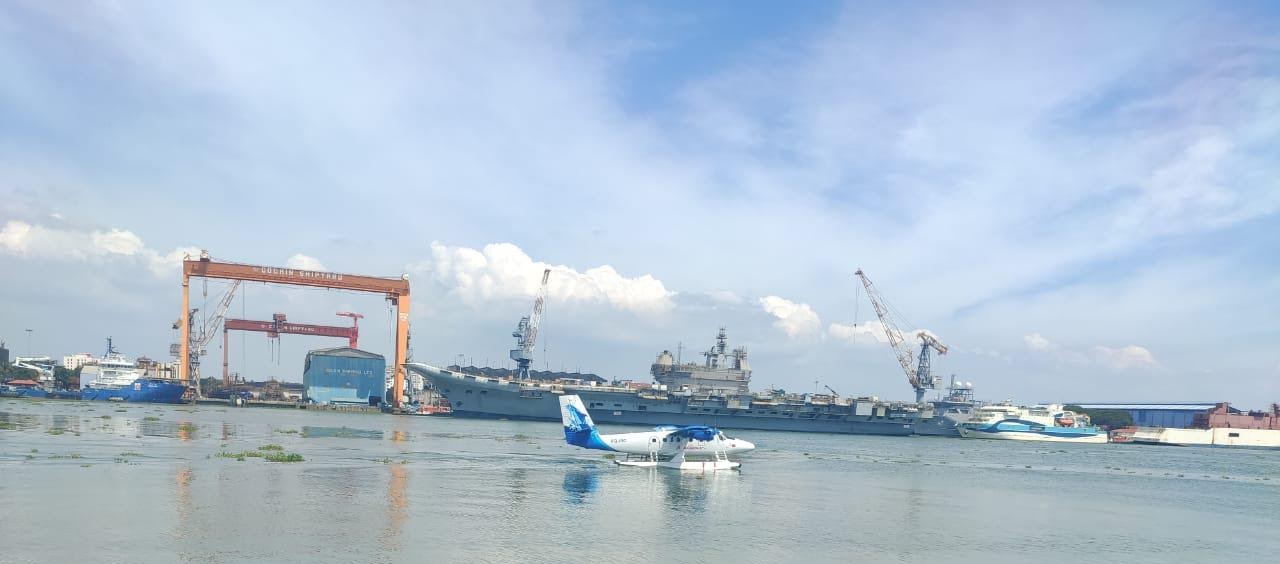
Going by this photograph of INS Vikrant posted by @DefencePROkochi on Twitter on October 25, 2020, INS Vikrant does not appear ready for basin trials.

The TNIE reported on October 4, 2020 that INS Vikrant is set to begin basin trials this month.

The TNIE had reported in August 2020 that NS Vikrant, is set to begin testing in waters (Basin Test) with its systems and equipment fitted.

Sources in Navy confirmed to TNIE that, “Harbour Trials have finished. The Basin Trials are planned for September.” Basin trials are conducted for proving of the propulsion (move), transmission (electricity) and shafting systems .

During his press conference on December 3, 2019 ahead of Navy Day December 4, 2019, CNS Admiral Karambir Singh stated that IAC will be fully operational by 2022 and will have MiG-29K aircraft.

Friday, October 9, 2020

Rudram - 1 : Next Generation Anti-radiation Missile (NGARM)


Introduction

In April 2012, DRDO announced that it is developing an anti-radiation missile on  priority to equip Su-30MKI aircraft.

In August 2014, DRDO Chief Avinash Chander confirmed to the press that missile design is in progress and hardware is being readied for the first trials. 

"We expect successful trials of this ARM from an aircraft in about the next three years," he very optimistically said.

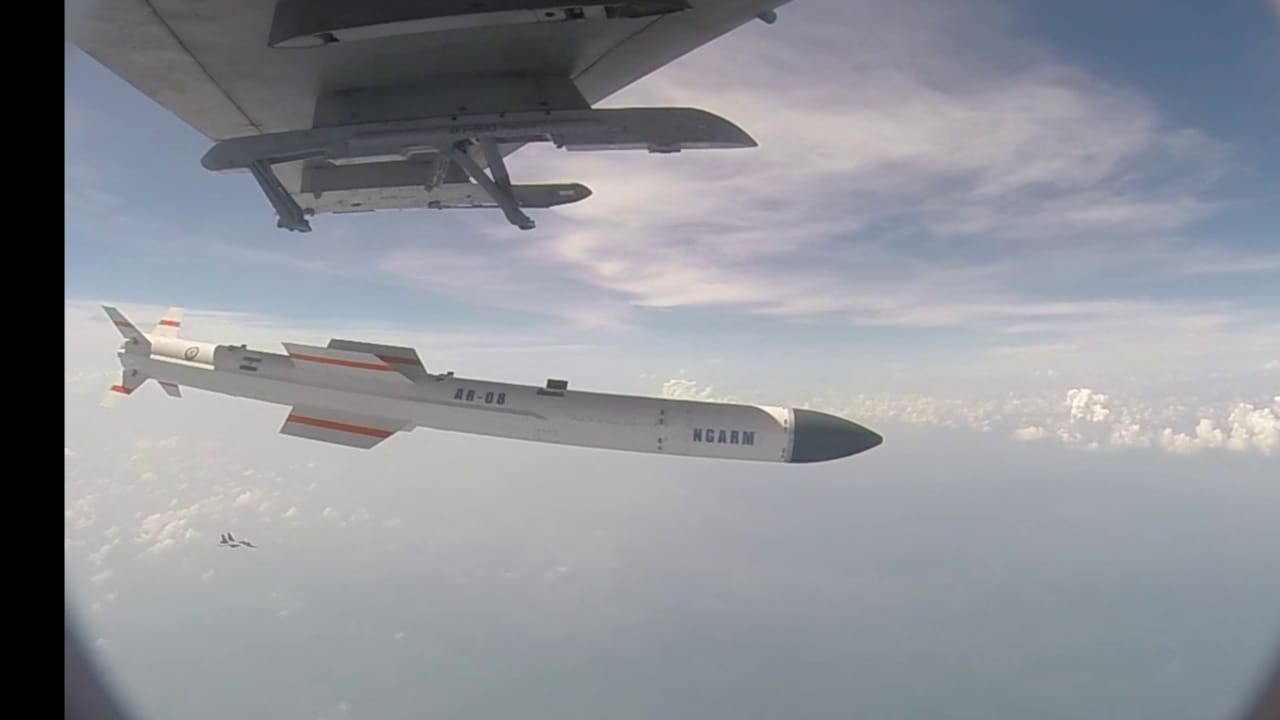
The missile, earlier known just as NGARM, was first officially referred to as Rudram-1 in a tweet by RM Rajnath Singh on October 9, 2020 while announcing a successful test of the missile on the same day. 


Missile Characteristics

Rocket Motor

NGARM reportedly employs an indigenously developed dual-pulse, solid-propellant rocket motor.

Seeker

RCI is developing  the MMW seeker for the NGARM. The seeker is reportedly a combination of passive and active radar.

Navigation

The missile uses a an inertial navigation system (INS) that is aided by GPS.

Targeting Pod

The NGARM would be cued using the DRDO developed Siva HADF (High Accuracy Direction Finder)

Test on October 9, 2020

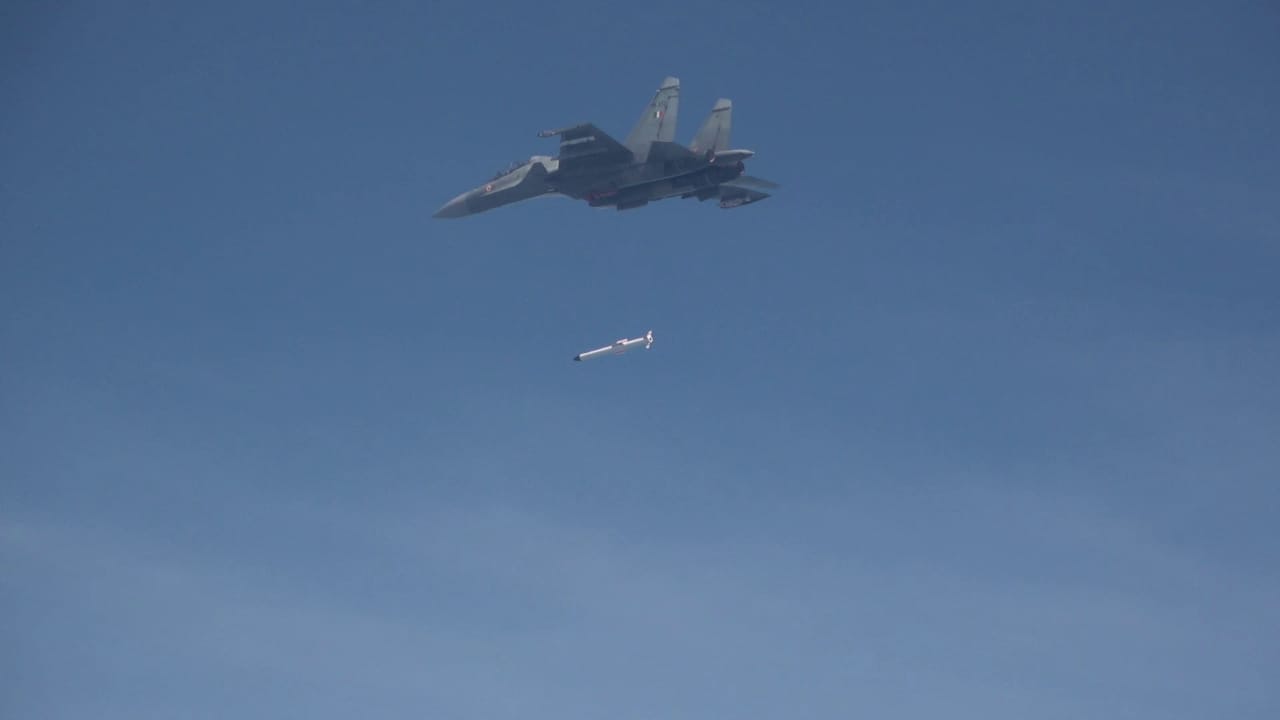
The Rudram NGARM was successfully Flight tested on October 9, 2020 onto a radiating target located on Wheeler Island off the coast of Odisha. The missile was launched from SU-30 MKI fighter aircraft. 

According to the PIB release following the test, Rudram, "has INS-GPS navigation with Passive Homing Head for the final attack. The RUDRAM hit the radiation target with pin-point accuracy. 

"The Passive Homing Head can detect, classify and engage targets over a wide band of frequencies as programmed. The missile is a potent weapon for IAF for Suppression of Enemy Air Defence effectively from large stand-off ranges."  

Photographs released with the PIB release show the launching Su-30MKI sans the HADR pod, indicating that the missile was launched in LOBL mode.

Test on January 18, 2019

“The missile was tested from a Sukhoi-30MKI on January 18, 2019 at the integrated test range at Balasore. The missile, with all systems functioning properly, hit the designated target with a high degree of accuracy in the Bay of Bengal. The NGARM can be launched from Sukhois from different altitudes and velocities,” said a source.

The test was likely sans a seeker

Missile Specifications

The missile will have a strike range of 15-100 km from launch altitudes of 100 m to 15 km from Su-30 MKI aircraft.

It will be carried by Su-30MKI on a modified AKU-58 launcher.

Sunday, September 27, 2020

PLAAF vs IAF: Which Air Force Would Prevail?


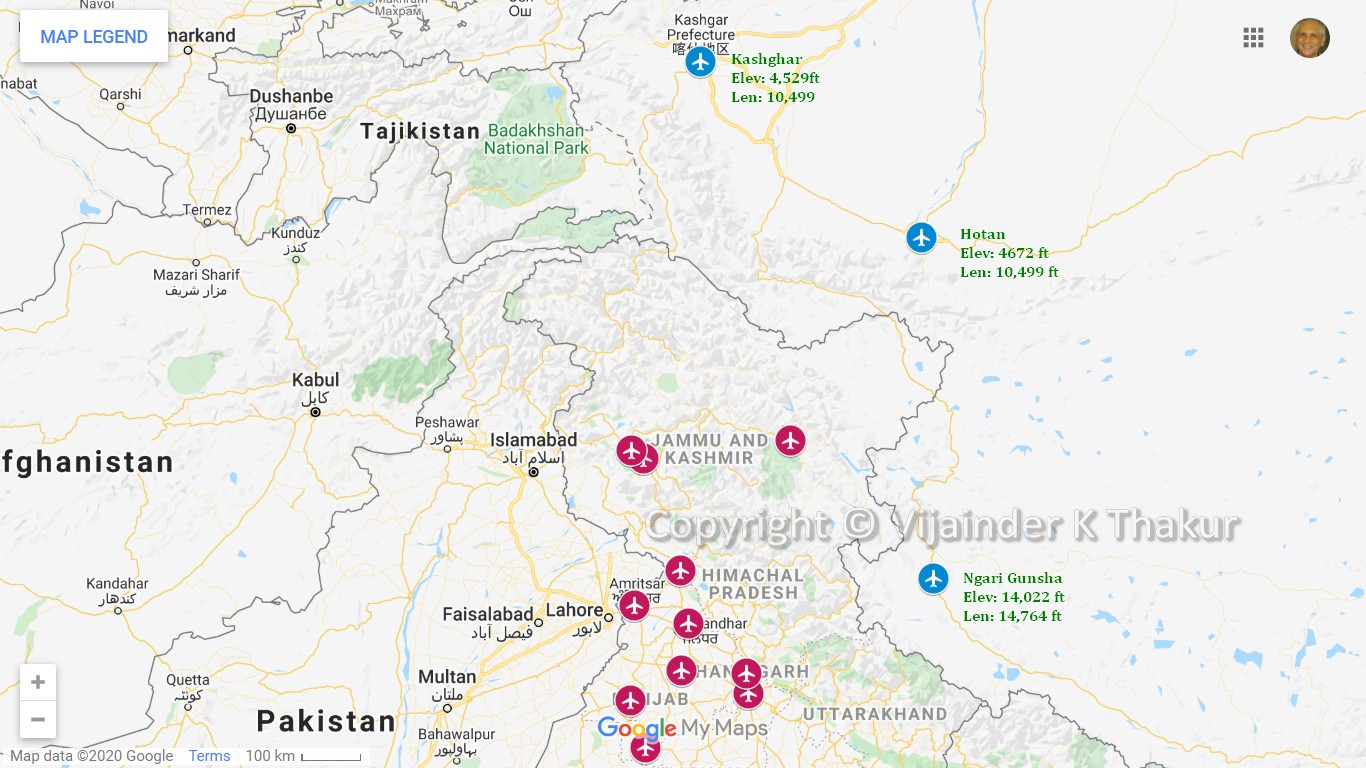
IAF, PLAAF airbases

Introduction

The People’s Liberation Army (PLA) Air Force (PLAAF) is a large, well trained and technologically air force. Arguably, more technologically advanced than the Indian Air Force (IAF)! Importantly, almost all PLAAF platforms and weapon systems are locally developed and manufactured. 

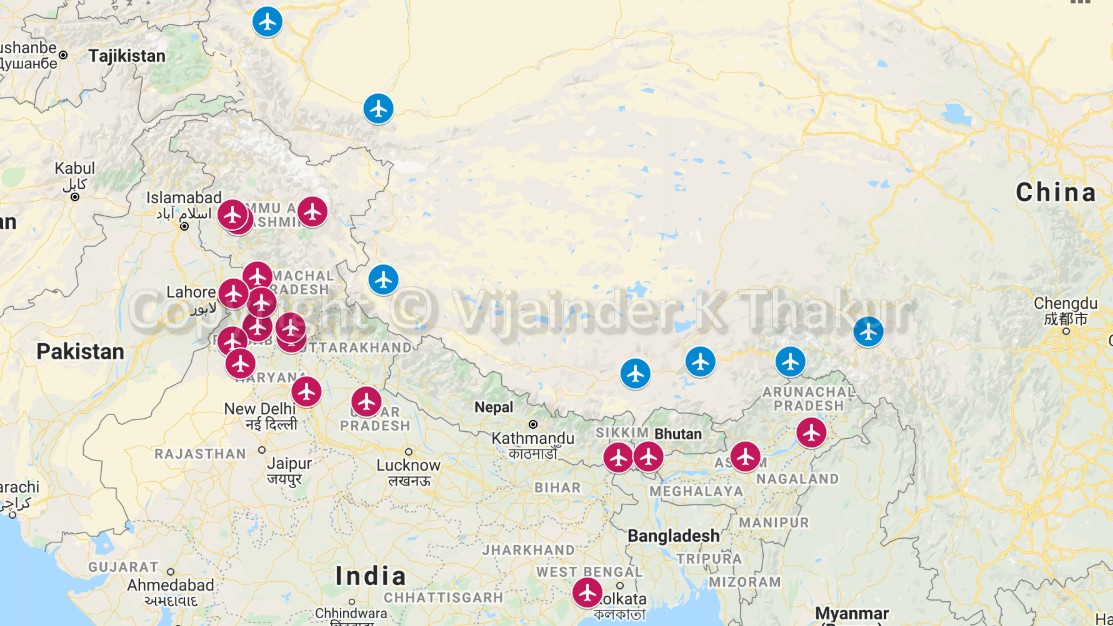
The PLAAF's size and technological edge notwithstanding, the well trained, motivated and technologically advanced IAF enjoys a significant advantage over the PLAAF in terms of the number of air bases it can operate from to - support Indian Army (IA) operations, interdict PLA supply lines and undertake counter-air operations against PLAAF bases. In the context of the current face-off along with the Ladakh - Tibet disputed border,  if the balloon does go up, would the IAF be able to support Indian troops fighting a grim battle perched on high mountains supplied through a tenuous road infrastructure? What if the conflict spreads all along the LAC? What if the conflict escalates into an all-out war?

In the following paragraphs, I will attempt an objective analysis of PLAAF capabilities to assess the extent of the threat it poses to IA operations. The analysis will dwell on PLAAF platforms, training, and likely tactics to assess the threat faced by the IAF. 

PLAAF Overview

In the following paragraphs, we will dwell on PLAAF platforms, training, and likely tactics in the context of a border war between India and China.

The PLA is likely to employ its following frontline fighters to challenge IAF operations. (Inventory holding obtained from Wikipedia is given in parentheses and includes assets deployed by the PLAAF and People’s Liberation Army Navy (PLAN))

  1. Su-35 Multi-role strike fighter (24)
  2. J-20 Stealth fighter and penetrating sensor (50 of which 25 are likely operationally configured)
  3. J-16 Multi-role strike fighter (128)
  4. Su-30MKK (76)
  5. J-11 Multi-role strike fighter (346)
  6. J-10C Multi-role interceptor (435)
Non-frontline fighters in PLAAF inventory, such as J-7, J-8, and JH-7 are unlikely to play a significant role in a war with India because of the limited number of PLAAF air bases in the theater as well as payload and range limitations of the fighters when operating from high altitude airfields.

Unlike the IAF, the PLA has a bomber force comprising 126 Xian H-6 bombers customized for varying roles such as nuclear weapon delivery, EW (Electronic Warfare), low-level penetration, cruise missile carriage, ballistic missile (Dongfeng-21D) carriage, WZ-8 high-speed UAV carriage, aerial refueling, etc.

The latest H-6 variants feature D-30KP turbofan engines of 12,000 kg thrust replacing the original Chinese turbojets. Other modifications include larger air intakes, a redesigned flight deck with smaller/fewer transparencies, and large dielectric nose radome. Upgraded H-6 have longer range, air-to-air refueling capability,  and the capability to deploy weapons such as the ones listed above.

PLAAF force multipliers include aerial refueling tankers (3 IL-78 and 10 HY-6U converted Xian H-6 bombers) and around 50 AEW&CS, AWACS aircraft.

Additionally, the PLAAF deploys around twenty EW aircraft and five Canadian Challenger 850 SIGINT aircraft. The PLAAF also has a large helicopter, transport, and UAV fleet which I will not dwell upon in this article.

PLAAF Training & Tactics

A  2016 Rand report on PLAAF fighter pilot training concluded that the PLAAF has embarked on a major reform of its pilot training program to remedy deep-seated flaws in fighter pilot competency. The report was based on a study of articles published in the PLAAF's official newspaper, Kongjun Bao (Air Force News) on fighter pilot training at operational units over a time frame of five years.

The study established that the PLAAF is training to fight and win battles against near-peer military adversaries, like the United States and is acutely aware of its present shortcomings. The PLAAF has progressed well beyond ground-controlled scripted air combat scenarios to more combat realistic exercises that train for the battlefield, not for the test. 

PLAAF conducts multi-day, multi-branch exercises spanning units equipped with surface-to-air missiles (SAMs), anti-aircraft artillery (AAA), and radars. During such "Red force vs Blue force" exercises, adversary forces enjoy autonomy in choosing targets, timings, and tactics. (In PLAAF exercises, Blue force represents the adversary unlike the conventions in the USAF where the Red Force represents the adversary). PLAAF exercises include force multipliers like tankers and AWACS/AEW&CS as well as EW equipment and aircraft. 

The PLAAF lacks an analog to the USAF Weapons School (AWS) for developing and disseminating combat skills and tactics across units. As a result, the PLAAF's ability to maintain broad uniformity in tactical practices remains limited. Unit commanders and other senior cadre exercise autonomy in the content and scope of certain training.
The PLAAF has participated in Aviadarts since the second edition of the Russian hosted exercise in 2014. PLAAF pilots who performed well during Aviadarts are honored and counted alongside the finest Chinese pilots as well as Chinese astronauts. 

PLAAF Tactics

The PLAAF's fighter combat capability would likely pivot around four fighter jets, namely;
  1. J-20 Stealth Strike & Penetrating Sensor Fighter
  2. Su-35 Multi-role strike fighter
  3. J-16 Multi-role Strike fighter
  4. J-10C Multi-role Interceptor
Considering the large number of AEW&CS/AWACS aircraft available in PLAAF inventory, it is likely they would be facilitating EMCON (Emission Control) by PLAAF fighters to reduce chances of their passive detection by IAF fighters. In other words, operating with an AEW&CS/AWACS platform, PLAAF fighters would not have to switch on their radars and risk revealing their presence.  

For air dominance and air superiority missions, PLAAF would use a combination of J-20 and J-16 fighters. The J-16s would sweep the airspace with their powerful Active Electronically Scanned Array (AESA) radar while forward deployed and data linked LO (Low observable) J-20s would engage any adversary aircraft breaking EMCON to engage the radiating J-16s. (A fighter aircraft that switches on its radar to engage a target can be passively detected, tracked and engaged by an adversary fighter!) Both the J-20 as well as the J-16 are capable of carrying the PL-15 missile, a Meteor missile analog, with a range of around 150-km. 

At the start of hostilities, PLAAF would use J-20 fighters to degrade adversary air defenses. The stealth fighter would be used to take out adversary high-value aerial assets such as AWACS, AEW&CS, and Aerial tankers using PL-15 missiles. Operating as a forward sensor, a J-20 would be able to freely penetrate heavily defended adversary airspace to obtain accurate coordinates of strategic targets such as missile batteries and radar stations. The coordinates would be relayed in real-time over data links to J-16 fighters and J-6H bombers operating outside contested airspace and armed with precision-guided long-range cruise missiles. 

After the J-20s have softened adversary air defenses, the PLAAF would rely on J-16 fighters to strike enemy ground forces including mobile radar stations, and the J-10C to provide local air superiority for the striking fighters.

J-20 Stealth Fighter Threat

The J-20 is a well-designed stealth aircraft featuring full extent frontal aspect and limited extent side aspect LO shaping. A detailed analysis of the fighter can be perused at IAF vs PLAAF: Assessing the J-20 Threat

The J-20 would be able to penetrate Indian airspace completely undetected on most occasions. On some occasions, it would be possible for the IAF to detect the J-20 using ground-based or airborne radars. However, because of the aircraft's faint radar signature, it would not be possible for the IAF to effectively engage the J-20 using air or ground-launched missiles. 

The PLAAF has a limited number of operationally deployed J-20 stealth fighters. They are based in Wuhu, Anhui Province, near the eastern coast. The J-20 is a highly specialized aircraft that likely depends on a lot of support facilities at its home base. It's RAM (Radar Absorbent Material) coating, for example, would frequently need to be tended. It's unlikely that the J-20 will be deployed for extended periods from bases in Tibet.

J-20 operations from high altitude air bases on the Tibetan plateau would be constrained by limited payload due to the rarefied air. As a result, their combat range and/or time over target would be restricted. Also, the physical displacement of PLAAF air bases from the border area would result in a longer time to target. Under the circumstances, it would not be possible for the PLAAF to effectively keep J-20 fighters on patrol along the entire 3,488 km length of the LAC. 

Likely J-20 Employment by the PLAAF

The J-20 would likely be employed for specialized roles. For example, shooting down high-value IAF assets such as AWACS & aerial tankers. Considering the limited number of aerial tankers and AEW&CS/AWACS assets in its inventory, the IAF would be greatly disadvantaged by any losses.

The PLAAF could also use its J-20 as a penetrating sensor, leveraging its ability to penetrate Indian airspace undetected. As a penetrating sensor, the J-20 would obtain target coordinates for cruise or ballistic missile attacks by other PLA assets. In case of an uncontrolled escalation, the J-20 could be used to obtain coordinates of mobile strategic missile launchers detected through surveillance satellites. 

Xian H-6 Bombers

In total, the Chinese military has 270 H-6 strategic bombers. Most of them are located on the eastern coast of the country.

Since the H-6s carry cruise missiles on board, their deployment in the border zone could provide the PLA with a significant advantage over the Indian army in the event of armed conflict.

The latest H-6 variants are armed with the relatively new CJ-20 cruise missiles featuring half ton warhead and  2,000 kilometers range. Additionally, China has the lighter YJ-63 cruise missiles, which although cover distances ten times less than the CJ-20, can be taken on board in larger quantities.

PLA's Cruise Missile Advantage

The PLA is better armed than the IAF in terms of the range and number of air-launched Land Attack Cruise Missiles (LACM) in its inventory. 

Air-Launched LACM

The following PLAAF LACMs are worth noting. 

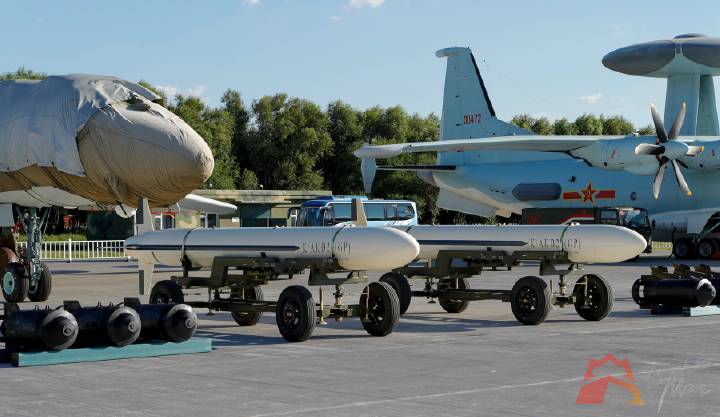
KD-63

KD-63 LACM on an Xian H-6 bomber via Twitter


The H-6 is capable of carrying the 500-km range KD-63 and the 1,500-km range CJ-10 LACMs.

The  KD-63 LACM is the latest upgrade of the YJ-63 aka C-603 series cruise missiles that entered service in 2004 - 2005. The KD-63 features a solid nose cone instead of a glass window, suggesting that it uses radar for terminal guidance instead of TV. The missile is powered by the  XW-41, turbojet engine, and has a range of 500-km.

CJ-20

CJ-20 missile via Twitter


The CJ-10 LACM, based on the Russian Kh-55 LACM, is a subsonic missile with a 500-kg warhead and a range over 1,500 km. The missile uses a combination of INS/GPS/TCM (Terrain Contour Matching) for navigation and possibly DSMAC  (Digital Scene-Mapping Area Correlator) for terminal guidance. The H-6 can reportedly carry four missiles externally. 

HN-3

The HN-3 is a subsonic, turbofan-powered missile weighing approximately 2.5 tons with a range of between 1,200km and 3,000km. The missile uses INS/TERCOM for navigation and  TV/IIR for terminal homing. 

China's PGM / UAV Advantage

The PLA has numerous types of armed UAV's and weapons developed for use by the UAVs. PLA's armed UAVs include LO UAVs that could penetrate Indian airspace undetected and loiter for hours performing ISR operations and obtaining coordinates for cruise and tactical ballistic missile targets. PLA LO UAVs also have an attack capability. 
The IAF doesn't have any armed UAVs.

A full analysis of the PLA's UAV capabilities can be read here. Based on the analysis, we can categorically conclude that the PLA enjoys a very significant advantage when it comes to UAVs

China's Air Defense Capability

The PLA has various types of very short range, short-range, and medium-range tactical air defense systems (ADS) for VA/VP (Vital A/Vital point) defense. The IAF tactical ADS match,  and in some cases exceed PLA systems capabilities. 

However, the PLA scores over the IAF in medium-range ADS and IADS (Integrated Air Defense Systems). IADS are complex, multilayered defense systems incorporating a range of ground-based and aerial sensors, as well as multiple surface-to-air missile (SAM) types. Modern IADS like the S-400 feature long-range missiles that restrict freedom of maneuver well outside their land borders. IAF medium-range ADS like MRSAM are likely superior to the PLA's HQ-16(Buk) medium-range ADS, however, the PLA has many more HQ-16 systems deployed.

PLA IADS comprises S-300 and S-400 systems. Additionally, the PLA has HQ-16 (Buk) air medium-range and HQ-9 long-range ADS currently in service. 

The Chinese armed forces were the first export customer of the Russian-made S-300PMU2 IADS capable of destroying aircraft, cruise missiles, and theater ballistic missiles in intense clutter and jamming environments. They were also the first export customer of the S-400 system!

The S-300PMU2 can engage aerial targets with a range from 3km to 200km, at altitudes between 10m to 27,000m. The S-300PMU2 also has the ability to detect and destroy anti-ballistic missiles with a range between 5km to 40km and altitudes between 2,000m to 25,000m. The system can engage up to six targets simultaneously, while guiding up to twelve missiles - two missiles per target ensuring target kill. Additionally, highly automated detection and acquisition procedures provide outstanding performance over previous SAM systems.

The S-400 system can engage aerodynamic targets at ranges varying from 3km to 380 km and ballistic targets at ranges varying from 6km to 50 km. It can simultaneously track up to 300 targets, and simultaneously engage 80 targets guiding 160 missiles (two per target) at the same time.

The S-400 comprises four types of interceptor missiles, covering different segments of the airspace protected by the unit. 

The HQ-9 is a two-stage, solid-propellant rocket motor powered missile with a max 300 km range capable of engaging aerodynamic and ballistic targets at up to 41km altitude. The missile features INS guidance and active radar homing. The HQ-9 missile system is roughly analogous to the Patriot/S-300

S-400 System Deployment

In September 2020, press reports suggested that the PLA had moved a regiment of S-400 opposite the Chumar sector and is in the process of moving another regiment opposite the Depsang sector.

PLAAF IADS limitations

Luckily for the IAF, terrain shielding will prevent PLA IADS from threatening IAF aircraft flying within Indian airspace. Also, IAF strikes into Tibet could reduce the lethality of PLA IADS by flying low. Considering the 4,500 m average elevation of the Tibet plateau, flying low over it wouldn't pose a significant range or payload penalty on IAF fighters.
Low flying is a stealth technique that the IAF is very comfortable with. IAF strike fighters like the Jaguar, Mirage 2000, and Rafale are honed for low-level flying. 

Chinese Fighter Bases

The following is an over view of Chinese fighter bases that would launch fighter operations against the Indian Army and the Indian Air Force. 

Chinese Fighter Bases Near Ladakh


The following are the PLAAF fighter bases relevant to the Ladakh sector.

via Twitter


Hotan Airbase

Elev: 4,672 ft
Len: 10,499 ft

This airbase has a standard length runway which would constraint fighter operations by limiting their payload.

The airbase reportedly hosts around 35-40 J-11, J-8, and other fighters, along with a few AEW&C

In September 2020, a report based on satellite imagery revealed that China is constructing a new R/W in Hotan. The existing runway may be constrained by terrain from further lengthening. Building a new longer length runway would allow their fighters to take off with a full load. It's also possible that the new runway would be utilized for fighter-sized drone operations, including GJ-11 Sharp Sword and J-8 drones.

Kashgar Airbase

Elev: 4, 529 ft
Len: 10,499

The airbase reportedly hosts J-11, JH-7, UAVs and H-6K?

Ngari Gunsa Airbase

Elev: 14,022 ft
Len: 14,764 ft

Ngari Gunsa is a dual-use military and civil airport which serves the town of Shiquanhe in the Ngari prefecture.

PLAAF Air Bases Near Arunachal Pradesh

Shigatse Airbase

Elev: 12,408 ft
Len: 16,404 ft

The Shigatse airport has recently been converted into an airbase. Construction of an additional airstrip is in progress on the western side of the main airstrip, likely to be used for UAV operations.

There are nine new aprons and eight new helipads recently constructed on the airbase, one of the satellite images suggests. The support buildings are used for the accommodations of the staff.

Qamdo Bamda Airport

Elevation: 14,436 ft
Length: 14,764 ft

The Bamda airport was upgraded with a longer runway in 2019. After the Doklam stand-off, another airstrip has been added to its eastern side. The additional airstrip would give this airport capability to take off and land aircraft in tandem.

Nyingchi Mainling

Elevation: 9,675 ft
Length: 9,843

Lhasa Gonggar Airport

Elevation: 11,713 ft
Length: 13,123

After the Doklam stand-off, at least two KJ-500 AEW aircraft have been observed permanently deployed here. Satellite images of October 2017 showed 20 J-11s, eight J-10s, eight Mi-171V, and two KJ-500 AEW aircraft at the airport, making it more of a military airbase.

IAF Air Base Location Advantage

The following annotated Google Earth map illustrates the advantage that the IAF enjoys in terms of the number and location of airbases. 

China's AWACS Advantage

Data linked with and under control of an AWACS the J-20 would pose a formidable challenge to all IAF fighters including Rafale. With the AWACS providing situational awareness and target tracking information, there would be no need for the J-20 to switch on its powerful AESA radar and risk revealing its position. It's conceivable that the J-20 can relay tracking information obtained from the AWACS to a PL-15 missile that the J-20 has launched till the PL-15 picks up the target on its little AESA active homing terminal tracker. 

PLAAF AWACS

The following is a brief roundup of PLAAF AWACS platforms.

KJ-2000

KJ-2000 via Twitter


The KJ-2000 is  based on IL-76. The 14-m diameter non rotating rotodome houses 3 phased array radar antennas.


KJ-200

KJ-200 via Twitter


The KJ-200 is based on  Shaanxi Y-8 (An-12 ripoff)

KJ-500

KJ-500 via Twitter

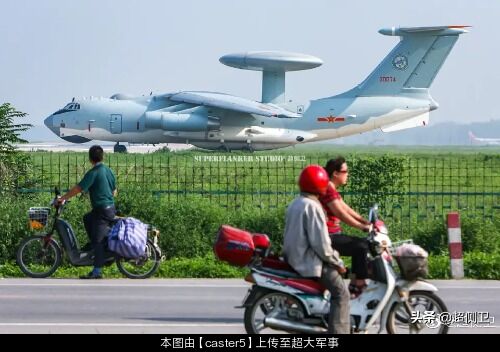
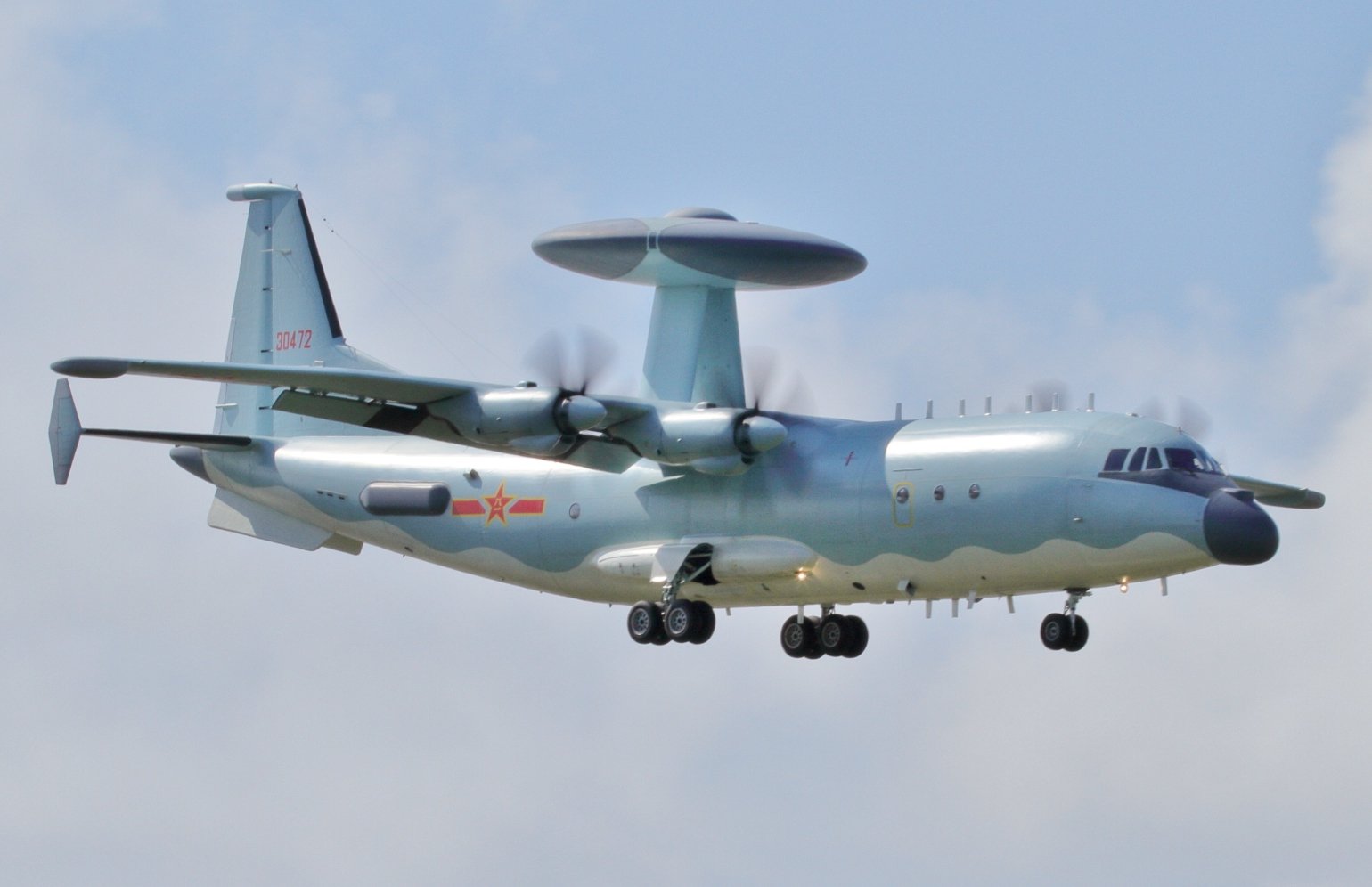
The Shaanxi KJ-500 is based based on the Y-9 airframe

The KJ-500 has a fixed dorsal rotodome containing three radar arrays each containing active electronically scanned array or AESA radars arranged in a triangular configuration to give full 360° coverage. The new radar design supplants the “balance beam” design used on the earlier Shaanxi KJ-200 AEW&C.

In September 2020 an upgraded variant of the KJ-500, equipped with a refueling probe was spotted in images published on the internet. 

PLAAF has deployed KJ-500s to Lhasa-Gonggar Airport in Tibet.

KJ-3000

A new variant with a claimed fixed next generation radar was spotted in 2013


Cyber Attacks

In a limited conflict or all-out war, China is likely to use its cyber and electronic attack capabilities to the hilt. Retired Chinese general Wang Hongguang, a former deputy commander of China’s Nanjing Military Region, reportedly claimed that China could seize air supremacy over Ladakh and simultaneously capture electronic control systems, destroying India’s command network, air defense network (radar network), and air command network. The PLAAF could target India’s key infrastructures, artillery positions, armored clusters, logistics storage warehouses, oil depots, etc. It would then occupy key strategic heights, dividing and trapping the Indian deployments by cutting off the Depsang Plain and the Siachen Glacier, and finally, occupying National Highway 1 from Srinagar to Leh and thereby cutting off the connection between Ladakh and the outside world.

That's a lot of wishful thinking, but it does give an insight into the PLA's intent to use cyber warfare.

The IAF trains to operate in a dense electronic warfare environment and is aware of Chinese cyberattack capabilities. 

Conclusion

The capability gap between the IAF and the PLAAF is significant and must not be overlooked. 

In addition to what has been discussed in this article, PLA tactical missiles and weapon systems such as the Type PCL191 MRLS (Guardian-2) with precision strike capability could pose a significant threat to IAF bases and radar units. The mobile PCL 191 modular rocket system can carry eight 370 mm (14½ inch) rockets — each with a range of 350 km (220 miles) — or two 750 mm Fire Dragon 480 tactical ballistic missiles — each capable of flying up to 500 km.

The combination of the S-400 AD system, AWACS, J-20 fighters, and Su-35 / J-16 fighters represents offensive and defensive capabilities that the IAF cannot match.  
The IAF does enjoy an edge over the PLAAF in terms of the number of air bases that it can operate from, and their lower elevation. 

In a limited conflict, both the IAF and the PLAAF would likely rely on their outstanding pilots and platforms to conduct operations. In which case, the two air forces are likely to be evenly matched. However, if the conflict escalates and lengthens, drawing average squadron pilots into the conflict, the IAF would likely enjoy an advantage on account of better training and motivation. 

Overall, in a short or limited scope conflict, the IAF would be in a position to stand up to the PLAAF. But with passage of time or increase in the scope of the conflict, the PLAAF's numbers, technological superiority, better supply chain on account of local manufacture, and greater national power will start to prevail. In any prolonged conflict, the PLAAF is likely to dominate the airspace over the border area and steadily erode the IAF's warfighting capability.

To remedy the imbalance in the short term, the IAF's best bet would be to procure cruise missiles in large numbers from Russia for its Su-30MKI and MiG-29K fleet, procure ground based EW equipment to neutralize the PLA's advantage in UAV's and PGMS, and step up production of Brahmos-A / upgrade of Su-30MKI for Brahmos-A carriage. Additionally, the IAF needs to augment its Air Defense capability by procuring MRSAM (Barak-8) missile systems directly from Israel.

Tuesday, September 8, 2020

Su-30SM2 Upgrade - Likely Base for HAL's Su-30MKI Upgrade


Su-30SM at MAKS 2019

Introduction

The Sukhoi Experimental Design Bureau in partnership with Irkut Corporation is developing a new modernized version of the Sukhoi Su-30SM Flanker-H that features upgraded engine, improved Radar and avionics and modern weapons. Designated as the Su-30SM2 (Earlier referred to as Su-30SMD), the aircraft leverages the operational lessons that Russia has learned during its operations over Syria. It is powered by the AL-41F-C1 engine. 

The Su-30SM2 is an attempt to converge to the maximum extent possible the Su-30 family with the Su-35 series to minimize logistics and maintenance overheads. 

Besides a new more powerful (AL-41F-S1) engine, the new Su-30SM2 variant will feature improved radar (IRBIS N035), avionics and OLS. In addition, it will be able to carry new air-to-air and air-to-ground weapons developed for the Su-57 fighter.  

Development History

Since 2015, development work has been underway to increase combat capabilities and import substitution of foreign components on the base Su-30SM, under a project designated "Adaptation-Su". 

Initially, the scope of the upgrade was restricted to making the aircraft compatible with newly developed weapons by fitting an improved avionics suite. The limited scope upgrade was designated Su-30SM1. In 2018, the Russian President Vladimir Putin sought maximum possible convergence of the Su-30SM and Su-35S platforms. Consequently, it was decided to power the upgrade with AL-41F-1S engines and replace the Bars radar with the much more powerful Irbis radar. The upgrade was named Su-30SM2.

AL-41F-S1

AL-41F-1S at MAKS 2019

The AL-41F-1S ( product 117S ) engine was developed by the Lyulka Design Bureau (part of the United Engine Corporation, UEC ). It is a twin-shaft variable bypass turbofan engine of modular design with thrust vector control and a digital integrated regulator. The engine powers the Su-35S platform.

Improved engine performance (lower SFC, higher thrust) is achieved through the use of a new low-pressure compressor with increased air flow and efficiency, as well as a new turbine with a more efficient blade cooling system.

Compared with the Su-30SM's AL-31FP engine, the product 117S engine features 16% increase in max thrust (14,500 kgf) and twice the service life (4000 hrs) while retaining the same weight and dimensions.

The more powerful Product 117S facilitates increased electrical power generation allowing more powerful radar and EW systems to be fitted on the fighter. The higher powered Irbis radar of the Su-30SM2 increases detection range of air and ground targets.

Work on the integration the Product 117S with the Su-30SM2 was jointly carried out by the Sukhoi company, the Irkut aircraft building corporation and the UEC-UMPO engine building association.

According to the developer, the new engine will not only increase the vehicle's capabilities in battle. The unification will simplify and reduce the cost of servicing the entire large fleet of aircraft and extend the service life of the Su-30SM already purchased by Russia and its allies.

IRBIS-E / N035 Radar

The Su-30SMD will feature the same IRBIS - N035 radar that is currently fitted on the Su-35. 

Designed by the Tikhomirov Scientific Research Institute (NIIP) in Zhukovsky, the Irbis-E is a direct evolution of the BARS design, but significantly more powerful. While the hybrid phased array antenna is retained, the noise figure is slightly worse at 3.5 dB, but the receiver has four rather than three discrete channels. The biggest change is in the EGSP-27 transmitter, where the single 7-kilowatt peak power rated Chelnok TWT is replaced with a pair of 10-kilowatt peak power rated Chelnok tubes, ganged to provide a total peak power rating of 20 kilowatts. The radar is cited at an average power rating of 5 kilowatts, with 2 kilowatts CW rating for illumination. NIIP claim twice the bandwidth and improved frequency agility over the BARS, and better ECCM capability. The Irbis-E has new Solo-35.01 digital signal processor hardware and Solo-35.02 data processor, but retains receiver hardware, the master oscillator and exciter of the BARS. 

IRBIS-E Operational Capabilities

New Weapons

The Su-30SMD would be able use the entire spectrum of modern and under development high-precision air-to-air and air-to-surface weapons including KAB-250 glide bombs as well as X-59MK2 air-to-surface missiles.

Orders

During a visit to the Irkutsk Aviation Plant in August 2020, Defense Minister Sergei Shoigu said that by the end of the year RuMoD plans to sign a contract for the construction of 21 Su-30SM2 fighters and 25 Yak-130 trainer aircraft. The total cost of the order will be more than RUB 100 billion.

Progress

On September 8, 2020, Izvestia reported that the Su-30SM fitted with a Product 117S engine would fly by the end of the year. 

Approval has been received for the first flight of the Su-30SM2 prototype with the AL-41F-1C engine "product 117S", sources in the Ministry of Defense and the military-industrial complex told Izvestia. According to the approved work schedule, which was reviewed by the publication, at the present time aircraft manufacturers have signed a contract to check the readiness of the newest aircraft for the first flight. The Super-Sukhoi is expected to take off before the end of the year.

***

It was earlier reported that Test flights of the Su-30SMD with the new engine should take place in 2020. The Russian military's official website announced in August 2019 that the first batch of Su-30MSD fighters equipped with the AL-41F-1C engines would be inducted in 2021. Eventually, the entire VKS Su-30SM fleet would be upgraded to Su-30SMD standard.