Showing posts with label air-to-air missile. Show all posts

Monday, January 5, 2026

Learning from Europe’s FMLA: Can the HTT-40 Become India’s Counter-Drone Platform?


A HTT-40 armed for counter drone operations Image by @Grok

The European Commission (EC) has taken the lead in developing a manned light combat aircraft optimised for hunting drones. Called the Future Multirole Light Aircraft (FMLA), the concept aircraft is intended to be an affordable, versatile platform for a variety of missions.

The EC has reportedly allocated €15 million for the first phase of development under the European Defence Fund (EDF) programme for 2026.

Besides intercepting drones, the FMLA would be able to undertake close air support, reconnaissance, and target designation missions. In addition to combat missions, it would be capable of conducting border patrols and participating in search and rescue operations.

The FMLA is conceived as a turboprop aircraft with a maximum take-off weight of around 7.5 tonnes, capable of short take-offs and landings on shortened runways. It will feature lightweight composite materials to reduce radar signature and will be equipped with advanced radar, sensors, and other electronic equipment.

The aim is to develop a cost-effective aircraft with advanced technology and mission flexibility.

The Need for Specialised Counter-Drone Operations

Ukraine and Russia are both using light sport/trainer aircraft and combat helicopters for counter-drone operations.

Russia employs platforms such as the Mi-28N and Ka-52 attack helicopters, as well as light sport aircraft retrofitted with machine guns and man-portable air defence systems (MANPADS), to patrol low-altitude airspace around critical infrastructure.

Ukraine similarly uses Mi-24 and Mi-8 helicopters, L-39 trainer jets equipped with gun pods, and even modified agricultural aircraft for night operations.

These platforms operate at low altitudes and slow speeds along likely drone ingress routes, particularly during nighttime raids. Pilots rely on visual detection using night-vision systems and tactical intelligence to identify and engage hostile drones.

Drones Fight Back

The use of manned combat helicopters and light aircraft in counter-drone operations has inevitably led to the development of drones capable of shooting down these manned threats.

Air-Combat-Capable Drones

Russian forces have recently (in the past month) deployed an interceptor variant of the Geran drone capable of launching R-60 air-to-air missiles. The Soviet-era short-range missile is mounted on a launcher on top of the drone. After launch, the heat-seeking missile can autonomously home in on its target.

The interceptor variant of the Geran drone operates as part of a swarm that includes other Geran drones configured for electronic warfare, photo reconnaissance, ELINT, communications relay, and decoy missions.

When launched from a fast-flying fighter aircraft, the R-60 has a range of 7–10 km. When launched from a slow-flying drone, its effective range would be significantly lower.

First Manned Aircraft Shootdown by a Drone

A Russian Geran-2 drone may have scored its first air-to-air kill recently, potentially creating aviation history. The supporting evidence, however, remains largely circumstantial.

A Ukrainian Mi-24 helicopter from the 12th Separate Army Aviation Brigade was lost in combat on December 17, 2025.

The specific location or area of operation has not been publicly disclosed. However, in recent months, Ukrainian combat helicopters have not been operating near the front, making it unlikely that the loss resulted from a ground-launched missile.

In fact, Ukrainian combat helicopters have been largely repurposed for counter-drone operations, increasing the likelihood that the loss occurred during such a mission.

Official Ukrainian sources have acknowledged the downing as a combat loss. While it is possible that the helicopter was brought down by a Geran-2 drone—either by ramming or through the use of an air-to-air missile—other possibilities exist, including controlled flight into terrain (CFIT) while manoeuvring to engage a drone.

Geran-2 drone armed with Igla-S MANPAD


MANPADS Armed Drones

On January 4, 2026, a photograph of a Geran-2 drone armed with an Igla-S man-portable air defence system (MANPADS) appeared on social media.

Ukraine’s Unmanned Systems Forces reported that Ukrainian forces had intercepted a Geran-2 drone armed with the MANPADS.

The drone is claimed to have crashed in the Chernihiv region.

R-60 vs Igla-S

Upgraded variants of the Geran-2 drone are capable of carrying a tandem warhead weighing about 100 kg. Geran-2 interceptor variants replace the warhead with an air-to-air missile and its launch system.

The Igla-S missile weighs approximately 10.8 kg; with its launch system, the total weight is around 18 kg. In contrast, the R-60 air-to-air missile has a launch weight of 44 kg, while the pylon and ejector mechanism used to launch it likely weighs an additional 20–40 kg. As such, it is highly likely that the switch to the Igla-S missile is intended to significantly lighten the load on the Geran-2 drone, allowing it to operate at longer ranges.

The Igla-S missile is tube-launched, unlike the R-60, which is launched using a pylon-ejector combination.

Like the R-60, the Igla-S features an infrared homing seeker, but it is resistant to countermeasures such as flares. The missile has a range of up to 6 km.

Geran-2 drone variants capable of carrying air-to-air missiles and MANPADS feature two cameras: a forward-facing camera positioned ahead of the missile and a rear-facing camera mounted behind it.

Need for More Agile Drone Hunters with Better Missile Countermeasures

The current evolutionary trajectory of one-way attack drones and loitering munitions points to a rapidly emerging need for manned platforms capable of quickly locating and engaging drones, while also being able to evade attacks by missile-armed drone interceptors.

India’s Options

At this point in time, based on current threat perceptions and limited resources, it may not be feasible for India to develop a specialised counter-drone platform. However, India should explore the possibility of modifying the HTT-40 trainer variant into a credible counter-drone platform. I have discussed this subject in an earlier analysis for The Eurasian Times.

Copyright © Vijainder K Thakur. First published on Thumkar.

Sunday, November 9, 2014

Aero India 2015: Diehl Defense to Exhibit IRIS-T Short Range Air-to-Air Missile

By M.begenat (Own work) [CC-BY-SA-3.0 or GFDL], via Wikimedia Commons
Germany's Diehl Defense has announced that it will exhibit its IRIS-T short-range air-to-air missile at Aero India 2015 in Bengaluru from February 18-22.

Germany decided to develop the IRIS-T when following reunification in 1990 it realized that the Vympel R-73 missiles (NATO reporting name: AA-11 Archer) on its MiG-29s was far more capable than earlier realized. The R-73 seeker was better at detecting and tracking targets than the seeker on the latest variant of the AIM-9 sidewinder. Also, the R-73 was  more maneuverable than its American analogue.

The IRIS-T is claimed to have higher ECM-resistance and flare suppression than contemporary dogfight missiles; its superior target discrimination facilitates head-on firing at a range 5 to 8 times greater than the AIM-9L. The IRIS-T's ability to turn at  rate as high as 60 deg/sec withstanindg 60 g allows it to engage targets in the rear quarter.

IRIS-T can successfully engage flying targets at a distance of up to 25 kilometers, reaches a speed exceeding Mach 3, weighs nearly 90 kg. It is 2.94 m long and has a body diameter of 12.7 cm.

IRIS-T has been jointly developed by Germany (46%), Italy (19%), Sweden (18%), Greece (13%), Canada and Norway (combined 4%).

Late in 2013, there were reports that the IAF was in negotiations with Dassault to make the Rafale compatible with the R-73 missile, of which the IAF had ordered a large stock. The Diehl pitch for IRIS-T would leverage the existing compatibility between IRIS-T and Rafale.


Friday, June 20, 2014

DRDO Successfully Tests ASTRA BVR Air-to-Air missile Against Electronic Target

Astra missile test on June 20, 2014


DRDO and IAF on June 20, 2014 successfully tested the ASTRA BVR air-to-air Missiles from a Su-30MKI at the naval range off Goa. The missile was released from an altitude of over 6 km and successfully guided by the aircraft's weapon and radar system to an interception of the electronically simulated target at long range.


DRDO earlier carried out a air-to-air test of the  missile on June 9, 2014 to demonstrate its aerodynamic characteristics. The test today demonstrated repeatability, reliability and endurance of the Astra BVR-AAM as a weapon system.


The maiden air-to-air test of the missile was conducted on May 14, 2014.

IDP Sentinel members can read more about the Astra missile at the link below.

Astra air-to-air missile (IDP Sentinel)

Saturday, May 24, 2014

Russia's New Air-to-Air Missile for T-50 to be Ready by 2016, Hypersonic Cruise Missile by 2020

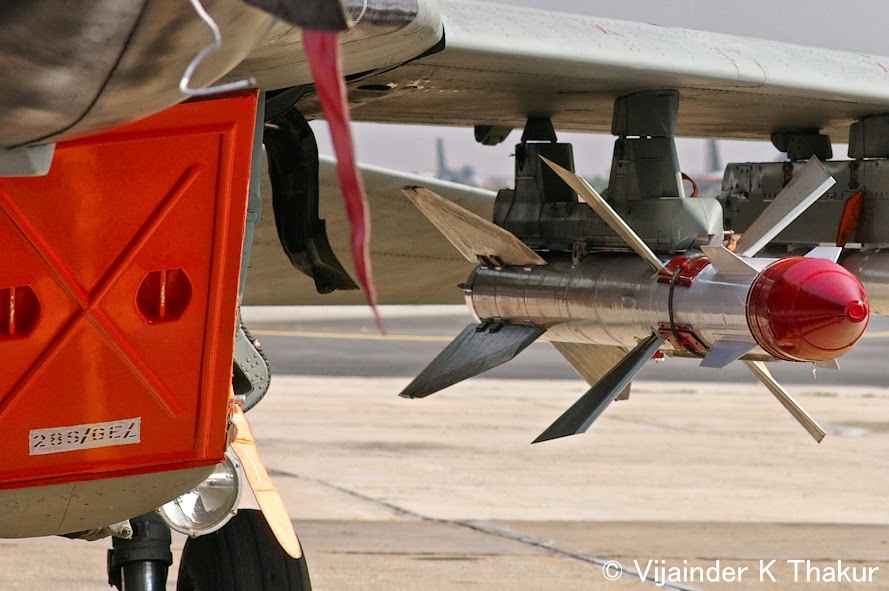
A Russian R-73 missile on Tejas LCA at Aero India 2013


On May 23, 2014 Boris Obnosov, the head of the Tactical Missiles Corporation (KTRV), told the press at the Kadex 2014 that KTRV would complete development of the new air-to-air missile, X-74M2, by 2016.

The X-74M2 is likely an improved version of the R-74M, which in turn was a R-73 (AA-11 Archer) missile derivative featuring fully digital and re-programmable systems. The X designation of the new missile likely refers to its development status.

The R-73 has a cryogenic cooled (MK-80) seeker and uses thrust vectoring for maneuvering giving it a substantial (45 deg either side) off-boresight capability.

"We have established close contact with the Sukhoi design office. A permanent working group is formed. All the protocols of informational cooperation are agreed on. Models are made according to schedule. Everything must be done by 2016," Obnosov said.

Obnosov added that the Tactical Missiles Corporation also planned to develop the first model of a hypersonic missile by 2020. The Defense Ministry and the Ministry of Industry and Trade had already approved the program.

Russia is developing tactical air-to-ground missiles and air-to-air missiles for use with the T-50

In April 2012, Obnosov told RIA Novosti that the missiles are undergoing tests.

“The development of Kh-35UE (AS-20 Kayak), Kh-38ME, Kh-58UShKE (AS-11 Kilter), and RVV-MD (AA-11 Archer) class missiles will be completed in 2012-2013,” Obnosov said.

Some of the missiles that will arm the T-50 have already been proven with other fighters.

The Kh-31PD (AS-17 Mod 2) class missiles, for example, have already been tested using Sukhoi Su-34 and put into serial production, he added.

According to KTRV, the Kh-35UE tactical anti-ship missile has a maximum range of 260 kilometers; the supersonic Kh-31PD anti-radiation missile for use against air defense systems, can fly up to 250 kilometers; the Kh-58UShKE missile, designed to destroy pulse radars, can hit targets within 245 kilometers, and the short-range RVV-MD air-to-air missile has a maximum range of 40 kilometers.

IDP Sentinel members can read more details about the PAK-FA / T-50 project at the link below

PAK-FA / T-50 (IDP Sentinel)


Sunday, May 4, 2014

Astra air-to-air missile successfully test fired from Su-30MKI

Astra all aspect, active homing air-to-air BVR missile maiden air launch on May 4, 2014. Photo Credit: DRDO

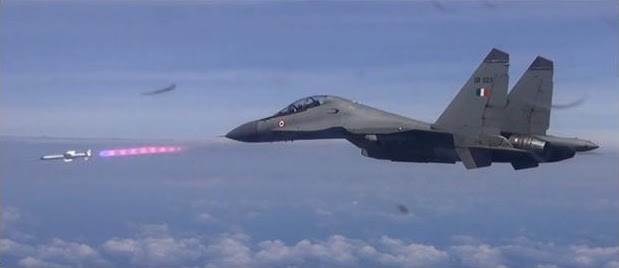
India successfully conducted the  maiden air-to-air test of its Astra all aspect, beyond visual range (BVR) air-to-air missile on Sunday, May 4, 2014. 

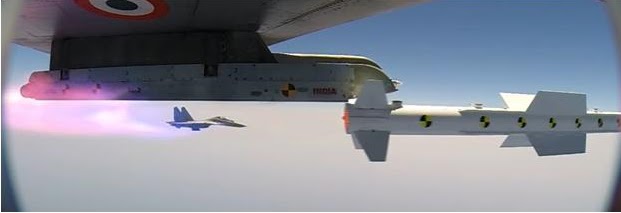
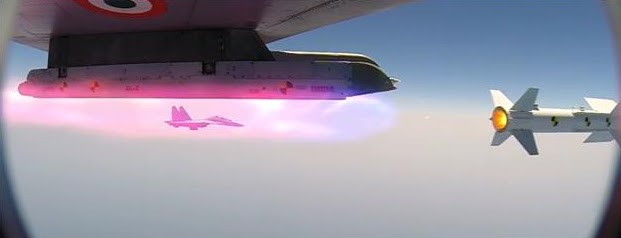
The missile was launched from an IAF Su-30MKI at a Naval range in the western sector. The test met all mission objectives. The release of the missile was captured by side and forward looking high speed cameras; the separation occurred exactly as per the simulation.


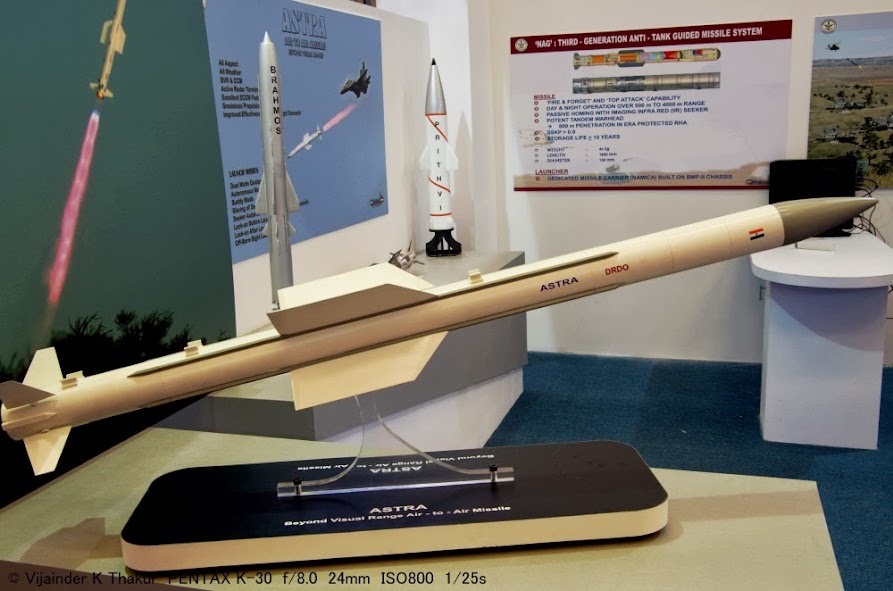
Scale model of Astra air-to-air missile at DRDO pavilion at Aero India 2013


The missile was launched against a simulated target during the test on Sunday. According to DRDO chief, Avinash Chander, the missile would be launched against a real target shortly.

"Many more trials are planned and will be conducted to clear the launch envelope. Weapon integration with ‘Tejas’ Light Combat Aircraft will also be done in the near future," Chander said.

Fish-eye view of the Astra air-to-air BVR missile leaving its Su-30MKI launcher during its maiden air launch on May 4, 2014. Photo Credit: DRDO


HAL carried out Astra related modification on the testbed Su-30MKI along with IAF specialists.

In 2013, the Astra missile underwent rigorous testing on Su-30MKI in the captive mode to validate avionics integration and evaluate the missile's seeker.


DRDO is already working on a Mk-2 variant of the Astra missile with grater range; it would be tested by the end of 2014

IDP Sentinel members can get additional details abut the missile at the link below

Sunday, April 20, 2014

DRDO Plans Nirbhay, Astra Tests in May 2014

Nirbhay cruise missile maiden test on March 12, 2013

DRDO Chief Avinash Chander told the press in Bhubaneshwar on April 19, 2014 that the second test of the Nirbhay cruise missile would be conducted in May 2014, following test of the BMD exoatmospheric interceptor in end April. He was in the city to address convocation of Siksha 'O' Anusandhan University.

DRDO has been planning the Nirbhay test for a while. Earlier on February 4, 2014, the DRDO Chief told the press on the sidelines of the Indian Science Congress that the second test would take place before February end. Still earlier, the Hindu reported on November 24, 2013 that a second test of the Nibrhay missile is planned in December 2013.

The debut test of the Nirbhay cruise missile at 11:50 AM on March 12, 2013 was aborted after about 20 mins of flight, as the missile deviated from its intended course.

The test was planned to the max range of the missile, which is 1,000 km. Following launch from a road mobile launcher, the first stage rocket booster separated, the second stage turbojet engine starter fired, and the engine attained full thrust; the missile reached a cruise speed of 0.7 M (460 k or 900 kph).

The missile is reported to have successfully navigated to two way-points before veering off course towards the coast.

The missile was flying at a height of 4.5 km when the mission was aborted by switching off the missile's engine. The missile had traveled around  300 km (30% of its envisage range.) at that point. All the parameters till then  were exactly as planned. The missile crashed on land.

DRDO's Avinash Chander, Chief Controller (Missiles and Strategic Systems), told The Hindu, "All the aspects of cruise vehicle were tested and verified. That is a major achievement."

He told Business-standard, "I would call the test 80 per cent successful. The Nirbhay demonstrated that it could take off correctly, establish a cruise profile, and navigate to its initial way-points. These were new performance parameters that we had never tested before, so we are satisfied that the test proved those. But then, one of the sub-systems malfunctioned and we had to terminate the test. All that remains is to determine why this happened and to rectify the flaw."

IDP Sentinel members can read more about the Nirbhay missile at this link.

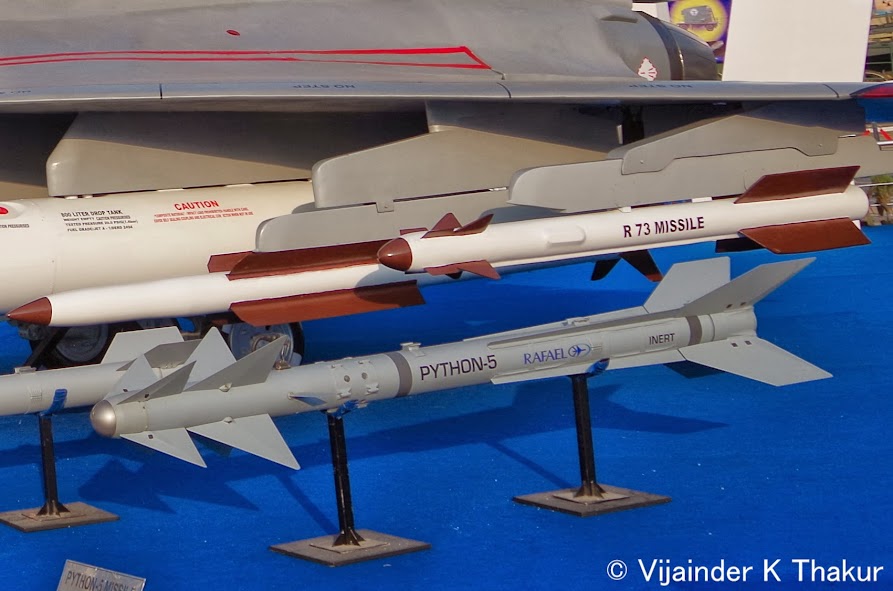
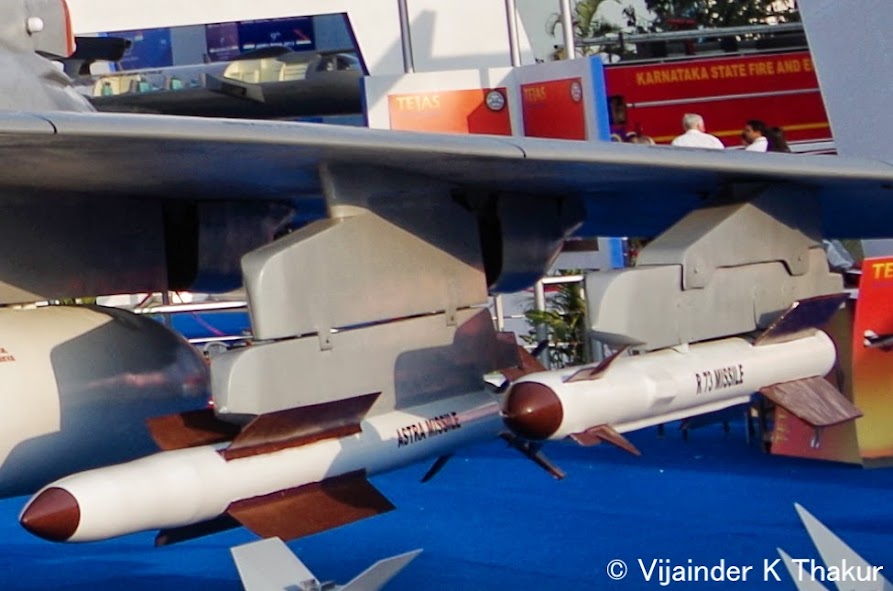
DRDO's Astra and the Russian R-73 (AA-11 Archer) air-to-air missiles on a LCA at Aero India 2013.

DRDO has also scheduled the maiden air launch test of the Astra air-to-air missile in May 2014. The missile would be launched from a Su-30MKI.

IDP Sentinel members can read about the development trials of the Astra missile at this link.


Friday, February 14, 2014

Large Indian R-27 (AA-10) Missile Purchase in 2013 Increased Ukraine's Artem's Profits 7 Fold!

A R-27 missile on a MiG-29 at Aero India 2009
In 2013, Ukraine's State Joint Stock Holding Company "Artem" completed the supply of a large consignment of R-27 air-to-air missiles to India.

The number of missiles involved was large enough to have pushed Artem's turnover 7 fold, from UAH 323 million to UAH 2.3 billion.

The semi-active home medium range R-27 series are analogs of late model US AIM-7 Sparrow series BVR missiles.

Those with access to IDP Sentinel can read more about the R-27 here.