Showing posts with label Surface-to-Air Missile. Show all posts

Thursday, April 16, 2015

INS Vikramaditya Undergoing Refit with Barak-1 missiles, CIWS

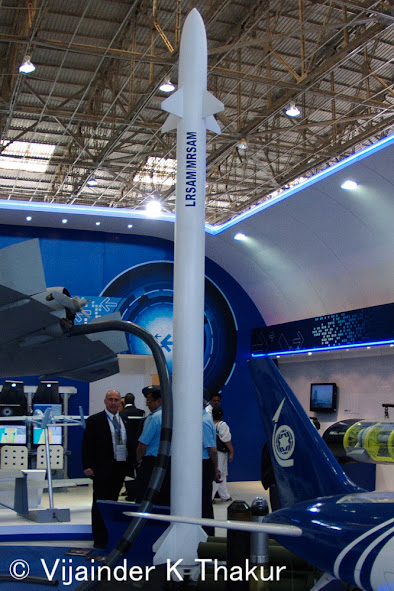
LR-SAM at Aero India 2011

INS  Vikramaditya is undergoing minor ‘refit’ at its home base, Karwar, south of Goa. The refit would equip the ship with Barak-1 missile and 4 Russian origin but made in India Kashtan AK-630 Close-In Warfare System (CIWS). [via TOI, Tribune India]

The Barak-1 missile system is being stripped away from the frigate INS Godavari which is due to be decommissioned. Godavari is 32-year old and got its Barak-1 CIWS 10 years back.

In a subsequent refit, INS Vikramaditya will also equipped with the LR-SAM medium range Point Defense Missile System (PDMS).

For the PDMS, the option was between LR-SAM and Russian Shtil missiles. Now that the LR-SAM has been successfully developed, it will the natural choice.

The Shtil system is the naval variant of Buk missile system that reportedly downed Malaysia Airlines flight MH17 over eastern Ukraine in 2014. It's currently fitted on IN Delhi-class destroyers and Talwar-class frigates.

Installing LR-SAM would entail some cutting through the deck, which would require four to nine months.

INS Vikramaditya would carry up to 32 or 48 LR-SAMs.

INS Vikramaditya (IDP Sentinel)

Monday, March 16, 2015

Maitri SR-SAM as Akash Mk-2?

Proposed DRDO-MBDA SR-SAM at Aero India 2015. Call it Maitri, or call it Akash Mk-2!
DRDO, following its tortured success with the Akash missile, a 1970s vintage SA-6 analog with modern day guidance and electronics, is now looking into a longer range (60-km) missile with active seeker, vertical launch and anti-ship missile capability.

It all started when the 2010 year end GOI press release referred to a Mark-2 version of the Akash.

In an interview in August 2014, former DRDO Chief Avinash Chander said, "We are examining various options for Akash Mk-2 so that it can operate over a larger profile. One of the options is putting a seeker on board. Of course its not simply a matter of adding a seeker since it changes the entire dynamics of the missile. Nevertheless we are looking at multiple options and are certainly working on a Mark 2 version of the Akash."

Defenseworld.net in a report on January 22, 2015 quoted a source as saying that the DRDO has decided to increase the range of the Aakash surface to air missile (SAM) and provide it with a ‘seeker’ in its warhead to achieve better targeting efficiency.

Most anti-ship missiles use active radar homing for terminal guidance so the use of an active seeker on Akash Mk-2 is logical.

Let us get some things clear, before moving forward. Its name notwithstanding, Akash Mk-2 will not be derivative of the Akash missile; it will be a new missile built from scratch using substantially different technologies.

A missile with an active seeker uses command guidance for the initial phase of interception and then switches to a miniaturized radar fitted in its nose cone for terminal phase (end game) interception. (The current Akash missile uses command guidance for the entire interception phase which limits its effective range.)

An active seeker makes a missile more accurate and less susceptible to countermeasures. It also gives the missile system some fire and forget capability, freeing it to engage other threats following terminal lock-on by the last launched missile.

The challenge in developing an active seeker is to minimize its size and weight while maximizing tracking range. India doesn't have a Akash Mk-2 worthy active seeker yet.

DRDO's Research Center Imarat (RCI) is known to be working on a X-band active seeker capable of engaging sea skimming anti-ship missile. (Sea skimming anti-shipping missiles are difficult to intercept because missile seekers find it hard to discriminate sea skimmers from the clutter generated by reflections from sea waves.)

DRDO is still struggling to replicate the Russian active seeker fitted on its Astra air-to-air missile under a partial TOT arrangement.

Private sector company Alpha Technology show cased an RF seeker that it has developed for Brahmos at Aero India 2015. However, the seeker is yet to be accepted as a substitute for the Russian developed Brahmos seeker.

We are trying hard, but the truth is we are not there yet, and active seeker development poses risks for the Akash Mk-2 project.

Vertical launch of surface-to-air missiles is also a new area for DRDO which has earlier demonstrated vertical launch with the Brahmos and some of its strategic missile. A vertically launched surface-to-air missile must quickly flip over in the direction of the threat and then be command guided towards the target over a data link.

Another big difference between Akash and Akash Mk-2 would be the dropping of Akash-1's ramjet sustainer in favor of pulsed rocket motor. A pulsed rocket motor has multiple propellant segments, with a barrier that stops ignition separating any two segments. When one segment burns out the missile coasts till  another segment is ignited. During end game, a freshly ignited rocket motor segment would make Akash Mk-2 much more lethal than the ramjet of Akash.

Pulsed rocket motor technology is something that the DRDO has imbibed working with Israel's IAI in the LR-SAM/MR-SAM project. So no problems there.

MBDA's Co-Development Offer


Faced with cancellation of the Maitri SR-SAM joint project, after an underfunded IAF decided to make do with the Akash missiles, France's MBDA is plugging the Maitri joint collaboration as the Akash-2 project!

The MBDA pitch might look opportunistic and self-serving at the outset, but if you listen to what MBDA officials have to say, you could well change your mind.

MBDA officials categorically confirmed to IDP Sentinel during Aero India 2015 that they will transfer complete seeker technology to DRDO. There was no question of a partial TOT as was the case with Russia and the Astra missile.

MBDA believes that the risks involved in a project to develop a missile from scratch, as DRDO intends to do with Akash 2, are substantial with long and uncertain development time. Seeker and Vertical Launch are risk areas. India would be much better off getting the technology from MBDA so that timelines are not stretched to an extent where the usefulness of the product comes under a cloud.

MBDA says it will not only help India develop the missile, it will help set up production facilities in India and support India's export efforts. Make in India, Export from India (I made that slogan, not the MBDA!)

I am sure there are other facets of the Akash Mk-2 project that I am not aware of, but going exclusively by the information available in public domain, it's hard to understand why DRDO must take risks when it doesn't have to.

Sunday, August 24, 2014

LR-SAM - Why it's Worth the Wait!

LR-SAM at Aero India 2011

One of the reasons why the Navy isn't as worried as the defense journos that INS Kolkata was commissioned with 48 empty cells of vertically launched Long Range Surface to Air Missiles (LR-SAM) that are to shield it against an attack by anti-shipping missiles, is because the missile system, when it's finally installed, would give the warship the best protection money can buy  in the world today! You can cross check that claim with any Navy man - he will agree!  What is confounding is the missile hasn't been tested even once! The confidence reposed in the missile system stems from its pedigree. It's basically an Israeli missile.

Former Navy Chief, Admiral Arun Prakash gives an interesting insight in today's Business Standard as to how the missile came to be the most coveted AD weapon system on Indian warships.

He recalls how the Israeli Navy, on behalf of its defense industry, offered the Indian Navy the long-range SAM with "superior anti-aircraft and anti-missile defense capabilities" in 2004-05.

"The 'cherry on the cake' was to be the new multi-function phased-array radar that accompanied it. There was no altruism behind this offer; the small numbers required by the Israelis made the project economically unviable for them, and there were not many nations they could trust with such sensitive technology. Driving a hard bargain, the IN obtained Israeli agreement for joint development and co-production of systems.

"Showing eminent good sense and pragmatism, the DRDO leadership agreed to the navy's proposal for a path-breaking tripartite collaborative arrangement with the Israelis for the development of the LR-SAM. The funding as well as manpower liabilities were shared by the IN and DRDO. The project, involving DRDO scientists, naval engineers and the defense-industry has rendered tremendous benefits to all three participants and, notwithstanding development delays, will bring the IN to front rank of navies technologically."

DRDO Chief, Avinash Chander, in a recent interview gave his own insight into the project. He said, "The Armed forces had actually tried to buy such a system from abroad, but nothing was really available that would come with satisfactory terms. And that is how we got into a joint venture with Israel, the system had to be developed ab initio. So there were issues with respect to radar development, issues with respect to the actuation system as well which was initially supposed to be pneumatic but then had to be changed to electromechanical. Then there was the two pulse motor which was being done for the first time and that got into certain combustion stability problems. But the good news is that all those problems have now been overcome. We launched a massive program on the rocket motor and today we have a motor which is stable and will be tested shortly."

There is a lot more to the LR-SAM project, only for IDP Sentinel members, at the link below:

Barak-8 / MR-SAM / LR-SAM - IDP Sentinel


Wednesday, August 6, 2014

Navy Initiates Procurement of Short Range Surface-to-Air Missile (SRSAM) System for Naval Surface Platform: IDP Exclusive!

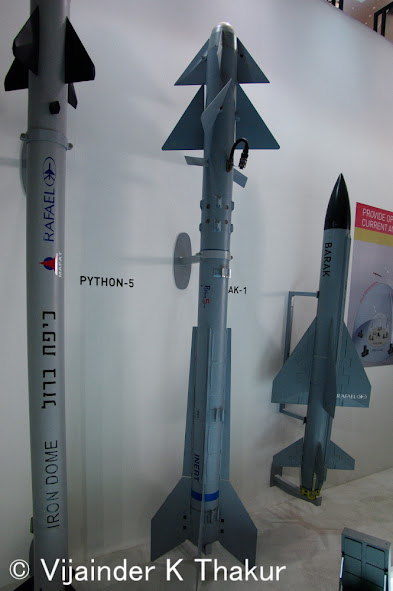
Bara missile, a possible SRSAM contender, on display at Aero India 2011
The Indian Navy on August 6, 2014 initiated procurement of a Short Range Surface to Air Missile (SRSAM) System for Indian Naval ships.

The Navy appears open to both vertical launch, canister based missile system; or over the deck, mechanical, rail launched system featuring automating loading from below deck missile storage compartments. The former are better suited to stealthy warships.

The system is required to be capable of engaging targets traveling at up to Mach 3.

The type of initial guidance is not stipulated but the missile is required to feature active RF seeker for the terminal guidance.

A minimum service life of 10-years is mandated, with provision to extend the life based on periodic inspection. The entire system should be easily transportable from ashore to a ship in containers mounted on vehicles.

The Navy's willingness to accept an over the deck rail launch could mean the immediate requirement is for a non stealthy warship.

It maybe noted that INS Vikramaditya currently does not have a Close-In Warfare System (CIWS) to neutralize anti-shipping missiles, or a long range Point Defense Missile System (PDMS) system to defend against fighter and bomber threats.

The CIWS is slated to be fitted in April-June 2015 at the Karwar naval base. On June 18, 2014, Indian Express reported that the an AK 630 system manufactured in India would be fitted.

Navy sources told The Tribune in June 2014 that the PDMS would be either the Israeli Barak or Russian Shitil missiles.

IDP Sentinel members can access more information at the link below

Short Range Surface to Air Missile(SRSAM) System for Naval Surface Platform (IDP Sentinel)


Thursday, July 17, 2014

Brahmos-A ALCM Live Firing in 2015

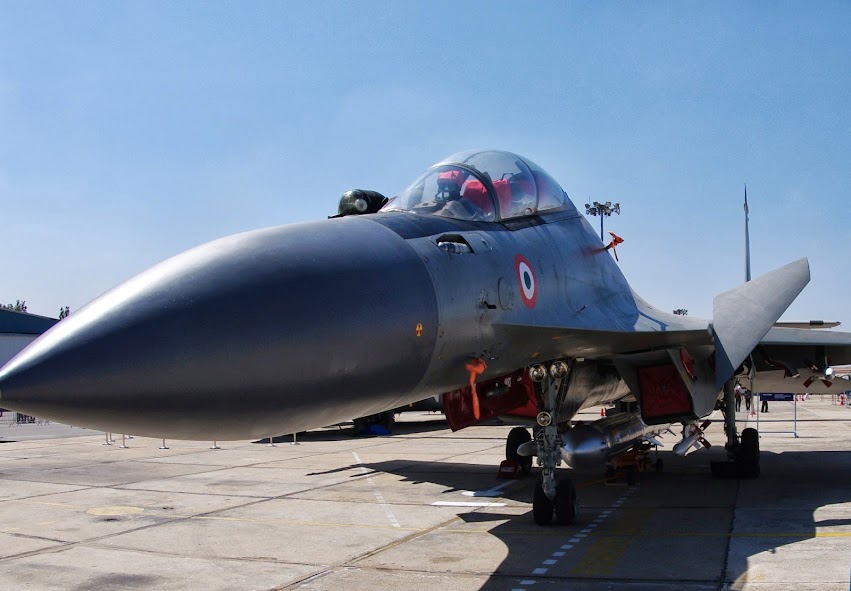
IAF Su-30MKI with Brahmos-A mock-up at Aero India 2011. Photo Copyright Vijainder K Thakur

According to ARMS-TASS, modifications of one the two IAF Su-30MKIs fighters being modified to carry and launch the Brahmos-A ALCM have been completed.

Flight trials using a developmental version of the Brahmos-A missile are likely to start within 2014, but live firing of the missile would take place only in 2015. 

The developmental version, which has been built in Russia, will not feature warhead, fuel and engine, but it will have the electrical circuitry to arm and launch the missile so that the "aircraft weapon system-pylon-missile interface" can be fully tested. The developmental missile will also have sensors to measure load and vibration levels experienced by the missile in flight.

India has developed the missile carriage pylon for the missile and is at present developing the "missile-pylon" interface.

Wind-tunnel tests of Su-30MKI model fitted with a Brahmos-A missile are underway in Bengaluru to ensure clean separation of the missile following release.

Russia is manufacturing the Brahmos-A which has a smaller booster rocket and other differences (see at link below) from the ground launched version of the missile.

IDP Sentinel members can read more about the Brahmos-A at the link below

Wednesday, May 28, 2014

Akash Missile Successfully Tested in Ripple Mode Against Multiple Targets

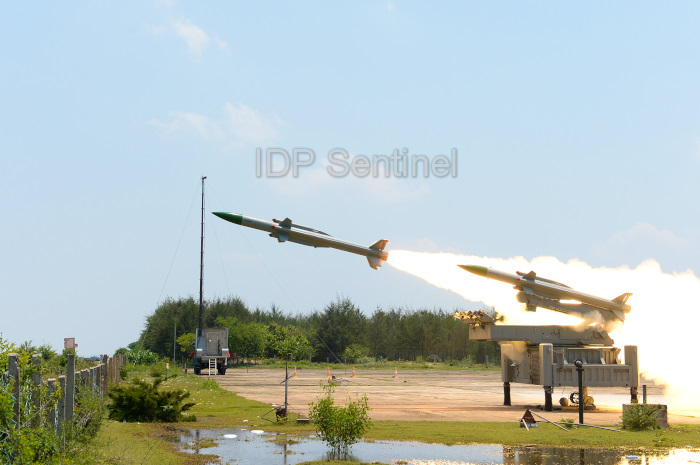
Akash surface-to-air missile ripple fire test on May 28, 2014


The DRDO developed Akash surface-to-air missile was successfully tested in ripple mode and against multiple targets at the extreme edge of the missile's engagement envelope.

Three Akash missiles were launched from the Integrated Test Range (ITR), Balasore on two targets being towed by Lakshya PTA at "low altitude far boundary".

Two of the missiles were launched on the same target in ripple mode. The missiles successfully intercepted the fast moving and maneuvering small RCS targets.

Akash Project Director G. Chandramouli told The Hindu that the first missile climbed to an altitude of 700-m and then slammed down on its target 20-km from the test range.

IAF personnel then launched two missiles in ripple mode with 5 sec interval on a second target.

"The first missile destroyed the target. The second homed in on the destroyed parts, falling down," said Mr. Chandramouli.


The DRDO released video above of the ripple test shows the first missile warhead detonating at 19-sec and a large chunk of debris falling to the ground. The second missile warhead detonates at 23-sec well above the altitude of the first detonation.

IDP Sentinel members can read about the Akash missile at the link below.

Akash Missile (IDP Sentinel)

Sunday, April 27, 2014

IAF Akash Missile Twin Tests on April 26, 2014: Photos & Additional Details

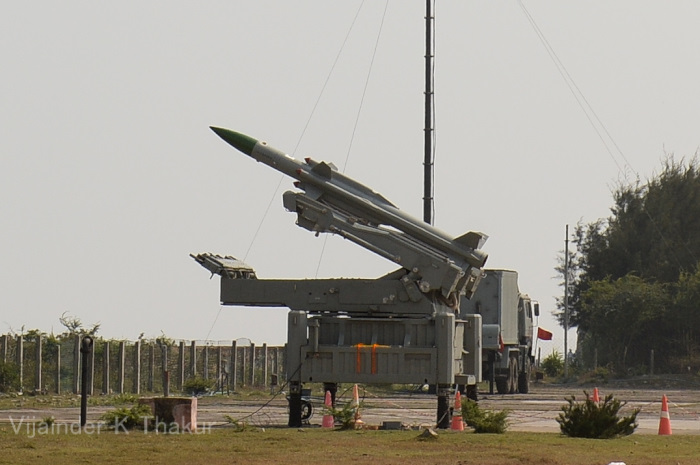
The second IAF Akash poised for launch during the twin missile test. Photo Credit: DRDO
DRDO has released additional details about the IAF's successful multiple launch test of the Akash missile at the ITR in Chandipur, Odisha on April 26, 2014.

Both the tests involved high speed maneuvering targets towed by Pilotless Target Aircraft (PTA), simulating enemy fighters. One missile engaged its target in the incoming mode and the other in the receding mode.

The Akash missile systems as well as the PTAs were operated by Indian Air Force personnel to simulate a realistic engagement to verify the missile's capability in different envelops.


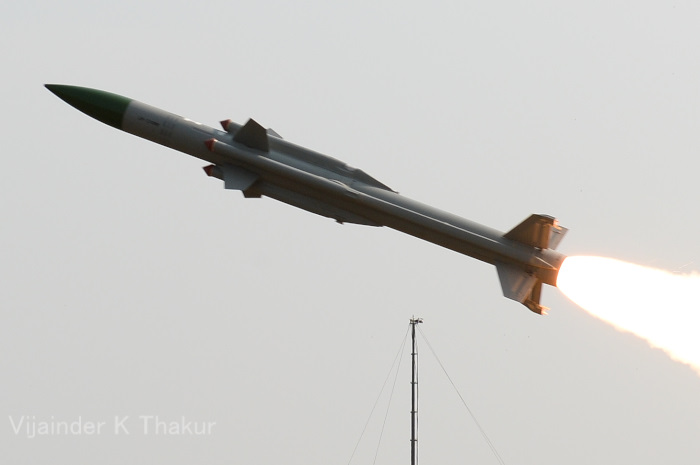
The first missile leaves its launcher during the April 26, 2014 test. Photo Credit: DRDO

Akash Missile Orders

The IAF has placed orders for a total of 8 Akash missile squadrons - An initial order for 2 squadrons in 2008 and a follow-up order for 6 squadrons in 2010. The Army has placed orders for two Akash regiments.

Akash missile is manufactured at Bharat Dynamics Limited (BDL). It's associated radars are produced by BEL, which  is the nodal production agency for the IAF order. (Interestingly, BDL is the nodal production agency for the Army order.)

Total production orders placed by Services (IAF and Indian Army) for Akash missile system roughly amounts to Rs 23,000 Cr. DRDO has so far delivered missile systems worth Rs 3,500 Cr to the services. 

In addition, the 3D-Central acquisition radar (3D-CARs) of the missile system. is being delivered to the three services against differeing requirements and is in continuous production.

A close up of the missile as it leaves its launcher. Note the guards on the four intakes of the ramjet second stage are still in place. Photo Credit: DRDO

IAF Order Fulfillment

The IAF has already inducted the two Akash missile squadrons delivered against its initial order. 

DRDO's press release for the April 26, 2014 tests suggests that the IAF asked for the missile tests on April 26, 2014 to reassure itself that production lot missiles would perform to their claimed specifications.

The press release also quotes Akash missile Project Director, Shri G Chandramouli as saying:

It is a notable achievement that the entire equipment of sophisticated radars, control centers, launchers & ground support systems for Indian Air Force have been realized and produced in less than two years indicating the integrated capability of DRDO, DDP, Inspection agency MSQAA and Indian Industry. A path has been created for continuous production of sophisticated surface to air missile systems in the country through this program. 

The statement suggests that though the IAF placed its initial order for two Akash missile squadrons in 2008, production didn't start till 2011 or 2012.

IDP Sentinel members can read more about the Akash missile at the link below

Saturday, April 26, 2014

Akash SAM Successfully Tested Twice


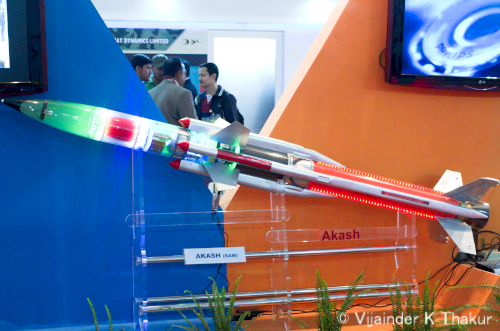
Akash Missile see through model on display at DefExpo 2014

IAF personnel carried out two tests of the Akash Surface to Air missile at the Integrated Test Range (ITR) at Chandipur near Balasore in Odisha on Saturday, April 26, 2014 as part of user trial. 

A defense source told PTI, "The sophisticated Akash missile was test fired twice in quick succession from launch complex-3 of ITR at about 11.55 am and 12 noon." 

Both the missiles were launched against targets towed by a PTA flying over the sea.

ITR Director M K V Prasad described the trials as being "fully successful."

The IAF tested an Akash missile on Wednesday, April 23, 2014 from the ITR.

The New Indian Express reported on April 24, 2014 that the missile missed its target - a pilot-less target aircraft (PTA). 

An official at the launch complex told the newspaper, "The missile was to destroy the PTA at an altitude of nearly 2 km as per the pre-designated coordination. But the mission failed as the weapon could not destroy the target. Though it attained the desired altitude, it failed to pass through missed-distance proximity."

The proximity fuse can be variously set to explode with 10, 20 or 100 meters of the missile, according to the official.

IDP Sentinel members can read more about the Akash missile at the link below