Showing posts with label Brahmos. Show all posts

Saturday, April 25, 2026

BrahMos at Risk: Is India Losing Its Missile Edge?


The Navbharat Times (NBT) Online has reported, based on inputs from “reliable sources,” that the production of BrahMos missiles has plunged to below 50% of the level achieved a year ago.

The disconcerting report partly attributes the drop in production to the transfer of around 56 employees from Hyderabad to Lucknow and Pilani over the last few months, leading to employee disgruntlement and resignations.

At Lucknow, BrahMos Aerospace is in the process of setting up an integration and testing facility for existing BrahMos variants and future BrahMos-NG production.

At Peepli, in the Pilani area of Rajasthan, BrahMos Aerospace has a production unit where subsystems fabricated at various Indian and Russian work centres are delivered for final missile integration, checking, mechanical and electrical assembly, fuel filling, storage, and related activities.

BrahMos has additional integration centres in Hyderabad and Nagpur.

Reliable sources have told NBT Online that BrahMos Aerospace has alerted the Indian Navy to the possible delay of a few years in the supply of BrahMos missiles.

On March 1, 2024, the Indian Navy placed an order for 220 BrahMos-ER supersonic cruise missiles, along with associated shipborne launch systems, primarily for deployment on Indian Navy warships (including Visakhapatnam- and Kolkata-class destroyers).

Large-scale transfers of employees between geographically dispersed integration units can understandably disrupt the family lives of affected personnel. If unavoidable, such transfers require deft management to preclude employee disgruntlement.

No Go-Ahead for BrahMos-NG

Besides the over 50% drop in BrahMos production levels, the NBT report also states, based on its sources, that the BrahMos-NG project has not yet been approved by the MoD.

It is ironic that the Government of India formally approved and initiated construction of the BrahMos-NG development and testing facility in Lucknow on December 26, 2021—when Defence Minister Rajnath Singh laid the foundation stone—yet has not approved development of the missile itself.

BrahMos-NG: Historical Perspective

BrahMos Aerospace first announced the BrahMos-NG missile concept in March 2021. The missile was expected to:

Be carried by lighter fighter jets such as the Tejas Mk.1A and MiG-29UPG.

Fit inside the internal weapons bay of the FGFA, the stealth fighter India and Russia were co-developing at the time.

The NG is not a BrahMos variant; it is a clean-sheet, high-supersonic missile design that will be smaller and lighter than the current BrahMos.

The missile was initially projected to be 6 m long and 0.5 m in diameter, with a top speed of Mach 3.5 and a 200–300 kg warhead, and a maximum range of 290 km.

In July 2019, a BrahMos official reportedly told India Today that the missile would be 5 m long—possibly to enable torpedo-tube launch.

More recently, it has been reported that the new missile would be capable of launching from standard submarine torpedo tubes—similar to the submarine-launched Exocet used on Scorpene submarines.

BrahMos-NG – Misleading Development Timelines

Over the years, BrahMos officials have made overly optimistic statements about the development timeline of BrahMos-NG.

A senior defence official reportedly told Times Now in November 2017 that the air-launched BrahMos-NG was “currently in the design stage,” adding that the missile would be ready by 2019.

In February 2024, BrahMos Aerospace’s Export Director, Pravin Pathak, stated that flight tests of BrahMos-NG would begin before the end of 2025.

He said:

“In parallel with construction of the (Lucknow) plant… the first flight samples of the new BrahMos-NG rocket will be assembled for flight testing… before the end of 2025.”

Finaly, Development Start

There is good reason to believe that development actually started in September 2025.

On September 9, 2025, TASS reported that BrahMos Aerospace is designing the missile and intends to begin autonomous testing in 2026.

TASS quoted Alexander Maksichev, Russian Managing Director of the JV, as saying:

“We are currently at the working design stage… and then we will move on to autonomous tests.”

He added that it was too early to discuss timelines for actual flight testing.

After 14 years of announcements, it finally appeared that the project was making progress.


A New Ramjet Engine

Because BrahMos-NG must be significantly smaller and lighter, it requires a new, scaled-down ramjet engine.

During Aero India 2019, a BrahMos official stated that Russia’s NPO Mashinostroeyenia is developing this new engine.

This engine, like the missile itself, is a clean-sheet design. Feasibility studies and engineering analysis were reportedly completed around 2020.

Link with the Su-57

Russia has made a compelling offer to India to procure its Su-57 stealth fighters for the IAF.

In July, the IAF projected a requirement for 2–3 squadrons of stealth fighters to the Indian government, given the depletion of its fighter inventory, delays in AMCA development, and the evolving threat environment.

If the government accepts the Russian offer—which appears attractive due to the inclusion of transfer of technology—the IAF would want BrahMos-NG to be compatible with the Su-57 variant it acquires. The missile would need to fit within the aircraft’s internal weapons bays and conform to their load-carrying limits.

During the Dubai Airshow 2025, the Su-57 displayed a pair of Kh-58UShK anti-radiation missiles in its forward internal weapons bay during flight demonstrations.

The Kh-58UShK has a launch weight of 650 kg. By extrapolation, the forward internal bay’s maximum payload capacity appears to be around 1,300 kg.

In March 2019, BrahMos CEO Sudhir Misra stated that the Tejas underwing hardpoint can support a maximum load of 1,250 kg, including the launcher. This implies that BrahMos-NG would weigh less than 1,250 kg.

For comparison:

Standard BrahMos weighs ~3,000 kg

BrahMos-A weighs ~2,500 kg

Thus, miniaturisation is critical.

In addition to physical fitment, radar and mission-computer integration would require close Russian-Indian collaboration.

If Not Su-57—AMCA Compatibility

If India does not pursue the Su-57, the missile will need to be compatible with AMCA’s internal bay—an uncertain proposition at this stage of AMCA development.

Conclusion

Any significant drop in the production of BrahMos missile variants at this stage would be a serious setback, potentially weakening the deterrence capability of the Indian Armed Forces.

Any delay in approving the development of BrahMos-NG could necessitate the import of a comparable system to keep the IAF’s MiG-29 and LCA fleets operationally viable.

Russia has already begun work on the engine and a new high-supersonic air-launched missile. India must now decide whether to participate meaningfully—before timelines slip again, as they did in the case of the FGFA.

Copyright © Vijainder K Thakur. First published on Thumkar.

Thursday, December 4, 2025

BrahMos Missile - What Uprade Does India Want from Russia?


via X

It is being widely reported in the Indian press that during President Putin's visit to New Delhi later today, India and Russia are likely to review the development of the BrahMos missiles and its proposed variants. 

Here is a quick analysis of the cooperation India is seeking for the existing BrahMos missile. In a subsequent post, I will dwell on the assistance we need for the development of the BrahMos-NG variant, which still remains largely conceptual. Notably, in March 2011, former BrahMos Aerospace chief A. Sivathanu Pillai had announced the start of its development with much fanfare

BrahMos Upgrade

India is not seeking Russian assistance to upgrade the existing BrahMos missile to increase its range, as some sections of the Indian press have reported. Instead, it is seeking Russian cooperation to reduce the missile’s production cost and thereby enhance its export potential.

The use of the BrahMos missile during Operation Sindoor not only impacted runways and hangars in Pakistan in a bad way, it also impacted global interest in the missile—in a good way. Indian Defence Minister Rajnath Singh has stated that at least 14 countries have expressed interest in acquiring the BrahMos supersonic cruise missile following its demonstrated success in the operation.

BrahMos Export Performance

The problem with the export of the Brahmos is that it's way too expensive. As such, procuring it in operationally significant numbers is beyond the fiscal capabilities of several small nations. 

India has so far exported the BrahMos missile to the Philippines, with deliveries of multiple batches completed under a $375 million deal signed in 2022. 

Recent reports suggest that in October 2025 India signed export contracts with two undisclosed countries worth approximately $455 million.

Negotiations are underway for the export of the missile to Vietnam ($700 million) and Indonesia ($450 million).

BrahMos Unit Price

Based on procurement figures of the Indian Armed Forces, the standard BrahMos missile is estimated to cost $2–3 million per unit, while the extended-range (ER) variant typically ranges from $3–4 million.

Prices can vary within both standard and ER categories depending on whether the missile is configured as an anti-ship variant or a land-attack cruise missile (LACM), each carrying different mission-specific features.

Cost Comparisons

Because of its high supersonic speed and large warhead, the BrahMos is a unique and potent missile. Only Russia and China have peer missiles. 

Russia's Onyx (P-800 Oniks) missile is a Brahmos analog that has been extensively and very effectively used in the war in Ukraine. Russia exports the missile. It's price is estimated at approximately $1.25 million based on multiple defense analyses and reports. 

The British Storm Shadow missile - which admittedly is a subsonic missile, but being stealthy, has good penetration - has a price tag estimated to be around $2 million.

Reasons for High Cost of Brahmos

The fact that India is discussing the unit cost of the BrahMos with Russia strongly suggests that Russia is exporting critical BrahMos components to India for final assembly. In other words, Russia’s profits come from the sale of these components—not from the missile itself. The reality is that BrahMos Aerospace functions less as a true joint venture and more as a structured arrangement in which the foreign partner earns revenue by supplying high-value parts.

In this respect, BrahMos Aerospace is no different from many of India’s joint ventures with Western or Israeli aerospace firms, where the commercial model similarly relies on exporting components rather than sharing the full value chain of the weapon system.

What is likely, however, is that Russia may be willing to make an exception for India—precisely to underscore how highly it values the strategic partnership.

Preliminary Cost Reduction Negotiations

BrahMos Aerospace Deputy CEO Chilukoti Chandrasekhar visited Moscow in September 2025 to discuss with the Russians India's plans to expand production capacity and lower costs. 

During his visit, responding to a question from TASS, he told journalists.

"The Russian side and the Indian side, both of us, are working to reduce the cost of the missiles so that more export orders can be honored at the same time. To augment the requirements for export as well as for our own need — for our own armed forces — we need to augment our production facilities also. We are working with our Russian partners to augment this facility," he said in response to a question from TASS.

Copyright © Vijainder K Thakur. First published on Thumkar.

Thursday, June 25, 2015

Brahmos, US Cruise Missiles Brace Up to Electronic Warfare Challenge

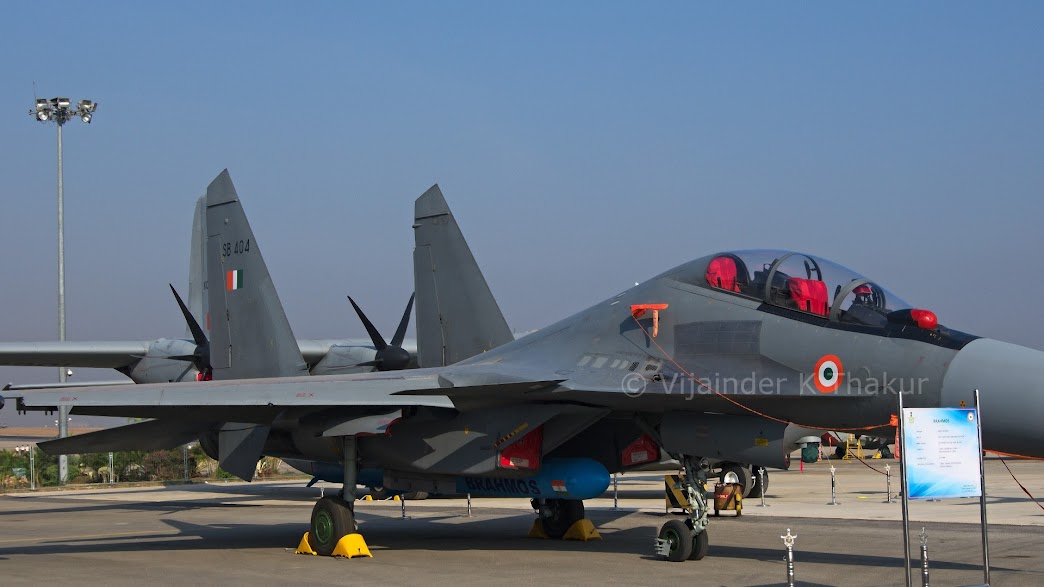
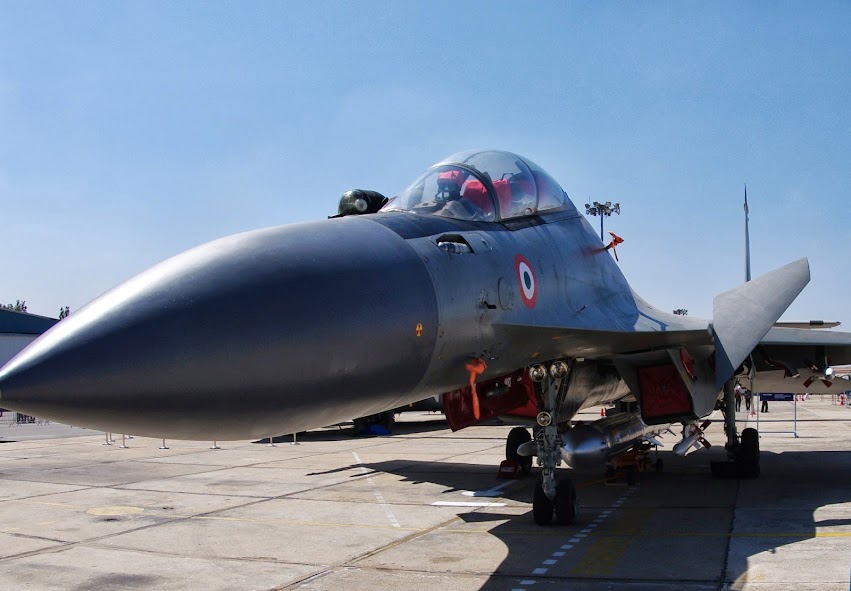
First IAF Su-30MKI modified to carry Brahmos-A, the ALCM variant of the Brahmos supersonic cruise missile at Aero India 2015 in Bengaluru.


SatNav signal jamming is poised to reduce the accuracy of the Indian Brahmos supersonic cruise missile, as also any other conventional cruise missiles that relies on accuracy for its destructive potential.

The Brahmos missile uses SatNav as its primary navigation system and is claimed to have a CEP (Circular Error Probability) of 3-m. As a backup, the missile has a ring laser gyro based inertial navigation (IN) system developed at Research Center Imarat (RCI), Hydrabad.

IN systems are prone to drift with time and need to be periodically fixed. Cruise missile IN systems are fixed using the primary SatNav system. In case of SatNav signal jamming, the accuracy of a cruise missile would depend on the time elapsed since the last fix. IN system CEP is significantly higher than SatNav and increases linearly with time.

India is planning to reequip Brahmos with a more accurate fallback IN system developed by French company Safran (Sagem).

Threat to US Space Based Assets


The US military is heavily dependent on its GPS system for the accuracy of its smart weapons and cruise missile.

Tass reported on June 25, 2014 that Russia’s Radio-Electronic Technologies Group (KRET) is developing a fundamentally new EW system that will target space based communication, navigation and surveillance. The multifunctional system, mounted on ground and airborne platforms, would 'switch off' all adversary satellite terminals, sending adrift aircraft, cruise missiles, and smart bombs that rely on SatNav, besides degrading adversary command and control.

The use of the term 'multifunctional' suggests the system uses several different jamming and spoofing techniques.

The system, which is currently being tested in workshops, will be field tested by the end of the year.

US Response to the Threat


Meanwhile, according to this report, the Pentagon is planning to setup a new joint command cell in the next 6 months to protect US space based assets against attacks from China and Russia.

U.S. Deputy Secretary of Defense Robert O. Work told the annual GEOINT symposium on Tuesday, June 23, 2015 that the cell will receive data from satellites belonging to all U.S. government agencies and coordinate response to attacks.

“[W]e are going to develop the tactics, techniques, procedures, rules of the road that would allow us … to fight the architecture and protect it while it’s under attack,” Work said. [via Defense One]

The scale and geographical spread of US military operations is so vast that US forces cannot retain their edge against regional powers like Russia and China without relying heavily on space based assets. Potential US adversaries recognizing the US dependence have acquired the capability to attack US satellites using soft kill (jamming, blinding), or hard kill (microwave / laser frying, kinetic attack).

“The ugly reality that we must now all face is that if an adversary were able to take space away from us, our ability to project decisive power across transoceanic distances and overmatch adversaries in theaters once we get there … would be critically weakened,” Work told the symposium.

Senior officials at the Pentagon and Office of the Director of National Intelligence are still finalizing details of the new center, which will back up the military’s Joint Space Operations Center at Vandenberg Air Force Base, California.

Friday, May 8, 2015

Analysis: Brahmos Block-3 LACM Test on May 8, 2015

Brahmos Block-3 LACM test on May 8, 2015


The Brahmos Block-3 LACM tested today (May 8, 2015) was likely the Block III Near Vertical Dive variant of the missile.

On October 16, 2014 Brahmos CEO Sudhir Mishra told The Hindu that a near vertical dive variant of the Brahmos Block-III missile was under development.

“We want to demonstrate a 'near vertical dive and surround' capability to take the enemy by surprise. While radars do not have 360 degree coverage in the mountains, we would like to show the missile taking a turn in the horizontal axis and decimating the target around the hill. We hope to do this in a year’s time,” Mishra said.

Brahmos Block-3 LACM test on May 8, 2015

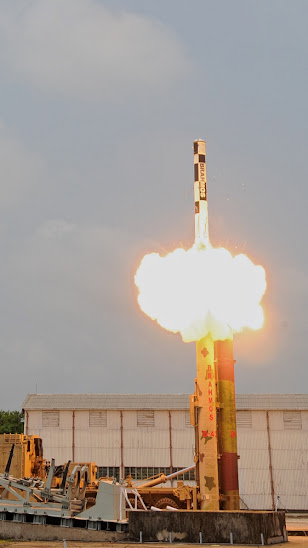
The press release announcing the launch said:

The land-to-land configuration of BRAHMOS Block – III version was test launched from a Mobile Autonomous Launcher (MAL) for its full-range of 290-kms at 1310 hrs....

...Meeting all flight parameters including high level maneuvers, the supersonic cruise missile successfully hit the designated land-based target with desired accuracy, officials confirmed. 

The reference to the high level maneuvers may well be the 'turn around the vertical axis' that Brahmos CEO Sudhir Mishra told The Hindu about.


Wednesday, May 6, 2015

DRDL Developing Long Duration High Power Ramjet

Brahmos-M side-by-side with Brahmos at DefExpo-2014

Defense Research & Development Laboratory (DRDL) Hyderabad is developing a high energy, long duration, solid fuel ramjet propulsion system.

The laboratory recently released a RFP for development of ceramic nozzle for the ramjet combustion chamber.

The throat diameter of ramjet nozzle directly affects the performance of ramjet propulsion system. Any erosion of ramjet throat adversely affect the ramjet performance. A ceramic nozzle would minimize erosion and facilitate long duration flight. Also, a ceramic nozzle would   ensure that temperature of metal casing and insulating materials remains within acceptable limits for long duration of operation of ramjet combustion chamber.

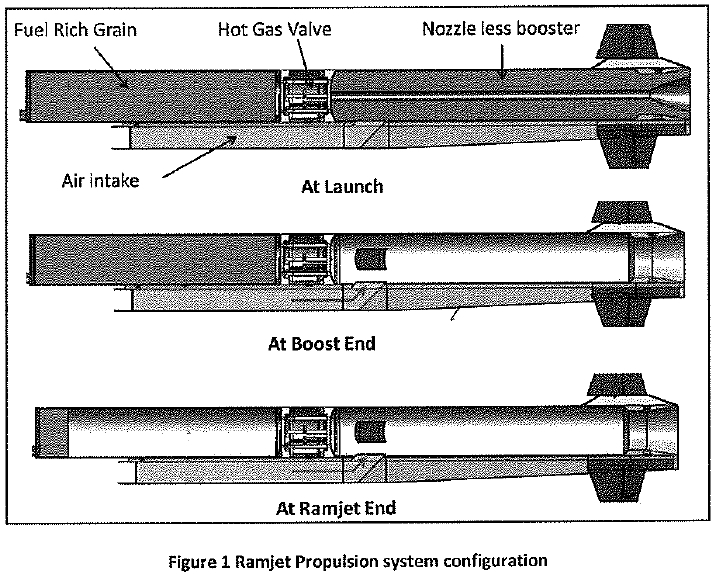
The configuration of the ramjet system is similar to the solid propellant ramjet - solid booster combo engine that powers the Akash missile.


The ramjet combustion chamber initially houses solid propellant for boost phase. In other words, the propellant is cast inside ramjet combustion chamber. The booster propellant is required to be configured in such a way that it acts like a nozzle less booster. Towards the end of boost phase, the ceramic nozzle will also encounter the combustion products of booster propellant though for a very short duration (0.5 sec). It is important that the ceramic layer of the nozzle bonds strongly with the propellant. If required a suitable suitable adhesive is used to provide required bond strength.

Analysis


The requirement for high energy and long duration suggest a ramjet engine is being developed for a bigger and longer range missile than a Akash follow-up variant.

It maybe noted that Brahmos Aerospace is in the process of developing Brahmos M, a smaller 1.5 t variant of the 2.5 t Brahmos missile. Brahmos-M would be capable of launch from any medium fighter, ship based missile container, submarine torpedo tube or land based missile container. Brahmos M would require a smaller ram-jet engine than the one fitted on Brahmos. Also, in order to make Brahmos-M suitable for launch from submarine torpedo tubes, the missile would need a solid fueled ramjet instead of the the liquid fueled ramjet fitted on Brahmos.

Is DRDL de

Friday, September 19, 2014

Brahmos Missile Facts We Tend to Ignore

Brahmos-A mockup on a Su-30MKI at Aero India 2013

Brahmos is not the only supersonic cruise missile, as is often claimed by the DRDO and local India media. The Chinese YJ-12, also powered by a ramjet engine like the Brahmos, can fly at speeds greater than Mach 4 and has a max range of 400-km! The YJ-12 can be launched from Chinese Su-30MKK aircraft.

The missile is armed with a newly designed 205 kg warhead, compared to the 200-kg warhead of the Brahmos missile. (Brahmos-A, the air launched variant of the missile, is reported to have a 300-kg warhead)

YJ-12 AShM can be armed with a radar seeker, an imaging infrared seeker, or a television seeker,

Brahomos-A weighs 2.55-ton or 5,600-lb making it the heaviest ALCM known to mankind! The Russian Kh-101/-102 (conventional and nuclear versions respectively) ALCM, carried by Russian Tu-95MS and Tu-160 bombers. is the current heaviest ALCM with a launch weight estimated at 5,300 lb. The Kh-101 has a range of 2000-3000 km (6,000 miles according to Russian media!) and features a 880-lb / 400-kg warhead,

Further Reading Links for IDP Sentinel Members

Brahmos Missile - IDP Sentinel
Brahmos-A ALCM Variant (IDP Sentinel)

Thursday, July 17, 2014

Brahmos-A ALCM Live Firing in 2015

IAF Su-30MKI with Brahmos-A mock-up at Aero India 2011. Photo Copyright Vijainder K Thakur

According to ARMS-TASS, modifications of one the two IAF Su-30MKIs fighters being modified to carry and launch the Brahmos-A ALCM have been completed.

Flight trials using a developmental version of the Brahmos-A missile are likely to start within 2014, but live firing of the missile would take place only in 2015. 

The developmental version, which has been built in Russia, will not feature warhead, fuel and engine, but it will have the electrical circuitry to arm and launch the missile so that the "aircraft weapon system-pylon-missile interface" can be fully tested. The developmental missile will also have sensors to measure load and vibration levels experienced by the missile in flight.

India has developed the missile carriage pylon for the missile and is at present developing the "missile-pylon" interface.

Wind-tunnel tests of Su-30MKI model fitted with a Brahmos-A missile are underway in Bengaluru to ensure clean separation of the missile following release.

Russia is manufacturing the Brahmos-A which has a smaller booster rocket and other differences (see at link below) from the ground launched version of the missile.

IDP Sentinel members can read more about the Brahmos-A at the link below

Tuesday, July 8, 2014

Brahmos LACM Destroys Hidden Target in Supersonic Steep Dive Using Satellite Navigation: Bunker Buster?

Brahmos LACM test on July 8, 2014
A land attack variant of the Brahmos missile was successfully tested from ITR on July 8, 2014. The missile featured a totally indigenous airframe and relied entirely on satellite based navigation to accurately destroy a hidden target in a steep glide supersonic attack. Possibly a bunker buster variant of the missile with a ground penetrating warhead.

According to a Brahmos press release

The launch took place from a from a Mobile Autonomous Launcher (MAL) prepared by the Brahmos 3rd regiment of Indian Army team at 1038 hrs. The missile flew through the designated 290 km distance at Mach 2.8 and achieved high precision with steep dive once again.


Brahmos LACM test on July 8, 2014
In a historical first, the advanced guidance system integrating multiple navigation satellites powered with new software algorithm, developed indigenously by Indian scientists and industries resulted in pinpoint accuracy of the missile system against hidden land targets.

Indigenous airframe produced by L&T and Godrej, guidance system by HAL, OBC, MIU by Ananth Technologies Ltd., Electronics industries, software development and guidance scheme by DRDO/RCI have been proved in the flight increasing the content from Indian industries.

Brahmos LACM test on July 2014

Highlights of the test:

1. Achieving high level of accuracy with multiple navigation satellites integrated with advanced software, without homing device, thus enabling pinpoint accuracy and further enhancing the precision capability against hidden land targets including mountainous regions.

2. Accomplishing the supersonic steep dive capability against difficult land targets.

3. Realization of airframe, both composite & metallic, built by the Indian industries which were tested and evaluated and altogether provided substantial increase of Indian produced content in the missile.