Friday, May 30, 2014

Was Modi's Message to China's Li Keqiang - We will accept the LAC as the border?

Border post on the LAC at Bum La Pass, Tawang, Arunachal Pradesh.


Prime Minister Narendra Modi possibly created history on Thursday May 29, 2014, and ironically no one seems to have noticed, thanks to our wayward newsmedia that considers anything non controversial as non news and currently has Article 370 coming out of all its orifices outlets.

The Indian PM told Chinese Premier Li Keqiang during a telephonic conversation on Thursday that the Indian government had resolved to "utilize the full potential of our strategic and cooperative Partnership with China...to work closely with the Chinese leadership to deal with any outstanding issues in our bilateral relations by proceeding from the strategic perspective of our developmental goals and long-term benefits to our peoples."

I am not a diplomat, but I don't think I have to be one to understand what Modi meant when he said "to deal with any outstanding issues in our bilateral relations by proceeding from the strategic perspective of our developmental goals and long-term benefits to our peoples."

For India's relations with China to flourish, the outstanding border dispute between the two nations with civilizational links needs to be resolved; not by round after round of official babu talks,  but a strategic political vision. A vision that focuses on "our developmen goals" and brings "long-term benefits to our peoples."

What Modi told Li Kequiang was - Lets move forward. Moving forward means leaving your past behind. India's relations with China have, for the past over 50 years, remained shackled by their border dispute.

A "strategic perspective" must look beyond intractable claims about our mutual border; it must look beyond give and take to resolve the border dispute. It must consider mutual give and forget.

A "strategic perspective" must come with the attitude - "What border dispute?"

For over 50-years India and China have clamored for their 'historical' border, unmindful of their differing perceptions on what was the historical border. Well 50-years is history by itself; the LAC could now well be viewed as the historical border and there is no difference in difference in perception over it.  (I believe the Chinese ambivalence on the LAC in Ladakh is really aggressive posturing, not a real difference in perception.)

So did Modi signal to China that it was time for India and China to resolve their border dispute along the lines suggested by the Chinese themselves earlier? By accepting the LAC as the new international border?

I think so. China's decision to send their foreign minister Wang Yi to India in the second week of June to follow-up on the Modi - Li Keqiang conversation is a clear indication that Modi has said something that China is delighted to hear.

Thursday, May 29, 2014

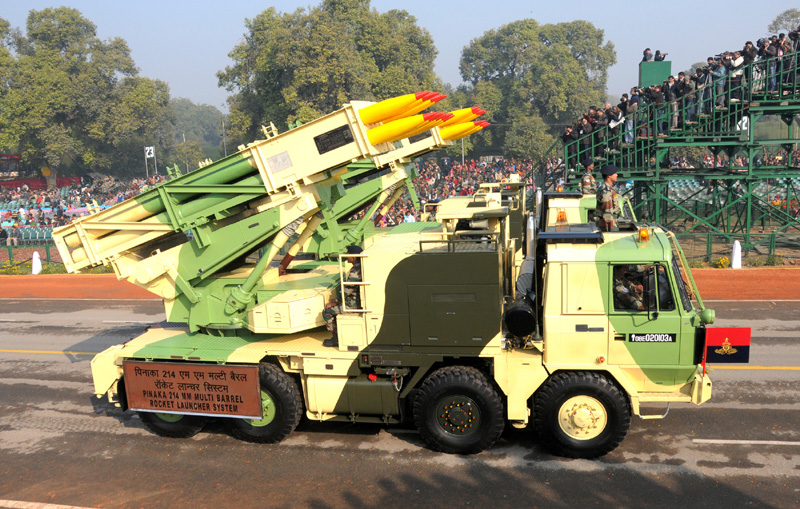
DRDO Successsfully Tests Pinaka Mk-2 MBRLS

Pinaka 214mm MBRLS during the full dress rehearsal for the Republic Day parade in 2012. Photo Credit : PIB

DRDO tested the Pinaka Mk-2 Multi Barrel Rocket Launch System (MBRLS) on Thursday, May 29, 2014 at Chandipur-on-sea, near Balasore in Odisha by firing three salvos.
 
"Three rounds of Pinaka rockets were successfully tested from the proof and experimental establishment (PXE) today at Chandipur," a source told PTI.

In July 2013, the Pinaka Mk-2 system had undergone successful trials at Chandhan area in Pokhran field firing ranges in western Rajasthan.

Development and trials of Pinaka Mk-2 is ongoiing and the advanced unguided rocket system is expected to enter service very soon.

DRDO is developing the Pinaka MK-II rocket, with an extended range of 60 kms, against 40 km for Pinaka Mk-I. 

In an interview with The Hindu published on August 22, 2013, DRDO Chief Avinash Chander confirmed that his scientists are "enhancing the range of Pinaka rockets from the existing 40 km to 60 km for Pinaka mark II."

Previously it was reported that early static validation trials of the rockets are underway and DRDO plans user trials of its warhead. 

IDP Sentinel members can read more about the Pinaka MBRLS at the link below.

Wednesday, May 28, 2014

Akash Missile Successfully Tested in Ripple Mode Against Multiple Targets

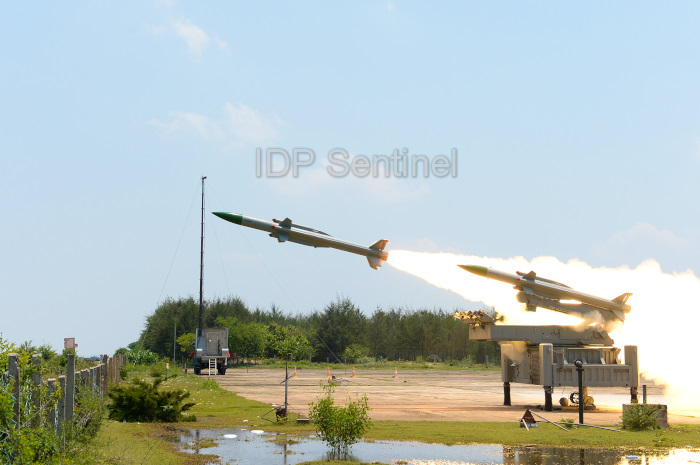
Akash surface-to-air missile ripple fire test on May 28, 2014


The DRDO developed Akash surface-to-air missile was successfully tested in ripple mode and against multiple targets at the extreme edge of the missile's engagement envelope.

Three Akash missiles were launched from the Integrated Test Range (ITR), Balasore on two targets being towed by Lakshya PTA at "low altitude far boundary".

Two of the missiles were launched on the same target in ripple mode. The missiles successfully intercepted the fast moving and maneuvering small RCS targets.

Akash Project Director G. Chandramouli told The Hindu that the first missile climbed to an altitude of 700-m and then slammed down on its target 20-km from the test range.

IAF personnel then launched two missiles in ripple mode with 5 sec interval on a second target.

"The first missile destroyed the target. The second homed in on the destroyed parts, falling down," said Mr. Chandramouli.


The DRDO released video above of the ripple test shows the first missile warhead detonating at 19-sec and a large chunk of debris falling to the ground. The second missile warhead detonates at 23-sec well above the altitude of the first detonation.

IDP Sentinel members can read about the Akash missile at the link below.

Akash Missile (IDP Sentinel)

Saturday, May 24, 2014

Russia's New Air-to-Air Missile for T-50 to be Ready by 2016, Hypersonic Cruise Missile by 2020

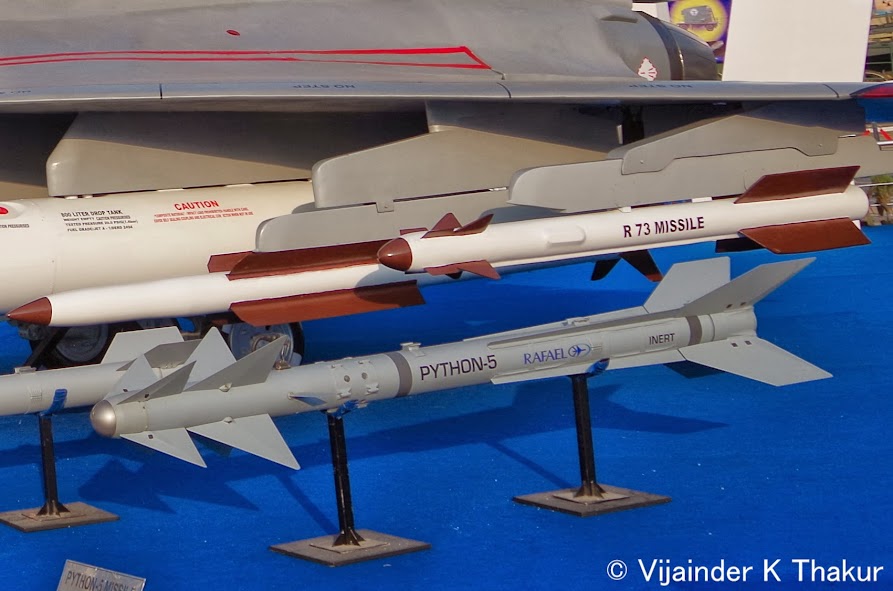
A Russian R-73 missile on Tejas LCA at Aero India 2013


On May 23, 2014 Boris Obnosov, the head of the Tactical Missiles Corporation (KTRV), told the press at the Kadex 2014 that KTRV would complete development of the new air-to-air missile, X-74M2, by 2016.

The X-74M2 is likely an improved version of the R-74M, which in turn was a R-73 (AA-11 Archer) missile derivative featuring fully digital and re-programmable systems. The X designation of the new missile likely refers to its development status.

The R-73 has a cryogenic cooled (MK-80) seeker and uses thrust vectoring for maneuvering giving it a substantial (45 deg either side) off-boresight capability.

"We have established close contact with the Sukhoi design office. A permanent working group is formed. All the protocols of informational cooperation are agreed on. Models are made according to schedule. Everything must be done by 2016," Obnosov said.

Obnosov added that the Tactical Missiles Corporation also planned to develop the first model of a hypersonic missile by 2020. The Defense Ministry and the Ministry of Industry and Trade had already approved the program.

Russia is developing tactical air-to-ground missiles and air-to-air missiles for use with the T-50

In April 2012, Obnosov told RIA Novosti that the missiles are undergoing tests.

“The development of Kh-35UE (AS-20 Kayak), Kh-38ME, Kh-58UShKE (AS-11 Kilter), and RVV-MD (AA-11 Archer) class missiles will be completed in 2012-2013,” Obnosov said.

Some of the missiles that will arm the T-50 have already been proven with other fighters.

The Kh-31PD (AS-17 Mod 2) class missiles, for example, have already been tested using Sukhoi Su-34 and put into serial production, he added.

According to KTRV, the Kh-35UE tactical anti-ship missile has a maximum range of 260 kilometers; the supersonic Kh-31PD anti-radiation missile for use against air defense systems, can fly up to 250 kilometers; the Kh-58UShKE missile, designed to destroy pulse radars, can hit targets within 245 kilometers, and the short-range RVV-MD air-to-air missile has a maximum range of 40 kilometers.

IDP Sentinel members can read more details about the PAK-FA / T-50 project at the link below

PAK-FA / T-50 (IDP Sentinel)


Friday, May 23, 2014

Fourth Boeing P-8I arrives at Naval Air Station Rajali

Fourth Boeing P-8I arrives at Naval Air Station Rajali from Boeing Field in Seattle on May 21, 2014.
Boeing has delivered the fourth P-8I to India on schedule. The aircraft departed from Boeing Field in Seattle and arrived May 21 at Naval Air Station Rajali, where it joined three P-8Is currently undergoing operational evaluation.

With the delivery, Boeing has fulfilled the first half of a contract for eight aircraft. Two additional aircraft are scheduled to be delivered in 2014.

IDP Sentinel members can read additional details about the project at

P-8I Long Range Maritime Reconnaissance and Anti Submarine Warfare (LRMRASW) Aircraft - IDP Sentinel

Monday, May 19, 2014

Indian Army Initiates Procurement of Anti Mine Boots for Infantry Soldiers

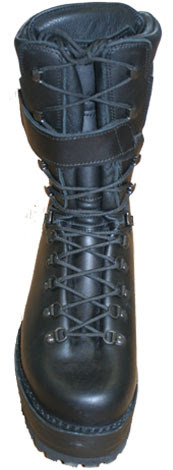
Anti Mine boots PPE50 from Energetics Technology, UK

MOD has initiated procurement of Boot Anti Mine Infantry (BAMI) for Infantry soldiers through the recent release of a RFI to identify probable vendors.

The Indian Army has in the past used boots procured from Czech Republic but troops found them heavy (4-kg) and uncomfortable. Indigenous anti-mine and snow boots designed by Footwear Design and Development Institute (FDDI), though lighter at 2.9-kg, did not meet other Army QRs.

MOD now wants to procure BAMI from a foreign vendor in a quantity large enough to enthuse the vendor to transfer technology for producing the boots locally in India.

Anti Mine boots are designed to protect troops from Anti Personnel mine to an extent where the injury from the blast, triggered by stepping on the mine, does not mandate amputation. The boots absorb most of the shock from the blast through sacrificial destruction of protective layers in the sole.

Anti Mine boots enable soldiers to fully recover from stepping on an anti-personnel mine. In a typical case, pressure from an anti-personnel mine blast can be to the order of 45,000kg/cm square. Without protective boots, such force would typically tear a limb apart. Anti-mine boots can reduce blast pressure to around 160kg/cm square. The reduced pressure results in relatively minor injury, such as fracture and some soft-tissue damage, precluding  It's unlikely to result in a limb amputation. Also, the reduced extent of injury allows more time between mine strike and medical evacuation, reducing the chances of a soldier bleeding to death on the battlefield, as so often happens during a battle. Soldiers recover more quickly at redcued medical cost.

The challenge is to make anti mine boots light and comfortable enough to allow soldiers to perform their missions. Instead of providing absolute protection, boots trade-off some protection for the imperative of mission accomplishment.

Without BAMI, attacking infanty soldiers breach protective minefields laid by the enemy by trailing tanks with  mine ploughs; in more difficult terrain the infantry uses explosive to blast a lane through the minefield. In both cases, the enemy is alerted to the attack. The use of BAMI enables attacking infantry to breach a minefield more stealthily.

MOD is looking for anti mine boots that can be used in various types of terrain (Plains, Deserts, Jungles, Glaciated, and High Altitude & Mountainous) encountered in India? The ministry is willing to consider strap on version of anti-mine footwear provided they can be worn over the in-service DMS boot used by Indian Army?


Tuesday, May 13, 2014

GRSE Accepts Gearbox for Fourth P28 ASW Corvette INS Kavaratti

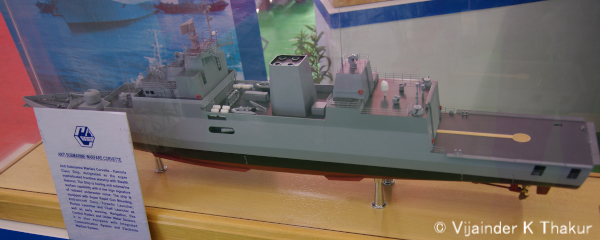
A model of the Kamorta class anti-submarine corvette on display at DefExpo 2014


On May 13, 2014 DCNS announced that in mid-March 2014 Garden Reach Shipbuilders and Engineers (GRSE), Kolkata had accepted without reservation the first of the two port raft-mounted gearbox for the Project 28 Kamorta class ASW Corvette INS Kavaratti.

GRSE have orders to build four Project 28 Kamorta class ASW Corvettes for the Indian Navy at a cost of approximately Rs. 1,700 crore each. The ships - INS Kamorta, INS Kadmatt, INS Kiltan and INS Kavaratti - have very low under water noise signature and low radar cross section. They are the first stealth corvettes designed and built indigenously.

P28 corvetts have with more than 80 percent indigenous content and are capable of fighting under NBC (nuclear, biological and chemical) environment.

In 2006, GRSE entered into a contract with DCNS for the design and integration of four pairs of raft-mounted gearboxes intended for the propulsion of the four P28 ASW corvettes.

Under the agreement, DCNS was to produce two raft-mounted gearboxes for the first corvette in France on the DCNS Nantes site. The remaining six gearboxes were to be produced in India by DCNS' industrial partner WIL (Walchandnagar Industries Limited).

IDP Sentinel members can read more about Project 28 at the link below:

Project 28 / Kamorta Class Corvette (IDP Sentinel)