Tuesday, February 11, 2014

Upgraded BMP-2 from Kalyani Group at DefExpo 2014

Kalyani's Upgraded BMP-2 with  Rafael's Samson MkII remotely controlled weapon system at DefExpo 2014

Pune based Kalyani Group pitched an upgraded BMP-2 Infantry Combat Vehicle (ICV) at the DefExpo 2014.. The upgraded BMP-2 features Rafael's Samson MkII remotely controlled weapon system with a 30mm cannon from ATK and two Spike LR missiles from Rafael. The turret, which features  two MiniPOP optronic sights for the gunner and commander, is designed to fit armor protection according to the level specified by the customer.

Upgraded BMP-2 from Elbit Systems and Kalyani at DefExpo 2014


The upgraded ICV features front, side, skirt and rear passive and reactive armor designed to defeat armor piercing rounds and artillery fragments. The skirt provides protection against IED, EFP and RPG-7.

The design is modular and light weight. The upgraded ICV is lighter than the BMP-2.

Upgraded BMP-2 from Elbit Systems and Kalyani at DefExpo 2014

L&T and Ukraine's SFTE Spectechnoexport Tie Up to Pitch Air Defense Missile System to the Indian Army

L&T and Ukrain's Ukroboronprom for developing ADMS


L&T and Ukrain's SFTE Spectechnoexport have signed a contract to develop an Air Defense Missile Systems (ADMS) for use by the Indian Army, Ukrain's State Concern “Ukroboronprom” reported on its website on February 10, 2014.

L&T has been invited by MOD to bid in a tender for supply of 138 ADMS to the Army.

Under L&T's contract, SFTE Spectechnoexport will supply L&T with one launch vehicle manufactured by the State Kyiv Design Bureau “Luch” and one command vehicle  manufactured by the Kharkiv Automobile Plant.

It's likely that L&T is developing the system against the Indian Army's requirement for Quick Reaction Surface-to-air Missiles (QRSAMs). If that is true and the system preforms well during firing trials, L&T is likely to be awarded a contract for the supply of the ADMS being  the only competing Indian vendor.

Monday, February 10, 2014

HTT-40 Powerplant and Other Details

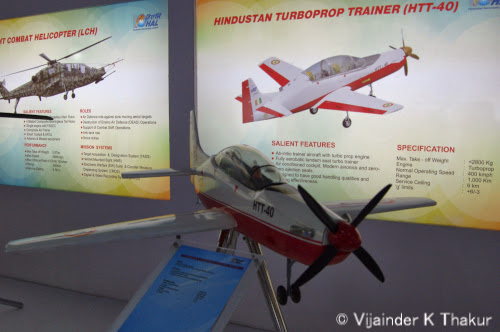
A model of the HTT-40 on display at HAL pavilion at DefExpo 2014
Far from being rattled by the IAF's lack of enthusiasm for the HTT-40 as a Pilatus PC-7 Mk-2 replacement, HAL is pushing ahead with the development of the turboprop powered tandem twin seat basic trainer.

An HAL rep told IDP Sentinel at the DefExpo that HAL is committed to obtain certification for the aircraft within 3-year of project sanction.

The aircraft will be powered by a Garret TPE 331-12 turboprop. HAL in 2009 tied up with Honeywell to manufacture the engine in India for international markets.

HAL has been manufacturing, repairing and overhauling the Garret TPE-5 for international clients under license from Honeywell since 1988. Besides many other aircraft, the engine also powers HAL manufactured Dornier DO-228 aircraft.

The TPE-331-12B powers the Short Tucano basic trainer of the RAF. The engine has a power output of 1,100 shp (820 kW).

HTT-40 at Aero India 2013

The Max T/O weight of the HTT-40 is < 2,800-kg, It has a range of 1,000-km, service ceiling of 6-km, G limit of +6 to -3 and a normal operating speed of 400 kph. The aircraft will feature modern avionics and zero-zero ejection seats.

Assuming that the TPE 331-12 engine is only marginally different from the 331-12B, HTT-40 performance figures don't compare well with those of the Short Tucano.

HAL proposes to develop a weaponized version of the HTT-40, which may tip the scales in favor of the aircraft over Pilatus PC-7 Mk-2 in MOD, the IAF's skepticism not withstanding.

The GOI sanctioned the purchase of 181 basic trainers to replace HPT-32's following their grounding in July 2009. Following global bidding, GOI approved procurement of 75 Pilatus PC-7 Mk-2 aircraft in May 2012. Pilattus on May 24, 2012 announced that it had signed a 500 million Swiss Franc contract with the IAF to supply 75 PC-7 Mk-2.

HAL wants to meet the residual order of 106 basic trainers with its HTT-40 aircraft, instead of locally producing more Pilatu PC-7 Mk-2 at its facilities in India, but the IAF doesn't want to strain its resources by inducting another aircraft type. It is also wary of HAL's ability to deliver, following the HPT-32 experience. In view of HAL's reluctance to manufacture the aircraft, the IAF in early 2014 proposed manufacturing the Pilatus at its own facilities.

HTT-40 Basic Flying Trainer (IDP Sentinel)

Project 75I Contender Scorpene SSK with MESMA AIP Section at DefExpo 2014

A see through model of Project 75I contender Scorpene SSK with cutaway MESMA AIP xection at the DCNS pavilion at DefExpo 2014 
France's DCNS, which is pitching its Scorpene SSK with a MESMA AIP section as a Project 75I contender displayed a see through model of the submarine with the SUBTICS combat system and a cutaway of the optional MESMA AIP at its stall at DefExpo 2014.

The MESMA module is fitted as an additional hull section within Scorpene which then measures 76.10 meters long and displaces 2000 tons.

A see through model of Project 75I contender Scorpene SSK with cutaway MESMA AIP xection at the DCNS pavilion at DefExpo 2014


The Scorpene model was displayed next next to a model of the newly developed French Barracuda class nuclear submarine, to stress that the Scorpene features acoustic discretion and combat system performance developed for the Barracuda.

A model of the newly developed French Barracuda class SSN with the Scorpene SSK in the background at the DCNS pavilion at DefExpo 2014


SSN Suffren, the first Barracuda class submarine, is scheduled to start sea trials early 2016. Six Barracudas will replace the six Rubis/Améthyste-class SSNs currently in service.

Project 75I submarines are required to have a land attack capability, which in the case of the Scorpene will come from torpedo tube launched Exocet missile. No Brahmos on the Scorpene, which may not be such a bad idea.


Project 75I Submarines (IDP Sentinel)

Sunday, February 9, 2014

L&T and Samsung Techwin (STW) Developed 155-mm/52-cal K9 Vajra-T Tracked Self Propelled Artillery at DefExpo 2014


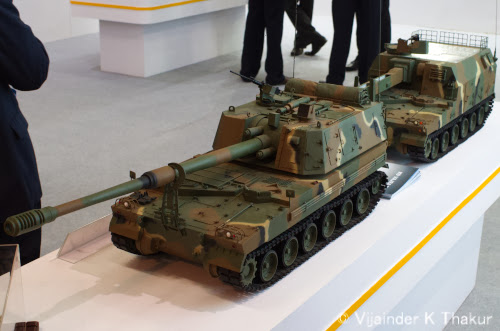
L&T and STW's 155-mm/52-cal tracked SP gun and loader

L&T displayed a model of it proposed K9 Vajra-T gun and its at their pavilion at DefExpo 2014.

Larsen & Toubro Limited (L&T) and Samsung Techwin (STW) Co of South Korea announced on March 29, 2012 during DefExpo 2012 that they would cooperate to develop a 155-mm/52-cal tracked, self propelled artillery for the Indian Army.

The Indian Army plans to acquire 100 155-mm/52-cal Tracked SP (Self Propelled) Guns under its artillery modernization program. MOD floated a tender inviting India's Tata Power SED, Larsen & Toubro, BEML and Rosoboronexport to bid. L&T submitted a bid as lead partner in 2011.

The proposed L&T gun is a localized version of STW's K9 Thunder Self-Propelled Howitzer, claimed as the ‘largest and most successful’ of the 155 mm/52 caliber self-propelled artillery systems globally today.

L&T, as the lead partner, would localize the K9 using key technologies from STW, and manufacture it at its defense equipment facility at Talegaon near Pune.
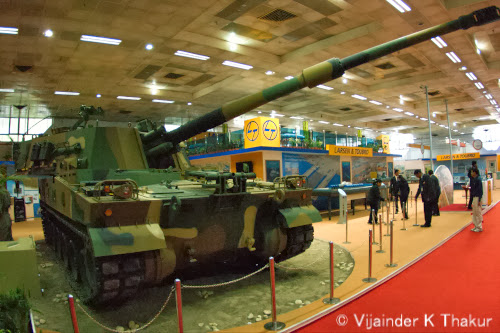
K9 Thunder at DefExpo 2012

The production version of the gun will feature over 50 per cent local content.

The K9 Vajra-T can fire Extended Range Full Bore Boat Tail (ERFB BT) and Extended Range Full Bore Base Bleed (ERFB BB) projectiles to ranges of 30-km and 40-km respectively. It can fire a K315 HE Rocket Assisted Projectile (RAP) to a range exceeding 50-km. The range using a standard M107 high explosive (HE) projectile is 18-km.

The Vajra-T has a direct fire sight to engage ground targets. It can engage a tank size (2.3-m x 2.3-m) target at 1-km.

It can fire a burst of 3 rounds in 30-sec, 6 to 8 rounds a minute for 3-min. Sustained rate of fire is 2 rounds per minute for one hour.

Equipped with a 1,000-hp engine, the K9 Vajra-T has a power-to-weight ration of 21-hp/ton. It's equipped with a hydro-pneumatic suspension system and can achieve a max speed of 67-kph.

The SP gun features an automatic fire control system (AFCS), powered gun elevation/depression and traverse system. The gun can be laid using a data link or on-board fire-control equipment. The automatic loading system receives projectiles from the storage position and places them on to the ammunition tray for ramming.

The driver has 6.5" video display for day driving  and an uncooled thermal imager for night driving.

The Ammunition Resupply Vehicle (ARV), K10, has a max transfer rate of 12 rounds / min. It can carry 104 rounds (Projectile) and 504 units (Charge).

Rustom-1 MALE-UAV Awaiting Army Order

Rustom-1 at DefExpo-2012
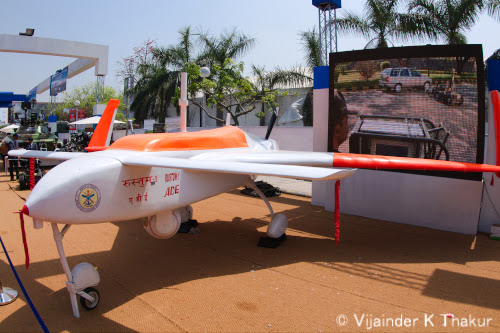
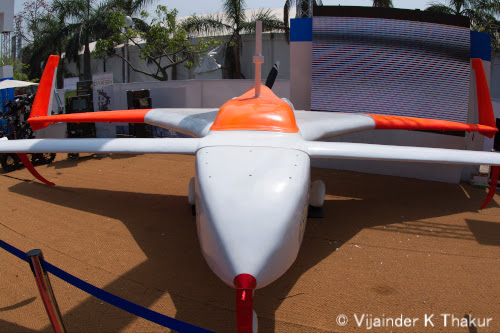
With Rustom-2 being one of the star attractions of DefExpo 2014 there was literally no place for the Rustom-1 in the display area outside the India Pavilion, but the project is well and kicking.

The all composite Rustom-1 based on the Rutan Long-EZ home built aircraft design and powered by 160-hp Lycoming engine has flown 30 time and logged 34 hrs, a DRDO rep told IDP Sentinel on February 8, 2014.

Rustom 1 has flown at an altitude of 20,000-ft and demonstrated an endurance of 5-hr. At the request of the Indian Army, the endurance is being stepped up to 8 to 10-hr. The aircraft cruises at 80-kt to 100-kt and has a max speed of 190-kt in a dive.

Presently, the aircraft needs to be externally piloted during take-off and landing. The Army has asked for autonomous take-off and landing (ATOL) capability, which the ADE is working on, both for Rustom-1 and Rustom-2.

Rustom-1 at DefExpo 2014

DRDO is currently pitching Rustom-1 for


  1. Reconnaissance & Surveillance
  2. Target Acquisition
  3. Target Designation
  4. Communication Relay
  5. Battle Damage Assessment
  6. Signal Intelligence.


The aircraft has a payload capacity of 60-kg. The wing has a hardened joint that will allow the UAV to carry light armament along with its EO sensors.

Increased endurance and ATOL would be compelling upgrades that would result in Army orders and pave the way for weaponizing the platform.

DRDO developed Rustom-1 as a replacement for the Israeli Searcher UAV that is used by all the three services. The Rustom-1 is claimed to have a much lower acoustic signature than the Searcher.

For additional details on Rustom-1 please visit the link below.

Rustom-1 MALE (IDP Sentinel)


Saturday, February 8, 2014

Arjun Catapult at DefExpo 2014

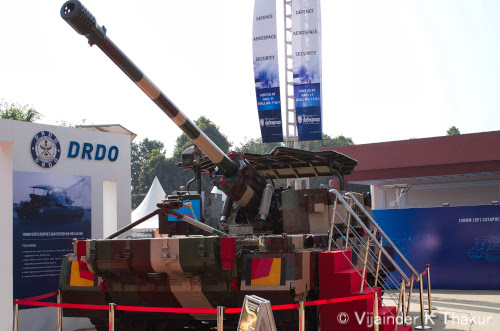
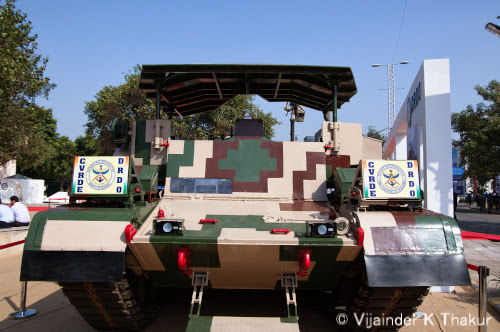
Arjun Catapult 130-mm M45  Tracked SP Gun at DefExpo 2014

DRDO has designed and developed the Arjun Catapult system by mounting the 130 mm, M-46 Catapult Russian gun on an Arjun Mk-1 MBT chassis.

The system has a crew of 8 and a combat weight of 54-t.

Earlier, DRDO developed a similar system called Vijayanta Catapult by mounting the gun on the Vijayanta chassis. Two Indian Army (IA) regiments are equipped with Vijayanta Catapult Guns. The IA intends to extend the life of the 130 mm Catapult system and mount it on the Arjun MBT, to address immediate and interim requirements.

This might look like the backside of the Arjun Catapult, but it is actually the front side, as is evident from the windshield on the left for the driver. The gun faces the backside. The large recoil of the gun forced the arrangement!


DRDO's Combat Vehicles Research and Development Establishment (CVRDE) developed the Arjun Catapult system in quick time, fielding the system for user trials in November 2013, within just four months of receiving the order from the Army.  DRDO says the first prototype performed well during trials, but admits further improvements are under incorporation to firm-up the configuration for production.

A user-assisted General Staff Qualitative Requirements (GSQR ) trial of the system is likely to to be held at the Pokharan Field Firing Range in Rajasthan during April-May 2014.

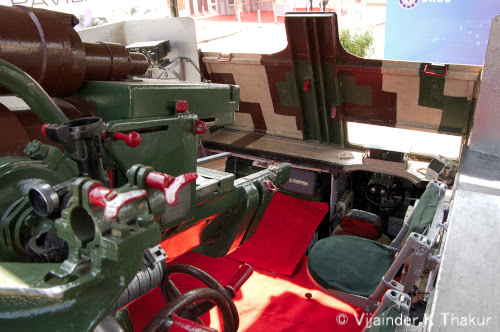
The driver's seat, facing in the opposite direction to the gun.


The Army is expected to place an order for 40 catapult gun systems.

K Sreethar, Head - Artillery, CVRDE, says, the Arjun Catapult has better stability, accuracy and consistency than the Vijayanta Catapult

“The gun barrel is mainly used to engage in indirect fire up to a maximum range of 27.4 km. It can also be fired directly on targets up to 1.4 km range. It can be fired at various angles of elevation as well. The catapult has STANAG Level II protection (a NATO standardization agreement) for the crew. It has low silhouette and has integrated fire fighting detection and suppression system,” he adds.

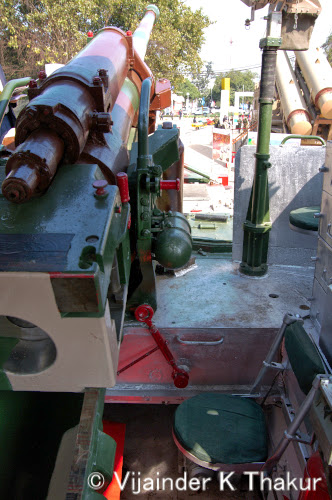
Looking down the barrel from one of the loader's seat.


The system features GPS and night vision devices for both the driver and the commander. The ergonomic design of the crew compartment factors in anthropometric data of Indian troops.

Arjun Catapult has excellent mobility because of its high performance engine, robust and effective transmission system and Hydropneumatic suspension.

The 130-mm M-46 rifled gun has a maximum range of 27.4-km.