|
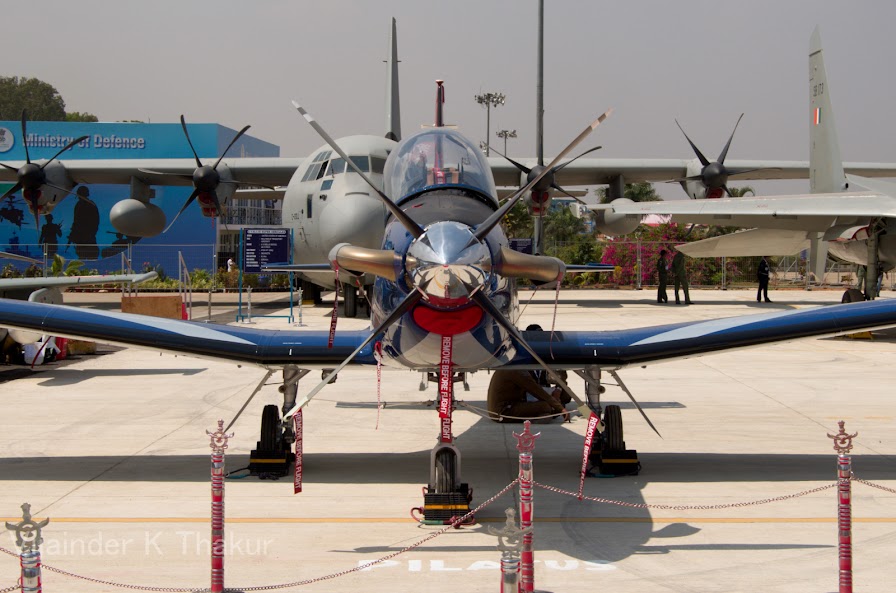
| Pilatus PC-7 Mk-2 at Aero India 2013 in Bengalure |
The IAF in 2013 acquired a modern Basic Flying Trainer (BFT) - Pilatus PC-7 Mk-2. The serivce is very happy with the aircraft, for which it paid good money from its budget, money that it could have well spent on acquiring more fighters to arrest the downward spiral of its fighter squadron strength, and thereby keep the country militarily strong! (Okay, maybe I made that too dramatic!)
The IAF was forced to
Having inducted the PC-7 Mk-2 and found it worthy of the money spent on it, the IAF now wants to place an additional order for 106 aircraft, as a follow-up to the initial order for 75 aircraft.
When the GOI approved procurement of 75 Pilatus PC-7 Mk-2 in May 2012, it was agreed between IAF, MOD and Hindustan Aeronautics Ltd. (HAL) that a follow-up order for 106 aircraft would be placed on a joint venture between HAL and Pilatus.
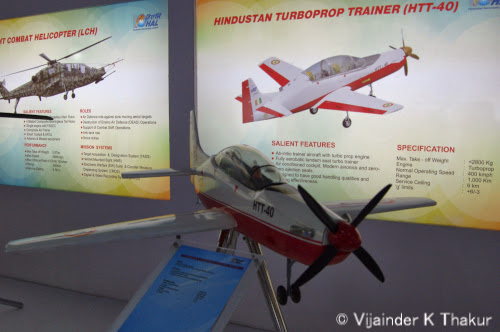
HAL has now backed out of the agreement and is cheekily offering to sell its still on paper HTT-40 BFT to the IAF. The IAF isn't amused, and for good reasons.
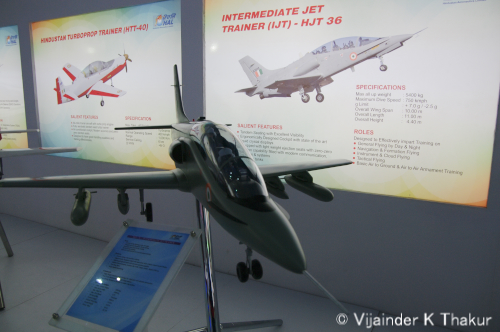
Going by HAL's past record, there is no chance the HTT-40 would be ready in time to meet the IAF's requirement. (Actually, going by past HAL record, the HTT-40 may never be ready - the Intermediate Jet Trainer (IJT) HJT-36 Sitara being a case in point. Having invested a lot of money in its development and waited long years, the IAF is now on the verge of giving up on the Sitara which has serious low speed handling and spin issues. Frustrated by the lack of progress on the project, the IAF recently floated a RFI for an alternative aircraft.)
The IAF doesn't want HAL to fritter away its very limited aircraft design talent on developing a new aircraft (HTT-40); instead it wants HAL designers to focus on bringing the Sitara project to fruition quickly, so that the IAF money invested in the project doesn't go waste.
Deferring to the IAF's preference for more PC-7 Mk-2, not HTT-40, aircraft, MOD on March 15, 2014 sought information from Indian companies for supply of 106 Pilatus PC-7 Mk-2 under the category of Buy and Make (Indian) as stipulated at Para 4(c) of DPP-2013.
Competing Indian vendors are expected to form a joint venture with Pilatus Aircraft Ltd, Switzerland and supply an initial lot of aircraft with support equipment in flyaway condition under the Buy portion of the procurement, and the remaining aircraft and equipment through licensed production/indigenous manufacture in India under the 'Make' portion.
The IAF wants the supply of the 106 aircraft to start in 2015-16 and be completed by 2020-21.
The first 10 of the 106 aircraft would be bought off the shelf, 28 in semi knocked down kits, and 68 in completely knocked down kits.
A recent press report suggests that the RFI has not generated any response from Indian private companies. The report quotes an unnamed official from Tata Group as saying that the order quantity isn't sufficient to interest private companies.
The executive says that "under the tender’s terms all interested Indian companies will have to first talk to Pilatus and then calculate their cost. Pilatus would be the main beneficiary under the Indian program, leaving little profit for the domestic firms."
I am skeptical about the report for several reasons. Firstly, a shadowy executive in "Tata Group" (Which isn't a company to begin with; the term alludes to the Tata group of companies) speaking on behalf of the entire Indian private industry sort of freaks me out. It doesn't sound like good reporting to me.
Secondly, an order for 106 aircraft with just 50% local make and assured TOT isn't trivial by any reckoning. It's a dream come true for any private sector wannabe aircraft manufacturer. HAL considered the order large enough in 2012. Isn't the private sector supposedly more efficient? Seriously, does the reporter know of any private aircraft manufacturer that started with a government order for 106 aircraft, that too for an aircraft that the company invested nothing in developing?
Thirdly, a small order can agreeably push up unit costs, but if the client is ready to pay the costs what is the problem? How can someone make a statement that there will be little profit for domestic firms when the contract price hasn't even been negotiated? Why would a private firm refuse to even discuss the issue with MOD?
Fourthly, what possible problems does the executive envisage in talking to Pilatus? Is an all paid for trip to Switzerland that daunting? (Talk to me. Send me to Switzerland. My math is good enough for cost calculations!)
Finally, we are talking about a RFI not a RFP. So why is the executive talking about a tender?
Is it that the shadowy executive doesn't exist?
Surprise! Surprise! The report ends with a not too subtle plug for HAL's HTT-40!
My own reading of the situation is that the IAF is going to stick with the Pilatus PC-7 Mk-2, because it's the sensible thing to do. The service rightly doesn't want to add another aircraft to its inventory, pushing up revenue costs. Local manufacture or outright purchase, the PC-7 Mk-2 is going to be cheaper than the HTT-40, because the latter's price tag would include the entire development cost, which is not the case for the PC-7 Mk-2. I have already touched upon the need for HAL to focus on the Sitara, not to mention improve its design, manufacture and support capabilities.
In January 2014, it was reported that the IAF has sought MOD nod for producing the Pilatus PC-7 Mk-2 trainer at 5 BRD in Sulur, near Nashik. The IAF proposal is reportedly backed by Pilatus, which sent a team to Sulur to inspect the facilities available there. The cost of producing the aircraft at Sulur is assessed as being comparable with the price paid for the 75 aircraft purchased earlier.
Hopefully, the IAF would not be pushed into taking such an extreme step. But if it is, the country and MOD in particular must back the IAF. A push for indigenous military hardware manufacture can only succeed if poor performance is not rewarded, as has been the case with HAL in the past.
On a humorous aside, if MOD really wants the IAF to rethink its additional PC-7 Mk-2 buy, MOD should order HAL to manufacture the aircraft. The IAF is more likely to lose its enthusiasm for an aircraft, if it's manufactured by HAL!
Update on April 24, 2014
On April 24, 2014 the IAF released a corrigendum to its initial RFI extending the last date for acceptance of a response to July 21, 2014. The corrigendum is likely to have been issued in response to a vendor request.
It's likely that Pilatus Aircraft will itself tie-up with an Indian company and clinch the additional order. The company's Deputy CEO Jim Roche told Express in a e-mail interview in April 2014 that the company has set “a short-term objective” for itself “to use the opportunity afforded by the successful trainer aircraft deal to establish production capabilities in collaboration with local industry players, such as HAL, BEL and other like companies” in India.
He said the original contract already had a provision for 50 per cent additional aircraft -- numbering 37 planes -- to be procured under the same terms and conditions as the current batch of 75 being delivered by Pilatus.
“This provision is still valid till 2015. Should there be a requirement to supplement that provision, I am quite sure that the government of India will inform us accordingly in good time to avail of the advantageous terms and conditions of the current contract,” he said.
Pilatus PC-7 Mk II Basic Trainer for IAF - IDP Sentinel