Showing posts with label UAV. Show all posts

Saturday, June 6, 2026

The Next India-Pakistan Conflict Will Be Won by Drone Killers


The ability to defeat drones is increasingly proving to be more important than the ability to field them. That is perhaps the most important lesson emerging from the wars in Ukraine and Iran—a lesson Indian military planners need to factor into preparations for the inevitable next conflict across our western border.

According to General Oleksandr Syrskyi, Commander-in-Chief of the Armed Forces of Ukraine, most Russian Shahed drones and other aerial attack systems neutralized by Ukrainian forces are now being brought down by interceptor drones.

Not helicopter gunships, armed light trainers, directed-energy weapons (DEWs), low-cost air-defence missiles, or specialised anti-aircraft guns firing programmable airburst ammunition. No—just interceptor drones.

Operationally effective interceptor drones have been around for more than a year. It is time DRDO took note of them.

Interceptor drones are optimised for low cost and typically destroy their targets by ramming them. Some variants employ a small warhead to increase the probability of a successful interception.

Currently, the three most prominent interceptor drones operating in Ukraine are:

* Sting (Ukraine) * Merops AS-3 Surveyor (United States) * Yolka (Russia)

In the following sections, we examine their features, capabilities, and key differentiators.

FPV Interceptor Drones

Interceptor drones were initially FPV (First-Person View) drones that relied on real-time radio control and live video feeds.

Using RF sensors, it is possible to detect the communication link between a drone and its operator, allowing triangulation and pinpointing of the operator's location. The control link can also be jammed or spoofed using electronic warfare (EW) systems.

FPV drone operators face significant danger because they must remain relatively close to the front line to maintain a strong signal. This exposes them to artillery fire, snipers, counter-drone attacks, and detection through radio-frequency triangulation.

Russian forces exploit this vulnerability by pairing Geran-2 drones. If an FPV interceptor is launched against one Geran-2, the second drone can use onboard sensors to locate the operator and attack immediately.

Ukraine's Sting Interceptor Drone

The most successful Ukrainian-developed interceptor drone currently in service is the Sting. The low-cost drone (approximately $2,000–2,100) uses a quadcopter architecture and features a 3D-printed aerodynamic airframe shaped like a bullet.

The Sting is capable of speeds of approximately 280–343 km/h. It is designed primarily as a kinetic interceptor, with the operator steering it directly into the target. Guidance is provided through day and thermal cameras, with possible sensor fusion from radar systems.

Ukraine began employing the Sting in combat during the spring of 2025, with widespread deployment by June 2025. The first publicly documented success occurred in April 2025 when footage of a Sting downing a Shahed-type drone went viral.

Sting Interceptor Drone Photo: The Telegraph


Perhaps the most remarkable feature of the Sting is its ability to be operated remotely from hundreds or even thousands of kilometres away.

Like other FPV drones, the Sting maintains a line-of-sight link to a forward control station. However, this forward station functions primarily as a relay node, connecting the drone to its pilot via Starlink's low-latency internet network. As a result, the pilot can be located virtually anywhere in the world.

Ukrainian operators typically control the drone from hardened shelters. The architecture also allows Sting drones to be launched from unmanned surface vessels (USVs).

Autonomous Interceptor Drones

The next generation of interceptor drones is being designed to operate autonomously using AI-powered machine vision, both during the day and at night.

These drones can independently detect, track, and engage targets without continuous human involvement. As a result, they do not require a vulnerable control channel that can be jammed or spoofed.

In effect, they are launch-and-scoot weapons that remove the operator from the battlefield and significantly reduce operational risk.

Russian Yolka Drone

Russian forces began operational deployment of the autonomous Yolka interceptor drone in early 2026.


The Yolka can be hand-launched, enabling widespread and highly distributed deployment. Once launched in the direction of a target, it operates autonomously.

Weighing approximately 1.3 kg, the Yolka is also based on a quadcopter architecture similar to the Sting. It can reach speeds of 200–250 km/h and operate at altitudes of up to 2 km.

Yolka vs Sting

The Yolka is significantly lighter and cheaper than the Sting, with an estimated cost of roughly $500 compared to the Sting's $2,000-plus price tag.

However, these savings come with trade-offs. The Yolka's range is limited to approximately 2.5–4 km, compared with the Sting's estimated 25–37 km range. It is also slower than its Ukrainian counterpart.

Merops AS-3 Surveyor

In addition to the Sting, Ukrainian forces are employing the American-made Merops AS-3 Surveyor, a sophisticated but significantly more expensive interceptor system.

Unlike the Sting and Yolka, the AS-3 requires catapult launch, reducing deployment flexibility. However, its conventional fixed-wing airframe enables much higher aerodynamic efficiency and speed.

The truck-portable counter-drone system consists of:

* Radar and electro-optical sensors for target detection and tracking * A command-and-control station * Pneumatic or mobile launch platforms * A fleet of Surveyor interceptor drones

The AS-3 derives its effectiveness from a combination of AI-enabled autonomy, high speed, and resistance to jamming.


After launch, the drone is initially guided using the sensors of the Merops system. During the terminal phase, it relies on onboard infrared and RF sensors combined with AI-powered machine vision.

The drone can continue homing in on its target even when satellite navigation and communication signals are jammed.

AI-powered machine vision, combined with the fusion of infrared and RF sensor inputs, is central to the Surveyor's effectiveness.

With a maximum speed of approximately 280 km/h, the AS-3 is capable of overtaking Russian Geran drones.

The current unit cost is estimated at around $15,000, although this is expected to fall below $10,000 as production scales.

Quadcopter vs Fixed-Wing Interceptors

The Sting and Yolka are quadcopter drones. They are simpler and cheaper to manufacture but are aerodynamically less efficient because they lack wings to generate lift and glide efficiently through the air.

Consequently, quadcopters are not optimised for sustained high-speed flight.

To intercept faster fixed-wing drones, quadcopter interceptors often position themselves above the incoming target. At the appropriate moment, they dive, converting altitude into speed and enabling a successful interception.

Future Developments

Interceptor-drone development is currently focused on increasing speed through the adoption of fixed-wing designs such as the AS-3 Surveyor.

Reusability is another area receiving considerable attention.

Fixed-wing drones can achieve higher speeds in level flight and generally manoeuvre more efficiently during the terminal interception phase.

Russian forces have already begun mass deployment of fixed-wing interceptor drones, including a dedicated air-defence variant of the Molniya family known as the Molniya-PVO. The drone is reported to be capable of speeds between 220 and 330 km/h.

Like the Yolka, the Molniya can be hand-launched. Alternatively, it can be launched using a lightweight catapult.

Conclusion

Ukraine seized an early lead in interceptor-drone technology with the Sting. Russia has largely closed the gap with the rapidly evolving Yolka and is now introducing fixed-wing interceptors such as the Molniya-PVO.

One important point stands out. Starlink has given Ukrainian forces a low-latency communications advantage that Russia is unlikely to match for several years.

There is another lesson for Indian defence planners. Rapid advances in drone autonomy are being driven by access to high-performance AI semiconductors and resilient communications networks.

India remains a long way from sovereign access to either low-latency broadband networks comparable to Starlink or the cutting-edge AI chips needed to support the next generation of autonomous combat systems.

Copyright © Vijainder K Thakur. First published on Thumkar.

Tuesday, December 2, 2025

Heron Mk.2: Israel’s Surprise Turnaround on Technology Transfer to India


The Economic Times reported on December 1, 2025, that talks are underway for additional procurement and local manufacture of Heron Mk.2 drones.

A source told ANI, “All three branches have decided to purchase the Mk-II.”

The discussions are centered on IAI’s obligation to meet the Indigenous Content (IC) standards mandated for the local manufacture of MALE UAV systems. The requirement calls for 60 percent local work and manufacturing.

Eventually, the Heron Mk.2 is expected to be weaponized with locally manufactured precision-guided munitions.

India and Israel have been in talks since 2016 to weaponize the IAF’s existing inventory of Searcher and Heron drones. However, little progress has been made because of Israel’s reluctance to share critical drone technologies.

In early February 2020, reports indicated that IAI and HAL would sign a contract during DefExpo 2020 to manufacture Heron Mk.2 drones in India, with 100 units planned to meet the requirements of the defence services. Nothing materialized from this proposal.

Israel Aerospace Industries (IAI) is now actively bidding on India’s ₹30,000-crore tender for 87 MALE UAVs, offering deep transfer of technology for 100% local assembly of Heron Mk.2 airframes, engines, avionics, and payloads in India.

One possible explanation for India’s renewed interest in locally manufacturing the Heron Mk.2 could be the DRDO’s recent success in developing weaponization technologies, including sensors, drone-launched PGMs, and drone-based weapon-launch computer systems.

Copyright © Vijainder K Thakur. First published on Thumkar.

Tuesday, April 4, 2017

IAF Heron TP-XP: A Strategic Platform, Not Just an Armed Drone

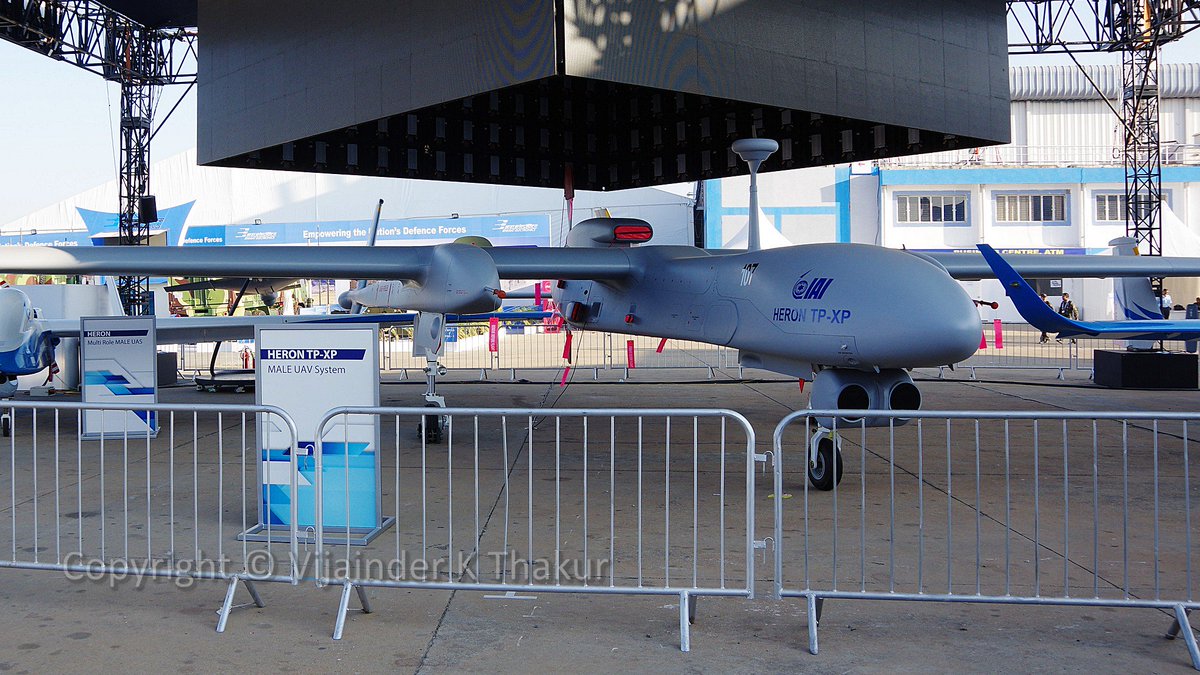
Heron TP-XP at Aero India 2017

IAI (Israel Aircraft Industries) introduced the Heron TP-XP, a special export variant of Heron TP, at Aero India 2017 in Bengaluru, India. (The 'special' probably refers to a customized IAF variant.)

The Indian MSM's  (Main Stream Media's) stress on the Heron TP-XP's attack capability is rather misleading. The acquisition has a strategic dimension that is much more important.

The IAI website states that "Heron TP-XP, the latest derivative of the Heron family, is an advanced long range, long endurance (MALE) UAS, designed to perform a variety of strategic missions with a high level of reliability."

An IAI press release before Aero India 2017 stated that the "Heron TP-XP constitutes a multitasking, multi-payload strategic air superiority aircraft, integrating the most advanced of IAI technologies." 

Notice that the word strategic features in both statements describing the Heron TP-XP.  The word armed features in neither.

The reason isn't difficult to understand. With its 30-hrs plus endurance, 45000-ft operational ceiling, and all weather, day and night surveillance capability the Heron TP-XP is a veritable satellite that can be stationed above a battlefield. 

EO (Electro Optical) / IR (Infra-red) sensors under its fuselage provide real-time vision of the battlefield under all lighting conditions. A LRF (Laser Range Finder) facilitates precise distance measurement to provide real time targeting information using a satellite communication link. 

A LD (Laser Designator) allows a target to be illuminated for stand-off strike by a fighter aircraft using laser guided bombs.

For surveillance, the TP-XP can be fitted with a Synthetic Aperture Radar (SAR) or a MPR (Maritime Patrol Radar).

ELINT / ESM payloads facilitate electronic snooping and spoofing. 

If you don't find the above roles strategic enough, here comes the clincher. The Heron TP is capable of missile defense and may just be the platform to put some sense into tactical nuke brandishing adversary generals! A Heron TP would be able to detect a Nasr TEL (Transporter, Erector, Launcher) much before it comes within striking range of an advancing armor column, allowing the TEL to be targeted using  coordinates beamed by the UAV 

There would be other significant pay-offs from the Heron TP acquisition. The UAV features ATOL (Automatic Taxi-Takeoff and Landing) systems and triple redundancy for maximal safety and reliability, features that DRDO is desperately trying to incorporate in its Rustom-2 MALE UAV.

It's clear that the purchase of 10 Heron TP-XP MALE UAVs from Israel's IAI would be a landmark acquisition, but hardly for the reason that the MSM is highlighting.

The deal is reportedly worth $400 million, which would put the cost of each UAV at $40 million.

It would be possible to lightly arm the Heron TP-XP to strike terrorist targets, but that wouldn't be optimal utilization of a strategic platform valued at $40 million.


Thursday, October 29, 2015

RCI Developing 275-kgf Thrust Cruise Missile Engine

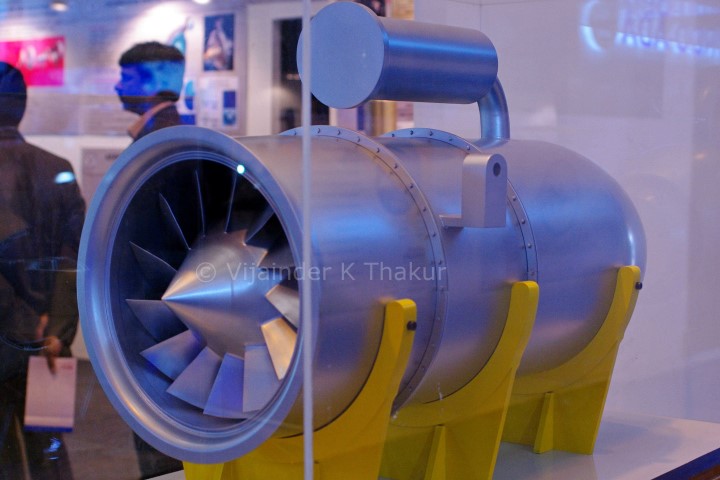
GTRE developed Manik 425-kgf thrust turbojet at Aero India 2015

RCI is developing a 275 kgf thrust Small Gas Turbine Jet Engine (SGTJE) to power a UCAV capable of cruising at 0.8M at SL. 

RCI will take assistance from NAL's Propulsion Division for design and analysis, engine cycle analysis and configuration of the turbojet engine. 

RCI has also sought private sector, Indian or foreign, participation in the detailed design of the 275-kgf thrust SGTJE. 

Project duration is specified as one year from project start.

Possible Application

The engine is required to be air start capable suggesting it is being developed for a cruise missile. The 275-kgf thrust requirement suggests a relatively smaller, possibly air launched, cruise missile. 

It maybe noted that the Nirbhay, powered by a 500-kgf thrust Saturn engine, would hopefully be replaced by the 425-kgf Manik engine being developed by GTRE. 

Other Cruise Missile Engine Projects

Besides RCI and GTRE, HAL is also developing a 400-kgf thrust Small Gas Turbine for Strategic Application,, based on the PTAE-7 which powers the Lakshya PTA.

IDP Sentinel members can read additional details and specifications of the SGTJE at the link below

Wednesday, October 28, 2015

Rustom-2 MALE UAV Update

Rustom-2 1:1 scale model at DefExpo - 2014
DRDO plans to display a Rustom-2 1/3 rd scale model during Republic Day 2016 and has released a RFP for building the model.

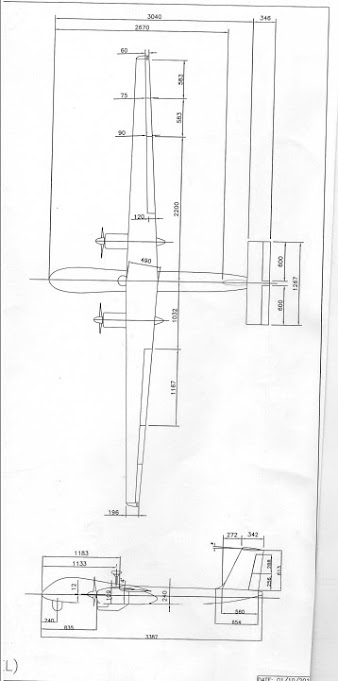
Based on the dimensions of the model published in a RFP, the Rustom-2 MAL UAV has a wingspan of 20.4m and length of 10.1m.

In comparison, IAF's Israeli developed Heron MALE UAV, which the Rustom-2 is being developed to replace, has a wingspan of 16.6m and length of 8.5m.

Rustom-2 1/3 rd scale model dimensions


It remains to be seen if the Rustom-2's larger dimensions translate into better performance and capabilities. DRDO says the Rustom-2 would be able to carry 350-kg payload against the Heron's 250-kg, but the single engine Heron has a marginally better (40hr vs 35hr) endurance.


The Rustom-2 will have a strike capability. It will loiter autonomously at high altitudes performing ISR with its SAR nd EO sensors. When a target is identified, it will either illuminate the target with a laser designator for other strike aircraft, or descend to lower altitude and attack the target with its own air-to-surface missiles.

DRDO's decision to display the scale model raises hopes of a first flight in the near future. DRDO had initially hoped to test fly a manually piloted variant of the UAV by June 2014. It now appears that the test flight program has been pushed back till a ATOL is developed for better flight safety.

For additional information visit the link below

Rustom-2 MALE UAV (IDP Sentinel)


Saturday, October 18, 2014

HAL, DRDO to Partner in Rustom UAV Project

Rustom-2 MALE UAV at DefExpo-2014

HAL will partner with DRDO in the Rustom-1 and Rustom-2 projects as part of HAL's new focus on UAVs DRDO Chief Chief Avinash Chander told Unmanned magazine in a recent interview.

Earlier in June, 2014, HAL Chief Dr. RK Tyagi announced in a press release that HAL will take-up more activities in Unmanned Air Vehicle (UAV) and Unmanned Combat Air Vehicle (UCAV) business segments.

DRDO Chief Avinash Chander gave the following additional insight into DRDO's efforts at meeting growing UAV requirements of the nation, particularly its armed forces.


  • DRDO is developing a supersonic target drone as a follow-up to Lakshya-2.
  • The Navy has projected a requirement for a 10-t class RUAV. DRDO is developing technology for the RUAV but is yet undecided on whether to convert an existing unmanned platform (like Chetak) to a RUAV, or develop a RUAV from scratch.
  • DRDO is actively working on a solar powered ISR UAV capable of remaining aloft for weeks at a time. It's also developing technology for a solar powered ISR airship capable of remaining on station at an altitude of 50-60 km for months at a stretch.
  • In the future, DRDO plans to pursue development of UAV swarms which theoretically are more resilient and adaptive in performing their tasks.


It maybe noted that HAL is also independently working on a RUAV project in partnership with Israel. The project involves converting a Chetak helicopter into an unmanned air vehicle. The Indian Navy has projected an initial requirement for 8 such helicopters. The order size may eventually grow to 40 aircraft.

The unmanned Chetak uses a flight control system developed by IAI using a Bell Helicopter 206.

The Malat unmanned air systems (UAS) division of IAI is working with HAL on the project under a wider cooperation agreement.

Here is the DRDO Chief's interview with Unammned magazine.

Wednesday, October 1, 2014

DRDO Developing Gagan DGPS Based Automatic Take Off and Landing (ATOL) System


Rustom-1 MALE at DefExpo-2012

DRDO plans to carry out flight trials of a DGPS based Automatic Take Off and Landing  (ATOL) System.

Differential Global Positioning System (DGPS) is an enhancement to Global Positioning System that improves GPS location accuracy from the 15-meter nominal to an incredible 10 cm in a well implemented system!

The DRDO developed ATOL system would use Gagan DGPS developed by ISRO and DGCA which is now operational countrywide.

DRDO has equipped a Rutan Long Ez Manned Aircraft (YN7501) with Accord Technologies NexNav GPS-SBAS receiver and a GPS receiver with antenna for the trials which would be conducted at HAL Airport and Kolar Runway.

The Rustom-1 MALE developed by DRDO is basically an unmanned version of the Rutan Long Ez, a home built aircraft with a canard layout designed by Burt Rutan's Rutan Aircraft Factory.

Rustom-1 MALE has roughly the same performance as the Israeli Searcher UAV which is widely used by the Indian Army (IA) and the Indian Air Force (IAF). The IA has told DRDO that it will place orders for Rustom-1 only if the UAV is equipped with an ATOL system, as take-off and landing using an external pilot are accident prone.

DRDO's Aeronautical Development Establishment (ADE) has initiated procurement of the Cassidian MDR-NES (MLDRF) for fitment on the Rustom-1 to facilitate automated flare-out and landings. The GAGAN DGPS based system will facilitate taxying, take-off and alignment with the runway center line during approach.

ADE has sought vendor assistance in conducting the flight trials spanning around 10 hours through a recently released RFI. The selected vendor will conduct and manage the manned flights so that ADE can focus on the ATOL system performance.

Additional Reading


Tuesday, June 3, 2014

ADE Initiates Structural Design Optimization of Rustom-II Composite Airframe

Rustom-II MALE UAV at DefExpo-2014


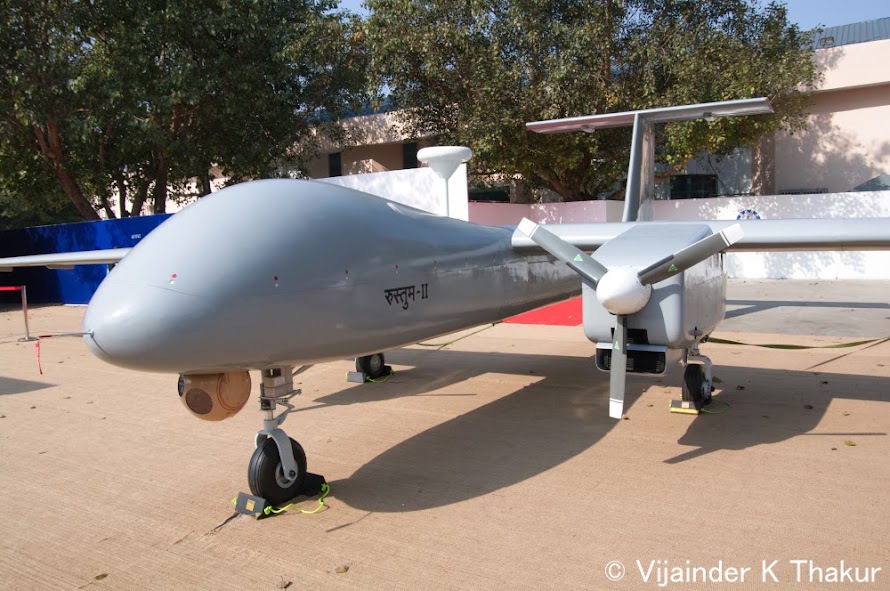
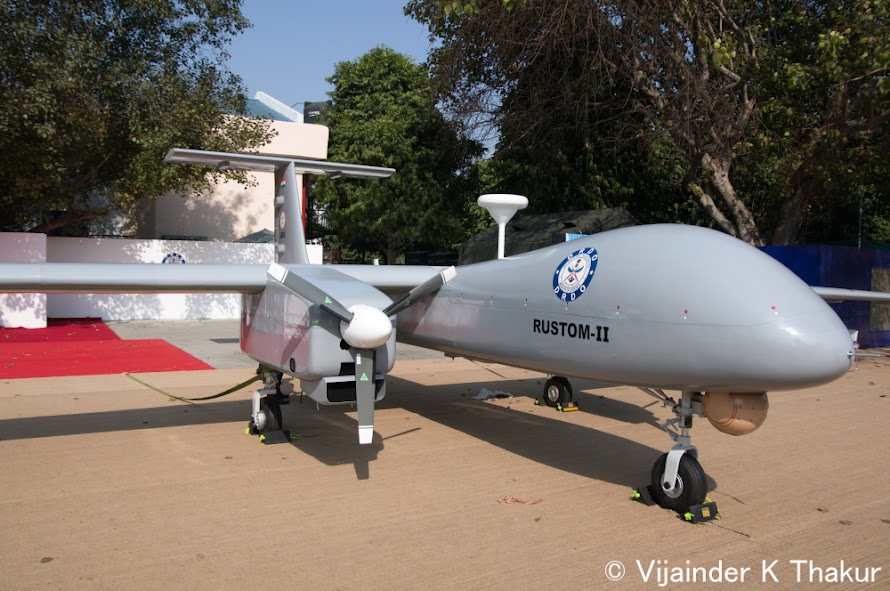
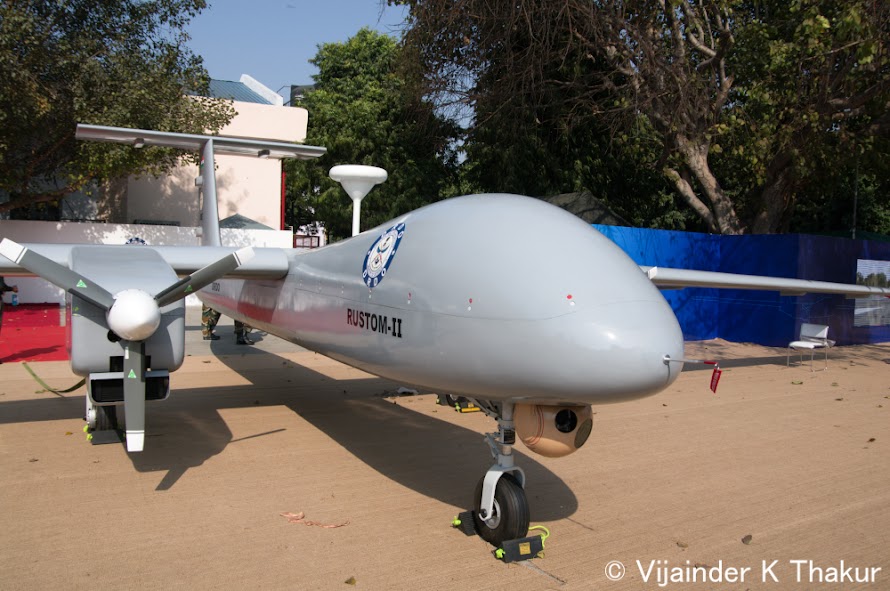
ADE has initiated a two year project to optimize the Rustom-II composite airframe, an indication perhaps of ADE's confidence in the design of its Medium Altitude Long Endurance (MALE) UAV and the UAV's suitability to the emerging needs of the Armed Forces.

The Rustom-II airframe is essentially FRP composite sandwich structure with metallic components. The airframe and its components are primarily made up of Carbon / Epoxy Composites with Acrylic foam as Core material in Sandwich structures with selective use of Glass/ Epoxy Composites. The metallic components are of Sheet metal or Machined. Integration of Airframe modules is carried out using standard fasteners, self plugging rivets and bonding.

Redesign of the airframe would be carried out using simulation and structural testing, ensuring weight optimization.

ADE recently released a RFI seeking vendor support for creating a team comprising composite airframe design expert, FEM analyst, structural testing expert, structural test rig designer, expert in hand calculation for stressing, based on stress flow weight optimization etc.

Rustom-II has been undergoing taxi trials and its first flight is expected to take place this year. DRDO aims to get the Rustom-2 certified by 2018. Optimization of the design and generation of structural strength and load data through simulations will be facilitate certification.

IDP Sentinel members can read more about the Rustom-II project at the link below

Rustom-2 MALE UAV (IDP Sentinel)


Thursday, February 20, 2014

Mini UAV Competitors for Indian Army Procurement


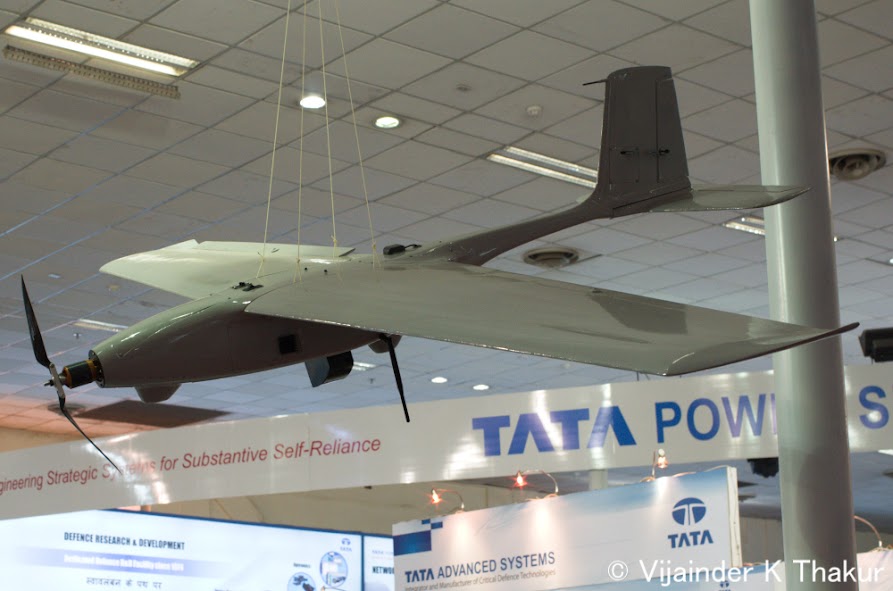
TAS Mini UAV on display at DefExpo 2014

The Indian Army plans to induct about 600 mini UAV systems comprising 1,400 to 1,600 UAVs with ISR and targeting data capabilities. The Army released a RFI against the requirement in the first quarter of 2011.

If you have access to IDP Sentinel you can read the QRs stipulated for the Mini UAVs here, and also peruse the full RFI.

Tata Advanced System (TAS) and Israel Aerospace Industries (IAI) are likely to emerge as top contenders for the contract.

TAS is a front runner having recently won a contract to supply Mini UAV'S to the Army's Northern Command. The company displayed its hand launched, field recovered mini UAV (above) at the DefExpo 2014.


IAI Mini Panther at Aero India 2011

IAI has been plugging its tilt rotor VTOL UAV, Mini Panther, at Aero India and DefExpo for years now.

The Mini Panther doesn't just take-off and land vertically, it does so automatically, reducing the likelihood of human error caused mishap. (The TAS UAV would suffer wear and tear during each field landing.)

The IAI UAV can carry a payload of 2-kg, has a operating range of 20-km, endurance of 2-hr and loiter speed of 40-k.


Mini-UAV Systems for Indian Army - IDP Sentinel

Sunday, February 9, 2014

Rustom-1 MALE-UAV Awaiting Army Order

Rustom-1 at DefExpo-2012
With Rustom-2 being one of the star attractions of DefExpo 2014 there was literally no place for the Rustom-1 in the display area outside the India Pavilion, but the project is well and kicking.

The all composite Rustom-1 based on the Rutan Long-EZ home built aircraft design and powered by 160-hp Lycoming engine has flown 30 time and logged 34 hrs, a DRDO rep told IDP Sentinel on February 8, 2014.

Rustom 1 has flown at an altitude of 20,000-ft and demonstrated an endurance of 5-hr. At the request of the Indian Army, the endurance is being stepped up to 8 to 10-hr. The aircraft cruises at 80-kt to 100-kt and has a max speed of 190-kt in a dive.

Presently, the aircraft needs to be externally piloted during take-off and landing. The Army has asked for autonomous take-off and landing (ATOL) capability, which the ADE is working on, both for Rustom-1 and Rustom-2.

Rustom-1 at DefExpo 2014

DRDO is currently pitching Rustom-1 for


  1. Reconnaissance & Surveillance
  2. Target Acquisition
  3. Target Designation
  4. Communication Relay
  5. Battle Damage Assessment
  6. Signal Intelligence.


The aircraft has a payload capacity of 60-kg. The wing has a hardened joint that will allow the UAV to carry light armament along with its EO sensors.

Increased endurance and ATOL would be compelling upgrades that would result in Army orders and pave the way for weaponizing the platform.

DRDO developed Rustom-1 as a replacement for the Israeli Searcher UAV that is used by all the three services. The Rustom-1 is claimed to have a much lower acoustic signature than the Searcher.

For additional details on Rustom-1 please visit the link below.

Rustom-1 MALE (IDP Sentinel)


Saturday, February 8, 2014

Rustom-2 Update

Rustom-2 prototype at DefExpo 2014

The Rustom-2 is currently powered by twin Rotax 914 engines, each driving a twin blade variable pitch propeller.

Austrian developed Rotax 914 is a four-cylinder, horizontally opposed engine with air-cooled cylinders and water-cooled cylinder heads. Sustained max power output is 73-kW (100-hp) with a 5-min burst of 84-kW (115-hp) at 5,800 rpm.

A single Rotax 914 powers the MQ-1 Predator in a pusher configuration. The engine is a popular power plant for light certified and home built aircraft, autogyros and military UAVs.

A study is on to assess the feasibility of using a diesel (Heavy Fuel or HF) engine on the Rustom-2.

Coming back to Rustom-2 itself, the prototype displayed at DefExpo 2014 has already done Low Speed Taxi Trials. First flight, which was earlier scheduled for February 2014, has been pushed back to June 2014.

As mentioned in my earlier post, an ATOL (AutonomousTake Off and Landing) system for Rustom-2 is yet to be developed, so initial flights will involve piloted take-offs and landings.

For additional details on the Rustom-2 project please visit the link below

Rustom-2 MALE UAV (IDP Sentinel)

Friday, February 7, 2014

Rustom-2: Not Powered by a Turboprop!


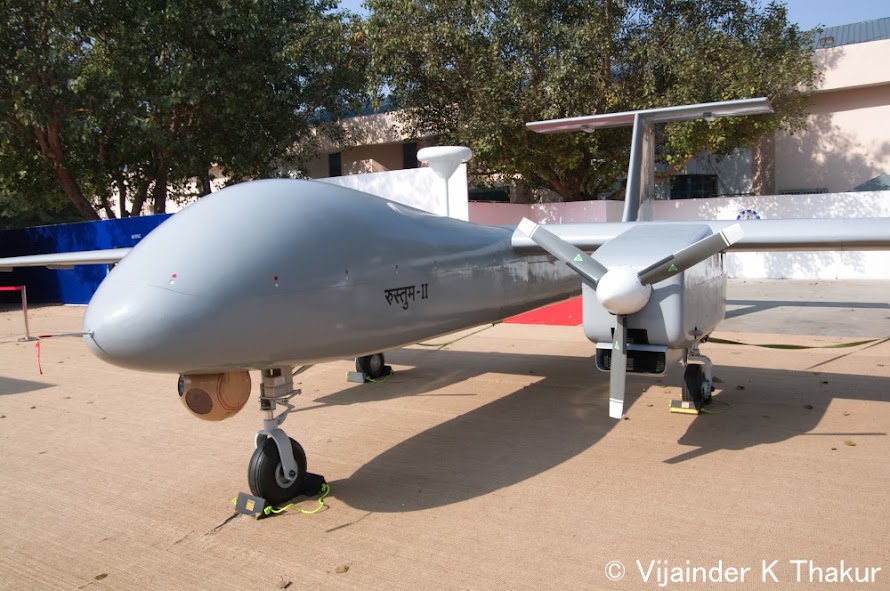
Rustom-2 at DefExpo 2014

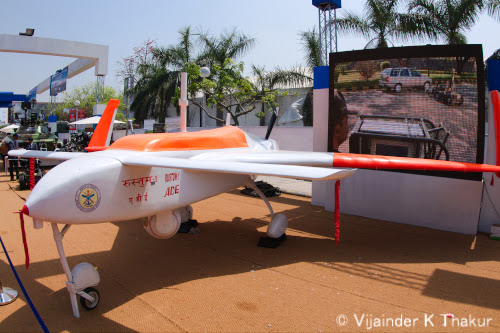
DRDO on February 6, 2014 unveiled what appears to be a yet to fly prototype of the Rustom-2 MALE UAV at DefExpo 2014.


What is most notable about the UAV is that it does not feature a turboprop engine, as Rustom-2 was expected to do.


Though I have yet to confirm it, the UAV may well be powered by twin diesel engines.

I should have an update tomorrow.


The Rustom-2 was supposed to fly in February 2014 and DRDO may have opted for a diesel engine as an interim power plant.


IDP has learned that DRDO has yet to develop autonomous take-off and landing capability so the initial version of the Rustom-2 will be piloted.

Rustom-2 model on display at Aero India 2013.
Please visit the UPDATE to this post at

Thum! Kaun Aata Hai?: Rustom-2 Update

For additional details on the Rustom-2 project please visit the link below.

Rustom-2 MALE UAV (IDP Sentinel)