Showing posts with label Submarine. Show all posts

Friday, February 13, 2026

Nirbhay’s Successors: Two Potent Naval Cruise Missiles Take Shape


ChatGPT generated image showing a submarine launching a cruise missile.


On February 12, 2026, The New Indian Express reported that the MoD has released a Request for Information (RFI) for procuring an undersea-launched missile capable of engaging land targets at ranges from a minimum of 50 km to beyond 500 km, with high accuracy and survivability. The missile is required to be compatible with standard 533 mm torpedo tubes used by the Navy’s existing conventional submarines and weigh under 1,500 kg, including the launch capsule.


The RFI states that the missile required is intended to provide “long-range strike capability against land targets” and stipulates that the missile should be capable of engaging targets “with high probability of kill” while being launched from conventional submarines.


The RFI further specifies that the missile should be capable of operating in contested environments, including GPS-denied conditions, and incorporate terrain-following capability, waypoint navigation, and anti-jamming features.


Indian Navy Requirement


The Indian Navy (IN) wants to procure a subsonic cruise missile that can be launched from a standard 533 mm torpedo tube of any conventional or nuclear submarine.


The IN had initially toyed with the idea of adapting the BrahMos for launch from a submarine. Indeed, a vertically launched submarine version of BrahMos was tested on March 20, 2013, from a submerged platform in the Bay of Bengal off the coast of Visakhapatnam.


However, to facilitate vertical launch from a submarine, an additional section would need to be plugged into the submarine. Plugging a new section would have been a risky proposition since it would have altered the buoyancy of an existing boat. Additionally, there would have been technical, financial, and timeline challenges.


A torpedo tube-launched cruise missile is a cheaper and more versatile option, though the missile would lack the destructive capability of the supersonic BrahMos.


The IN is currently equipped with Russian-origin Klub-S cruise missiles integrated with its Project 877EKM (Sindhughosh class) and HDW Type 209 (Shishumar class) submarines, and the French SM39 Exocet cruise missiles integrated with its HDW Type 209 (Shishumar class) submarines.


The SM39 Exocet missile does not have a land-attack variant. However, a land-attack variant of the missile called SM40 is under development in France.


The Klub-S has two variants — 3M54E1 anti-ship and 3M14E land-attack cruise missiles.


In July 2018, Russian shipbuilder Zvezdochka and Indian shipbuilder Larsen and Toubro announced their partnership to conduct medium refit and life certification (MRLC) upgrades on four of the Indian Navy's Sindhughosh-class submarines, which are the local designation for the Russian Project 877EKM Kilo-class diesel-electric attack submarines.


The partnership involved one submarine undergoing refit at Zvezdochka's facility in Severodvinsk, Russia, to facilitate technology transfer and training for Indian personnel. The remaining three would be handled at L&T's Kattupalli shipyard near Chennai, India.


The MRLC included integration of the Klub-S (3M-54E/3M-14E) missile system for anti-ship and land-attack capabilities, allowing strikes up to 220–300 km depending on the variant.


DRDO's SLCM


According to the DRDO Annual Report 2018, the MoD sanctioned the development of a Submarine-Launched Cruise Missile (SLCM) in 2017.


The SLCM is a derivative of the ITCM subsonic cruise missile.


ITCM


The ITCM, in turn, is a Nirbhay derivative. During DefExpo 2020, the DRDO announced completion and closure of the Nirbhay project and the launch of the Indigenous Technology Cruise Missile (ITCM) project based on technology developed for the Nirbhay project.


The ITCM differs from the Nirbhay in being powered by an indigenously developed small turbofan engine named Manik. Additionally, the ITCM features an RF seeker, something that the Nirbhay was never tested with.


The ITCM was last flight-tested successfully on April 17, 2024. The successful flight test established reliable performance of the Manik turbofan developed by the Gas Turbine Research Establishment (GTRE), Bengaluru, and all other subsystems, including the RF seeker.


According to the DRDO, the ITCM has a range of 1,000 km and a warhead of 300 kg. It weighs 1,500 kg and has a length of 6 m.


SLCM


The SLCM variant of the ITCM would need to be shorter and lighter to make it compatible for launch from a torpedo tube. Consequently, it will feature a 250-kilogram penetration-cum-blast or airburst warhead.


The SLCMs will be tested first on the Russian-origin Sindhughosh-class (Kilo-class) submarines as per the plan.


According to a media report, the DRDO successfully validated submarine launch capability in February 2023 during a developmental missile launch from an underwater platform. The missile tested covered a range of 402 kilometers.


The test was reportedly aimed at validating critical underwater launch processes such as wing deployment after surfacing and engine start during flight.


LR-LACM


Besides the SLCM, the DRDO is also developing a longer-range variant of the ITCM called the Long-Range Land-Attack Cruise Missile (LR-LACM) for precision attacks on static targets using its RF terminal seeker.


The LR-LACM flies a terrain-hugging/sea-skimming profile to avoid radar detection. It can navigate using waypoints and make flight profile changes to avoid adversary air defence zones, terrain, and other obstructions.


The missile can execute precision attacks on static targets using an RF seeker similar to the one developed for BrahMos for terminal homing.


The LR-LACM is being developed to meet the QRs projected by the IN to the DRDO. The missile is configured to launch from the ground (coastal batteries) using mobile articulated launchers and from frontline warships using a UVLM (Universal Vertical Launcher Module). Developed and patented by BrahMos Aerospace, the UVLM is already deployed on 30 ships of the Indian Navy.


Test of LR-LACM on November 12, 2024


The DRDO conducted the maiden flight test of the LR-LACM from the Integrated Test Range (ITR), Chandipur, off the coast of Odisha on November 12, 2024, from a mobile articulated launcher.


"The missile followed the desired path using waypoint navigation and demonstrated its capability to perform various manoeuvres while flying at various altitudes and speeds. The missile is also equipped with advanced avionics and software to ensure better and reliable performance."


Copyright © Vijainder K Thakur. First published on Thumkar.

Friday, January 9, 2026

How Outrageously Ambitious Indian Navy QRs Paved the Way for Project 75I Submarine Import

Representative Image by @Grok

The ET reports that Germany and India are poised to sign a deal worth over $8 billion for the supply of six SSKs, with transfer of technology, during Chancellor Friedrich Merz’s visit to India next week


Germany’s Thyssenkrupp Marine Systems (TKMS) and Indian state-owned Mazagon Dock Shipbuilders Ltd. (MDL) will work together to manufacture the vessels.


In August 2024, the Ministry of Defence (MoD) cleared MDL to build six submarines in partnership with Germany’s TKMS.


The diesel-electric submarines, being procured by the MoD under Project 75I, will feature Air Independent Propulsion (AIP) and will be larger and more advanced than the current Indian Navy (IN) submarines.


TKMS, which had initially declined to bid for Project 75I due to the RFP’s “terms and conditions,” entered the competition after the German government backed the project.


Why the Need for Import


It is intriguing that India—having built four SSBNs and currently building two SSNs (with a total of six SSNs planned)—still needs to acquire SSKs from Germany, especially after already inducting seven Scorpene-class SSKs with technology transfer from France.


There are three possible explanations:


1. The SSBNs and SSNs are being built in India with foreign (Russian?) assistance, assemblies, equipment, and materials. No real ToT took place as part of Project 75. 


2. Despite trumpeting the Atmanirbhar Bharat mantra, the Government of India continues to use defence procurement as a geopolitical ingratiation tool.


3. Indian shipyards capable of building submarines are fully committed to existing submarine projects.


The Need for Fast-Paced Procurement


We will set aside the first two explanations as overly speculative and assume that Project 75I procurement through a foreign OEM is driven by the Indian Navy’s urgent operational need to replenish its ageing submarine fleet.


It is noteworthy that the Indian Navy had initially stipulated that only operational submarine designs would be considered under Project 75I. TKMS, however, has proposed a submarine based on its Type 214 design, incorporating specific modifications for the Indian Navy, such as enhanced stealth and AIP. Clearly, TKMS is not offering a fully operational, off-the-shelf design. As such, the possibility of delays runs counter to the objective of fast-paced procurement.


According to Khalil Rahman, head of TKMS India, the company successfully demonstrated the AIP capability on its Type 212 submarine during evaluation.


India’s Limited Options


The qualitative requirements (QRs) stipulated by the Indian Navy (IN) when Project 75I was initiated were extremely ambitious. They included construction of all boats at Indian shipyards, fitment of DRDO-developed AIP, and the ability to launch land-attack cruise missiles (LACMs).


The draft RFI mandated that, in addition to DRDO-developed AIP, the submarine should be fitted with Indian steel, missiles, and torpedoes, including the DRDO-developed heavyweight torpedo. The Navy also wanted all intellectual property rights for the submarine to rest with India after the initial batch of six boats, enabling India to export the design.


No submarine OEM was able to meet these QRs. As a result, the QRs were repeatedly diluted, delaying procurement by nearly a decade.


Only Germany and Spain eventually submitted bids for Project 75I, after multiple deadline extensions, culminating in July 2023. However, Spain's Navantia was unable to immediately demonstrate an AIP system while submerged, having demonstrated the system only on a surfaced submarine.


Procurement negotiations progressed under the Strategic Partnership model of the defence acquisition procedure. L&T and MDL were shortlisted as Indian partners to collaborate with foreign submarine manufacturers.


Robust Existing MDL–TKMS Relations


Fortunately for India, MDL and TKMS share a long-standing working relationship dating back to the early 1980s.


In December 1981, India signed an agreement with Howaldtswerke-Deutsche Werft (HDW) to procure Shishumar-class diesel-electric attack submarines. The Shishumar boats are Indian variants of the HDW Type 209, featuring a larger-diameter pressure hull.


HDW later became a subsidiary of TKMS following its acquisition in January 2005.


Under the 1981 contract, HDW was to build two submarines in Kiel, Germany, and supply knock-down kits to MDL for assembling two more submarines in Mumbai.


In 1984, an agreement was announced for the construction of two additional submarines at MDL, but this was subsequently cancelled due to the economic crisis of the late 1980s.


Shishumar-class submarines were commissioned between 1986 and 1994. These submarines displace 1,660 tons when surfaced, have a top speed of 22 knots (41 km/h), and carry a complement of 40 personnel, including eight officers.


In 2018, the Indian Navy awarded a $151 million contract for the Medium Refit and Life Certification (MRLC) of INS Shishumar. MDL carried out the refit in Mumbai with technical cooperation from TKMS.


TKMS also supplied new equipment, maintenance and component support, on-site technical assistance, documentation, training, and spare parts. The MRLC aimed to extend the submarine’s service life by a decade.


TKMS in Good Financial Health


A year back, there were concerns about the financial health of TKMS. However, the conglomerate is now in good financial health having won major submarine orders.


Under the German–Norwegian 212CD programme, TKMS will build six boats each for Germany and Norway, modernise six Type 212A submarines for Germany, and build four Type 212A submarines for Singapore.


Additional orders that TKMS is likely to secure—besides the six Project 75I submarines for India—include up to 12 boats for Canada and two Type 218SG boats for Singapore


Conclusion


The DAC approved procurement of 6 submarines under Project 75I in October 2014. 


Project 75I has been delayed primarily because the Indian Navy drafted qualitative requirements that were excessively ambitious.


This import was not inevitable. Had the Indian Navy set realistic qualitative requirements at the outset, L&T—armed with SSN-building experience—could have built what the Navy is now buying from TKMS, filling gaps through partners of its own choosing.


The Indian Navy may then have obtained far more than it is getting now—including submarines built with Indian steel, missiles (vertical launch Brahmos), torpedoes, and full intellectual property rights for future exports.


Updated on January 11, 2026


Some more facts to corroborate my contention that the IN QRs were too ambitious. My information is based exclusively on news reports. The following were reportedly the original qualitative requirements (QRs): 1. Air Independent Propulsion 2. High degree of stealth 3. Land-attack capability. (At least 12 LACMs with 500-km range) 4. Anti shipping missile attack capability. 5. Ability to launch missiles from under water, preferably the Brahmos missile 6. Salvo launch of missile at a single or multiple targets 7. Ability to carry and launch 18 heavyweight torpedoes in the sea. 8. Ability to launch both torpedoes and cruise missile from torpedo tubes. It was believed that the Indian Navy preferred a submarine with a vertical launch segment capable of firing BrahMos missiles to increase overall firepower. According to an April 4, 2019, Business Standard report, a draft EoI released by the IN specified that the submarines must carry at least 12 land-attack cruise missiles (LACMs), in addition to anti-ship cruise missiles (ASCMs). The IN also specified that the boats should be able to carry and launch 18 heavyweight torpedoes. The Navy further wanted all intellectual property rights for the submarine to vest with India once the initial batch of six submarines was constructed, enabling India to export the platform. Clearly, to induct the TKMS Type 214, the IN had to drop several QRs. The IPR for the Project 75I submarines will certainly not rest with MDL. Particularly so when indigenous content will likely not exceed 45%! Had the QRs been more realistic, MDL and L&T—drawing on their HDW-209, Scorpene, SSBN, and SSN experience—could have built an Indian-designed, developed, and manufactured submarine. Perhaps not as capable initially as the Type 214, but with the potential to surpass it through sustained development over time.

Copyright © Vijainder K Thakur. First published on Thumkar.

Friday, January 2, 2026

India’s Nuclear Submarine Program and the Ursa Major Incident

Ursa Major Sinking


The Spanish newspaper La Verdad has reported that the Russian ship Ursa Major—which sank in the Mediterranean Sea, 60 miles south of Cartagena, on December 23, 2024—was transporting the hulls of two VM-4SG nuclear reactor cores from Russia to North Korea.


The ship sank due to a mysterious underwater explosion, best explained as sabotage.


VM-4SG reactors are used in the nuclear power plant of Project 667BDRM SSBNs, an advanced variant of the Delta submarine. Designed by the Rubin Central Design Bureau and built at Sevmash in Severodvinsk between 1984 and 1992, seven boats were commissioned.


These submarines feature a double-hulled configuration for enhanced survivability, measuring 167.4 meters in length, with a beam of 11.7 meters and a submerged displacement of 18,200 tons. Powered by two OK-700A nuclear propulsion units, they achieve submerged speeds of up to 24 knots and operational depths of 320 meters, with unlimited range and 90-day endurance.


The OK-700A propulsion units (nuclear steam-generating propulsion plants) use two VM-4 series reactors.


The VM-4SG, a specific upgraded variant of the VM-4 reactor, powers second-generation submarines such as the Project 667BDR (Delta III, using VM-4S) and 667BDRM (Delta IV, using VM-4SG), providing reliable, long-endurance operation for strategic ballistic missile roles.


VM-4SG reactors use enriched uranium fuel (typically 20% U-235, though some variants reach 40%) in a compact, modular design with pipe-within-pipe coolant loops for reduced size and enhanced safety.


There is some skepticism over the La Verdad report. Many Russian analysts point out that the reactor is currently not in production.


Indian Connection


Notably, bmpd TC has reported that the VM-4SG reactor is part of the propulsion unit of the Indian Arihant-class SSBN. Since Arihant-class submarines remain in production, it is likely that VM-4SG reactors remain in production.


Officially, the Arihant-class submarines are equipped with Indian-made CLWR-B1 nuclear reactors. However, it was only in 2021 that the Nuclear Power Corporation of India Limited (NPCIL) and Larsen & Toubro Special Steels and Heavy Forgings Limited announced completion of a facility in Hazira to produce nuclear reactor hulls. So far, there has been no report of a hull being manufactured at the facility. Despite the secrecy surrounding India’s nuclear submarine development and manufacturing, the lack of such an announcement appears odd, particularly keeping in mind Indian media hype over self-sufficiency in defence manufacturing.


According to bmpd, Indian sources acknowledge that the Arihant CLWR-B1 reactor is “heavily based on the Soviet VM-4/4SG reactor.” However, it is well known that the CLWR-B1 reactor vessels are manufactured in Russia, along with several other critical submarine components.


The four Arihant-class submarines will be followed by a clean-sheet, new-design SSBN with a 13,300-tonne displacement, carrying twelve K-6 6,000-km-range ballistic missiles. The new design, referred to as the S-5-class submarine, will be powered by CLWR-B2, a 190-MW reactor designed by the Bhabha Atomic Research Centre (BARC).


It is being reported that CLWR-B2 is based on the design of the Soviet VM-11 (OK-650B) submarine reactor, used on Soviet third-generation submarines, including the Project 971 Akula submarines that the Indian Navy leased from Russia.


The OK-650B reactor is rated at approximately 190 MW thermal output. It drives a steam turbine delivering around 43,000–50,000 shaft horsepower (shp) to a single seven-bladed propeller, enabling submerged speeds of up to 33–35 knots and unlimited range.


@Grok generated photo of a Arihant class like SSBN


Conclusion


La Verdad cited details from an official Spanish maritime investigation (report 8059/24-Escora) into the sinking of the Russian cargo ship.


According to the report, the ship was carrying two undeclared, blue-tarped containers at the stern, each weighing approximately 65 tons, that did not appear on the manifest.


Aerial imagery from Spanish rescue operations, while the ship was still afloat but listing, revealed the blue containers. Crew interrogation led to the identification of the undeclared cargo as VM-4SG reactor casings.


The hull breach (a 50 cm × 50 cm inward-bent hole) and seismic data from the explosions pointed to the use of a supercavitating torpedo to sink the ship. The seismic data were consistent with 1.6–1.8 magnitude waves generated by 20–50 kg of TNT.


The ship was tracking an unusual 15,000 km route from St. Petersburg to its declared destination of Vladivostok. Onboard heavy-lift cranes were incongruous with Vladivostok’s facilities but suitable for underdeveloped ports. As such, investigators concluded that the cargo was bound for Rason, North Korea—a port near the Russian border with rail links.


The logically appearing conclusion would be that the ship was sunk by a US/NATO submarine to prevent North Korea from acquiring SSN/SSBN capability.


No independent corroboration of the La Verdad report, such as public photos of the reactors or official Spanish government statements, has emerged.


North Korea is in the process of developing nuclear-powered submarines (SSN/SSBN capabilities). In January 2021, Kim Jong Un announced at the 8th Congress of the Workers’ Party of Korea that the design of a new nuclear-powered submarine was in the final examination stage as part of a five-year weapons development plan.


Notably, North Korea remains upbeat about its SSN/SSBN plans, suggesting that there may have been no setbacks.


In March 2025, state media released photos of Kim inspecting a partially constructed nuclear-powered strategic guided missile submarine, described as a “significant advancement” in naval nuclear capability.


In December 2025, North Korea unveiled the completed hull of an 8,700-ton nuclear-powered SSBN, amid reports of potential Russian assistance in reactor technology.


Developing a nuclear propulsion unit for a submarine is a challenging task. Designing and testing a propulsion unit is one thing; manufacturing it is quite another challenge.


Finally


Fortunately for India, all Arihant-class submarines have already been launched, ensuring that there will be no immediate impact from the loss of two VM-4SG nuclear reactors—if they were indeed lost. However, the Ursa Major sinking starkly underscores the urgency for India to accelerate the development of fully indigenous capabilities for designing and manufacturing nuclear reactors for submarine propulsion.


Copyright © Vijainder K Thakur. First published on Thumkar.


Tuesday, September 9, 2014

Scorpene (Project 75) Submarines Being Equipped for Speical Ops & Network Centric Warfare

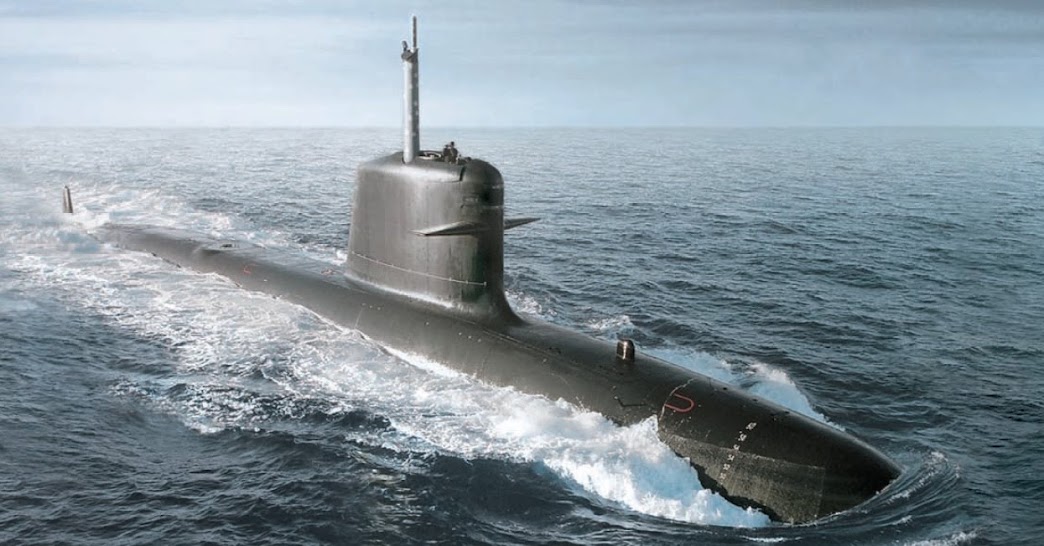
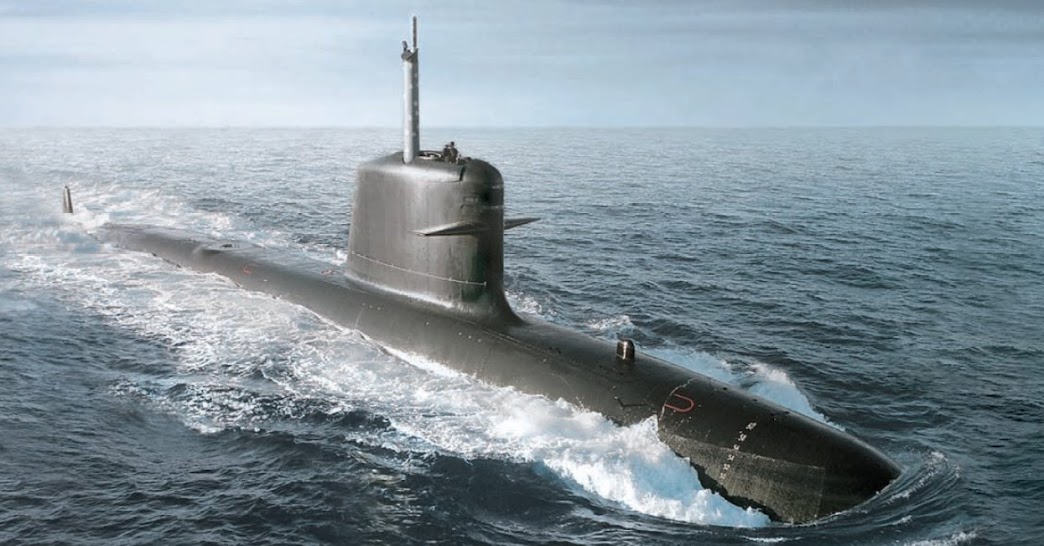
Scorpene. Photo Courtesy DCNS

The Indian Navy is equipping its six Scorpene (Project 75) subs for special operations and network centric operations. The boats will be networked with the rest of the fleet using Ku and S band SATCOM systems.

The boats will feature a Communication Intelligence System with Direction Finding Capability (COMINT/DF) which will enhance situation awareness by displaying the DOA (Direction of Arrival) of the intercepts and other data on MFCCs of Combat System of submarine.

The COMINT/DF fitted on the Scorpenes would also uplink DOA data using a S-Band Satellite Communication System (SATCOM) to the Indian Navy's Rukmini GSAT, so as to provide other fleet ships real-time data on communication intercepts.

COMINT/DF systems typically feature High Sensitivity and High Probability of Interception (HPOI); the system searches, intercepts, measures, classifies, analyzes, locates and monitors ground, airborne and naval communication transmissions. Such transmissions are characterized by high mobility, short duration, complex signals and frequent changes in signal parameter in the most dense electromagnetic environments.

The Scorpene COMINT/DF would provide capability to DF, monitor, intercept, record and analyse communication signals in V/UHF frequency range used for air-to-air and surface-to-air communication.

The S-Band SATCOM system typically provide low data rate communication. As reported earlier, Scorpenes would also be equipped with Ku-band SATCOM high data rate communication.

The Combat System from Project-75 subs is being supplied by M/s DCNS, France.

IDP Sentinel members can read more about the Indian Navy's Project-75 subs at the link below.

Project 75 Scorpene Submarines - IDP Sentinel

Monday, September 1, 2014

Indian Navy Scorpene (Project 75) Submarines to be Equipped with Ku-Band SATCOM

Scorpene Submarine

MoD has initiated procurement of six Ku-Band Satellite Communication Systems (SATCOM) for its Project -75 Scorpene submarines.

The Ku-Band SATCOM system is required to be compatible with Indian Navy SATCOM network operating in Ku-Band using ISRO developed Rukmini Geostationary Communication Satellite (GSAT) dedicated for use by the Indian Navy. The Navy wants the SATCOM terminal to be capable of voice and high speed data at a minimum speed of 256 kbps.

The Ku band SATCOM should also be capable of interfacing with the Combat System supplied by M/s DCNS, France installed onboard Project 75 submarines.

IDP Sentinel members can browse through other recent Navy RFIs at the link below.

Saturday, July 26, 2014

India Pushes Ahead with Kilo Class Submarine Upgrades

IN Kilo class submarine after overhaul in Russia. Photo Courtesy Indian Embassy in Russia, credit: KR Deepak

India has asked Russia to upgrade another two Russian Kilo Class submarines (Type 877EKM) submarines, RIR reported on July 25, 2014.

The director-general of the Rubin Central Maritime Design Bureau Igor Vilnit told the website, "The Indian governments filed a request to the Russian Federal Service for Military-Technical Cooperation to extend the life of two Russian Kilo Class submarines."

Specialists of the Zvyozdochka ship repair center and the Rubin design bureau are expected to leave for India to inspect the first submarine.

Earlier on December 3, 2013, Vice-Admiral Satish Soni, Flag Officer Commanding-in-Chief of the Southern Naval Command, told the press that the Indian Navy (IN) intends to get four of its Kilo class subs overhauled in Zvezdochka shipyard in North Russia to extend their lives by another 10 years.

Also, the General Director of the Russian submarine repair yard Zvyozdochka in north Russia, Vladimir S. Nikitin, told The Hindu that the shipyard was close to signing a contract for life-extension refit of two Indian Kilo-class submarines in 2015.

In January 2013, the Indian Navy (IN) completed the overhaul and upgrade of its Kilo class (Project 887EKM) submarines in Russia under a deal signed in 2001.

Each upgrade cost $80 million and involved complete overhaul of the submarine and its hull structures; installation of an improved control system, sonar, electronic warfare system, and an integrated weapon control system. Additionally the subs were equipped to launch Club-S missiles from its torpedo tubes.

The refit included support for the new version of Klub-S (3M54E1 anti-ship and 3M14E land attack) cruise missiles and over ten Indian and foreign-made systems including the Ushus hydro-acoustic (sonar) system and CSS-MK-2 radio communications system.

In addition, the boat's cooling system was modified, the Porpoise radar fitted and other work carried out "increasing the boat's military capacity and safety."

Two submarines - INS Sindhuvir and INS Sindhuraj - were modernized at the Admiralty Shipyard in St. Petersburg.

Later, five subs - INS Sindhukesari, INS Sindhuratna, INS Sindhugosh and INS Sindhuvijay and INS Sindhurakshak - were modernized at  - Zvyozdochka Shipyard in Severodvinsk.

Of the remaining 3 subs, one has already been overhauled in India, and another two are in the process of being overhauled.

Kilo class submarines were developed by the Rubin Central Design Bureau (St. Petersburg).

IDP Sentinel members can read more about the Kilo Class submarine overhaul project at the link below.

Kilo Class submarines upgrade (IDP Sentinel)


Friday, June 20, 2014

INS Arihant Sea Trials: Kabhi Khushi, Kabhi Gum!

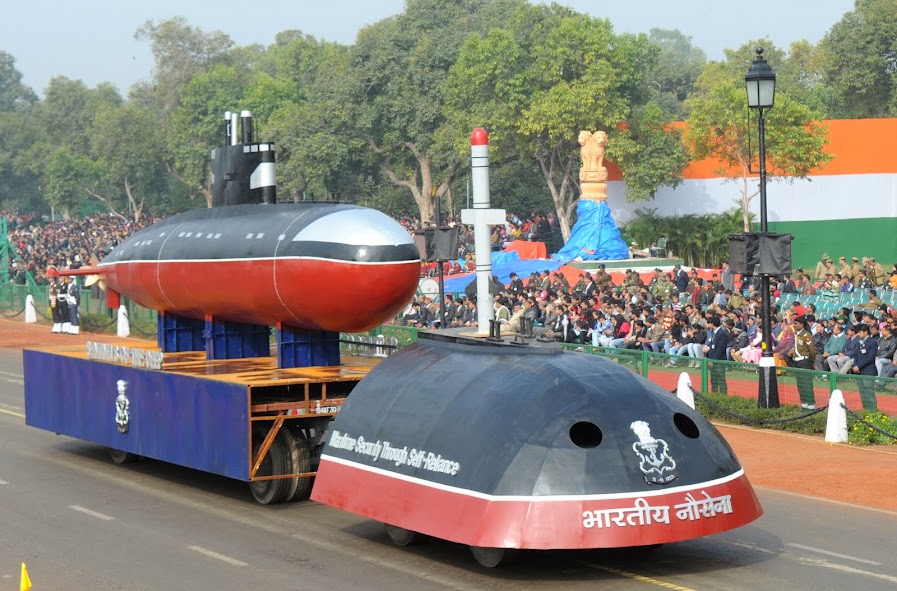
INS Arihant mock-up at the Republic Day parade 2014

INS Arihant may or may not be undergoing sea trials.

DRDO Chief Avinash Chander told The Tribune on May 15, 2014 that sea trials of INS Arihant are already underway. :-)

He told PTI yesterday that Sea Trials would start in a month or two! :-(

INS Arihant may or may not be facing serious technical issues with its nuclear reactor.

DRDO Chief Avinash Chander told India Today during DefExpo, "What is going on right now is the power up phase, where the boat is building up her power, a progressive exercise which is being monitored." He added, "It is for the first time that we are going through a nuclear power up exercise in a submarine. It has to go through various levels of checks for safety and security reasons. But we are confident of completing it and going through, shortly."

Chander recently told PTI, "Arihant is going through the power-up cycle (in its nuclear reactor). It is the first time that we are doing the power-up cycle on a nuclear submarine. So, we are very cautious and going step by step."

The DRDO chief's statements may make you wonder whether time has stopped, or indeed reversed?

Look at it this way. If the DRDO and the Indian Navy announced that Arihant Sea Trials are about to commence, or are underway, there would be a lot of Chinese, Burmese (Chinese again, of course!) , Sri Lnakan (Yes, Chinese again) fishing trawlers off the Vizag coast and they won't be fishing fish! Many Panama registered merchant vessels with snooping equipment and US, British and Australian intelligence agents on board losing their way in the Bay of Bengal and ending up near Vizag! (The Russians would, of course, be sitting inside the sub!)

So what happens if the DRDO Chief inadvertently releases information about the Sea Trials to a Chandigarh based newspaper. And The Hindu does a follow-up and confirms the sea trials? Well...let me think...Yes! the DRDO Chief could make a contradictory statement to a government news agency (like the PTI?) to discredit the earlier reports.

I am not suggesting that is what happened.

It's up to each of us to decide what is happening with INS Arihant, nearly five years after its launch and nearly a year after its reactor went critical.

IDP Sentinel members can access all statements made by DRDO and Navy Officials on the status of the submarine since its launch at the link below to help them make a more informed guess.

INS Arihant SSBN (IDP Sentinel)

Thursday, May 1, 2014

Navy Modernizing its Submarine Escape Training Facility at Visakhapatnam

 A Sailor assigned to the Los Angeles-class attack submarine USS Key West (SSN 722), receives training with the MK10 Submarine Escape Immersion Equipment (SEIE). Photo Credit: US Navy / Wikimedia Common

A catastrophic explosion on board INS Sindhurakshak shortly after midnight on August 14, 2013 while docked at Mumbai harbor resulting in its sinking and death of 18 crew members and a fire on INS Sindhuratna on February 26, 2014 resulting in the death of two crew members has spurred the Navy to be better prepared for submarine accidents.

The Indian Navy has so far relied heavily on the professionalism of its carefully screened submariners to preclude submarine related accidents; it has remained ill prepared to handle accidents like the sinking of a submarine in high seas. The Sindhurakshak tragedy seems to have hit home and jolted the the Naval leadership into accepting that submarines do sink. And they don't just sink on high seas, they can even sink in harbor!

On April 30, 2014, through a RFI the Navy initiated procurement and installation of a 5-m Escape Training Tower (ETT) at Visakhapatnam in its quest to develop a state-of-the art submarine escape training facility at its premium submarine base. The service want an ETT built around the SEIE Mk 11 escape suit.

In the case of a mishap resulting in the sinking of a submarine, the foremost priority of crew members is survival. Next, comes the need to escape. This should preferably by done using a submarine rescue vehicle which connects directly to the escape hatch of a submarine allowing crew members to be brought up  to safety without exposing them to the high pressure at oceanic depths and possibly very cold temperatures.

In case no rescue vehicle is available, as a last resort submariners can escape a stricken sub by wearing protective gear like the Submarine Escape Immersion Equipment (SEIE) MK-11 and bubble up to the surface. To facilitate escape, the escape tower or chamber of a submarine is designed to allow a submariner in protective gear to enter and flood it while inside. The submariner then opens the escape hatch and floats up to the surface. The process is repeated one at at time, allowing eight or more crewmen to escape per hour.

This is referred to as Tower Escape. When escaping from depths greater than 100-m using tower escape, there is a significant risk of decompression sickness. A re-compression facility must be available.

The RFI projects the requirement of a one/two man pressurization chamber for tower escape facility. In addition, the ETT should facilitate Rush Escape which is resorted to when either the single man pressurization chamber is not available for escape or the submarine hull is breached and the internal compartment is exposed to rapid flooding and raised ambient pressure.

Flooding causes compression of the air within the rescue compartment, to an extent where air pressure matches the water column pressure at the ocean depth. When resorting to Rush Escape, submariners don their protective gear and open the escape hatch and one by one pass through the tower to the surface.

Rush escape is perilous because bulky escape suits can make it difficult for crew to pass through the escape hatch; darkness and danger can result in crew mistakes and trigger panic.

Submarine Escape Immersion Equipment (SEIE) MK-11

Submarine Escape Immersion Equipment (SEIE) MK-11 is whole-body suit and one-man life raft that allows submariners to escape from a sunken submarine at depths down to 600-ft at a rate of eight or more men per hour.

Developed by British company RFD Beaufort Limited, the SEIE typically comprises a submarine escape and immersion suit, an inner thermal liner, and a gas-inflated single-seat life raft, all contained in an outer protective stowage compartment.

The equipment's buoyancy facilitates free ascent from a stricken submarine at a "safe" speed of approximately two to three meters per second. The inner thermal liner protects escapees from hypothermia. At the surface, the SEIE provides shelter and visibility.

The SEIE provides a last resort escape option. In the case of a mishap, foremost priority for the crew is survival. Next, may come the need to escape. This should preferably by resorted to using a submarine rescue vehicle. A rescue vehicle connects directly to the escape hatch of a submarine protecting the crew.

IDP Sentinel members can read more about Submarine escape at the link below

Submarine Rescue (IDP Sentinel)

Tuesday, March 25, 2014

DRDO Pitches its AIP Section for 6th Scorpene Sub

Scorpene Submarine

DRDO is in talks with DCNS to install a DRDO-developed AIP based on hydrogen fuel cell on the last Scorpene submarine built at Mazagaon Dock under the Navy’s Project 75.

DRDO DG (Naval Systems & Materials), V. Bhujanga Rao, told The Hindu, "Our technology is proven on a land-based prototype. A submarine-based prototype plug weighing nearly 300 tonnes is now being worked on. The French MESMA AIP being offered for the Scorpenes is an old system with a steam turbine.”

He added that the DRDO AIP could be reconfigured for the submarines to be acquired under Project 75I .

DRDO is developing Air Independent Propulsion (AIP) technology for use on submarines at the Naval Material Research Laboratory (NMRL), Ambernath.

A land based technology demonstrator project is currently underway. Full scale operations of a AIP System is likely to be demonstrated by 2015.

Earlier, the Indian Navy asked MDL to equip the fifth and sixth boats with Air Independent Propulsion by fitting an additional section.

During his visit to India with French President Nicolas Sarkozy in December 2010, DCNS CEO Patrick Boissier said that if a contract were to be placed on DCNS by next year, AIP systems could be integrated into the fifth and the sixth submarines rolling out of MDL in 2018.

The four Scorpenes launched earlier could be retrofitted under an upgrade program.

IDP Sentinel members can read additional information on the Scorpene project at the link below

Project 75 Scorpene Submarines - IDP Sentinel

Saturday, March 1, 2014

Indian Navy's Submarine Rescue Capability - Current and Future

INS Chakra SSN.

The recent incident on board  INS Sindhuratna while it was sailing submerged off the Mumbai coast,  which led to loss of life and serious injuries, has highlighted the need for a credible Submarine Rescue Capability for the Indian Navy.

Here is a brief overview of the situation as it exists.

The crew of a stricken submarine in shallow waters (Up to 100 m) can escape using "submarine escape pressurized suits" using a technique called bubbling up.

Were a submarine to be crippled in deeper waters (upto 300 m), the Navy's diving support ship INS Nireekshak would be called in. It's equipped with Submarine Rescue Bells (SRBs).

Typically a SRB can accommodate 12 men  (10 escapees + 02 operators). A Launch and Recovery System (LARS) is used to lower and winch up the tethered SRB which is fitted with life support systems and a locator system. The SRB has a mating skirt/surface that fits on a submarine's escape trunk / seating surface structure to mate with the submarine rescue hatch.

If the SRB mates perfectly with the rescue hatch and the stricken submarine's hull is not compromised, a 1 atmosphere pressure rescue can be carried out from depths upto 300-m. If the submarine hull is compromised resulting in flooding of  the rescue compartment, a wet rescue is carried out.

This is how a wet rescue works, Flooding of the rescue compartment is stopped by releasing compressed air that pushes back the water. The release of the compressed causes a build up of air pressure in the rescue compartment, which in turn causes the human blood to absorb the nitrogen in the body. If the rescued crew is brought to the surface (1 atmosphere pressure) straight away, the blood releases nitrogen bubbles causing 'bends,' which can be fatal. In a wet rescue, the crew needs to be brought up in stages, allowing the body to safely release the absorbed nitrogen. The depth from which crew can be rescued under wet conditions is reduced to around 140-m

A SRB rescue can become difficult if the crippled submarine is resting on the seabed in an awkward position, since it makes mating the SRB with the rescue hatch difficult. Also, SRB rescue requires accurate position keeping by the submarine rescue ship (INS Nireekshak) to which the SRB is tethered. The rescue ship is equipped with a computerized station keeping system that uses GPS and multiple electrically driven propellers to keep the ship within 1-m of the desired position without the use of an anchor, in sea states up to 3.

It's easy to see why a SRB rescue isn't very reliable. Indeed, while submariners regularly practice bubble escape wearing  "submarine escape pressurized suits" at the Escape Training School (ETS) in Vishakapatnam, a SRB rescue has not been attempted. Till recently INS Nireekshak had reportedly never demonstrated a  SRB  mating with a submarine's rescue hatch!

The Indian Navy in August 2013 released a RFI seeking a SRB that conforms to STANAG 1297 specifications to ensure perfect mating of the SRB with the rescue hatches fitted on its subs.

Also, the Indian Navy is in the process of acquiring two Deep Submergence and Rescue vessel (DSRV).

The Navy initiated the case for two free swimming DSRVs in June 2000. The CCS approved the procurement in principal in November 2002. In December 2010, the Indian Navy initiated procurement by releasing a RFI.

The Navy reportedly wants a DSRV that is capable of diving to depths of over 600-m, mating with a disabled sub and extricating around 20 sailors at a time. It would be equipped with pressurized chambers, sonars and cameras.

Two vendors - Russia's Admiralty Shipyards (Bester-1 rescue submersible) and Britain's James Fisher and Sons PLC - are in contention for supply of the DSRVs. Offset proposals from the two vendors are being examined before finalizing a contract.

Unlike a SRB, a DSRV is not tethered. It's a free swimming vessel which can dive deep and locate a crippled submarine, mate with its rescue hatch, even if the submarine is awkwardly positioned, and rescue the crew.

As an interim measure, in 1997, India signed a contract with US Navy for its "global submarine rescue fly-away kit" service, paying an initial $734,443.

Deep Submergence and Rescue vessel (DSRV) (IDP Sentinel)
Recent Navy RFIs (IDP Sentinel)

Wednesday, February 12, 2014

MDL to Deliver First Project 75 Scorpene SSK to Indian Navy in 2015

A Scorpene SSK model with a cutaway optional MESMA AIP section on display at the DCNS pavilion at DefExpo 2014
MDL will deliver the first Scorpene SSK to the Indian Navy in 2015.

A DCNS press release dated February 3, 2014 stated:

"The hulls of the 6 submarines are completed. The outfitting of these hull sections is now progressing as per schedule. The First of Class P75 built in MDL should be ready to start Harbour tests and sea trials as per schedule indicated by MDL. The first Scorpene submarine is to be commissioned in 2015."

IDP Sentinel clarified with a DCNS rep that the first Scorpene submarine will be delivered to the Indian Navy in 2015 for commissioning in September 2016.

In July 2013, Rear Admiral (retd.) Rahul Kumar Shrawat, Chairman and Managing Director of Mazagon Dock Limited (MDL) told The Hindu, "We have set a new target of September 2016 for delivery of the first Scorpene."

For additional details on Project 75 Scorpene submarines please visit the link below.

Project 75 Scorpene Submarines (IDP Sentinel)

Monday, February 10, 2014

Project 75I Contender Scorpene SSK with MESMA AIP Section at DefExpo 2014

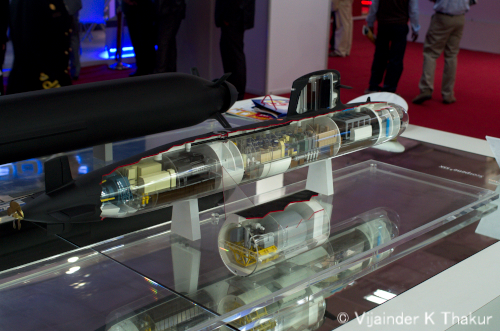
A see through model of Project 75I contender Scorpene SSK with cutaway MESMA AIP xection at the DCNS pavilion at DefExpo 2014 
France's DCNS, which is pitching its Scorpene SSK with a MESMA AIP section as a Project 75I contender displayed a see through model of the submarine with the SUBTICS combat system and a cutaway of the optional MESMA AIP at its stall at DefExpo 2014.

The MESMA module is fitted as an additional hull section within Scorpene which then measures 76.10 meters long and displaces 2000 tons.

A see through model of Project 75I contender Scorpene SSK with cutaway MESMA AIP xection at the DCNS pavilion at DefExpo 2014


The Scorpene model was displayed next next to a model of the newly developed French Barracuda class nuclear submarine, to stress that the Scorpene features acoustic discretion and combat system performance developed for the Barracuda.

A model of the newly developed French Barracuda class SSN with the Scorpene SSK in the background at the DCNS pavilion at DefExpo 2014


SSN Suffren, the first Barracuda class submarine, is scheduled to start sea trials early 2016. Six Barracudas will replace the six Rubis/Améthyste-class SSNs currently in service.

Project 75I submarines are required to have a land attack capability, which in the case of the Scorpene will come from torpedo tube launched Exocet missile. No Brahmos on the Scorpene, which may not be such a bad idea.


Project 75I Submarines (IDP Sentinel)

Wednesday, December 4, 2013

Indian Navy Proposes Round 2 of Kilo Class Submarine Overhaul

INS Sindhurakshak after its overhaul at Zvezdochka shipyard.

The Indian Navy (IN) intends to get four of its Kilo class subs overhauled in Zvezdochka shipyard in North Russia to extend their lives by another 10 years, Vice-Admiral Satish Soni, Flag Officer Commanding-in-Chief of the Southern Naval Command, said on Tuesday December 3, 2013. [via TOI]

Earlier, the General Director of the Russian submarine repair at Zvyozdochka, Vladimir S. Nikitin, told The Hindu that the shipyard was close to signing a contract for life-extension refit of two Indian Kilo-class submarines in 2015.

In January 2013, the Indian Navy (IN) completed the overhaul and upgrade of its 10 Kilo class (Project 887EKM) submarines under a deal signed in 2001.

Each upgrade cost $80 million and involved complete overhaul of the submarine and its hull structures; installation of an improved control system, sonar, electronic warfare system, and an integrated weapon control system. Additionally the subs are being equipped to launch Club-S missiles from its torpedo tubes.

The refit included support for the new version of Klub-S (3M54E1 anti-ship and 3M14E land attack) cruise missiles and over ten Indian and foreign-made systems including the Ushus hydro-acoustic (sonar) system and CSS-MK-2 radio communications system.

In addition, the boat's cooling system was modified, the Porpoise radar fitted and other work carried out "increasing the boat's military capacity and safety."

Two submarines - INS Sindhuvir and INS Sindhuraj - were modernized at the Admiralty Shipyard in St. Petersburg.

Later, five subs - INS Sindhukesari, INS Sindhuratna, INS Sindhugosh and INS Sindhuvijay and INS Sindhurakshak - were modernized at  - Zvyozdochka Shipyard in Severodvinsk.

Of the remaining 3 subs, one has already been overhauled in India, and another two are in the process of being overhauled.

Kilo class submarines were developed by the Rubin Central Design Bureau (St. Petersburg).

The Indian Navy also plans to extend the lives of its two HDW (Shishumar Class) submarines through an overhaul and refit at Mazagaon Docks.

For additional details on the Kilo class subs and their upgrades please visit the link below