Friday, February 7, 2014

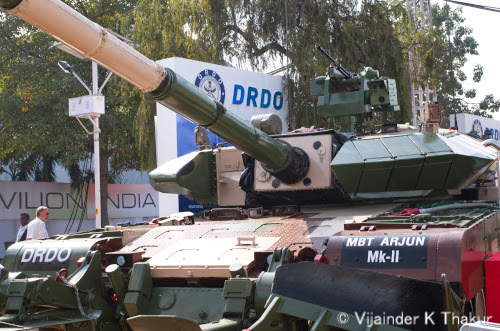
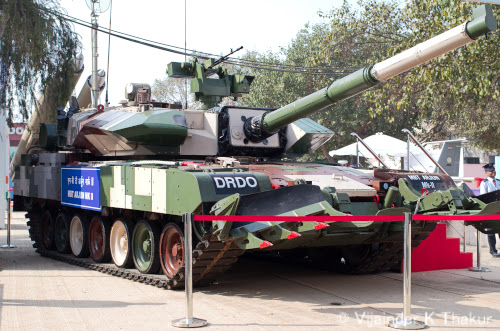
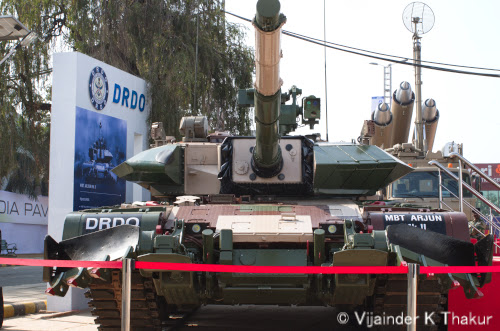
Arjun-2 MBT at DefExpo-2014

Arjun Mk-2 on display at DefExpo 2014

DRDO for the first time publicly displayed its Arjun Mk-2 MBT at DefExpo 2014.

The tank is currently undergoing trials. The project has reportedly slipped behind schedule.

In January 2014,  sources told the TOI that Arjun Mk-II has a long way to go before being accepted by the Indian Army.


The Israeli Laser Homing Attack (LAHAT) missile hasn't performed up to expectations. The missile, which is launched from the main gun, lacks accuracy and emits smoke.

DRDO Chief, Avinash Chandra, is reported to have told the press, "Israeli counterparts have been conveyed the issues and asked to rectify the problems at the earliest."


DRDO has fitted the Mk-2 with the same German engine that powers the Mk-1, pending large enough orders from the Army to justify investment in a new engine manufacturing plant.

Almost 55 to 60% of the Arjun's components and major part of the technology is imported, including the engine, engine transmission, gun barrel, computer-controlled integrated fire control system, tracks, suspension, and the Muzzle Reference Systems.

For additional details on the Arjun Mk-2 project, please visit the link below.

Arjun MBT Mk-II (IDP Sentinel)

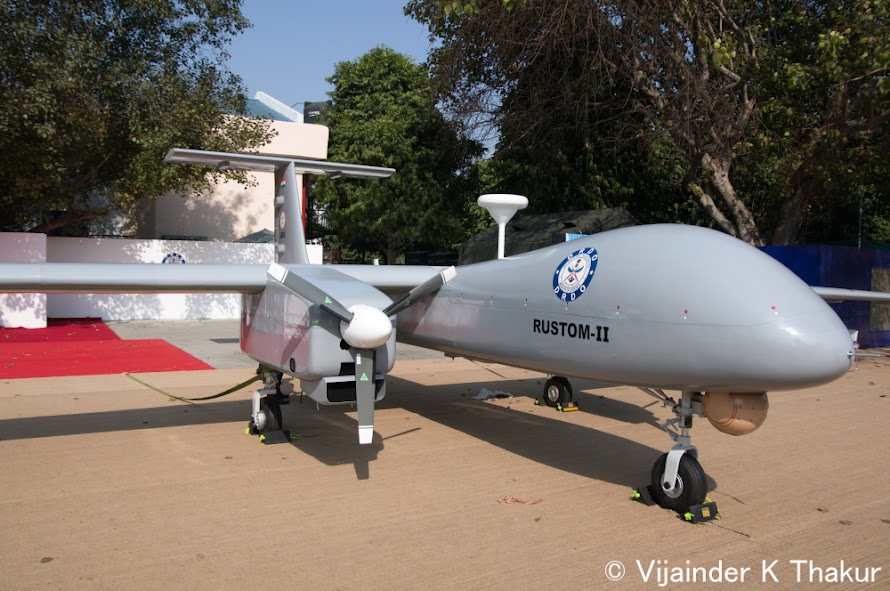
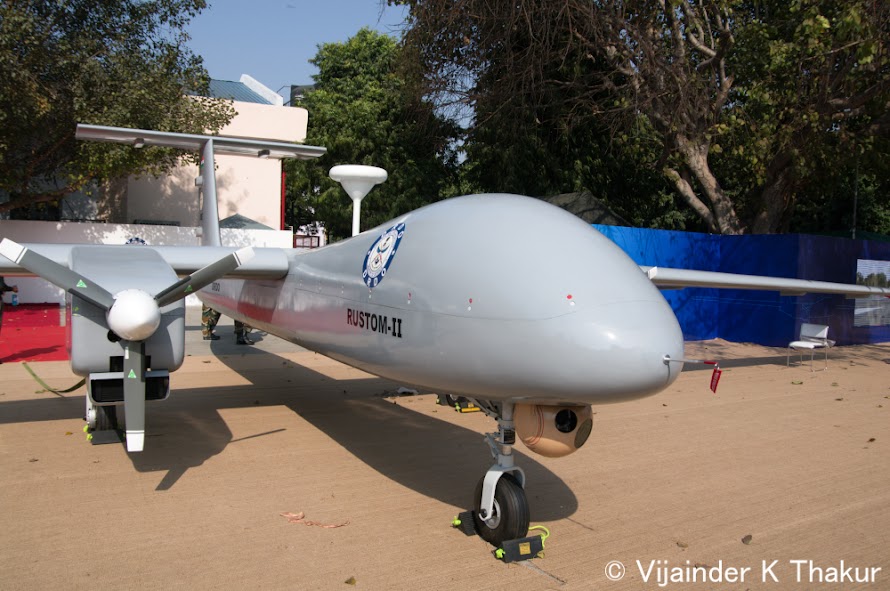
Rustom-2: Not Powered by a Turboprop!


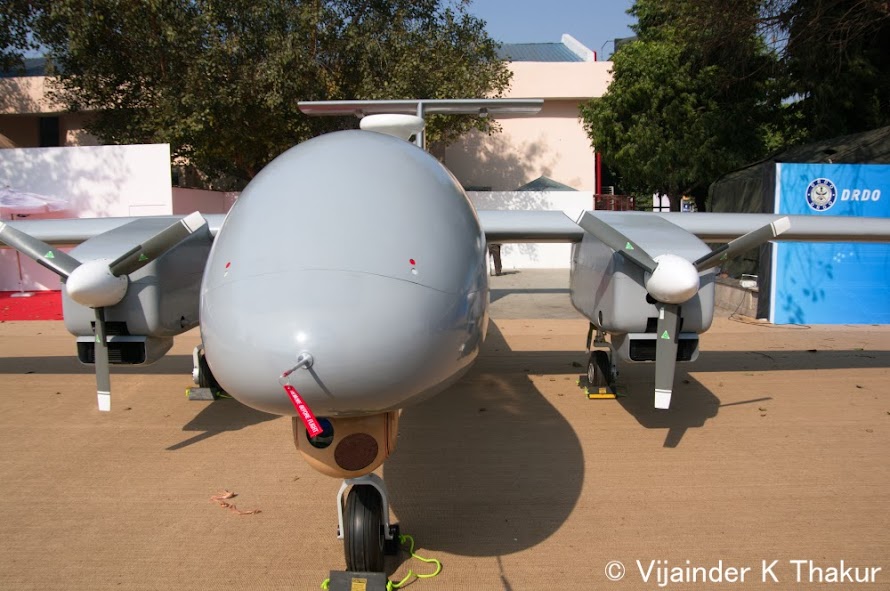
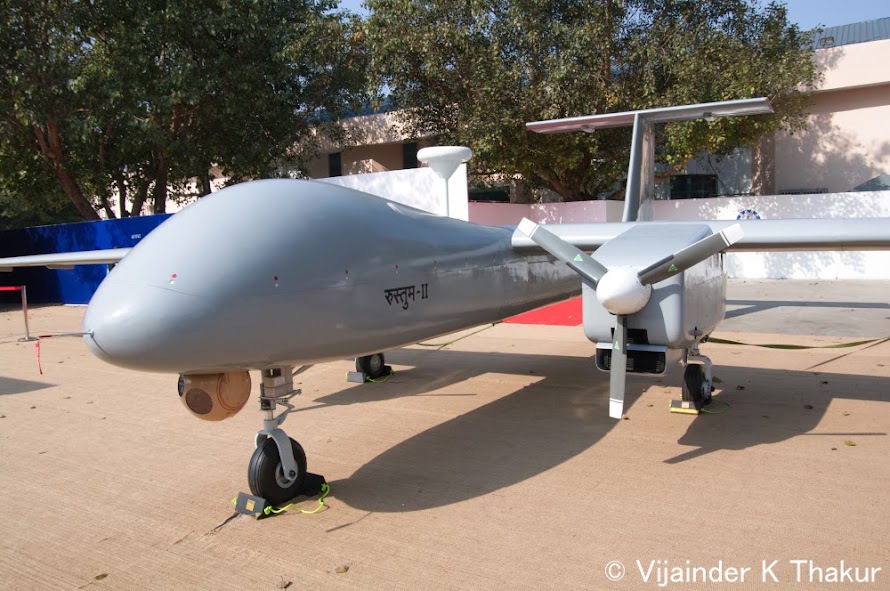
Rustom-2 at DefExpo 2014

DRDO on February 6, 2014 unveiled what appears to be a yet to fly prototype of the Rustom-2 MALE UAV at DefExpo 2014.


What is most notable about the UAV is that it does not feature a turboprop engine, as Rustom-2 was expected to do.


Though I have yet to confirm it, the UAV may well be powered by twin diesel engines.

I should have an update tomorrow.


The Rustom-2 was supposed to fly in February 2014 and DRDO may have opted for a diesel engine as an interim power plant.


IDP has learned that DRDO has yet to develop autonomous take-off and landing capability so the initial version of the Rustom-2 will be piloted.

Rustom-2 model on display at Aero India 2013.
Please visit the UPDATE to this post at

Thum! Kaun Aata Hai?: Rustom-2 Update

For additional details on the Rustom-2 project please visit the link below.

Rustom-2 MALE UAV (IDP Sentinel)


Tata Power - Strategic Engineering Division (SED) 155-mm/52-cal MGS at DefExpo 2014


Tata Power SED's 155-mm/52-cal  Mounted Gun System at DefExp0 2014
Tata Power SED's 155-mm/52-cal  Mounted Gun System (MGS) is competing in a global tender to procure 814 155mm / 52 caliber mounted gun systems through a joint venture with the private sector under its artillery modernization program.

The gun  has a range of


  • 31-km with a Boat Tail projectile
  • 42-km with Base Bleed projectile
  • 55-km with V-LAVP projectile


It features a ring laser gyro inertial system, weapon management system and a automatic laying system with joystick control

The gun has a traverse of -3-deg to +75-deg in elevation and 40-deg right and left in azimuth.

You can read more about the Indian Army's 155-mm/52-cal MGS procurement at

155mm / 52 Caliber Mounted Gun System (MGS) (IDP Sentinel)


Thursday, February 6, 2014

Tacit Blue - Stealth Aircraft Developed at Area 51

Tacit Blue Stealth Observation Aircraft at National Museum of the U.S. Air Force, near Dayton Ohio. Photo Credit: Vijainder K Thakur
CNN recently published a news report on the Tacit Blue stealth aircraft which was developed and tested at the super-secretive Area 51 in Nevada from 1978 to 1985.

The program aimed to develop a single-seat jet for battlefield surveillance was declassified in 1996. (I took the photo above in 2004 during a visit to the AF Museum with my family. My wife and daughter can be seen on the far right in the foreground.)

Only one and a half copies of the aircraft were built, the half being a backup that could be built upon if the one were to crash. The aircraft flew 135 sorties.

The rather odd shape of the aircraft, which resembled an inverted bath tub, earned it the nickname of Whale.

One of the test pilots who flew the aircraft, Ken Dyson, told CNN, "The airplane flew pretty solid, I'd say."

Tacit Blue was used to validate the ability of curved surfaces to deflect radar waves and facilitated development of the B-2 Spirit Bomber.

Monday, January 27, 2014

The Andaman Tragedy: Authorities Were Aware of Overcrowding, Flouting of Safety Norms

The jetty at Port Blair, Andamans on December 30, 2013, unsafely overcrowded. Photo © Copyright: Vijainder K Thakur

The news this morning about the tragic sinking of a ferry in Andaman Islands was painful and frustrating for me, more so than such tragic incidents normally are. The ferry was taking tourists from North Bay to Ross Island.

During a recent visit to Andaman Islands our family experienced dangerous overcrowding at the jetty at Port Blair and in the boats that ferry tourists to North Bay and Ross Islands, as also blatant flouting of safety norms by boat masters.

On the Port Blair jetty on December 30, 2013, there was just one police constable to oversee boarding of ferry boats by hundreds of tourists. As the jetty gates opened, the constable made an effort to maintain order, beseeching tourists to form a line, but the constable's efforts were soon completely undermined by tour operators who openly encouraged their parties to jump the line. Eventually, the constable beat a retreat and chaos prevailed on the narrow jetty with hundreds of people including women and children jostling to board the ferries on a first come, first serve basis.

An American lady broke into tears seeing the mob like crowd; I and my wife did our best to reassure her that she was in no danger. We may have done a better job had the danger not appeared palpable to us also.

Boarding a ferry was a nightmare. The sea was rough causing docked ferries to rock 2-3 ft as travelers climbed on to them. The stairs leading down to the ferries were wet, making them unsafe for many tourists who were overweight, old, or women with children in arms. To make matters worse, two to three ferries were docked abreast against the jetty forcing travelers to negotiate one or two rocking ferries before finding a seat. (You know which ferry the first to reach sat down in.) I saw at least one overweight and elderly lady totter and recover as she tried to step on from the wet stairs to the rocking ferry. A fall may well have split her brains out!

All the ferry boats, including the one that we traveled in, were overloaded. I was among the dozen or so passengers who rode the boat standing. I counted the life jackets and estimated there was 25% shortfall. Later, when I tried to wear one life jacket I could only partially secure it.

I am not the activist kind. I am reconciled to the corruption and lawlessness that prevails in this country, in my country. It takes a lot to provoke me into reporting something to authorities. In the past, on a few occasions, I have reported jaw dropping wrong doings, both while serving in the IAF and post premature retirement in the civil street. On all occasions, I ended up wasting time. (While in the IAF, I reported a contractor who put a briefcase full of cash on my table. Nothing happened to the contractor or any other personnel in the unit. No investigation was ordered. I was posted out. The unit was in Delhi, my first posting to the Indian Capital, and I was told I needed to get used to how things work here!)

What I observed during my boat ride from Port Blair to North Bay was blood curdling. It was a disaster in the making; people could die, I felt. Suspending my well founded cynicism and fatalism about our country, I took time off from my vacation to report the matter to the authorities.

Following the ferry ride from Port Blair to North Bay, I went up to Sub Inspector KN Mistra, SHO Bambooflat, who was on duty at the beach during the morning hours on December 30 and reported that the ferry that I traveled in was over crowded and had more passengers on board than life jackets. Also , on arrival at North Bay, passengers were transported from the ferry boat to the beach in boats without any life jackets. I filed a written report.

Later, I followed up on the report and was told by the SHO that he had filed an FIR based on my report, having investigated the matter and confirmed the veracity of my statements from other ferry passengers.

On return to Port Blair that evening, I and my wife met with Deputy Resident Commissioner Vinod Kumar, at Andaman Information, Publicity and Tourism building and made an impassioned plea that the authorities needed to do something otherwise there would be tragedy. I apprised him of the FIR based on my written complaint and told him all that I had observed. The official assured me he could look into the issue, but added that such crowding was probably one off and highly unusual. Having been a part of the government, I realized that Shri Vinod Kumar wasn't likely to do anything.

I had once again wasted my time.

(I had planned to use Thumkar exclusively to express my opinion on military matters. Please bear with this blog; a one off exception.)
Saturday, January 25, 2014

Textron Plugs FMS Sale of Bell 407 as 197 LUH Procurement Alternative

According to PTI, the US firm Textron has pitched procurement of its Bell 407 helicopter through FMS as an alternative route for meeting India's requirement for 197 LUHs, tendering for which has been stalled for the second time as a fallout of bribery allegations in the recently cancelled deal to purchase 12 AW-101 VVIP choppers from AugustaWestland.

Bell helicopters has been pitching the Bell 407 to India for a while without fanfare, as is evident from this. photo showing the helicopter flying unannounced during evening hours at Aero India 2013.

Friday, January 24, 2014

Rafale's Heavily Armed Configuration in Indian Context


Rafale in its heavily armed configuration. Photo Credit: Dassault

The Rafale was recently tested for the first time in its heavily-armed configuration, comprising six air-to-ground precision AASM Hammer missiles, four medium and long range air-to-air missiles from the MICA family, two very long range METEOR missiles, as well as three 2,000 liter fuel tanks.

Rafale has 14 hard-points, including 8 under the wings, and is the only fighter capable of carrying a load that is 1.5 times its own weight.

Two Rafale aircraft represent the same potential as six Mirage 2000 aircraft.

Its payload capacity and the mix of weapons that it can carry, give the Rafale a lot of versatility and firepower. From the outset, Dassault pitched the Rafale as a swing role fighter to India capable of performing interdiction and interception during the same sortie.

The question is - How relevant is a swing role fighter to the Indian context. Launching an aircraft heavily armed with air-to-ground and air-to-air weapons is most effective when the airspace is uncontested, as was the case for allies in Libya and Iraq. In a conventional Indian war against Pakistan or China, airspace on both sides of the border is likely to be heavily contested. Attacking aircraft are very likely to be challenged by enemy fighters. A heavily armed swing role aircraft would be forced to jettison its weapon load frequently in such an environment resulting in a lot of wasted missions.

However, a swing role aircraft would come in pretty handy in a Kargil like situation, where the airspace in the area of operation is uncontested, because there is no conventional war underway.

The fact that the IAF has opted for the Rafale could be a pointer to the types of wars that it expects to fight in the future.

Kargil did happen and could happen again. Indeed, another Kargil is more likely to happen than a conventional war across the international border. This is true even in the context of China. Swing role fighters could well save the day in case large portions of Arunachal Pradesh were to fall to the PLA following quick mobilization and attack.