Showing posts with label Strategic. Show all posts

Saturday, June 21, 2014

Uranium Enrichment at Ratnahalli: The Hindu Plays Mischief!

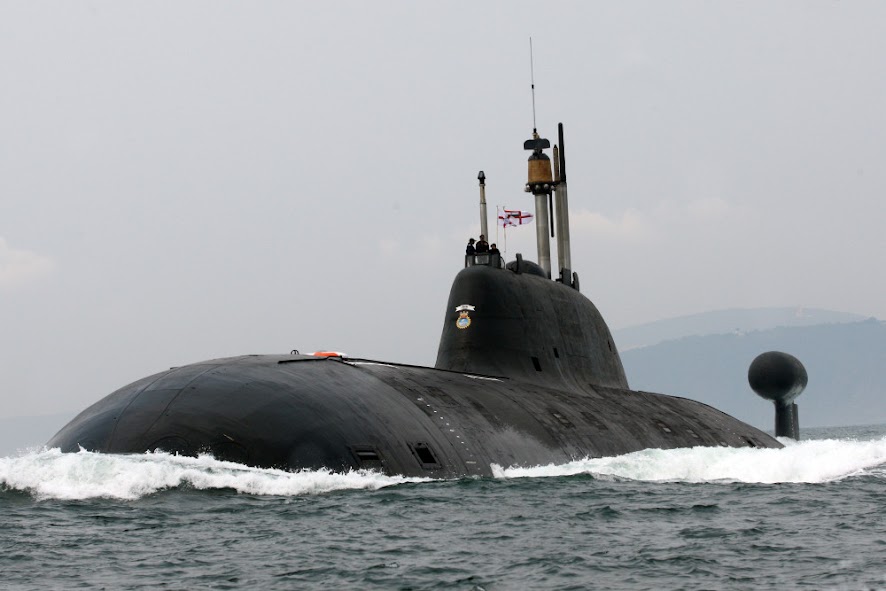
Nuclear powered INS Chakra

The Hindu today  reported that IHS Jane’s experts believe the expanded Uranium Enrichment facility at Ratnahalli is expected to become operational by mid-to late-2015, greatly increasing the availability of enriched uranium in India. While some of the increased production would be utilized for fueling Indian nuclear submarines (there are currently two), there would  be enough remaining for India to build more nuclear and thermonuclear bombs.

Karl Dewey, Proliferation Editor at IHS Jane’s Intelligence Review, told The Hindu, "The enrichment plant is primarily built to provide uranium for submarine reactors. However, there will now be significant excess capacity that could be used for other purposes, such as developing nuclear weapons."

I believe the news report at best reflects a lack of due diligence on the part of the The Hindu, and at worst a pandering to interests inimical to our nation. (The Hindu has in the past done some very dubious reporting on India's relations with China.)

The Hindu news is no news! In October 2011, the Institute for Science and International Security released a Google Earth image that showed what appears to be a new uranium enrichment facility at Ratnahalli. The Hindu has published a similar Google Earth photo in its news today!

The Hindu report bizarrely alleges that India has expanded its Uranium Enrichment facility at Ratnahalli secretly.

Ironically, during an interview with The Hindu in September 2010, Srikumar Banerjee, Chairman, Atomic Energy Commission (AEC) and Secretary, Department of Atomic Energy (DAE), was asked:

Where will the enriched uranium for these boats come from? There is only one Rare Materials Plant at Ratnahalli, near Mysore, to produce enriched uranium. Will the proposed Special Material Enrichment Facility in Chitradurga district in Karnataka be helpful?

Banerjee replied: Chitradurga will come a little later, not immediately. Our Ratnahalli plant capacity has been enhanced. But more than that, there is significant improvement in our technology. Usually, a term called Separating Work Units (SWUs) defines the technology level that we have achieved in this, and I can assure you that there has been considerable improvement in SWUs of our next generation caskets of centrifuges. The separating capacity of our centrifuges has improved. So total capacity enhancement at Ratnahalli has been done. We are confident of supplying the entire fuel for the set of….

You cannot say anymore that India does not have enrichment technology. India has its own technology and we can produce [enriched uranium]. We have not started doing it for large-scale commercial nuclear power stations, which require a much larger quantity of enriched uranium. We will be able to do that once we go to Chitradurga.

Clearly, Banerjee was far from secretive about the Ratnahalli expansion. 

There is more! In an interview to CNN-IBN in December 2011, Dr Banerjee alluding to the expanded capacity of the Ratnahalli plant and reiterated that India will have enough HEU from Ratnahalli to fuel its nuclear submarine fleet.

Clearly, The Hindu is not revealing any secrets about the Ratnahalli.

But there are secrets The Hindu needs to reveal? For example, what is its motivation to rehash old allegations as new news?

IDP Sentinel members can read more at the link below.

Uranium Enrichment Program - IDP Sentinel

Thursday, January 16, 2014

Nirbhay Cruise Missile Capability Analysis

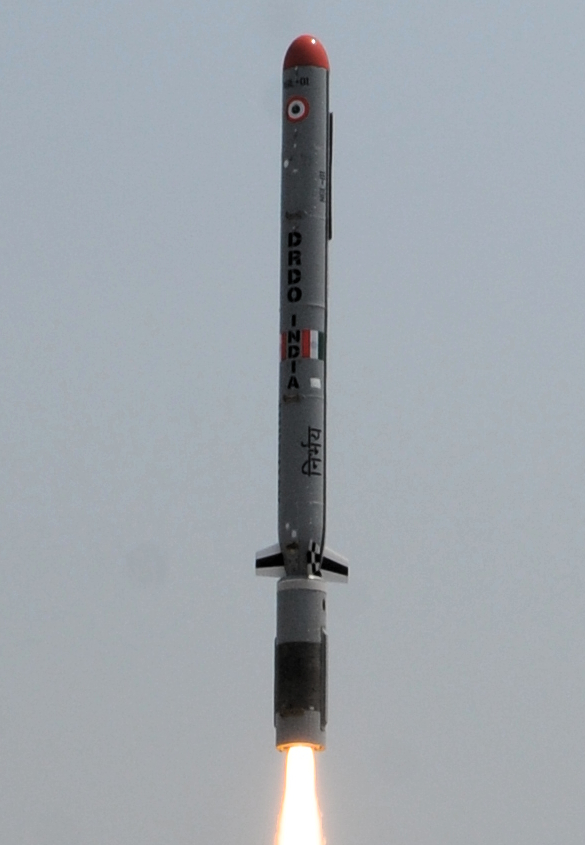
Nirbhay Cruise Missile Debut Test on March 12, 2013. Photo Credit: DRDO

The second test of the Nibrhay cruise missile is due (The Hindu had reported on November 24, 2013 that the test would take place in December 2013) on Friday, October 17, 2014 and this post presents a recap and analysis of the missile's reported capabilities.

The debut test of the Nirbhay cruise missile on March 12, 2013 was aborted after about 20 mins of flight. A DRDO statement following the test said, "After travelling approximately mid-way, deviations were observed from its intended course.  Further, flight was terminated to ensure coastal safety."

Following launch from a road mobile launcher, the first stage rocket booster separated, the second stage turbojet engine starter fired, and the engine attained full thrust; the missile reached a cruise speed of 0.7 M (460 k or 900 kph).

The missile is reported to have successfully navigated to two waypoints and was flying at a height of 4.5 km when the mission was aborted.

The test was planned to the max range of the missile, which is 1,000 km. The missile successfully covered half the distance, proving many of the critical systems of the missile such as vertical launch and boost, tip over to horizontal flight, engine light up and cruise at max turbojet power. DRDO correctly labels the test as a partial failure.


Nirbhay's Reported Capabilities


Nirbhay is projected to be a terrain hugging (30m AGL) stealthy cruise missile capable of delivering different warheads as per mission requirement.

A DRDO official told the press that the missile would be capable of carrying 24 types of warhead.

On March 11, 2013 The Hindu reported that the Nirbhay is capable of dropping bombs and coming back. The missile cruises at 500-m to 1-km and has a cruise speed of 0.67M.

A DRDO missile engineer told The Hindu of Nirbhay, "It will cruise in the atmosphere like an aircraft and it is capable of travelling up to 1,000 km. The biggest advantage with Nirbhay is that it can be launched from land, air and sea. It is a potent system. ”

An unnamed DRDO official reportedly told The Hindu in March 2012 that the Nirbhay will be able to carry multiple payloads and engage one of several targets.

“Even if there are multiple targets, it can pick out a target and attack it. It is a loitering missile; it can go round and round a target, perform several manoeuvres and take it apart. It has precision, endurance and accuracy. It is an important missile,” the official said.

Flight Profile


Nirbhay takes off vertically from a road mobile launcher using its first stage solid rocket motor booster. As it reaches 500-m to 1-km, it archs to a horizontal flight path and accelerates. On burn out, the first stage motor drops off and the second stage turbo-jet engine powered by aviation kerosene lights up. The missile then cruises to its target at a speed of 0.67 Mach.

Stealth


Nirbhay has no LO shaping, though the missile has a clean design and a recessed, shielded air-intake to reduce radar signature, like in the US Tomahawk CM.

Analysis


Loitering Missiles


Typically, a loitering missile can fly a search pattern over a wide area for identifying targets and relaying their location back to the command center, where these targets are engaged by direct attack PAMs or by other assets.

Toward the end of its mission, or when a priority target appears, the missile brakes out of its search pattern and attacks the target.

The Nirbhay's loitering capabilities are likely inspired by those of the Tactical Tomahawk or RGM/UGM-109E Tomahawk Land Attack Missile (TLAM Block IV). The missile has network-centric warfare-capabilities - it can use targeting data from multiple sensors (aircraft, UAVs, satellites, foot soldiers, tanks, ships) to find its target and its sensors can send data to these platforms - which allow it to be re-targeted during a loiter. Instead of attacking target coordinates stored in its memory, the missile can be directed to attack fresh co-ordinates uploaded in realtime.  The missile entered service with the US Navy in late 2004.

The TLAM-D carries 24 canisters containing 166 bobmlets (7-ea in 22 canisters and 6-ea in 2 canisters).  The missile can perform up to five separate bombing runs dispensing two canisters, one from each side, at a time during a run, allowing it to attack multiple targets. However, typically the missile dispenses all 24 canisters sequentially from back to front to ensure the density of bomblets on target is adequately destructive.

The DRDO official who reportedtly told the press that the missile would be able to carry 24 types of warhead was likely referring to this capability.

Nirbhay's Loitering Capability


A loitering ability at a range of 750 km would require reliable satellite based communication link, something India doesn't have yet. Besides, loitering deep in enemy territory would make the missile susceptible to enemy defenses.

For loitering to be effective, it would have to be from a height where the missile will be an easy target for enemy air defenses.  The missile's reported max speed of 0.67 M or approximately 400 kts should make it an easy target, despite the LO features, were it to loiter in contested airspace.

It's likely the Nirbhay will have separate versions, like the Tomahawk, for strategic (single nuclear warhead) and tactical (multiple munitions) use, with only the tactical version using loitering capabilities.

It is possible that the Air Force satellite GSAT-7A will give the IAF an ability to control the Nirbhay right through to its limiting range.

Most likely the Tactical version of the Nirbhay will operate at limited range so that it can remain effectively networked, with AWACS providing a high bandwidth data link.

Recoverable Missile


DRDO scientists have alluded to the Nirbhay having an ability to engage targets and return.

Even if the missile is capable of being recovered, like the Lakshay-2, it would be limited to a few reuses. The cost of recovering the missile and subjecting it to rigorous testing for reuse would likely be close to the cost of a new missile if it is being produced in large enough quantities.

Fitted with a nuclear warhead, Nirbhay's loitering capabilities makes no sense and it's low cruise speed make it highly vulnerable.

It is possible that the ability of the missile to return is a reference to a recall of the missile, but no reuse.

For additional details about the Nirbhay missile, please visit the link below

Nirbhay Cruise Missile - IDP Sentinel

Tuesday, January 14, 2014

Work Starts on Fathebad Nuclear Reactor as India Aims for 20,000 MW capacity by 2020

The Prime Minister, Dr. Manmohan Singh being briefed about the project model, at the foundation stone laying ceremony of the Gorakhpur Haryana Anu Vidyut Pariyojana (Nuclear Power Project), in Fatehabad, Haryana on January 13, 2014. The Governor of Haryana, Shri Jagannath Pahadia and the Union Minister for Social Justice & Empowerment, Kumari Selja are also seen.

The Prime Minister, Dr. Manmohan Singh, laid the foundation stone of the 2,800 MW Gorakhpur Nuclear Power Reactor Complex on January 13, 2014, taking India another step closer to achieving its nuclear power generation goals.

India currently operates 20 commercial nuclear power plants with a total installed capacity of 5,680 MW.

The installed nuclear power capacity will reach 10,080 MW by the year 2017 on progressive completion of projects under construction. The XII Five Year Plan proposals envisage start of work on 19 new reactors with a capacity of 17400 MW.

Planned Reactors


The details of nuclear reactors planned to be constructed within the XII Five Year Plan are:

Indigenous Reactors


 Project        Location Reactor Type  Capacity (MW)
 Gorakhpur, Units 1&2 Gorakhpur, Haryana PHWR 2X700
 Chutka, Units 1&2 Chutka, Madhya Pradesh PHWR 2X700
 Kaiga, Units 5&6 Kaiga, Karnataka PHWR 2X700
 Mahi Banswara, Units 1&2 Mahi Banswara, Rajasthan PHWR 2X700
 Fast Breeder Reactor, Units 1&2 Kalpakkam, Tamil Nadu FBR 2X500
 Advanced Heavy Water Reactor Site to be decided AWHR 300

LWRS with International Co-operations


 Project        Location Reactor Type  Capacity (MW)
 Kudankulam Units 3&4 Kudankulam, Tamil Nadu LWR 2X1000
 Jaitapur Units 1&2 Jaitapur, Maharashtra LWR 2X1650
 Chhaya Mithi Virdi Units 1&2 Chhaya Mithi Virdi, Gujarat LWR 2X1100
 Kovvadda Units 1&2 Kovvada, Andhra Pradesh LWR 2X150


Reactors Under Construction 

A total of  9 commercial and one prototype reactors are currently under construction.

Four 700 MW PHWR reactors at Gokhpur (Fathebad) in Haryana
One 1000 MW VVER reactor at Kudankulam. (Unit-1 started commercial operations in January 2014)
Two 700 MW PHWR reactors at Kakrapar in Gujarat (KAPP 3&4).
Two 700 MW PHWR reactors at Rawatbhat, near Kota in Rajasthan (RAPP 7&8). [Construction started on July 17, 2011]

In addition, Bharatiya Nabhikiya Vidyut Nigam is building a 500 MW prototype fast breeder reactor at Kalpakkam.

Thursday, December 5, 2013

DRDO Breakthrough in Canister Launch Technology, Agni-V Canister Launch in March-April 2014

Agni-5 second test on September 15, 2013. Photo Credit: DRDO

On December 5, 2013, The Hindu reported that recently DRDO successfully carried out a “Missile Ejection Test” (MET) using a dummy missile weighing 50 tons. Following the breakthrough, Agni-V would be launched from a canister in March-April, 2014 for its third test.

The MET validated critical newly developed technologies such as launcher-canister interface and effective sealing between the missile and gas generator. The missile exited the canister at the correct velocity and the inter-facing instruments, electronics and sensors worked perfectly. As the missile cleared the canister by 15m, the sensors accurately signaled first stage ignition to the missile computer.

Placing the missile in a hermetically sealed canister facilitates long term storage (10 years) without any maintenance.  DRDO has committed to make canister launch a feature of all its new land based strategic missiles, starting with Agni-V.

DRDO has designed a canister that can eject the 50-tonne missile 50 m in the air and fire the first stage. The missile canister is made of maraging steel allowing it to withstand the 300-t to 400-t shock generated when the 50-ton missile is ejected out.

In September 2012, ASL director of, Dr V G Sekharan, told Business Standard, "The gas pushes the Agni-V out, like a bullet from the barrel of a gun. In less than half a second, the 50-tonne missile clears the canister by 15-m, and that is when the rocket motor can safely ignite. In 30 seconds, the Agni-V breaks the sound barrier and, in 90 seconds, it has left the atmosphere."

The canister could be carried on railcars or on a 12x12 road-mobile truck. Carrying the missile on a road-mobile launcher gives more flexibility as it can be launched from any patch of level ground. The Agni-5 is tailored for road-mobility. The mobile launcher for Agni-V is being produced by the private industry.

Canister technology was initially developed for the naval variant of Brahmos missile. The technology was completely mastered during the development of the K-15 / Shourya missiles. However, canister launch technology doesn't scale well.. In order to develop a 50-t missile canister launch capability, the DRDO has set up a facility for MET  at Shamirpet near Hyderabad.

For additional details on the Agni-V please visit the link below

Agni-V LRBM - IDP Sentinel

Tuesday, November 5, 2013

Strategic Rail Projects - An Update


Tawang, Arunachal Pradesh
Tawang, Arunachal Pradesh. Photo Credit: Vijainder K Thakur

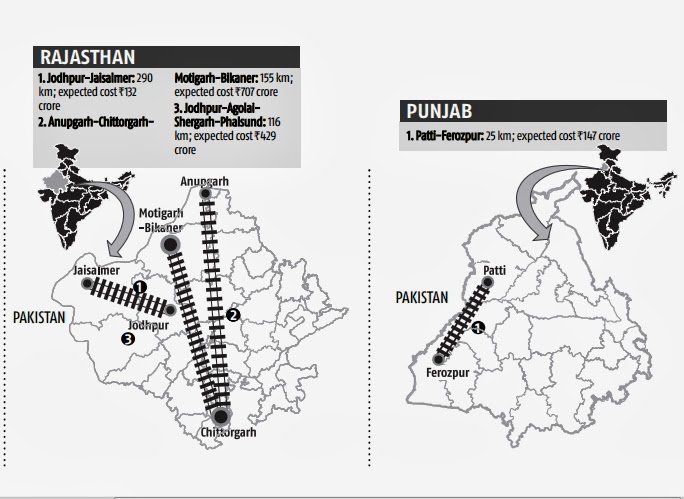
India is developing the following 14 Strategic railway lines as part of its efforts to strengthen the infrastructure along the LAC and LOC. The projects are located in Jammu and Kashmir, Assam, Arunachal Pradesh, Uttarakhand, Punjab and Rajasthan.

Murkongselek-Pasighat-Tezu-Parasuramkund-Rupai (Assam, Arunachal Pradesh)
Missamari-Tawang (Arunachal Pradesh)
North Lakhimpur-Along-Silapathar (Assam)
Patti-Ferozpur (Punjab)
Jodhpur-Jaisalmer (Doubling) (Rajasthan)
Pathankot-Leh (Punjab)
Tanakpur-Bageshwar (Uttrakhand)
Jammu-Akhnoor-Poonch (J&K)
Dehradun-Uttarkashi (Uttrakhand)
Rishikesh-Karanprayag-Chamoli (Uttrakhand)
Anupgarh-Chattargarh-Motigarh-Bikaner (Rajasthan)
Tanakpur-Jauljibi (Uttrakhand)
Jodhpur-Agolai-Shergarh-Phalsund (Rajasthan)
Srinagar-Kargil-Leh (J & K)

Graphic Courtesy: Business Standard
The 378-km long Missamari-Tawang link is one of the most strategically important projects, which is expected to cost about Rs 19, 108 crore.

Out of the 14 planned railway lines, survey has been completed for 12, PTI reported on October 27, 2013.

Cost of four lines is yet to be estimated.

Work has started on two lines: the 160-km Hrishikesh-Karnaprayag-Chamoli line and the 30-km stretch of the Murkongselek-Pasighat segment (North Frontier Railways).

Rail Vikas Nigam Limited (RVNL) has submitted details of the Hrishikesh-Karnaprayag-Chamoli railway line alignment to the state government and Railway Board for approval and is awaiting environmental clearances for the initial 12-km stretch of the track.


Graphic Courtesy Business Standard

The 30 km Murkongselek-Pasighat segment is over flat terrain; the challenge lies ahead from Tezu to Rupaithe.

The four lines planned in Uttarakhand traverse difficult terrain.

Some of these lines were planned a hundred years ago. Projects are stalled by lack of funds and the absence of a cost-sharing agreement between the various ministries involved.
Reference: Strategic Rail Projects

Tuesday, September 17, 2013

Agni-V's Impressive CEP Revealed


India's Agni-V has a CEP that is impressive for a missile with more than 5,000 km range and DRDO scientists are striving to reduce it further.

Agni-V second test on September 15, 2013. Photo Credit: DRDO

Following the second test of the missile on September 15, 2013, DRDO Chief Avinash Chander told the press that the current CEP of the Agni-V is 100m, and DRDO scientists hope to reduce it to 10-15m!


Let's see how the 5,000 km plus Agni-Vs CEP compares with the CEPs of other contemporary ICBMs.

The US Midgetman with a range of 11,000 km has a CEP of 90m. Russia's Bulava with a range of 10,000 km has a CEP of 200m. The CEP of Chinese ICBMs like DF-41 and DF-31A is not know.

Second Test Range 


It's interesting that DRDO's press release on Agni-Vs second test made no mention of the range to which the missile was tested.

The missile was targeted to its maximum range of 5,000 km during its maiden test on April 19, 2012. Following the test, DRDO scientists had said that in subsequent tests the missile's would be targeted to its 'minimum' and 'middle' ranges.

So was the second test a 'minimum' or 'middle' range test?

Additional Tests 


According to DRDO Chief Avinash Chander, at least three to four additional successful flight tests would be needed before the missile could be inducted into service.

Some of these tests would be conducted as user trials.

Both the tests so far have been conducted in the presence Strategic Force personnel.

Production

According to the DRDO press release, which you can peruse at the link below, the second test has paved "the way for initiation of productionisation and subsequent induction."

Canister Launch

The press release and Dr. Chander both say the next launch will be from a canister.

Please visit the link below for more information on the Agni-V project

Agni-5 LRBM