Showing posts with label Nirbhay. Show all posts

Tuesday, June 16, 2026

DRDO's LR-LACM Test Deserves More Attention Than It Is Getting

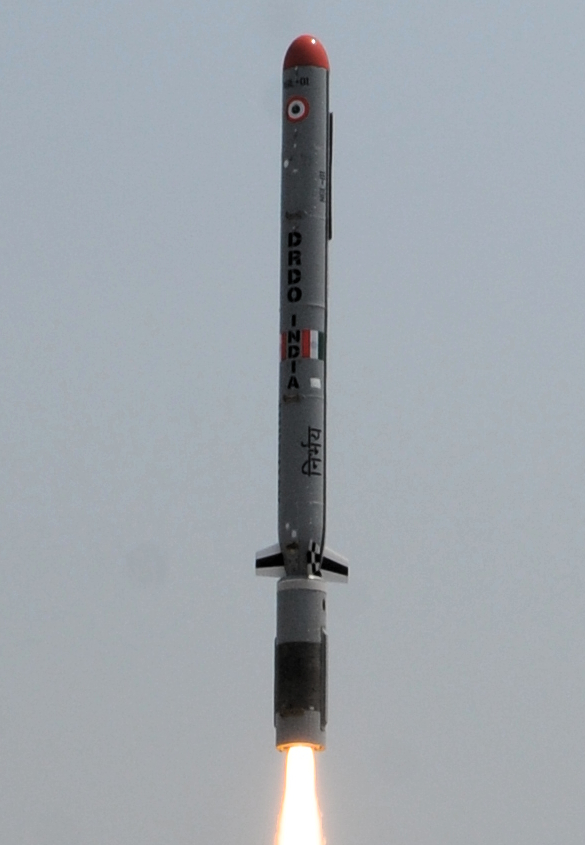
LR-LACM Test on June 15, 2026: Photo PIB


 The DRDO successfully flight-tested the Long-Range Land Attack Cruise Missile (LR-LACM) from Dr APJ Abdul Kalam Island, off the coast of Odisha, on June 15, 2026, using a mobile articulated launcher.


The missile was last tested on November 12, 2024, during its maiden flight. That test was also conducted from a mobile articulated launcher.


During its maiden test, the missile followed the desired flight path using waypoint navigation and demonstrated its ability to perform various manoeuvres while flying at different altitudes and speeds.


The LR-LACM flies a terrain-hugging or sea-skimming profile to avoid radar detection. It can navigate using waypoints and modify its flight profile to avoid adversary air-defence zones, terrain features, and other obstacles.


The missile can execute precision strikes against static targets using an RF seeker for terminal homing, similar to the one developed for the BrahMos missile.


The DAC accorded approval for the acquisition of the LR-LACM for the Indian Navy and the Indian Air Force on July 2, 2020.


The LR-LACM is a derivative of the ITCM (Indigenous Technology Cruise Missile).


ITCM


The ITCM was a technology-demonstrator project, while the LR-LACM is intended for operational deployment.


The ITCM itself was derived from the Nirbhay missile. During DefExpo 2020, DRDO announced that it had completed and closed the Nirbhay capability-development project.


The ITCM featured a small turbofan engine named Manik, developed by GTRE, and an indigenously developed RF seeker for terminal guidance. The Nirbhay lacked a terminal seeker and was powered by a Russian turbofan engine.


The ITCM was last flight-tested successfully on April 17, 2024, with the Manik turbofan engine and all other subsystems, including the RF seeker. According to DRDO, the ITCM has a range of 1,000 km and carries a 300 kg warhead. It weighs 1,500 kg and is 6 metres long.


LR-LACM Test on November 12, 2024 Photo PIB


LR-LACM Features


The LR-LACM is dimensionally similar to the ITCM. However, it is believed to be significantly lighter, at around one tonne, and to have a longer range of up to 1,500 km. It is also likely capable of executing more complex flight profiles.


With a range of up to 1,500 km, the LR-LACM would allow India to hold high-value targets at risk deep inside adversary territory. Its nap-of-the-Earth profile and waypoint navigation capability would allow it to easily exploit gaps in the low level coverage of adversary radars. 


The LR-LACM is configured for launch from the ground using mobile articulated launchers and from frontline warships using the UVLM (Universal Vertical Launcher Module). Developed and patented by BrahMos Aerospace, the UVLM is already deployed on 30 Indian Navy warships for launching BrahMos missiles.


Since the DAC has also approved acquisition of the LR-LACM for the Indian Air Force, it is likely that an air-launched variant of the missile is under development and could be tested in the near future.


Besides the LR-LACM, DRDO is developing another derivative of the ITCM—the Sea-Launched Cruise Missile (SLCM), which will be capable of launching from a standard 533 mm submarine torpedo tube.


SLCM


The SLCM (Submarine Launched Cruise Missile) will need to be shorter and lighter to make it compatible with torpedo-tube launch. Consequently, it is expected to feature a smaller 250 kg penetration-cum-blast or airburst warhead.


DRDO plans to initially flight-test the SLCM from a Russian-origin Sindhughosh-class (Kilo-class) submarine.


According to media reports, DRDO successfully validated submarine-launch capability in February 2023 during a developmental missile launch from an underwater platform. The missile tested covered a range of 402 km.


The test was reportedly aimed at validating critical underwater-launch processes, including wing deployment after surfacing and engine start during flight.


Looking Ahead


The operational deployment of the LR-LACM, which now appears to be only a matter of time, will represent a significant milestone in India's quest for missile self-reliance, signalling the maturation of DRDO's ability to develop and deploy indigenous cruise missiles capable of operating from multiple platforms.

In the near future, DRDO could further enhance the missile's penetration capability and lethality by equipping it with self-protection modules featuring radar jammers to disrupt RF-guided interceptors and dispensers for decoy submunitions—such as dipole reflectors and heat traps—to create false targets during the terminal phase of flight. The addition of optical sensors for navigation and target recognition could also make the missile more resilient against electronic warfare measures aimed at spoofing or jamming GNSS signals.

Copyright © Vijainder K Thakur. First published on Thumkar.

Friday, February 13, 2026

Nirbhay’s Successors: Two Potent Naval Cruise Missiles Take Shape


ChatGPT generated image showing a submarine launching a cruise missile.


On February 12, 2026, The New Indian Express reported that the MoD has released a Request for Information (RFI) for procuring an undersea-launched missile capable of engaging land targets at ranges from a minimum of 50 km to beyond 500 km, with high accuracy and survivability. The missile is required to be compatible with standard 533 mm torpedo tubes used by the Navy’s existing conventional submarines and weigh under 1,500 kg, including the launch capsule.


The RFI states that the missile required is intended to provide “long-range strike capability against land targets” and stipulates that the missile should be capable of engaging targets “with high probability of kill” while being launched from conventional submarines.


The RFI further specifies that the missile should be capable of operating in contested environments, including GPS-denied conditions, and incorporate terrain-following capability, waypoint navigation, and anti-jamming features.


Indian Navy Requirement


The Indian Navy (IN) wants to procure a subsonic cruise missile that can be launched from a standard 533 mm torpedo tube of any conventional or nuclear submarine.


The IN had initially toyed with the idea of adapting the BrahMos for launch from a submarine. Indeed, a vertically launched submarine version of BrahMos was tested on March 20, 2013, from a submerged platform in the Bay of Bengal off the coast of Visakhapatnam.


However, to facilitate vertical launch from a submarine, an additional section would need to be plugged into the submarine. Plugging a new section would have been a risky proposition since it would have altered the buoyancy of an existing boat. Additionally, there would have been technical, financial, and timeline challenges.


A torpedo tube-launched cruise missile is a cheaper and more versatile option, though the missile would lack the destructive capability of the supersonic BrahMos.


The IN is currently equipped with Russian-origin Klub-S cruise missiles integrated with its Project 877EKM (Sindhughosh class) and HDW Type 209 (Shishumar class) submarines, and the French SM39 Exocet cruise missiles integrated with its HDW Type 209 (Shishumar class) submarines.


The SM39 Exocet missile does not have a land-attack variant. However, a land-attack variant of the missile called SM40 is under development in France.


The Klub-S has two variants — 3M54E1 anti-ship and 3M14E land-attack cruise missiles.


In July 2018, Russian shipbuilder Zvezdochka and Indian shipbuilder Larsen and Toubro announced their partnership to conduct medium refit and life certification (MRLC) upgrades on four of the Indian Navy's Sindhughosh-class submarines, which are the local designation for the Russian Project 877EKM Kilo-class diesel-electric attack submarines.


The partnership involved one submarine undergoing refit at Zvezdochka's facility in Severodvinsk, Russia, to facilitate technology transfer and training for Indian personnel. The remaining three would be handled at L&T's Kattupalli shipyard near Chennai, India.


The MRLC included integration of the Klub-S (3M-54E/3M-14E) missile system for anti-ship and land-attack capabilities, allowing strikes up to 220–300 km depending on the variant.


DRDO's SLCM


According to the DRDO Annual Report 2018, the MoD sanctioned the development of a Submarine-Launched Cruise Missile (SLCM) in 2017.


The SLCM is a derivative of the ITCM subsonic cruise missile.


ITCM


The ITCM, in turn, is a Nirbhay derivative. During DefExpo 2020, the DRDO announced completion and closure of the Nirbhay project and the launch of the Indigenous Technology Cruise Missile (ITCM) project based on technology developed for the Nirbhay project.


The ITCM differs from the Nirbhay in being powered by an indigenously developed small turbofan engine named Manik. Additionally, the ITCM features an RF seeker, something that the Nirbhay was never tested with.


The ITCM was last flight-tested successfully on April 17, 2024. The successful flight test established reliable performance of the Manik turbofan developed by the Gas Turbine Research Establishment (GTRE), Bengaluru, and all other subsystems, including the RF seeker.


According to the DRDO, the ITCM has a range of 1,000 km and a warhead of 300 kg. It weighs 1,500 kg and has a length of 6 m.


SLCM


The SLCM variant of the ITCM would need to be shorter and lighter to make it compatible for launch from a torpedo tube. Consequently, it will feature a 250-kilogram penetration-cum-blast or airburst warhead.


The SLCMs will be tested first on the Russian-origin Sindhughosh-class (Kilo-class) submarines as per the plan.


According to a media report, the DRDO successfully validated submarine launch capability in February 2023 during a developmental missile launch from an underwater platform. The missile tested covered a range of 402 kilometers.


The test was reportedly aimed at validating critical underwater launch processes such as wing deployment after surfacing and engine start during flight.


LR-LACM


Besides the SLCM, the DRDO is also developing a longer-range variant of the ITCM called the Long-Range Land-Attack Cruise Missile (LR-LACM) for precision attacks on static targets using its RF terminal seeker.


The LR-LACM flies a terrain-hugging/sea-skimming profile to avoid radar detection. It can navigate using waypoints and make flight profile changes to avoid adversary air defence zones, terrain, and other obstructions.


The missile can execute precision attacks on static targets using an RF seeker similar to the one developed for BrahMos for terminal homing.


The LR-LACM is being developed to meet the QRs projected by the IN to the DRDO. The missile is configured to launch from the ground (coastal batteries) using mobile articulated launchers and from frontline warships using a UVLM (Universal Vertical Launcher Module). Developed and patented by BrahMos Aerospace, the UVLM is already deployed on 30 ships of the Indian Navy.


Test of LR-LACM on November 12, 2024


The DRDO conducted the maiden flight test of the LR-LACM from the Integrated Test Range (ITR), Chandipur, off the coast of Odisha on November 12, 2024, from a mobile articulated launcher.


"The missile followed the desired path using waypoint navigation and demonstrated its capability to perform various manoeuvres while flying at various altitudes and speeds. The missile is also equipped with advanced avionics and software to ensure better and reliable performance."


Copyright © Vijainder K Thakur. First published on Thumkar.

Tuesday, February 10, 2026

Positive Indigenisation Lists, Negative Political Will - Is India Buying Western Weapons Unnecessarily?


V-BAT Drone. Image via Shield AI


ANI has recently reported that India and France are moving closer to a deal worth around €300 million for the procurement of additional SCALP long-range cruise missiles.


Doesn’t the import of SCALP missiles adversely impact the development and induction of the ITCM—Indigenous Technology Cruise Missile (Nirbhay)?


Under the Defence Acquisition Procedure (DAP) 2020 and subsequent Positive Indigenisation Lists (formerly called Negative Import Lists), the Ministry of Defence barred the import of long-range cruise missiles to support the Nirbhay programme.


We appear to be breaking our own Make-in-India rules to acquire weapons from Western nations, increasing our dependency on foreign vendors instead of reducing it.


If Atmanirbharta is a genuine quest, why isn’t the development of the ITCM being prioritised?


The ITCM Mystery


The ITCM has been under development since 2010. It is ironic that in 15 years we have not been able to develop a subsonic cruise missile, and yet we are confident of developing the AMCA, which is not even at the prototype stage, within 10 years.


However, ITCM was last successfully tested on April 18, 2024. During the test, all subsystems performed as per expectations.


The successful flight test also established the reliable performance of the indigenous propulsion system (Manik turbojet) developed by the Gas Turbine Research Establishment (GTRE), Bengaluru.


Would it not make more sense to use the €300 million earmarked for the SCALP purchase to operationalise the ITCM as soon as possible, at least on the Su-30MKI? One cannot help but wonder if the additional purchase of SCALPs is a quid pro quo for the recent trade deal with the EU.


India, it appears, is bending over backwards to please Western nations despite being shabbily treated by the U.S.


Ignoring Russian Weapons


It appears that the Atmanirbharta paradigm applies only to Russian weapons. The IAF has projected a requirement for 2–3 interim stealth fighters. Russia has offered the Su-57 fighters, but India cannot acquire them because it could negatively impact the AMCA programme. (More likely, it is because we fear U.S. sanctions.)


Logically speaking, if AMCA is delivered as per the projected timeline and turns out to be better than the Su-57, then that would be the end of the Su-57—not just in India, but also in other possible Russian export markets.


With Russian weapons, which tend to be more cost-effective, we look a gift horse in the mouth. Western weapons, however, are treated like thoroughbreds even when they are actually overpriced mules.


Our desire to please the West now goes well beyond acquiring weapon systems that we cannot develop.


Take the case of drones, for example. By any logic, all types of drones should be on the Positive Indigenisation List. Where is the need to import drones? Surely, we have the time, talent, and technical know-how to develop our own.


So how does one explain India’s increasing dependence on U.S. and European companies for drones?


V-BAT Acquisition & Local Production


The recent tie-up between India’s JSW Defence and U.S. defence contractor Shield AI to locally manufacture the V-BAT Unmanned Aerial System in India for use by the Indian Army (IA) deserves scrutiny.


V-BAT is a very capable reconnaissance drone with around 12 hours of endurance. It can operate at altitudes of up to 20,000 feet and has a range of up to 180 km with a line-of-sight data link, which can be extended using SATCOM.


Besides its ability to navigate through GPS-denied environments, the drone stands out for its ability to take off and land vertically. Despite its large size, its VTOL capability allows it to operate from only a 12×12-foot clearing, making it deployable from jungle clearings or narrow Himalayan ridges.


V-BAT uses ducted-fan technology, which facilitates an improved maximum take-off weight to payload weight ratio.


V-BAT’s duct increases thrust by 80%+ at equivalent engine power, enabling take-off and landing with a single powerplant. It can fly for half a day or stop and hover for hours on end.


On the downside, the drone costs approximately $1 million per unit.


The IA has acquired V-BAT drones worth roughly $35 million (approximately ₹295 crore) under the emergency purchase provision. Now, JSW Defence is investing $90 million to set up production in Hyderabad.


To be useful to the IA, the drone would need to operate near the LoC or LAC. However, considering its large size, slow speed (167 km/h), and operating height of 20,000 ft, when operating close to the border the drone would always be vulnerable to adversary AD systems.


Notably, the drone is powered by Shield AI’s licensed Hivemind autonomy software. Hivemind AI allows the V-BAT to operate autonomously using machine vision in GPS-denied environments and during heavy electronic warfare (EW) jamming.


One should not expect Shield AI to part with the software’s source code.


The question here is: is the requirement for V-BAT capability compelling enough for the private-sector JSW to invest $90 million without firm orders? Or is there proverbially more to it than meets the eye?


Drone Racket


Many small Indian private-sector companies are now selling drones to the Indian Armed Forces. You might think the drones they are selling are indigenously developed. Think again!


Most of the drones with fancy Sanskrit names being sold to the Armed Forces (AFs) are not Indian-designed, developed, or manufactured, despite Atmanirbharta claims.


Chennai-based private company TUNGA Aerospace Industries was in the news recently for having tied up with Czech firm U&C UAS to supply drones to India’s armed forces. Disconcertingly, the drones proposed to be sold to the AFs are based on Ukrainian technology.


U&C UAS is marketing modified Ukrainian drones, including platforms derived from the Leleka and Bulava drone families.


Any ToT clause notwithstanding, Indian private-sector joint ventures with foreign OEMs will not lead to Indian-designed, developed, and manufactured products in the future. The JSW–Shield AI joint venture will continue peddling V-BAT upgrades and follow-on variants under Sanskrit names, just as TUNGA Aerospace will continue peddling Ukrainian drones.


Copyright © Vijainder K Thakur. First published on Thumkar.

Thursday, January 16, 2014

Nirbhay Cruise Missile Capability Analysis

Nirbhay Cruise Missile Debut Test on March 12, 2013. Photo Credit: DRDO

The second test of the Nibrhay cruise missile is due (The Hindu had reported on November 24, 2013 that the test would take place in December 2013) on Friday, October 17, 2014 and this post presents a recap and analysis of the missile's reported capabilities.

The debut test of the Nirbhay cruise missile on March 12, 2013 was aborted after about 20 mins of flight. A DRDO statement following the test said, "After travelling approximately mid-way, deviations were observed from its intended course.  Further, flight was terminated to ensure coastal safety."

Following launch from a road mobile launcher, the first stage rocket booster separated, the second stage turbojet engine starter fired, and the engine attained full thrust; the missile reached a cruise speed of 0.7 M (460 k or 900 kph).

The missile is reported to have successfully navigated to two waypoints and was flying at a height of 4.5 km when the mission was aborted.

The test was planned to the max range of the missile, which is 1,000 km. The missile successfully covered half the distance, proving many of the critical systems of the missile such as vertical launch and boost, tip over to horizontal flight, engine light up and cruise at max turbojet power. DRDO correctly labels the test as a partial failure.


Nirbhay's Reported Capabilities


Nirbhay is projected to be a terrain hugging (30m AGL) stealthy cruise missile capable of delivering different warheads as per mission requirement.

A DRDO official told the press that the missile would be capable of carrying 24 types of warhead.

On March 11, 2013 The Hindu reported that the Nirbhay is capable of dropping bombs and coming back. The missile cruises at 500-m to 1-km and has a cruise speed of 0.67M.

A DRDO missile engineer told The Hindu of Nirbhay, "It will cruise in the atmosphere like an aircraft and it is capable of travelling up to 1,000 km. The biggest advantage with Nirbhay is that it can be launched from land, air and sea. It is a potent system. ”

An unnamed DRDO official reportedly told The Hindu in March 2012 that the Nirbhay will be able to carry multiple payloads and engage one of several targets.

“Even if there are multiple targets, it can pick out a target and attack it. It is a loitering missile; it can go round and round a target, perform several manoeuvres and take it apart. It has precision, endurance and accuracy. It is an important missile,” the official said.

Flight Profile


Nirbhay takes off vertically from a road mobile launcher using its first stage solid rocket motor booster. As it reaches 500-m to 1-km, it archs to a horizontal flight path and accelerates. On burn out, the first stage motor drops off and the second stage turbo-jet engine powered by aviation kerosene lights up. The missile then cruises to its target at a speed of 0.67 Mach.

Stealth


Nirbhay has no LO shaping, though the missile has a clean design and a recessed, shielded air-intake to reduce radar signature, like in the US Tomahawk CM.

Analysis


Loitering Missiles


Typically, a loitering missile can fly a search pattern over a wide area for identifying targets and relaying their location back to the command center, where these targets are engaged by direct attack PAMs or by other assets.

Toward the end of its mission, or when a priority target appears, the missile brakes out of its search pattern and attacks the target.

The Nirbhay's loitering capabilities are likely inspired by those of the Tactical Tomahawk or RGM/UGM-109E Tomahawk Land Attack Missile (TLAM Block IV). The missile has network-centric warfare-capabilities - it can use targeting data from multiple sensors (aircraft, UAVs, satellites, foot soldiers, tanks, ships) to find its target and its sensors can send data to these platforms - which allow it to be re-targeted during a loiter. Instead of attacking target coordinates stored in its memory, the missile can be directed to attack fresh co-ordinates uploaded in realtime.  The missile entered service with the US Navy in late 2004.

The TLAM-D carries 24 canisters containing 166 bobmlets (7-ea in 22 canisters and 6-ea in 2 canisters).  The missile can perform up to five separate bombing runs dispensing two canisters, one from each side, at a time during a run, allowing it to attack multiple targets. However, typically the missile dispenses all 24 canisters sequentially from back to front to ensure the density of bomblets on target is adequately destructive.

The DRDO official who reportedtly told the press that the missile would be able to carry 24 types of warhead was likely referring to this capability.

Nirbhay's Loitering Capability


A loitering ability at a range of 750 km would require reliable satellite based communication link, something India doesn't have yet. Besides, loitering deep in enemy territory would make the missile susceptible to enemy defenses.

For loitering to be effective, it would have to be from a height where the missile will be an easy target for enemy air defenses.  The missile's reported max speed of 0.67 M or approximately 400 kts should make it an easy target, despite the LO features, were it to loiter in contested airspace.

It's likely the Nirbhay will have separate versions, like the Tomahawk, for strategic (single nuclear warhead) and tactical (multiple munitions) use, with only the tactical version using loitering capabilities.

It is possible that the Air Force satellite GSAT-7A will give the IAF an ability to control the Nirbhay right through to its limiting range.

Most likely the Tactical version of the Nirbhay will operate at limited range so that it can remain effectively networked, with AWACS providing a high bandwidth data link.

Recoverable Missile


DRDO scientists have alluded to the Nirbhay having an ability to engage targets and return.

Even if the missile is capable of being recovered, like the Lakshay-2, it would be limited to a few reuses. The cost of recovering the missile and subjecting it to rigorous testing for reuse would likely be close to the cost of a new missile if it is being produced in large enough quantities.

Fitted with a nuclear warhead, Nirbhay's loitering capabilities makes no sense and it's low cruise speed make it highly vulnerable.

It is possible that the ability of the missile to return is a reference to a recall of the missile, but no reuse.

For additional details about the Nirbhay missile, please visit the link below

Nirbhay Cruise Missile - IDP Sentinel