Showing posts with label DefExpo. Show all posts

Saturday, April 26, 2014

Navy Wants Autonomous Underwater Vehicle (AUV) for Mine and Harbor Defense: L&T Adamya AUV a Frontrunner?

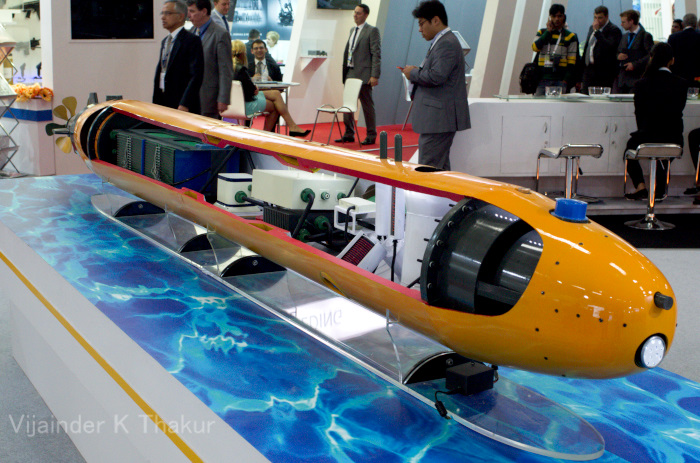
L&T Adamya AUV at DefExpo 2014


MOD has initiated procurement of 15 lightweight (man-portable) and 10 heavyweight Autonomous Underwater Vehicles (AUVs) from Indian Vendors for Mine Reconnaissance and sea bottom mapping.

A RFI circulated by the MOD states that the robotic device should have an on-board propulsion system, possess three dimensional maneuverability,y and be controlled and piloted by an on-board computer. The AUV would have a communication link with control platform on ship/shore but the Navy would also prefer an Automatic Target Recognition capability.

AUVs are being developed worldwide to assist in mine detection and sea bottom mapping of harbors and other areas of interest. Other AUV applications include Intelligence-Surveillance-Reconnaissance (ISR), Clandestine Monitoring, Environmental Monitoring, even Anti-Submarine Warfare.

Based on endurance and ease of handling requirements, the Navy has a requirement for both light weight (man-portable) and heavy weight AUVs for the Indian Navy.

The Navy prefers a low maintenance vehicle with an automatic computerized system for carrying out integrated checks in assembled condition. The results from the checks should be recorded and displayed for analysis.
L&T's Admaya AUV

L&T's Adamya AUV

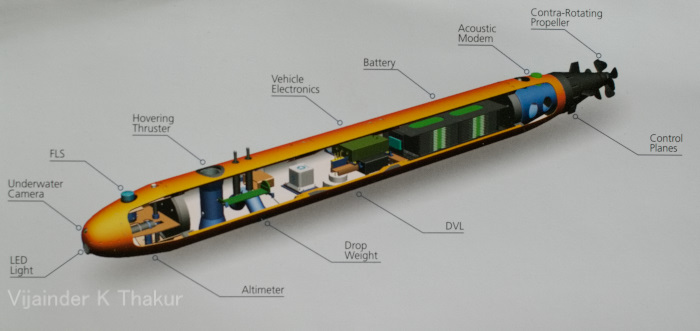
During DefExpo 2014 in New Delhi, L&T displayed its Adamya AUV. Adamya (the Sanskrit adjective translates to - impossible to subdue or defeat) has been developed in-house by L&T. It's unique in its ability to be launched from the torpedo tube of a submarine.

The vehicle has a modular design and can be configured with different depth rated shells eliminating the need to pressure-proof the internal electronic system. It's subsystems can be accessed externally for rapid diagnostics and turnaround servicing.

The vehicle, batteries and internals can be taken apart and packaged into air-ship-able sections, allowing the vehicle to be swiftly deployed in remote areas.

The Adamya navigates with real time position accuracy. It has a velocity logger, an inertial navigation system with GPS update. It looks ahead using a Forward Looking Sonar (FLS) and a Under Water camera.

The 850-kg AUV with a diameter of 533-mm and length of 5700-mm is powered by Lithium-polymer batteries with enough charge to keep it going for 8-hr at 4 kts. Two contra-rotating propellers give the Adamya a top speed of 6-kt, and a cruise speed of 4-kts. The vehicle is also capable of hovering.

The vehicle communicates with its control platform using RF, acoustic or Ethernet via attached cable.

Thursday, February 13, 2014

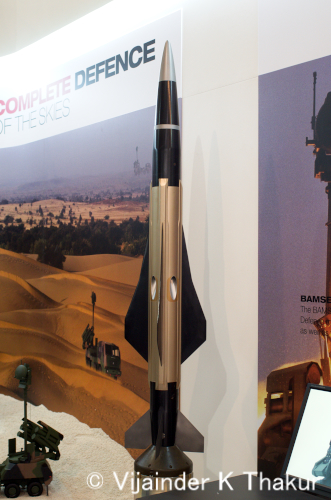
SAAB's Bamse SR-SAM System at DefExpo 2014

SAAB's Bamse SR-SAM on display at DefExpo 2014
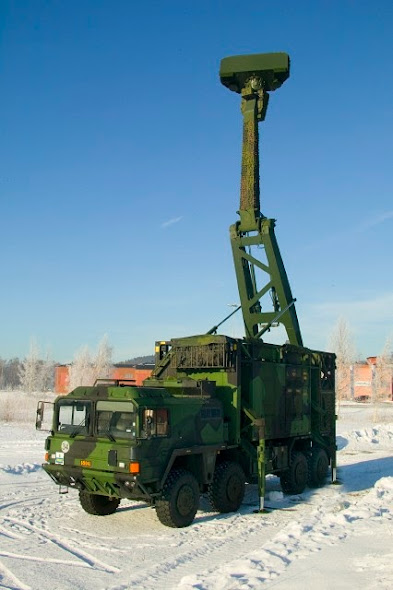
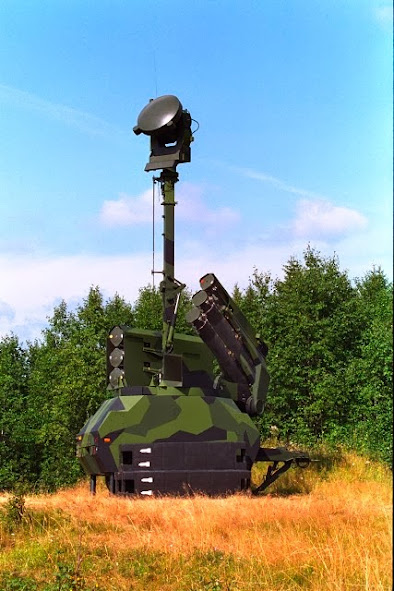
SAAB is fielding its Bamse Ground Based Missile Defense (GBMD) system for the Indian Army's SR-SAM requirement.

The BAMSE system comprises


  1. Giraffe AMB surveillance radar for detecting targets.
  2. Bamse Fire Control Radar (FCR) for Line Of Sight (ACLOS) missile guidance function.
  3. A MCC wit six Bamse Missile to engage targets.

Giraffe AMB. Photo Courtesy SAAB

The Bamse FCR and Bamse missiles are mounted on a single vehicle. The Giraffe AMB has its own vehicle. A single Giraffe AMB can function with multiple missile batteries.

The C-band (5.4 – 5.9 GHz) Giraffe AMB has a 3D phased array, digital beam forming antenna. The radar has an instrumented range of 120-km with elevation coverage of > 70-deg. It can detect targets flying as high as 20-km.

Bamse missile battery with Fire Control Radar

The Bamse FCR operates in the Ka-band (34 – 35 GHz) and provides target and missile tracking. It has an instrumented range of 30-km.

The Bamse missile has an effective range of 20-km and can engage targets as high a 15-km. It uses Automatic Command to Line of Sight (ACLOS) and is fitted with a shaped charge fragmentation warhead with proximity fuse.

The system is capable of engaging fighters, helicopters, stand-off missiles and guided bombs.

SAAB has tied up with Ashok Leyland to provide the vehicles for the Bamse system. All sub-units within the Bamse SRSAM are being integrated with the Ashok Leyland Super Stallion 8x8, a high-mobility vehicle capable of operating in all types of terrain under all weather conditions.

Pune based Kalyani group will be responsible for a lot of the engineering work that goes into the system.

For additional details on the Indian Army's SR-SAM acquisition, please visit the link below.
SR-SAM for Indian Army (IDP Sentinel)

Wednesday, February 12, 2014

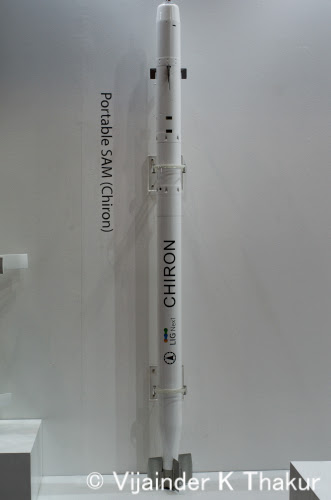
South Korea's LIG's Chiron Portable Surface-to-Air Missile at DefExpo 2014

LIG's Chiron portable surface-to-air missile at DefExpo 2014

South Korea's LIG, a contender in the VSHORAD procurement program for the Indian Army, displayed its Chiron portable Surface-to-Air missile at the DefExpo 2014.

The Chiron, which can engage aircraft, helicopters, and UAVs at low levels, is fitted with an IFF system to safeguard against fratricide.

Max range of the Chiron is 7-km and  max altitude, 3.5-km. The Mach 2 missile is 1.6-m long, 8-cm in diameter, and weighs 15-kg.

The missile features a two color IR seeker that can differentiate between flares and the heat from an engine. It's command guided and requires the operator to track the target following launch. It's fragmented warhead is triggered by a proximity fuse.

Besides a man portable single tube launcher, the missile can also be fitted on a four-launcher remotely controlled station giving it additional versatility.

Very Short Range Air Defense (VSHORAD) System (IDP Sentinel)


Tuesday, February 11, 2014

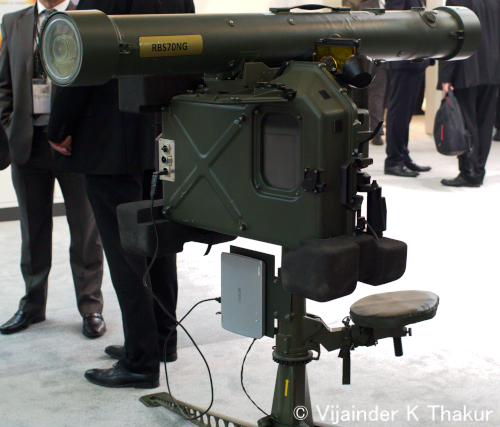
VSHORAD Procurement Contender SAAB RBS 70 NG at DefExpo 2014

RBS 70 NG VSHORAD at DefExpo 2014
SAAB has tied up with Pune based Kalyani Group to pitch its RBS 70 NG missile for the VSHORAD project.

The RBS 70 NG is a laser beam riding missile with an effective range between 250-m to 5,000-m. The system's integrated guidance unit features a thermal imager with built in autotracker and advanced visual curing aids.

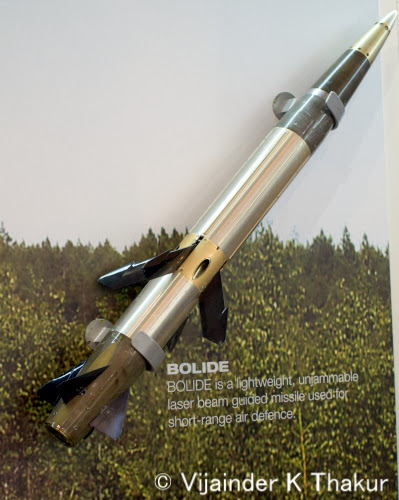
The Mach 2 BOLIDE missile of the RBS 70 NG

 It fires the new Mach 2 BOLIDE missile with a shaped charge and pre-fragmented warhead, making it effective against aircraft,  UAVs, cruise missiles as well as armored ground targets such as ICVs.

The autotracker reduces the tracking noise resulting in higher maneuverability and p-kill than the earlier RBS 70 against small targets at maximum range.

The system is modular and very flexible. It can be configured as a remotely controlled workstation mounted on a vehicle. 

Russia's Tor-M2KM Anti-missile System Displayed at DefExpo 2014

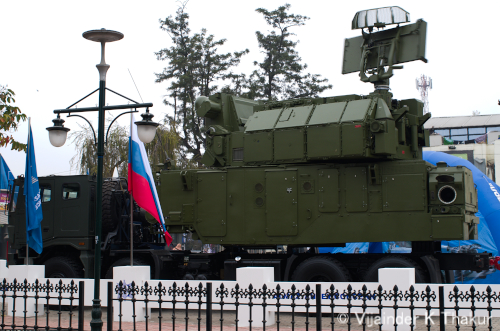
Tor-M2KM anti-missile system at DefExpo 2014

Russia for the first time displayed its Tor-M2KM anti-missile system outside the country at the DefExpo 2014. The weapon system developed by Russia's Kupol Izhevsk Electromechanical Plant JSC (a subsidiary of Almaz Antey Concern PVO) is a contender in the SR-SAM procurement for the Indian Army.

The system displayed at DefExpo 2014 from February 6 to February 9 was the real deal, not a mock-up. It was shipped after extensive trials at Russia's Kapustin Yar range where it went through cruise tests on a special track, and completed three combat runs against Saman targets.

The system will participate in the SR-SAM evaluation trials starting in Spring 2014.

The Tor-M2KM is a point defense weapon system that can engage low flying aircraft as well as cruise missiles. The system - Missiles, Radars, Gensets, Communication link - was displayed mounted on a single all terrain vehicle, but the system is modular and can be installed independently of the vehicle on rooftops,  defensive structures of major cities and nuclear power plants. Russia offers a containerized variant of the Tor-M2KM that can be placed on the decks of low tonnage ships.

Russia says the Tor-M2KM is primarily meant to neutralize precision guided bombs and cruise missiles of all kinds, including anti-ship. Aircraft, including fighters, are an easy kill for the system.

The Tor-M2KM can engage targets up to 15-km away flying as high as 10-km. It features modern electronics and radar capable of detecting and handling up to 48 targets, automatically determining the 10 most dangerous threats.

Tor-M1 Specs


Simultaneously processed detected targets, pcs. - 48
Number of simultaneously tied runs (target + jamming direction) - 10 (9 +1)
SOC detection range, km - 27
Range target tracking, CH, km - 25
Temp review SOC space with the period from - 1

The affected area, km:

in range - 1,0-12
height - 0,01-9
the parameter - 8


The probability of hitting a SAM - 0,56-0,98
Maximum speed of the targeted objectives, m / s - 700

Average response time while shooting with:

with position (parked) - 7.4
with a short stop - 9.7


Shortest response time, s - 4.8
The average flight speed Zour, m / s - 600
Method guidance - radio command
Aerodynamic design Zour - "duck"
Missile weight, kg - 168
Warhead weight, kg - 14.5
Channel on the target - 2
Ducted by SAM - 2
Deployment time (clotting), min. - 3
A method of loading a combat vehicle modules - 4 SAM
Loading time rockets, mines. - 20
Ammunition Zour on combat vehicle, pcs. - 8
Maximum speed, km / h - 65
Weight, t - 37
Mated with CVT - UBKP 9S737
Combat Crew. - 4
Year of adopting - 1991

SR-SAM for Indian Army - IDP Sentinel

Upgraded BMP-2 from Kalyani Group at DefExpo 2014

Kalyani's Upgraded BMP-2 with  Rafael's Samson MkII remotely controlled weapon system at DefExpo 2014

Pune based Kalyani Group pitched an upgraded BMP-2 Infantry Combat Vehicle (ICV) at the DefExpo 2014.. The upgraded BMP-2 features Rafael's Samson MkII remotely controlled weapon system with a 30mm cannon from ATK and two Spike LR missiles from Rafael. The turret, which features  two MiniPOP optronic sights for the gunner and commander, is designed to fit armor protection according to the level specified by the customer.

Upgraded BMP-2 from Elbit Systems and Kalyani at DefExpo 2014


The upgraded ICV features front, side, skirt and rear passive and reactive armor designed to defeat armor piercing rounds and artillery fragments. The skirt provides protection against IED, EFP and RPG-7.

The design is modular and light weight. The upgraded ICV is lighter than the BMP-2.

Upgraded BMP-2 from Elbit Systems and Kalyani at DefExpo 2014

Monday, February 10, 2014

HTT-40 Powerplant and Other Details

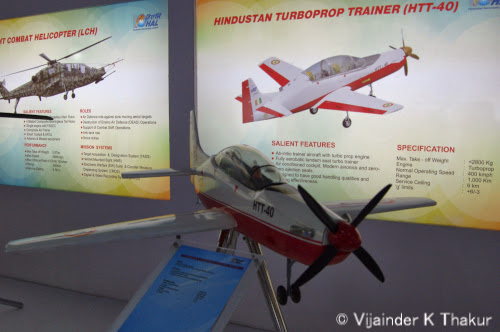
A model of the HTT-40 on display at HAL pavilion at DefExpo 2014
Far from being rattled by the IAF's lack of enthusiasm for the HTT-40 as a Pilatus PC-7 Mk-2 replacement, HAL is pushing ahead with the development of the turboprop powered tandem twin seat basic trainer.

An HAL rep told IDP Sentinel at the DefExpo that HAL is committed to obtain certification for the aircraft within 3-year of project sanction.

The aircraft will be powered by a Garret TPE 331-12 turboprop. HAL in 2009 tied up with Honeywell to manufacture the engine in India for international markets.

HAL has been manufacturing, repairing and overhauling the Garret TPE-5 for international clients under license from Honeywell since 1988. Besides many other aircraft, the engine also powers HAL manufactured Dornier DO-228 aircraft.

The TPE-331-12B powers the Short Tucano basic trainer of the RAF. The engine has a power output of 1,100 shp (820 kW).

HTT-40 at Aero India 2013

The Max T/O weight of the HTT-40 is < 2,800-kg, It has a range of 1,000-km, service ceiling of 6-km, G limit of +6 to -3 and a normal operating speed of 400 kph. The aircraft will feature modern avionics and zero-zero ejection seats.

Assuming that the TPE 331-12 engine is only marginally different from the 331-12B, HTT-40 performance figures don't compare well with those of the Short Tucano.

HAL proposes to develop a weaponized version of the HTT-40, which may tip the scales in favor of the aircraft over Pilatus PC-7 Mk-2 in MOD, the IAF's skepticism not withstanding.

The GOI sanctioned the purchase of 181 basic trainers to replace HPT-32's following their grounding in July 2009. Following global bidding, GOI approved procurement of 75 Pilatus PC-7 Mk-2 aircraft in May 2012. Pilattus on May 24, 2012 announced that it had signed a 500 million Swiss Franc contract with the IAF to supply 75 PC-7 Mk-2.

HAL wants to meet the residual order of 106 basic trainers with its HTT-40 aircraft, instead of locally producing more Pilatu PC-7 Mk-2 at its facilities in India, but the IAF doesn't want to strain its resources by inducting another aircraft type. It is also wary of HAL's ability to deliver, following the HPT-32 experience. In view of HAL's reluctance to manufacture the aircraft, the IAF in early 2014 proposed manufacturing the Pilatus at its own facilities.

HTT-40 Basic Flying Trainer (IDP Sentinel)

Project 75I Contender Scorpene SSK with MESMA AIP Section at DefExpo 2014

A see through model of Project 75I contender Scorpene SSK with cutaway MESMA AIP xection at the DCNS pavilion at DefExpo 2014 
France's DCNS, which is pitching its Scorpene SSK with a MESMA AIP section as a Project 75I contender displayed a see through model of the submarine with the SUBTICS combat system and a cutaway of the optional MESMA AIP at its stall at DefExpo 2014.

The MESMA module is fitted as an additional hull section within Scorpene which then measures 76.10 meters long and displaces 2000 tons.

A see through model of Project 75I contender Scorpene SSK with cutaway MESMA AIP xection at the DCNS pavilion at DefExpo 2014


The Scorpene model was displayed next next to a model of the newly developed French Barracuda class nuclear submarine, to stress that the Scorpene features acoustic discretion and combat system performance developed for the Barracuda.

A model of the newly developed French Barracuda class SSN with the Scorpene SSK in the background at the DCNS pavilion at DefExpo 2014


SSN Suffren, the first Barracuda class submarine, is scheduled to start sea trials early 2016. Six Barracudas will replace the six Rubis/Améthyste-class SSNs currently in service.

Project 75I submarines are required to have a land attack capability, which in the case of the Scorpene will come from torpedo tube launched Exocet missile. No Brahmos on the Scorpene, which may not be such a bad idea.


Project 75I Submarines (IDP Sentinel)