Showing posts with label Missiles. Show all posts

Thursday, April 16, 2015

INS Vikramaditya Undergoing Refit with Barak-1 missiles, CIWS

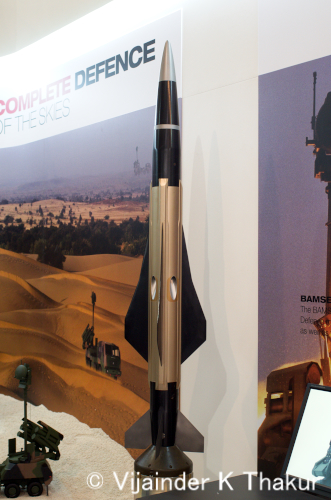
LR-SAM at Aero India 2011

INS  Vikramaditya is undergoing minor ‘refit’ at its home base, Karwar, south of Goa. The refit would equip the ship with Barak-1 missile and 4 Russian origin but made in India Kashtan AK-630 Close-In Warfare System (CIWS). [via TOITribune India]

The Barak-1 missile system is being stripped away from the frigate INS Godavari which is due to be decommissioned. Godavari is 32-year old and got its Barak-1 CIWS 10 years back.

In a subsequent refit, INS Vikramaditya will also equipped with the LR-SAM medium range Point Defense Missile System (PDMS).

For the PDMS, the option was between LR-SAM and Russian Shtil missiles. Now that the LR-SAM has been successfully developed, it will the natural choice.

The Shtil system is the naval variant of Buk missile system that reportedly downed Malaysia Airlines flight MH17 over eastern Ukraine in 2014. It's currently fitted on IN Delhi-class destroyers and Talwar-class frigates.

Installing LR-SAM would entail some cutting through the deck, which would require four to nine months.

INS Vikramaditya would carry up to 32 or 48 LR-SAMs.

INS Vikramaditya (IDP Sentinel)

Friday, September 19, 2014

Brahmos Missile Facts We Tend to Ignore

Brahmos-A mockup on a Su-30MKI at Aero India 2013

Brahmos is not the only supersonic cruise missile, as is often claimed by the DRDO and local India media. The Chinese YJ-12, also powered by a ramjet engine like the Brahmos, can fly at speeds greater than Mach 4 and has a max range of 400-km! The YJ-12 can be launched from Chinese Su-30MKK aircraft.

The missile is armed with a newly designed 205 kg warhead, compared to the 200-kg warhead of the Brahmos missile. (Brahmos-A, the air launched variant of the missile, is reported to have a 300-kg warhead)

YJ-12 AShM can be armed with a radar seeker, an imaging infrared seeker, or a television seeker,

Brahomos-A weighs 2.55-ton or 5,600-lb making it the heaviest ALCM known to mankind! The Russian Kh-101/-102 (conventional and nuclear versions respectively) ALCM, carried by Russian Tu-95MS and Tu-160 bombers. is the current heaviest ALCM with a launch weight estimated at 5,300 lb. The Kh-101 has a range of 2000-3000 km (6,000 miles according to Russian media!) and features a 880-lb / 400-kg warhead,

Further Reading Links for IDP Sentinel Members

Brahmos Missile - IDP Sentinel
Brahmos-A ALCM Variant (IDP Sentinel)

Friday, April 25, 2014

Akash Missile Test Failure Exposes Limitations? Maybe Not


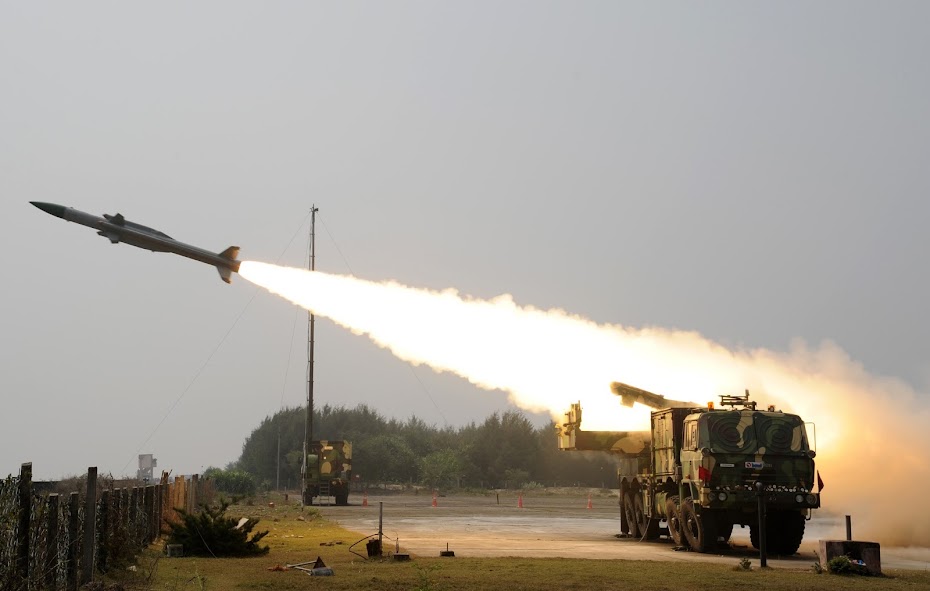
Akash Missile Test on February 24, 2014. Photo Credit: DRDO

An official at the Integrated Test Range (ITR) at Chandipur in Odisha told the New Indian Express on Thursday, April 24, 2014 that the Akash missile test on April 23 by IAF personnel failed.

"The missile was to destroy the PTA at an altitude of nearly 2-km as per the pre-designated coordination. But the mission failed as the weapon could not destroy the target. Though it attained the desired altitude, it failed to pass through missed-distance proximity," said the official.

The proximity fuse of the missile can be variously set to explode within 10, 20 or 100 meters of the missile, according to the official.

Earlier in February 2014, DROD conducted a series of successful tests on the production models of the Akash being delivered to the Indian Army to equip two regiments. During the first test was on February 21, 2014 the missile successfully intercepted an approaching target being towed by a Laskhya PTA. In the second test on February 24, 2014, the missile scored a hit  on a receding target towed by a Lakshya PTA. A third test was carried out on February 26, 2014.

Following the February tests, DRDO said in a press release that mission objectives had been met. A "few more trials are planned in different engagement modes."

It is possible that the Thursday failure of the missile occurred during an engagement mode other than approaching or receding.

According to the DRDO, the fully-automated Akash has an 88% kill probability within a specified kill zone. In other words, if the PTA aircraft was maneuvering a single miss would not be alarming. If the PTA was not maneuvering the failure would certainly be disturbing.

Two more tests of the missile are reportedly planned as a part of the current series. If the failure on Wednesday was out of the ordinary, we could see an cancellation of the upcoming tests.

IDP Sentinel members can peruse additional information on the Akash at the link below.

Akash Missile (IDP Sentinel)


Monday, April 14, 2014

DRDO Plans Test of New Ballistic Missile Defense (BMD) Exo-atmospheric Interceptor


AAD (endo-atmospheric) Interceptor Missile test on March 6, 2011

DRDO will test its the new PDV interceptor missile on April 27, or April 28, 2014 according to The Hindu.

The BMD Phase 1 PDV interceptor will engage a target enemy missile as its warhead separates from the booster to re-enter the earth's atmosphere at an altitude of 125-140  km. The test will demonstrate the PDV interceptor's ability to discriminate between the harmless booster and the potent warhead, destroying the later with a hit-to-kill strike.

The two stage all solid fueled PDV replaces the two stage solid and liquid fueled PAD missile as the exo-atmospheric interceptor of BMD Phase-1 system.

The  PDV uses a dual mode (IR and active radar) seeker. In comparison, the PAD interceptor uses inertial navigation with mid-course correction from 'Swordfish' Long Range Tracking Radar (LRTR). In its terminal phase, PAD switches to active radar homing.

The PDV retains the PAD interceptor's maneuvering gimbaled directional warhead that can rotate 360 degrees to explode towards the incoming missile in order to destroy. Because it is directional, the 30 kg interceptor warhead is able to generate an impact equivalent to a 150 kg omni-directional warhead.

With a liquid fueled second stage, PAD isn't a viable missile defense interceptor, since it requires fueling before launch, delaying interception. Not surprisingly, the missile has been tested just two times so far, that too in the initial phases of BMD development - On March 6, 2006 and November 27, 2006. The PAD was likely intended to be a technology demonstrator / stop gap missile.

The all solid fueled PDV is capable of immediate launch. It is designed to intercept enemy missiles at altitudes upto 150 km, ensuring that the enemy warhead debris burns up in the atmosphere, causing no ground contamination. The missile is equipped with a innovative system to facilitate maneuvering well outside the earth's atmosphere where aerodynamic surfaces are completely ineffective.

During the upcoming test, a modified PAD launched from a Navy ship will fly the trajectory of a 2,000 km range "enemy" missile. The new PDV interceptor, launched from a Navy ship, will attempt hit-to-kill destruction of the target missile.

Tortured Development

Development of PDV has taken DRDO much longer than planned.

The first trial of the missile was initially scheduled for late June or early July 2010.

DRDO next scheduled a test of the interceptor missile in end June - early July 2011.

"We will have a test in end June or early July and are calling this new missile the PDV and it will have two solid stages," Dr Saraswat said.

On February 14, 2012, DRDO Chief VK Saraswat told  Express News Service that the missile would be tested by the end of 2012.

“If every thing goes as per the plan, the new missile that can also carry the directional warhead would be test-fired by the year-end,” Saraswat said.

In May 2013, DRDO Chief VK Saraswat told The Hindu that the next test of the BMD would take place in July 2013. It would involve a PDV missile and demonstrate an interception at an altitude of 100-150 km

The Hindu reported on September 30, 2013 that DRDO plans the debut test of PDV missile in the last week of November 2013.

IDP Sentinel members can read more about India's Ballistic Missile Defense Project at the link below.

Ballistic Missile Defense (BMD) System (IDP Sentinel)

Thursday, April 10, 2014

Agni-1, BMD Interceptor, Akash Missile Tests Planned

AAD-05 during 7th test on February 10, 2012.


Strategic Forces Command (SFC) of the Army plans to test the Agni-1 MRBM on Friday, April 11, 2014, using a randomly selected missile from the production lot.

The Agni-1 test would be followed on April 19 by a test of  DRDO's Ballistic Missile System (BMD) endo-atmospheric interceptor missile. A Prithvi missile flying a trajectory similar to that of an IRBM would serve as the target.

Starting April 21, Indian Army and Air Force personnel will conduct a series of 12 tests of the Akash missile.

It's not clear from the report as to which BMD interceptor is to be tested -  BMD Phase 1 interceptor, or the BMD Phase 2 interceptor.

DRDO has carried out 8 tests of its BMD Phase 1 system so far, the last being on on November 23, 2012. During that test, the Phase-1 endo-atmospheric interceptor AAD successfully intercepted a Prithvi missile flying the trajectory of a missile with a range of 600 km to 1,000 km.

In the past, DRDO has claimed that BMD Phase-1 is ready for deployment.

BMD Phase-2 is designed to intercept  ballistic missiles with ranges greater than 5,000 km.

The Hindu reported on September 30, 2013 that DRDO has completed design of the Phase 2 interceptor missiles - AD-1 endo-atmospheric interceptor and AD-2 exo-atmospheric interceptor - and trials would be held next year.

IDP Sentinel members can read details about BMD Phase-1, BMD Phase-2 and BMD Phase-1 tests at the link below:

Ballistic Missile Defense (BMD) System (IDP Sentinel)

Wednesday, April 9, 2014

DRDO's Hypersonic Missiles and Maneuvering Re-entry Warheads Take Shape in New Hypersonic Wind Tunnel

Graphic by Siddharth Pandey for IDP Sentinel

DRDO's quest for hypersonic missiles and maneuvering re-entry missile warheads received a boost with the official commissioning of the 0.5-m hypersonic wind tunnel at IISc Bengaluru on Tuesday, April 8, 2014.

The wind tunnel is already being used to develop the design of DRDO's HSTDV, a technology demonstrator for the Brahmos-2 hypersonic missile. (Other than their names, nothing else would be common between Brahmos and the hypersonic Brahmos-2.)

As of now, IISc is in the process of fabricating a sub scale model of the HSTDC and developing its nozzle design. The scale mode will be used to ascertain booster panel separation forces at Mach 6.0. (A rocket booster would accelerate the HSTDV to Mach 6 and fall away on burnout.) IISc is expected to be complete development and testing within 8 months.

B Vasudevan, head, Hypersonic Wind Tunnel, at IISc told TOI on April 7, 2014, "We have tested seven of these vehicle models and this will be the eighth."

HSTDV is reported to have achieved M 6.5 in wind tunnel testing so far.

The 0.5-m Hypersonic Wind Tunnel at IISc, Bengaluru is the second largest such facility in the country, with the largest being the ISRO funded hypersonic wind tunnel at the Vikram Sarabhai Space Center of ISRO in Thiruvananthapuram.

A DRDO official told the TOI that the tunnel cost about Rs 6 crore and similar facilities abroad have been constructed at costs of over hundreds of crores of rupees.

"This facility will save the country a lot of money as we're charging only about Rs 2 crore for tests which would cost Rs 15 or Rs 20 crore in Russia or some other countries," he said.

The official also claimed that the HSTDV project would be be the equivalent of Nasa's X43.

DRDO's 1-m Hypersonic Windo Tunnel

DRDO is in the process of setting up an additional 1-m hypersonic wind tunnel at the Missile Complex Shamirpet (Badamafi) in Hyderabad at a cost of Rs 300 - 400 crore.

The new hypersonic wind tunnel would facilitate research and development of futuristic hypersonic missiles and re-entry vehicles which requires generation of extensive aerodynamic data.

DRDO has tendered for a contract to build the facility that it wants completed within 48 months of contract signing.

Hypersonic Wind Tunnel Facility consists of three major systems i.e, High Pressure System, Wind Tunnel System and Vacuum System. High pressure system provides dry air at 300 bar and ambient temperature and vacuum system provides the required vacuum for various tunnel operating conditions. Wind Tunnel System provides the required flow conditions to be simulated for testing the models.

The facility will facilitate testing of various parameters of the Hypersonic Technology Development Vehicle (HSTDV), including engine performance.

"It is pivotal to test the [HSTDV] in the range of up to Mach 12. This will be a unique installation in India," DRDO Chief VK Saraswat told AW&ST on November 22, 2010.

On November 1, 2012, Janes reported that DRDO plans to conduct the first flight trial of the HSTDV in the next 12 to 18 months.

DRDO sources told the website that initial ground tests with the kerosene-fueled scramjet (supersonic combustion ramjet) had been completed and the propulsion system is now being integrated with the air vehicle.

Roughly 10 engine runs have been completed although the development team has yet to undertake a sustained 20-second burn, which is the operating time required for initial flight trials. DRDO expects to reach the milestone "soon."

IDP Sentinel members can read more about DRDO's HSTDV project at the link below:

Hypersonic Technology Development Vehicle (HSTDV) (IDP Sentinel)

Friday, April 4, 2014

Russian S-400 'Triumph' Missile Sale to China Would Weaken Indian Deterrent


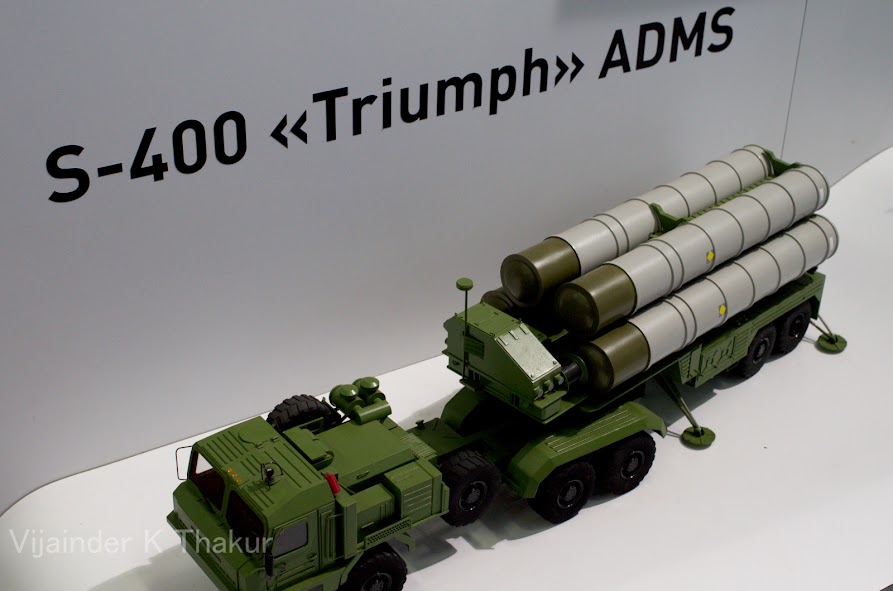
S-400 Triumph system on display at DefExpo 2014

President Vladimir Putin has reportedly green lighted the sale of S-400 "Triumph" AD system to China and the two countries are negotiating the number of systems to be sold and their value.

The sale of the Russian missile system to China, would inevitably erode the effectiveness of the already very limited Indian nuclear deterrence.

Ironically, Russia has repeatedly offered the system to India, but India has spurned the offer, betting heavilly on its homegrown BMD system.

The Russian Federal Service for Military-Technical Cooperation (FSMTC) reported in 2012 that Chinese Defense Ministry had expressed interest in buying S-400,

On March 2, 2014 Service Director Alexander Fomin told "Kommersant" that the two countries are now negotiating a deal, following a go ahead from President Vladimir Putin in early 2014.

Sources close to FSMTC, told Kommersant that initial negotiations are focused on the purchase of one battalion (eight launchers) of the missile complex.

The Russian decision to sell the missile system to China is not linked to its dispute with the west over Crimea, says the official.

The Russian General Staff and the Federal Security Service have in the past resisted sale of the system to China till their own demand for the system are fully met.

The manufacturer of the missile, Almaz-Antey, has already commenced delivery of the first regimental sets of S-400 to the Russian troops. By 2020, 28 regiments are expected to be equipped.

 In January, 2014 Russian Deputy Prime Minister Dmitry Rogozin announced plans to build three new factories to produce missile defense systems, which would enable "Almaz-Antey" to step up production.

However, sale of the missile system to China is unlikely to commence before 2016.

In 2010, Russia fulfilled a contract to supply China 15 battalions of antiaircraft missile systems S-300.

The S-400 (SA-21 Growler) is designed to intercept and destroy airborne targets at a distance of up to 400 kilometers (250 miles), twice the range of the U.S. MIM-104 Patriot, and 2.5 times that of the S-300PMU-2.

The system is expected to form the cornerstone of Russia's theater air and missile defenses up to 2020 or even 2025.

Tuesday, February 25, 2014

BDL Shows LRSAM with Dual Pulse Motor at DefExpo 2014

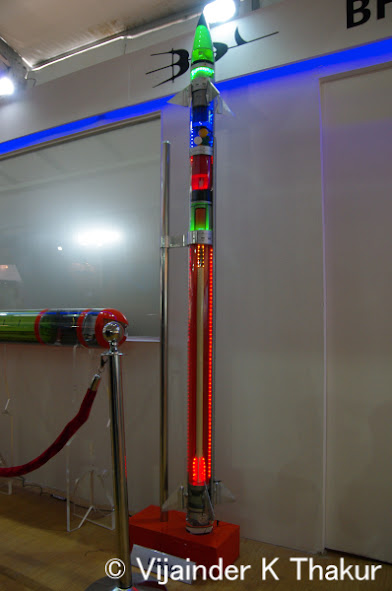
LRSAM at BDL pavilion at DefExpo 2014

LRSAM which is set to replace the shorter range Barak missile as the Indian Navy's preferred anti-missile defense weapon is still under development, but BDL, which will locally produce the missile, displayed its model at DefExpo 2014 perhaps signalling that development work is close to completion.

The model showed the internal layout of the missile's USP - a dual pulse smokeless solid fuel motor that provides high maneuver capability at target interception range throughout the missile's wide envelope.

LR/SAM is being jointly developed by DRDO and Rafael with the work split as follows.

DRDO

Two Pulse Rocket Motor
The rear controller
Thrust Vector Control
Folded Fins
Pneumatic Actuation System
Safe & Arm for Rocket Motor

RAFAEL

Multi-function Phased Array Radar
Missile Seeker
The Front Controller
Command electronic
Warhead
Pulsed Rocket Motor

Those with access to IDP Sentinel can read more about Pulsed Rocket Motor and the LR/MR SAM project at the link below.

Barak-8 / MR-SAM / LR-SAM (IDP Sentinel)

Monday, February 24, 2014

Akash Missile Test Series of Army Production Lot: Second Test Successfull

Akash Missile Test on February 24, 2014. Photo Credit: DRDO
DRDO is conducting a a series of tests on production models of the Akash missiles being delivered to the Indian Army to equip two regiments. The tests are taking place at the Integrated Test Range off Chandipur in the coastal district of Balasore, 230 km from Bhubaneswar.

During the first test was on February 21, 2014 the missile successfully intercepted an approaching target being towed by a Laskhya PTA.

In the second test, on February 24, 2014, the missile engaged a receding target towed by a Lakshya PTA.

According to a DRDO press release today, both the tests met mission objectives. A few more trials are planned in different engagement modes.

Akash Missile - IDP Sentinel

Thursday, February 20, 2014

Club-M Coastal Missile System at DefExpo 2014

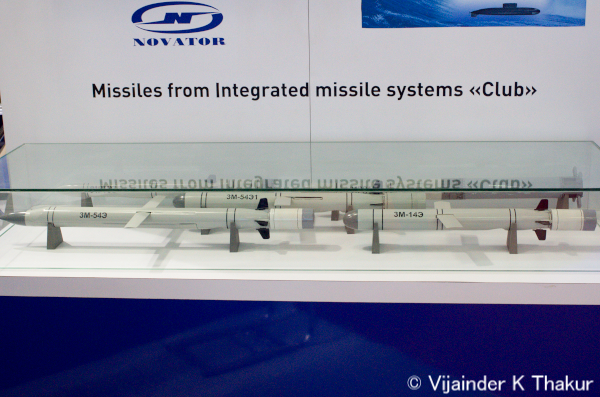
Models of the three missiles that comprise the Club-M Coastal Missile Defense System from Novator on display at DefExpo 2014.

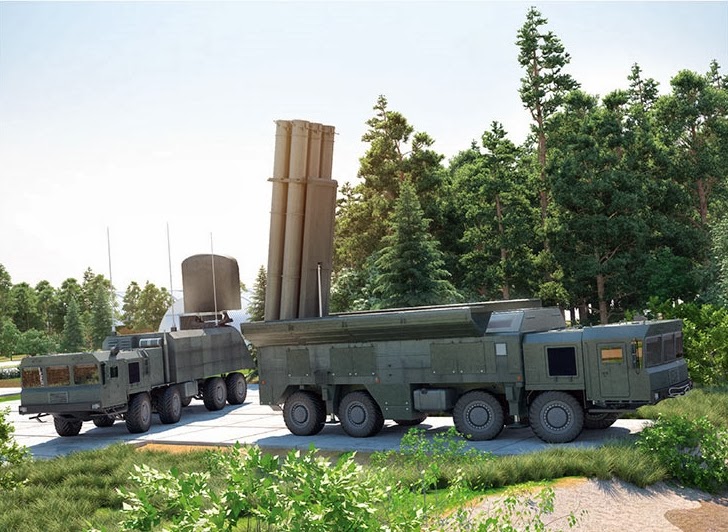
Russia is pitching its Club-M Coastal Missile System, comprising of three missiles from the Club family, for India's MMCB requirement. Anti ship and land attack variants of the Club missile already equip several IN ships and the torpedo tube launched variant of the missile arms IN's Kilo class submarines.

The Club-M system can engage targets up to 100-km from the coastline. The 3M-54KE and 3M-54E1 are anti-ship missiles while the 3M-14KE is the land-attack variant.

Club-M Coastal Missile System - Launcher and Radar

The containerized missiles are launched from a transporter launcher with six tubes. The missile can be fired one at a time or in a salvo.

The system comes with a vehicle mounted radar capable of picking up targets as far as 250-km. The missiles can also be targetted using reconnaissance data obtained from UAVs or satellites.


Mobile Missile Coastal Battery (MMCB) (IDP Sentinel) (Membership only site. Click link to request access.)

Tuesday, February 18, 2014

SAAB RBS15 Mk-3 Mobile Missile Coastal Battery (MMCB) Contender at DefExpo 2014

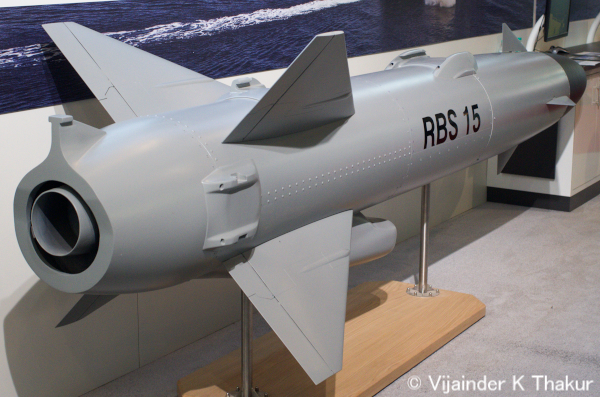
SAAB RBS-15 at DefExpo 2014
SAAB's RBS15 Mk-3 displayed at DefExpo 2014  is a strong contender for India's planned Mobile Missile Coastal Batteries (MMCB) procurement because of its land attack capability and multiple launch platform options.

The RBS15 has been around for 30 years and has been deployed by several countries on ships, coastal batteries and aircraft for targeting sea based threats. The RBS15 Mk-3 has the ability to also engage land targets, a requirement stipulated in the MMCB RFI released by Integrated Headquarters in October 2013.

The latest air-to-surface version of the missile - RBS15F ER - is capable of engaging sea based threats in open seas or littoral waters.

The RBS15 Mk-3 has a range of 200-km and carries a 200-kg blast and fragmentation warhead triggered by delayed impact (to ensure penetration) or proximity fuse. The sea skimming missile can be programmed to route through numerous vertical and horizontal way points, facilitating over the horizon targeting. It's capable of carrying out random maneuvering during its terminal phase.

The missile uses inertial and GPS navigation. It features a pre-launch programmable radar seeker with ECCM and target discrimination giving it a fire and forget ability.

The sea and land launched RBS15 Mk-3 variant of the missile weighs 670-kg and the air-launched RBS15F ER variant, 600-kg.

Mobile Missile Coastal Battery (MMCB) (IDP Sentinel)


Saturday, February 15, 2014

Akash Missile Model at DefExpo 2014 Showing Missile's Integrated Ramjet Rocket Propulsion

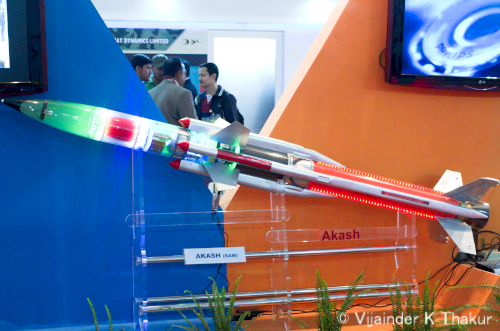
Akash Missile Model at DefExpo 2014 Showing the Missile's Integrated Ramjet Rocket Propulsion 
Bharat Dynamic Limited (BDL) displayed a model of the Akash showing the missile's unique propulsion system based on what was employed by the Russians for the SA-6 missile.

The ramjet-rocket propulsion combination provides thrust to the missile right through to target engagement, ensuring the missile can maneuver at high G till impact. The missile is initially propelled by its solid fuel rocket motor. When the solid fuel burns out completely its containers serves as the combustion chamber for the ramjet engine.

Most other surface-to-air missiles, including the U.S. Patriot and the Russian S-300 series, use solid-fuel rocket propulsion.

The all weather Akash features a digitally-coded command guidance system and a 60-kg warhead.

The fully-automated Akash has an 88% kill probability within a specified kill zone and DRDO claims it has intercepted a target with a 0.02 sqm radar cross-section (a fighter has a 2 sqm)

According to DRDO, the missile is capable of engaging cruise missiles.

Akash is supported by multi-target and multi-function phased array fire control radar called 'Rajendra' that has a range of about 60 km.

The Akash missile system is mobile, with the missile launcher, radar and  command center all mounted on T-72 chassis.

Those will access to IDP Sentinel can read more about the Akash system at the link below.

Akash Missile (IDP Sentinel)

Friday, February 14, 2014

Large Indian R-27 (AA-10) Missile Purchase in 2013 Increased Ukraine's Artem's Profits 7 Fold!

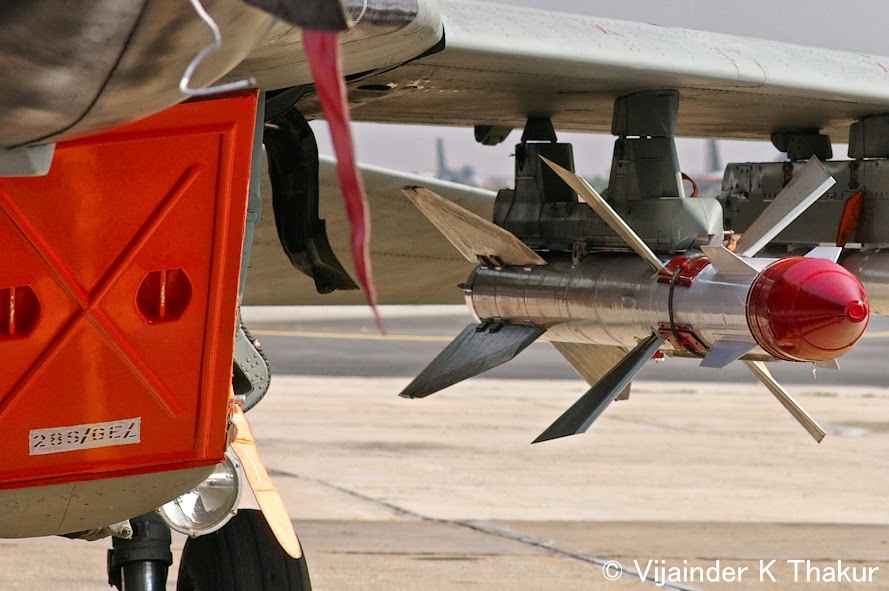
A R-27 missile on a MiG-29 at Aero India 2009
In 2013, Ukraine's State Joint Stock Holding Company "Artem" completed the supply of a large consignment of R-27 air-to-air missiles to India.

The number of missiles involved was large enough to have pushed Artem's turnover 7 fold, from UAH 323 million to UAH 2.3 billion.

The semi-active home medium range R-27 series are analogs of late model US AIM-7 Sparrow series BVR missiles.

Those with access to IDP Sentinel can read more about the R-27 here.


Thursday, February 13, 2014

SAAB's Bamse SR-SAM System at DefExpo 2014

SAAB's Bamse SR-SAM on display at DefExpo 2014
SAAB is fielding its Bamse Ground Based Missile Defense (GBMD) system for the Indian Army's SR-SAM requirement.

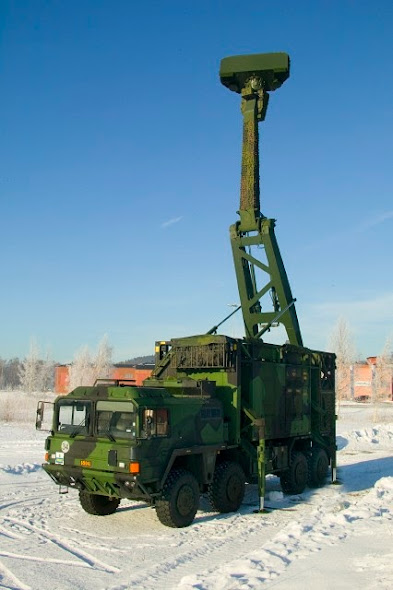
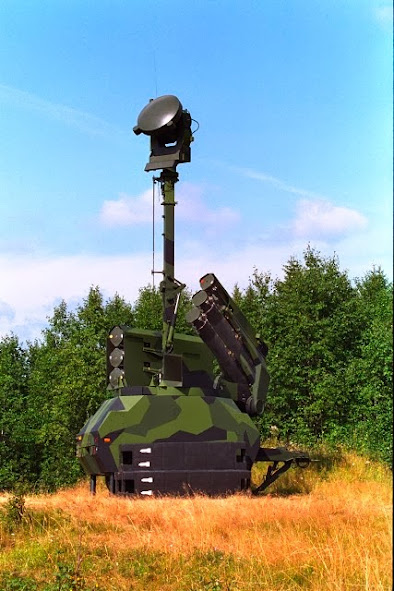
The BAMSE system comprises


  1. Giraffe AMB surveillance radar for detecting targets.
  2. Bamse Fire Control Radar (FCR) for Line Of Sight (ACLOS) missile guidance function.
  3. A MCC wit six Bamse Missile to engage targets.

Giraffe AMB. Photo Courtesy SAAB

The Bamse FCR and Bamse missiles are mounted on a single vehicle. The Giraffe AMB has its own vehicle. A single Giraffe AMB can function with multiple missile batteries.

The C-band (5.4 – 5.9 GHz) Giraffe AMB has a 3D phased array, digital beam forming antenna. The radar has an instrumented range of 120-km with elevation coverage of > 70-deg. It can detect targets flying as high as 20-km.

Bamse missile battery with Fire Control Radar

The Bamse FCR operates in the Ka-band (34 – 35 GHz) and provides target and missile tracking. It has an instrumented range of 30-km.

The Bamse missile has an effective range of 20-km and can engage targets as high a 15-km. It uses Automatic Command to Line of Sight (ACLOS) and is fitted with a shaped charge fragmentation warhead with proximity fuse.

The system is capable of engaging fighters, helicopters, stand-off missiles and guided bombs.

SAAB has tied up with Ashok Leyland to provide the vehicles for the Bamse system. All sub-units within the Bamse SRSAM are being integrated with the Ashok Leyland Super Stallion 8x8, a high-mobility vehicle capable of operating in all types of terrain under all weather conditions.

Pune based Kalyani group will be responsible for a lot of the engineering work that goes into the system.

For additional details on the Indian Army's SR-SAM acquisition, please visit the link below.
SR-SAM for Indian Army (IDP Sentinel)

Wednesday, February 12, 2014

South Korea's LIG's Chiron Portable Surface-to-Air Missile at DefExpo 2014

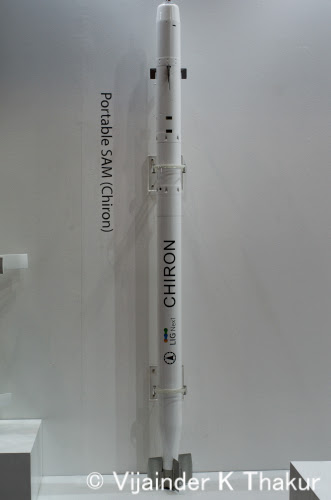
LIG's Chiron portable surface-to-air missile at DefExpo 2014

South Korea's LIG, a contender in the VSHORAD procurement program for the Indian Army, displayed its Chiron portable Surface-to-Air missile at the DefExpo 2014.

The Chiron, which can engage aircraft, helicopters, and UAVs at low levels, is fitted with an IFF system to safeguard against fratricide.

Max range of the Chiron is 7-km and  max altitude, 3.5-km. The Mach 2 missile is 1.6-m long, 8-cm in diameter, and weighs 15-kg.

The missile features a two color IR seeker that can differentiate between flares and the heat from an engine. It's command guided and requires the operator to track the target following launch. It's fragmented warhead is triggered by a proximity fuse.

Besides a man portable single tube launcher, the missile can also be fitted on a four-launcher remotely controlled station giving it additional versatility.

Very Short Range Air Defense (VSHORAD) System (IDP Sentinel)


Tuesday, February 11, 2014

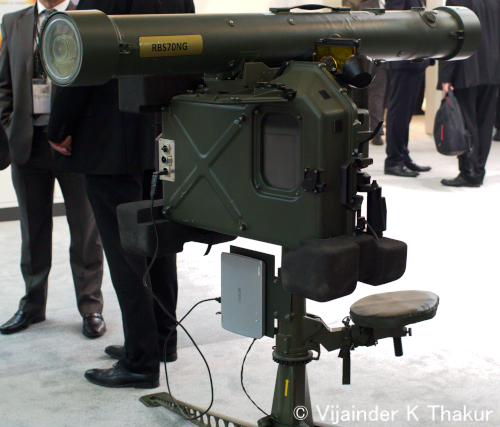
VSHORAD Procurement Contender SAAB RBS 70 NG at DefExpo 2014

RBS 70 NG VSHORAD at DefExpo 2014
SAAB has tied up with Pune based Kalyani Group to pitch its RBS 70 NG missile for the VSHORAD project.

The RBS 70 NG is a laser beam riding missile with an effective range between 250-m to 5,000-m. The system's integrated guidance unit features a thermal imager with built in autotracker and advanced visual curing aids.

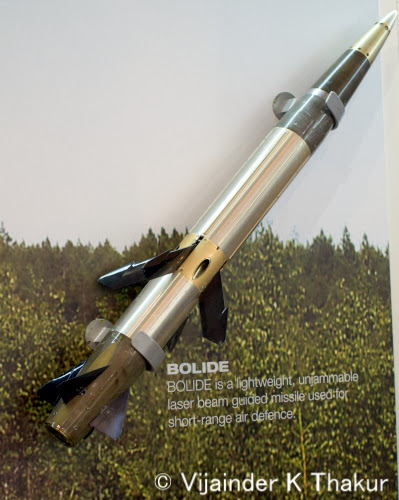
The Mach 2 BOLIDE missile of the RBS 70 NG

 It fires the new Mach 2 BOLIDE missile with a shaped charge and pre-fragmented warhead, making it effective against aircraft,  UAVs, cruise missiles as well as armored ground targets such as ICVs.

The autotracker reduces the tracking noise resulting in higher maneuverability and p-kill than the earlier RBS 70 against small targets at maximum range.

The system is modular and very flexible. It can be configured as a remotely controlled workstation mounted on a vehicle. 

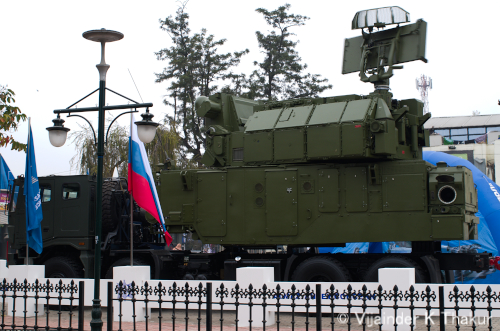
Russia's Tor-M2KM Anti-missile System Displayed at DefExpo 2014

Tor-M2KM anti-missile system at DefExpo 2014

Russia for the first time displayed its Tor-M2KM anti-missile system outside the country at the DefExpo 2014. The weapon system developed by Russia's Kupol Izhevsk Electromechanical Plant JSC (a subsidiary of Almaz Antey Concern PVO) is a contender in the SR-SAM procurement for the Indian Army.

The system displayed at DefExpo 2014 from February 6 to February 9 was the real deal, not a mock-up. It was shipped after extensive trials at Russia's Kapustin Yar range where it went through cruise tests on a special track, and completed three combat runs against Saman targets.

The system will participate in the SR-SAM evaluation trials starting in Spring 2014.

The Tor-M2KM is a point defense weapon system that can engage low flying aircraft as well as cruise missiles. The system - Missiles, Radars, Gensets, Communication link - was displayed mounted on a single all terrain vehicle, but the system is modular and can be installed independently of the vehicle on rooftops,  defensive structures of major cities and nuclear power plants. Russia offers a containerized variant of the Tor-M2KM that can be placed on the decks of low tonnage ships.

Russia says the Tor-M2KM is primarily meant to neutralize precision guided bombs and cruise missiles of all kinds, including anti-ship. Aircraft, including fighters, are an easy kill for the system.

The Tor-M2KM can engage targets up to 15-km away flying as high as 10-km. It features modern electronics and radar capable of detecting and handling up to 48 targets, automatically determining the 10 most dangerous threats.

Tor-M1 Specs


Simultaneously processed detected targets, pcs. - 48
Number of simultaneously tied runs (target + jamming direction) - 10 (9 +1)
SOC detection range, km - 27
Range target tracking, CH, km - 25
Temp review SOC space with the period from - 1

The affected area, km:

in range - 1,0-12
height - 0,01-9
the parameter - 8


The probability of hitting a SAM - 0,56-0,98
Maximum speed of the targeted objectives, m / s - 700

Average response time while shooting with:

with position (parked) - 7.4
with a short stop - 9.7


Shortest response time, s - 4.8
The average flight speed Zour, m / s - 600
Method guidance - radio command
Aerodynamic design Zour - "duck"
Missile weight, kg - 168
Warhead weight, kg - 14.5
Channel on the target - 2
Ducted by SAM - 2
Deployment time (clotting), min. - 3
A method of loading a combat vehicle modules - 4 SAM
Loading time rockets, mines. - 20
Ammunition Zour on combat vehicle, pcs. - 8
Maximum speed, km / h - 65
Weight, t - 37
Mated with CVT - UBKP 9S737
Combat Crew. - 4
Year of adopting - 1991

SR-SAM for Indian Army - IDP Sentinel

Thursday, December 5, 2013

DRDO Breakthrough in Canister Launch Technology, Agni-V Canister Launch in March-April 2014

Agni-5 second test on September 15, 2013. Photo Credit: DRDO

On December 5, 2013, The Hindu reported that recently DRDO successfully carried out a “Missile Ejection Test” (MET) using a dummy missile weighing 50 tons. Following the breakthrough, Agni-V would be launched from a canister in March-April, 2014 for its third test.

The MET validated critical newly developed technologies such as launcher-canister interface and effective sealing between the missile and gas generator. The missile exited the canister at the correct velocity and the inter-facing instruments, electronics and sensors worked perfectly. As the missile cleared the canister by 15m, the sensors accurately signaled first stage ignition to the missile computer.

Placing the missile in a hermetically sealed canister facilitates long term storage (10 years) without any maintenance.  DRDO has committed to make canister launch a feature of all its new land based strategic missiles, starting with Agni-V.

DRDO has designed a canister that can eject the 50-tonne missile 50 m in the air and fire the first stage. The missile canister is made of maraging steel allowing it to withstand the 300-t to 400-t shock generated when the 50-ton missile is ejected out.

In September 2012, ASL director of, Dr V G Sekharan, told Business Standard, "The gas pushes the Agni-V out, like a bullet from the barrel of a gun. In less than half a second, the 50-tonne missile clears the canister by 15-m, and that is when the rocket motor can safely ignite. In 30 seconds, the Agni-V breaks the sound barrier and, in 90 seconds, it has left the atmosphere."

The canister could be carried on railcars or on a 12x12 road-mobile truck. Carrying the missile on a road-mobile launcher gives more flexibility as it can be launched from any patch of level ground. The Agni-5 is tailored for road-mobility. The mobile launcher for Agni-V is being produced by the private industry.

Canister technology was initially developed for the naval variant of Brahmos missile. The technology was completely mastered during the development of the K-15 / Shourya missiles. However, canister launch technology doesn't scale well.. In order to develop a 50-t missile canister launch capability, the DRDO has set up a facility for MET  at Shamirpet near Hyderabad.

For additional details on the Agni-V please visit the link below

Agni-V LRBM - IDP Sentinel

Wednesday, September 25, 2013

The Brahmos Saga: Co-production, License Production, Assembly - Same to Same!

ALCM variant of Brahmos (scale model) displayed at DefExpo 2012. Photo Credit: Vijainder K Thakur
In a recent blog post, I had lamented that the much hyped co-development of Brahmos was nothing more than a new spin on  the 50 year old license manufacture model that just hadn't worked for India. The co-production spin makes buying weapons from abroad more palatable to Indian citizens and lawmakers, but results in very little or no transfer of technology.

Statements made Brahmos Aerospace CMD A Sivthanu Pillai at NAMEXPO in Kochi on September 24, 2013, reiterate my point.

Claiming that the Indo-Russian joint venture Brahmos Aerospace Ltd. will roll out a fully indigenous BrahMos in three years, he told reporters:

"We currently use fully indigenous steel for the missile. Now we are trying to undertake the integration of parts also at BrahMos.

"Efforts to make the missile engine at BrahMos will also be realized in three years. However, the explosive components of the missiles will be sourced from outside as we cannot handle explosives in our unit."

Nine years after Brahmos was first tested in India in late 2004, the country has still not imbibed the technology to locally manufacture the missile in India!

The Brahmos missile is currently being assembled at the Brahmos Integration Complex (BIC) in Hyderabad. The BIC integrates components sourced from various manufacturers in Russia and India.

The missile is not being used by Russian armed forces and there are no manufacturing facilities in Russia.

The ramjet engine of the missile is currently being produced at a plant in the Orenburg province of Russia.

Brahmos Aerospace is setting up a new plant to  produce Brahmos engines at the Brahmos Aerospace Thiruvananthapuram Limited (BATL) complex in Kerala, India.

A new plant is needed because soon Brahmos production volumes are expected to exceed the manufacturing capabilities of the Orenburg plant.

Other critical components of the missile are also being made in Russia. Its seeker, for example, and the warhead as acknowledged by Pillai.

Going by BrahMos Aerospace's past record, its unlikely India the joint venture will be producting the ramjet engine within the country in three years, even using a lot of imported components.

Meanwhile, the Navy and the IAF are already clamoring for a downsized version of the missile that can be launched from submarine torpedo tubes and medium category fighter aircraft. Brahmos Aerospace says its working on a such a version - Brahmos 3 - but little progress has been made.

I am skeptical there will be a Brahmos 3 in the next 10 years. As to the hypersonic Brahmos 2, I doubt it will be a reality in the next 15 years. The truth is Russia is planning to develop a hypersonic cruise missile with Indian funding, which Brahmos Aerospace will claim to have developed.

Tuesday, September 24, 2013

Advantages of MMW Seeker Over IR Seeker in an ATGM

Nag ATGM at Aero India 2011. Photo Credit: Vijainder K Thakur


DRDO plans to fit a MMW (Millimeter Wave) seeker on the Helina missile, which it successfully tested in Pokharan on Sunday, September 22, 2013.

Currently, the missile features a IR cum Image Co-relation seeker.

What's the big deal about a MMW seeker? Here is an attempt to answer the question.

1. MMW seekers are more suited to battlefield environment as they perform better in fog, mist, dust and smoke, but not rain. IR seeker capabilities get moderately degraded with weather (fog, mist) and more severely by battlefield obscurants such as dust and smoke.

2. MMW seekers are capable of doppler detection of moving targets.

3. MMW seekers allow for low drag nose shape of missile warheads.

4. MMW seekers are capable of providing range and range rate information for accurate triggering of proximity fuse.

For additional details about the Nag ATGM, please visit the link below.

IDP Sentinel - Nag / Helina ATGM