Showing posts with label Missile. Show all posts

Friday, October 16, 2015

Russia's Kalibr-NK / SSN-30A Cruise Missile - The Deets

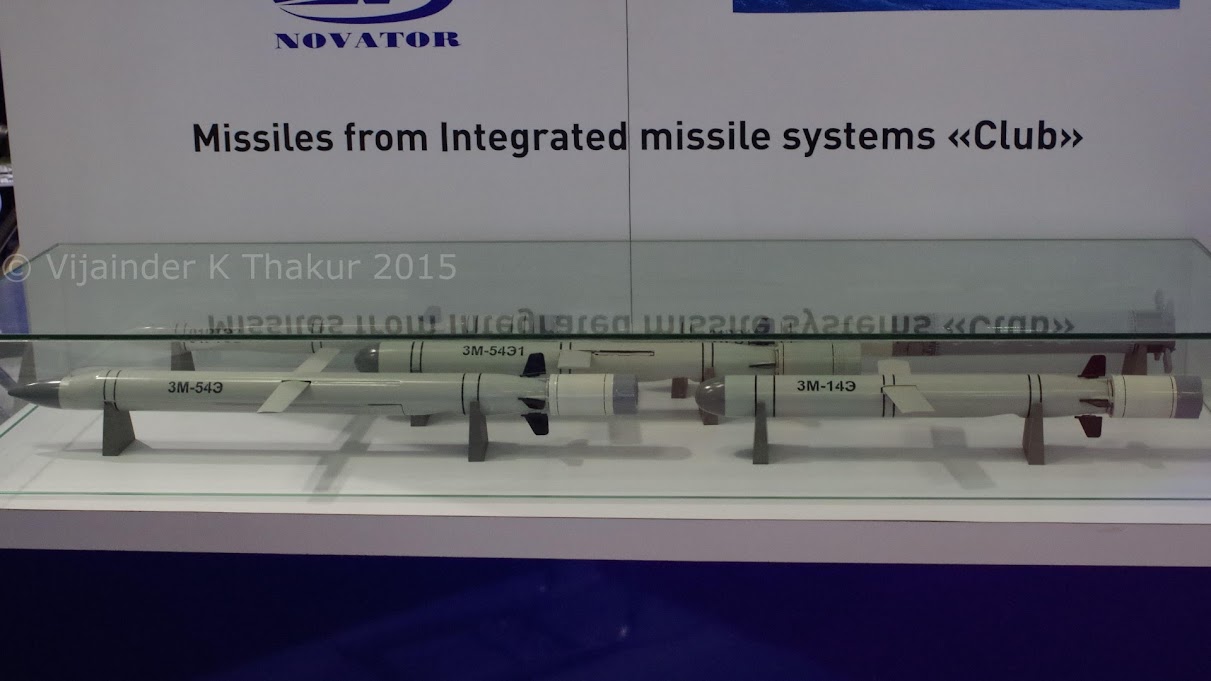
3M-14 / 3M-54 export variant missiles at DefExpo 2014
On October 7, 2015, Russian Gepard-class frigate Dagestan, and three other Russian Navy destroyers launched 26 Kalibr-class cruise missiles from the Caspian Sea at 11 targets in Syria.

The Russian ministry of defense posted the following video that purportedly shows Kalibr-NK cruise missiles being launched from ships deployed in the Caspian sea.


The range of the targets from the launch point in the Caspian sea exceeds 500-km.

The minister of defense told the president that the actual range was "more than 1,500 km."

According To Sputnik News the missiles traveled 1,500 km through Iranian and Iraqi airspace and struck terrorist positions in Raqqa, Aleppo and Idlib provinces, reportedly destroying all.

Sputnik News reports that the missile was first launched in 2012. It can travel 50 to 150 meters above the ground and hit sea targets up to 350 kilometers away and ground targets more than 2,500 kilometers away. Their maximum deviation from the designated target is only three meters.

The name Kalibr-NK suggests that the missile is a variant of the 3M-54 / 3M-14 Kalibr (NATO designation SSN-27A 'Sizzler') family of missiles that equip Russian Navy submarines and surface ships.

The 3M-54 is the anti shipping variant and the 3M-14, the LACM variant. The surface ship launched variant of the 3M-54 is called 3M-54T, and the surface ship launched variant of the 3M-14 is called 3M-14T.

The 3M-54/3M-14 (anti-shipping) missile variants have a 200 kg (440 lb) warhead and range of 440-660 km (270-410 mi). The missiles fly at supersonic speed in the terminal phase to reduce target reaction time.

As compared to the surface launched 3M-54T, the submarine launched 3M-54 is shorter (8.22m vs 8.9m).

The 3M-14 missile has a 450 kg (990 lb) warhead, a range of 1,500-2,500 km (930-1,550 mi), and subsonic terminal speed of Mach 0.8.

The submarine launched variant 3M-14 is significantly shorter at 6.2 m (20 ft) than the 8.9m (29 ft) 3M-14T, but other specs are the same.


Export variants of the 3M-54/3M-54T (Kalibr) are designated 3M-54E/3M-54E1 (Klub). Similarly, the export variant of the 3M-14/3M-14T are designated 3M-14E/3M-14E1 (Klub).

All export variants are restricted to 300 km range.

Washington Post reports that Russia conducted a flight test of the NK-Kalibr on September 11, 2015, a month before firing the missiles from the Caspian Sea. The NATO designation for the missile, which has capabilities similar to the US Navy Tomahawk, is SSN-30A (3M-14T). During the test, the missile traveled some 2,000 kilometers, or about 1,200 miles.

The missile was tested earlier in August 2015, at which time US officials said it was nearing deployment. The new missile can be armed with either nuclear or conventional warheads.

According to some western reports, four of the missiles launched against targets in Syria malfunctioned and landed in Iran. Russia and Iran have rubbished these reports.

Operational use of Kalibr-NK has prompted NATO military intelligence analysts to upgrade its status to "deployed."

Saturday, January 31, 2015

Agni-V First Canister Launch Details

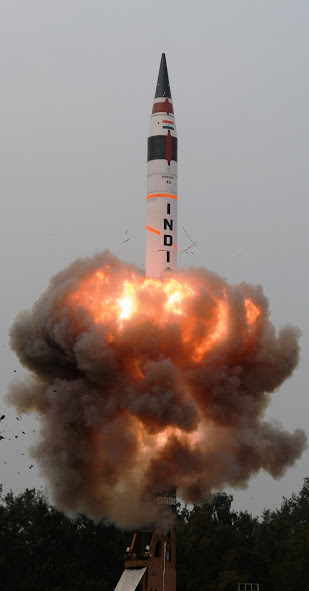
Agni-V First Canister Launch on January 31, 2015


The third test of the missile, its first canister launch, on January 31, 2015 was successful.

The missile was launched from a road mobile launcher after its canister was erected to a vertical position.

On launch, gas generators in the canister pushed up and out the 17-m long missile weighing over 50-ton. As the missile cleared the canister, at a height of about 20-m its first stage ignited and the missile climbed and accelerated along its pre-programmed ballistic trajectory towards its target. After the firs stage burnt out, the missile continued to climb and accelerate using its all composite second stage, and later, its all composite, shaped third stage.

At the end of its powered flight, the missile continued to climb into space bleeding speed. It reached an altitude of more than 600 km before arching back towards Earth under gravitational pull. As it lost altitude, it accelerated and rapidly gained speed. On re-entering the Earth's atmosphere, air friction raised Reentry Vehicle (RV) surface temperature to beyond 4000 degree Celsius. Protected by its indigenously designed and developed carbon-carbon composite heat shield, the missile's dummy warhead remained cool at less than 50 degree Celsius.

Guided by the on-board computer, ring laser gyro based inertial navigation system, state-of-the-art micro inertial navigation system (MINS) and fully digital control system the missile hit the designated target point accurately, meeting all mission objectives.

Agni-5 First Canister Launch on January 31, 2015

Announcing the success of the test launch, Dr VG Sekaran, Mission Director, Prog. Dir. Agni and DG Missiles and Strategic Systems said, "All mission objectives have been achieved, down range ships have confirmed final splashdown, the mission is a great success and it is a momentous occasion."

Ships located in midrange and at the target point tracked the Vehicle and witnessed the final event.  All the radars and electro-optical systems along the path monitored all the parameters of the Missile and displayed in real time.


The DRDO had earlier successfully carried out a “Missile Ejection Test” (MET) using a dummy missile weighing 50 tons.

The MET validated critical newly developed technologies such as launcher-canister interface and effective sealing between the missile and gas generator. The missile exited at the correct velocity and the inter-locking instruments, electronics and sensors worked perfectly. As the missile cleared the canister, the sensors accurately signaled first stage ignition to the missile computer.

Sunday, August 24, 2014

LR-SAM - Why it's Worth the Wait!

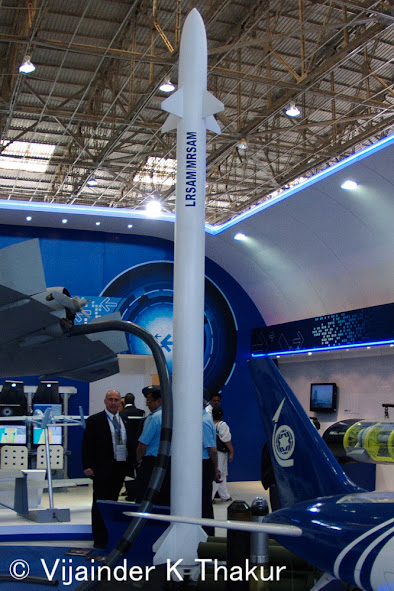
LR-SAM at Aero India 2011

One of the reasons why the Navy isn't as worried as the defense journos that INS Kolkata was commissioned with 48 empty cells of vertically launched Long Range Surface to Air Missiles (LR-SAM) that are to shield it against an attack by anti-shipping missiles, is because the missile system, when it's finally installed, would give the warship the best protection money can buy  in the world today! You can cross check that claim with any Navy man - he will agree!  What is confounding is the missile hasn't been tested even once! The confidence reposed in the missile system stems from its pedigree. It's basically an Israeli missile.

Former Navy Chief, Admiral Arun Prakash gives an interesting insight in today's Business Standard as to how the missile came to be the most coveted AD weapon system on Indian warships.

He recalls how the Israeli Navy, on behalf of its defense industry, offered the Indian Navy the long-range SAM with "superior anti-aircraft and anti-missile defense capabilities" in 2004-05.

"The 'cherry on the cake' was to be the new multi-function phased-array radar that accompanied it. There was no altruism behind this offer; the small numbers required by the Israelis made the project economically unviable for them, and there were not many nations they could trust with such sensitive technology. Driving a hard bargain, the IN obtained Israeli agreement for joint development and co-production of systems.

"Showing eminent good sense and pragmatism, the DRDO leadership agreed to the navy's proposal for a path-breaking tripartite collaborative arrangement with the Israelis for the development of the LR-SAM. The funding as well as manpower liabilities were shared by the IN and DRDO. The project, involving DRDO scientists, naval engineers and the defense-industry has rendered tremendous benefits to all three participants and, notwithstanding development delays, will bring the IN to front rank of navies technologically."

DRDO Chief, Avinash Chander, in a recent interview gave his own insight into the project. He said, "The Armed forces had actually tried to buy such a system from abroad, but nothing was really available that would come with satisfactory terms. And that is how we got into a joint venture with Israel, the system had to be developed ab initio. So there were issues with respect to radar development, issues with respect to the actuation system as well which was initially supposed to be pneumatic but then had to be changed to electromechanical. Then there was the two pulse motor which was being done for the first time and that got into certain combustion stability problems. But the good news is that all those problems have now been overcome. We launched a massive program on the rocket motor and today we have a motor which is stable and will be tested shortly."

There is a lot more to the LR-SAM project, only for IDP Sentinel members, at the link below:

Barak-8 / MR-SAM / LR-SAM - IDP Sentinel


DRDO Developing Long Range Anti-Shipping Ballistic Missile to Counter China's DF-21D

When sailing in the Bay of Bengal Indian aircraft carriers can be easily targeted by Chinese DF-21D missile

DRDO is working on a Chinese DF-21D missile analog.

August 24, 2014 - DRDO Chief Avinash Chander told the press recently that the DRDO is developing a long range anti-shipping ballistic missile capable of striking enemy aircraft carriers 1500-2000 km from our shores.

"The long range anti-ship missile is on the drawing board, and we are confident that in about six years we would be able to get it ready," Chander said.

Somewhat similar to the Chinese DF-21D, the missile would follow a ballistic trajectory to evade ship based radars and use its seeker to locate and strike an aircraft carrier. Chander didn't say how the initial targeting information would be obtained. 

Warships comprising a carrier group are honed to detect and engage low to medium level threats, such as fighter aircraft and anti-shipping missiles launched from stand-off ranges. Their radar beams don't look up beyond around 60-deg exposing the carrier to ballistic missiles attack. 

The challenge in developing an anti-shipping ballistic missile lies in obtaining initial targeting information and end-game tracking of a carrier moving at around 30-kts (60 kph). Airborne ISR assets employed to obtain targeting information can be easily engaged and neutralized by carrier group warships in a protective cordon around the aircraft carrier. Low level satellite coverage can do the job if it's persistent, which requires a a large satellite constellation of low orbit satellites to be deployed, a very expensive proposition.

IDP Sentinel members may also like to read updates on the following projects

Sunday, May 4, 2014

Astra air-to-air missile successfully test fired from Su-30MKI

Astra all aspect, active homing air-to-air BVR missile maiden air launch on May 4, 2014. Photo Credit: DRDO

India successfully conducted the  maiden air-to-air test of its Astra all aspect, beyond visual range (BVR) air-to-air missile on Sunday, May 4, 2014. 

The missile was launched from an IAF Su-30MKI at a Naval range in the western sector. The test met all mission objectives. The release of the missile was captured by side and forward looking high speed cameras; the separation occurred exactly as per the simulation.


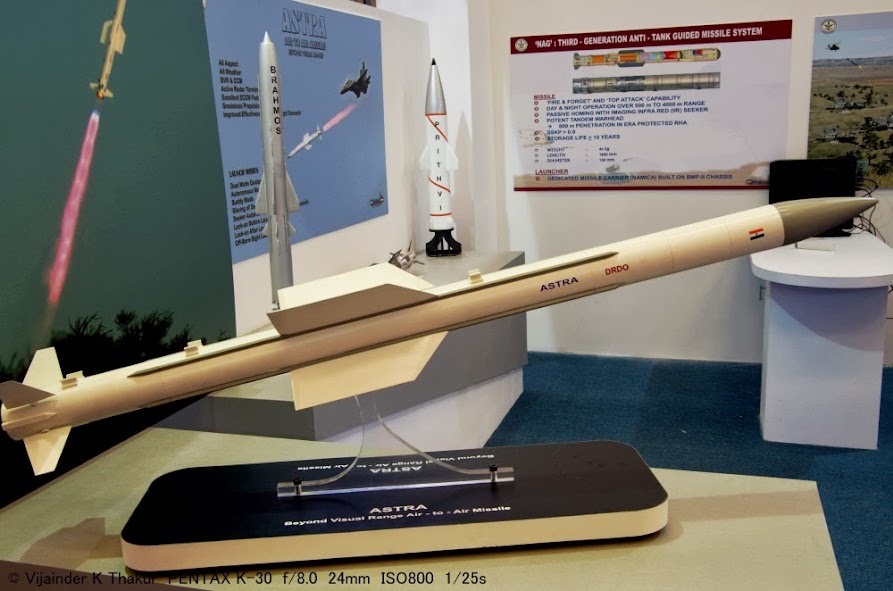
Scale model of Astra air-to-air missile at DRDO pavilion at Aero India 2013


The missile was launched against a simulated target during the test on Sunday. According to DRDO chief, Avinash Chander, the missile would be launched against a real target shortly.

"Many more trials are planned and will be conducted to clear the launch envelope. Weapon integration with ‘Tejas’ Light Combat Aircraft will also be done in the near future," Chander said.

Fish-eye view of the Astra air-to-air BVR missile leaving its Su-30MKI launcher during its maiden air launch on May 4, 2014. Photo Credit: DRDO


HAL carried out Astra related modification on the testbed Su-30MKI along with IAF specialists.

In 2013, the Astra missile underwent rigorous testing on Su-30MKI in the captive mode to validate avionics integration and evaluate the missile's seeker.


DRDO is already working on a Mk-2 variant of the Astra missile with grater range; it would be tested by the end of 2014

IDP Sentinel members can get additional details abut the missile at the link below

Sunday, April 27, 2014

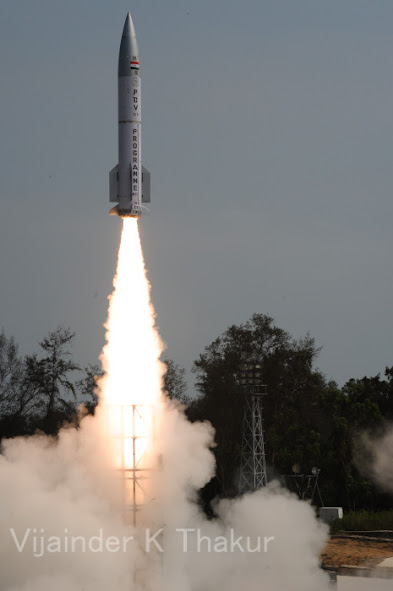
PDV Exo-Atmospheric Interceptor BMD Phase 1: Maiden Test Photos & Video

PDV Exo-Atmospheric Interceptor BMD Phase 1: Maiden Test on April 27, 2014. Photo Credit: DRDO

The maiden test of the Prithvi Defense Vehicle (PDV0 Ballistic Missile Defense (BMD) interceptor missile on April 27, 2014 was a proud moment for DRDO and the nation.

The PDV missile will replace the existing PAD-1 exo-atmospheric interceptor of Ballistic Missile Defense (BMD) Phase 1.

The PAD-1 has a solid fuel first stage and a liquid fuel second stage. Liquid rocket fuel tends to be corrosive. Once its loaded into a stage, the stage must either be used or discarded. As such, the use of liquid fuel is incompatible with the qualitative requirements of an operational BMD interceptor.

The PDV is a two stage, all solid fueled, which facilitates easy storage and quick launch.

PDV Exo-Atmospheric Interceptor BMD Phase 1: Maiden Test on April 27, 2014. Photo Credit: DRDO

It is capable of intercepting enemy missiles at altitudes upto 150 km, ensuring that the enemy warhead debris burns up in the atmosphere, causing no ground contamination.

The missile features a dual mode (IR and Active radar) seeker, and like the PAD, has a directional warhead.

The missile is equipped with an innovative system to allow it to maneuver at altitudes up to 150 km, well outside the earth's atmosphere. (In the photo above you can see that the second stage does not have any aerodynamic control surfaces such as fins; they would be ineffective outside the atmosphere.)

The kill vehicle of the interceptor, equipped with an attitude control mechanism, reaches a speed of 1,500 m/sec before impacting its target.


A modified PAD-1 missile, launched from a ship, was used in the test on Sunday. The mechanism used to stabilize the missile during launch from a ship is clearly visible in the video clip above.

IDP Sentinel members can read more about the BMD Phase 1 and the PDV missile at the link below.

DRDO Successfully Tests New PDV Exo-Atmospheric Interceptor

PDV Exo-atmospheric interceptor of BMD Phase 1 Maiden Launch on April 27, 201

DRDO successfully tested its new PDV exo-atmospheric interceptor at the Integrated Test Range (ITR) in Chandipur, Odhisha on April 27, 2014.

The PDV interceptor successfully engaged its target approximately 125-km above the surface of the earth outside its atmosphere. The target, a PAD missile fitted with a second stage, was launched from a ship in the Bay of Bengal at 0907 hrs; it flew a trajectory similar to that of a 2,000-km range ballistic missile.

The entire interception was automated - radar detection of the "enemy" missile, its tracking and trajectory prediction, launch and command guidance of the PDV interceptor towards the enemy missile and the final interception.

Following launch, the PDV initially used its Ring Laser Gyro Inertial Navigation System (INS) and a Redundant Micro Navigation System to fly an interception trajectory using uplinked target location data from ground radars.

Once the missile exited the atmosphere, its heat shield jettisoned and the dome of its IR seeker opened; the IR seeker was automatically aligned towards the computed location of the target location.  For the subsequent interception, the PDV relied on its Inertial Guidance system and target location data obtained from its IR seeker.

The PDV features a maneuvering gimbaled directional warhead.  However, for the maiden test a dummy warhead was used, as the focus of the test was to validate the ability of the IR imaging seeker to discriminate, acquire and track the target. DRDO is in the process of precisely determining how close the interceptor warhead flew to the target missile to ascertain if the target would have been destroyed had there been a warhead on the interceptor.

Avinash Chander, SA to the Defense Minister, told the press, "The mission’s main objective was to track the target missile. We wanted to see the performance of the IR seeker. The warhead in the interceptor missile was not meant to be exploded in this mission. Since we did not fire the warhead, the debris did not fall."

Chander added,  "We have to work out the missed distance between the target missile and the interceptor. Based on that, the hit-to-kill would take place. We are not able to say right now whether the hit-to-kill took place.”

The missile interception was monitored in real-time by the Telemetry/Range Stations, at various other locations.

According to a DRDO press release, the mission was completed and the interception parameters were achieved.

The PDV interceptor has been developed to destroy an enemy missile as its warhead separates from the booster to re-enter the earth's atmosphere at an altitude of 125-140  km.

The test on Sunday demonstrated the PDV's ability to discriminate between the harmless booster and the potent warhead, destroying the later with a hit-to-kill strike.

The two stage all solid fueled PDV replaces the two stage solid and liquid fueled PAD missile as the exo-atmospheric interceptor of BMD Phase-1 system.

With a liquid fueled second stage, PAD wasn't a viable missile defense interceptor, since it required fueling immediately before launch. delaying interception. (Once fueled, a liquid fuel rocket motor must either be used or discarded because of the corrosive nature of the liquid fuel.). Not surprisingly, the PAD has been tested just two times so far, that too in the initial phases of BMD development - On March 6, 2006 and November 27, 2006. The PAD was likely intended to be a technology demonstrator / stop gap missile.

The all solid fueled PDV is capable of immediate launch. It is designed to intercept enemy missiles at altitudes upto 150 km, ensuring that the enemy warhead debris burns up in the atmosphere, causing no ground contamination.

The second stage of the PDV missile is equipped with an attitude control system to allow maneuvering at altitudes up to 150 km, well outside the earth's atmosphere, where aerodynamic control surfaces like fins are ineffective. The kill vehicle of the interceptor reaches a speed of 1,500 m/sec before it impacts the target.

Development of PDV has taken DRDO much longer than planned. DRDO first indicated that it is ready to test the missile in July 2010.

Ballistic Missile Defense Overview

India's Ballistic Missile System is being developed in two phases under a capability based deployment plan.

In the first phase, which is currently underway, DRDO is developing a system for defense against missiles with less than 2,000 km range, like Pakistan's Ghauri and Shaheen missiles and China's solid-fuel Dongfeng-21 (NATO designation: CSS-5).

In the second phase, system capability will be upgraded to defend against missiles with ranges greater than 2,000 km that can additionally deploy decoys or maneuver.

BMD Phase 1 System is a two tiered terminal phase interceptor system comprising of

  1. PAD / PDV exo-atmospheric interceptor missile for intercepting targets outside the atmosphere. 
  2. Advanced Air Defense (AAD) endo-atmospheric interceptor missile for intercepting targets up to an attitude of 30 km . 
  3. 'Swordfish' Long Range Tracking Radar (LRTR). The Swordfish LRTR has been developed jointly by LRDE, Bengaluru and ELTA of Israel. It is based on the Israeli Green Pine early warning and fire control radar imported by India from Israel in 2001-2002.
  4. Multi Functional Guidance radar that tracks the incoming missile in its terminal phase and guides the interceptor missile onto the target. The DRDO developed the guidance radar in collaboration with French company, Thales.

IDP Sentinel members can read more about India's Ballistic Missile Defense Project at the link below.

Ballistic Missile Defense (BMD) System (IDP Sentinel)
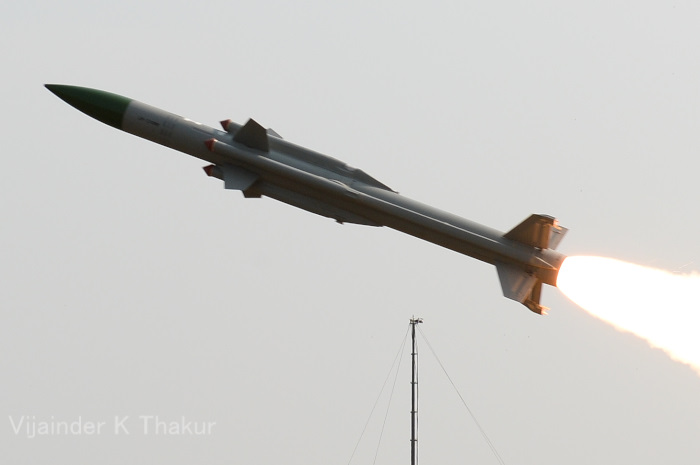
IAF Akash Missile Twin Tests on April 26, 2014: Photos & Additional Details

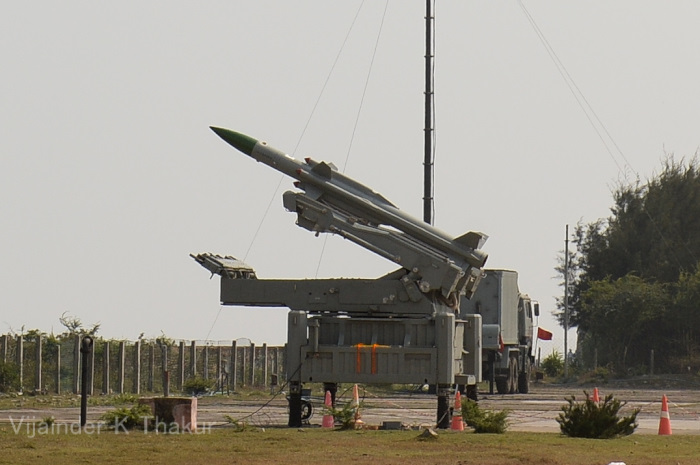
The second IAF Akash poised for launch during the twin missile test. Photo Credit: DRDO
DRDO has released additional details about the IAF's successful multiple launch test of the Akash missile at the ITR in Chandipur, Odisha on April 26, 2014.

Both the tests involved high speed maneuvering targets towed by Pilotless Target Aircraft (PTA), simulating enemy fighters. One missile engaged its target in the incoming mode and the other in the receding mode.

The Akash missile systems as well as the PTAs were operated by Indian Air Force personnel to simulate a realistic engagement to verify the missile's capability in different envelops.


The first missile leaves its launcher during the April 26, 2014 test. Photo Credit: DRDO

Akash Missile Orders

The IAF has placed orders for a total of 8 Akash missile squadrons - An initial order for 2 squadrons in 2008 and a follow-up order for 6 squadrons in 2010. The Army has placed orders for two Akash regiments.

Akash missile is manufactured at Bharat Dynamics Limited (BDL). It's associated radars are produced by BEL, which  is the nodal production agency for the IAF order. (Interestingly, BDL is the nodal production agency for the Army order.)

Total production orders placed by Services (IAF and Indian Army) for Akash missile system roughly amounts to Rs 23,000 Cr. DRDO has so far delivered missile systems worth Rs 3,500 Cr to the services. 

In addition, the 3D-Central acquisition radar (3D-CARs) of the missile system. is being delivered to the three services against differeing requirements and is in continuous production.

A close up of the missile as it leaves its launcher. Note the guards on the four intakes of the ramjet second stage are still in place. Photo Credit: DRDO

IAF Order Fulfillment

The IAF has already inducted the two Akash missile squadrons delivered against its initial order. 

DRDO's press release for the April 26, 2014 tests suggests that the IAF asked for the missile tests on April 26, 2014 to reassure itself that production lot missiles would perform to their claimed specifications.

The press release also quotes Akash missile Project Director, Shri G Chandramouli as saying:

It is a notable achievement that the entire equipment of sophisticated radars, control centers, launchers & ground support systems for Indian Air Force have been realized and produced in less than two years indicating the integrated capability of DRDO, DDP, Inspection agency MSQAA and Indian Industry. A path has been created for continuous production of sophisticated surface to air missile systems in the country through this program. 

The statement suggests that though the IAF placed its initial order for two Akash missile squadrons in 2008, production didn't start till 2011 or 2012.

IDP Sentinel members can read more about the Akash missile at the link below

Saturday, April 26, 2014

Akash SAM Successfully Tested Twice


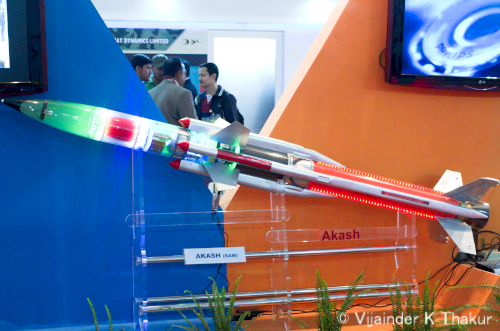
Akash Missile see through model on display at DefExpo 2014

IAF personnel carried out two tests of the Akash Surface to Air missile at the Integrated Test Range (ITR) at Chandipur near Balasore in Odisha on Saturday, April 26, 2014 as part of user trial. 

A defense source told PTI, "The sophisticated Akash missile was test fired twice in quick succession from launch complex-3 of ITR at about 11.55 am and 12 noon." 

Both the missiles were launched against targets towed by a PTA flying over the sea.

ITR Director M K V Prasad described the trials as being "fully successful."

The IAF tested an Akash missile on Wednesday, April 23, 2014 from the ITR.

The New Indian Express reported on April 24, 2014 that the missile missed its target - a pilot-less target aircraft (PTA). 

An official at the launch complex told the newspaper, "The missile was to destroy the PTA at an altitude of nearly 2 km as per the pre-designated coordination. But the mission failed as the weapon could not destroy the target. Though it attained the desired altitude, it failed to pass through missed-distance proximity."

The proximity fuse can be variously set to explode with 10, 20 or 100 meters of the missile, according to the official.

IDP Sentinel members can read more about the Akash missile at the link below