Sunday, June 28, 2015

A-10 Warthog as Dedicated Close Air Support (CAS) Aircraft for the IAF?


Boeing to build 56 more A-10 wings for US Air Force
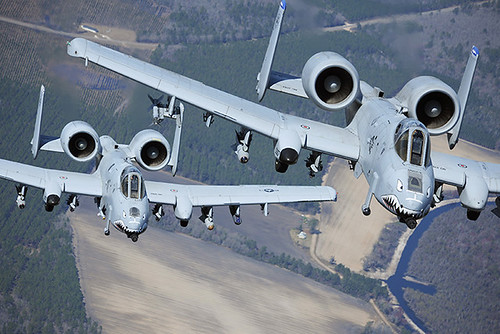
U.S. Air Force A-10 Thunderbolt II. Photo Credit: U.S. Air Force photo/Airman 1st Class Benjamin Wiseman

My recent articles here and here on MyInd.net advocating that the IAF acquire specialized Close Air Support (CAS) aircraft like the US A-10 Warthog to better support Army operations generated some discussion on the IDP Sentinel FB Page and my twitter timeline.

My case for a dedicated CAS aircraft is based on the premise that India's next war would be fought in  mountainous terrain - along the LAC or LoC. The premise is based on a near consensus among leading defense analysts.

In the articles I suggested that since the USAF plans to draw down its 283 aircraft A-10 Thunderbolt II fleet to cut costs, and is contemplating overseas sale of the aircraft, the IAF could purchase some A-10s to add CAS muscle at low cost.

The case for a dedicated (single role) CAS aircraft goes against IAF doctrinal thinking advocating the use of multi-role aircraft to save costs. The IAF's doctrine is based on the prevalent mindsets in the US and western nations that high performance multi-role aircraft can give effective CAS from stand-off ranges using smart weapons.

Understandably, there was skepticism over A-10 purchase in some of the social media responses to my article. In this post I will address the reservations expressed as well as strengthen my case with additional facts and comments made by the GAO in its recent report questioning the USAF's A-10 draw down plans!

Some readers question the ability of the A-10 Warthog to penetrate contested airspace. What they are forgetting is that the A-10 is a dedicated CAS aircraft - it will attack the enemy in proximity to friendly forces. The role doesn't involve penetrating heavily contested airspace; CAS aircraft are called in after establishing local air superiority using air defense fighter combat air patrol in combination with ground and/or airborne radar.

In my MyInd articles I pointed out that the Warthog has some unique capabilities that would make it more useful for CAS in mountainous terrain. These are:


  1. It's high maneuverability would allow it to enter valleys and engage the enemy from close quarters after visual identification. Close quarter engagement after visual identification is essential when battle lines are fluid, as they are likely to be in the case of an incursion along the LAC or LoC.
  2. Featuring armor protection and safe engine placement, the Warthog is designed and built to absorb enemy AD gunfire. It also features SEAD capability against battlefield AD weapons. 


An additional point that I would like to make is that advances in EW such as SatNav jamming could degrade standoff CAS support ability of multi-role aircraft.

The GAO in its report points out that with its great firepower, high maneuverability and SEAD capabilities the A-10 is an invaluable asset


  1. For escorting helicopters ferrying troops and equipment to the battlefield with its firepower and SEAD capabilities.
  2. For rescue missions behind enemy lines.
  3. Against boat swarms threatening warships.
  4. During a need to operate under the weather.


It maybe noted that the need to operate under the weather would be frequent for IAF aircraft  supporting troops along the LAC and LoC


Saturday, June 27, 2015

News Roundup: Project 11356 Frigate Modernization, Rustom-1 Shapes Up for Operational Roles & More


INS Teg a Project 11356 (Talwar Class) Frigate

Project 11356 Frigate Modernization


On June 23, 2015 RIR reported that India has expressed interest in fitting its Project 11356 (Talwar class) ships with an improved variant of the Shtil-1 PDMS (Point Defense Missile System) that is currently undergoing state trials in Russia.

The system features vertical launch and a Multi Function Radar with phased array antenna.

The existing Shtil-1 system can launch a missile once every 12 seconds, while the new Shtil-1 can launch once every 1.5-2 seconds.

The Shtil system is designed to engage all the modern means of air attack at medium range and at altitudes from five meters to 15 kilometers.

On October 20, 2014 Vladimir Spiridopulo, the general director working on this project at the Northern Design Bureau, told TASS that negotiations are underway for the overhaul of the first three Project 11356 supplied to the Indian Navy in the early 2000s.

"But the contract for the modernization has not been signed yet," said Spiridopulo.

IDP Sentinel members can read more details at

Project 11356 Talwar Class Missile Frigates (IDP Sentinel)

INS Sindhukirti Returns to IN


INS Sindhukirti was handed over to the Indian Navy on June 26, 2015 after refit spanning 9 years and month long post refit sea trials.

The sub would be re-inducted into the Navy after final full-power trials.

INS Sindhukirti underwent refit at Hindustan Shipyard Limited (HSL). The boat started acceptance trials on November 4, 2014 after completion of the refit with assistance from Zvezdochka Shipyard in Severodvinsk.

The sub was expected to rejoin the fleet in March 2015, but acceptance trials were halted when it was realized that cyclone Hudhud, which battered Visakhapatnam on October 12, 2014, had brought in a lot of sand and reduced the draft from seven to four meters. HSL dredged the harbor and the submarine sailed out for acceptance trials on May 21, 2015.

INS Sindhukirti's refit, expected to take just 3 years, started in June 2006; it involved repair and modernization of hull, cables, machinery, sonar and missile equipment with the help of Russian experts.

Timelines got stretched when in 2011 the Russians insisted that electrodes, mainline cables and several other parts for the submarine be sourced from Russia.

The refit involved modifying torpedo tubes to launch Klub LACM, installing MCA inertial navigation suite, a Palady nerve system, and a Pirit ship control console. The boat now features BEL's Ushus sonar and a modernized CCS Mark II communications suite.

IDP Sentinel members can read more details at

Life Extension Refit of Kilo Class submarines - I - IDP Sentinel

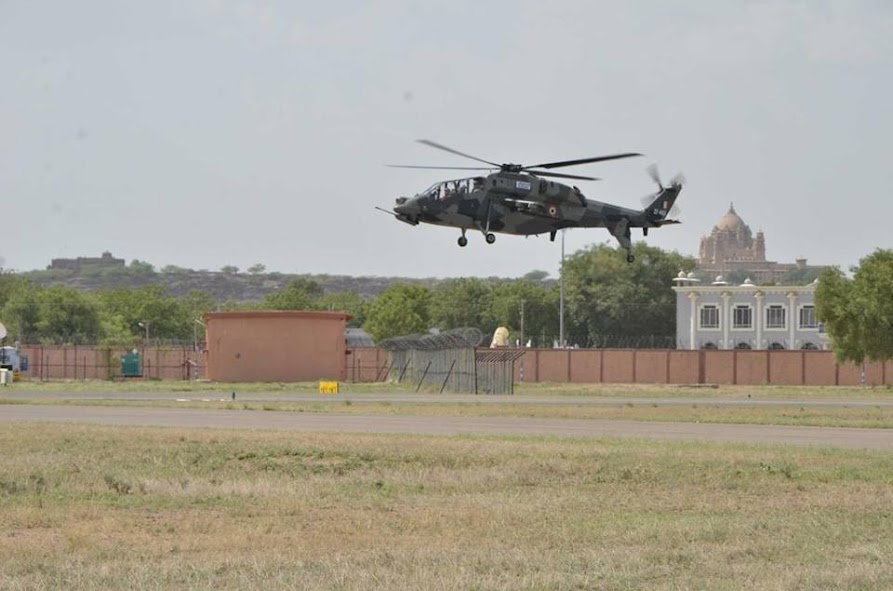
LCH Hot Weather trials at Jodhpur in June 2015

LCH Hot Weather Trials

The LCLH completed week-long hot weather trials in Jodhpur on June 26, 2015.

During the trials, the TD-3 prototype was flown in temperatures ranging from 39-deg to 42-deg C.

The testing involved temperature survey of engine bay and hydraulic system, assessment of performance, handling qualities and loads at different all up weights, low speed handling and height-velocity diagram establishment. [via The Hindu]

In July 2015 the LCH is scheduled to undergo hot and high trials in Ladakh. [via Business Standard]

IDP Sentinel members can read more about the LCH project at the link below:-

Light Combat Helicopter (LCH) - IDP Sentinel

Rustom-1 at Aero India 2015

Rustom-1 Improvements for Operational Role

The IN has shown an interest in procuring DRDO's Rustom-1 drone for surveillance of the Indo-Sri Lanka maritime boundary, the Business Standard reported on June 26, 2015. The Indian Army earlier told DRDO that it would place orders for the Rustom-1 if its take-off and landing could be automated and endurance increased.

Rustom-1 was initially conceived as a technology development and demonstration platform. DRDO is now steadily improving the drone to meet operational requirements.

Flight Operations

Presently, the aircraft needs to be externally piloted during take-off and landing. The Army has asked for autonomous take-off and landing (ATOL) capability, which the ADE is working on.

Rustom-1 takes-off and lands like a conventional aircraft, with the take off and landing being controlled by an external pilot standing close to the runway.

After T/O, the external pilot hands over the control of the UAV to another pilot operating from a ground control station, who pilots the aircraft for the rest of the mission.

A payload operator manages the various payloads from ground control station to capture essential video pictures and data.

Automated T/O and Landings (ATOL)


DRDO is in the process of equipping the drone with sensors required for the ATOL implementation. Extensive real-time simulation have been done on the UAV flight simulator to develop and fine-tune the guidance and control algorithms.

The ALS (Automated Landing System) helps in safe landing of the UAV with minimum Pilot involvement. It performs calculations to keep the UAV on the correct glide slope and aligned to the center-line of the runway. It automates approach and flareout using the UAV's autopilot .

With ATOL capability the UAV would be able to lift a heavier payload since the ground pilot would not be taxed with the longer take-off roll.

The ALS system includes a ground based Laser transmitter and receiver, and a Retro reflector on the UAV. ALS also has a Day TV Camera for streaming video that is monitored by the Internal Pilot (IP). After acquiring a UAV in its vicinity, the ALS continuously transmits Laser pulses and receives reflections from the retro reflectors on the UAV. The system uses the laser reflections to compute the dynamic position of the UAV (ie Distance, Azimuth and Elevation angles) and uplinks the data to the UAV autopilot for a safe landing.

Weight Optimization


DRDO is making the Rustom-1 lighter in order to increase its useful payload.

A DRDO scientist told the Business Standard in June 2015, "We are replacing the existing data link, which weighs about 14-kg with a newer data link that weighs just 4-kg. We are shaving off another 25-kg from the flying package. That will give us the long 'persistence' we need over the mission area."

Multiple GCS Operations


The Rustom-1 datalink has a max range of 200-km. In order to make the drone capable of long range patrols, such as monitoring maritime boundaries, DRDO is modifying the datalink to facilitate mid-flight switching from one GCS to another.

AIS Interrogator


DRDO is working with the Navy to equip Rustom-1 with AIS interrogator to facilitate surveillance of the maritime boundary between India and Sri Lanka. [via Business Standard]

IDP Sentinel members can read more about the Rustom-1 project at the link below:-

Rustom-1 MALE - IDP Sentinel
Thursday, June 25, 2015

Brahmos, US Cruise Missiles Brace Up to Electronic Warfare Challenge

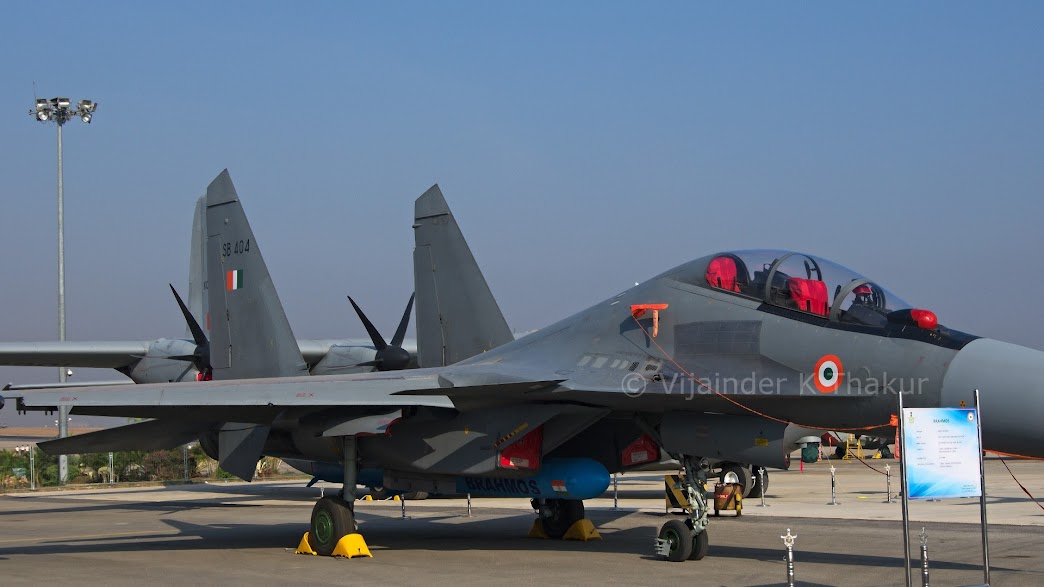
First IAF Su-30MKI modified to carry Brahmos-A, the ALCM variant of the Brahmos supersonic cruise missile at Aero India 2015 in Bengaluru.


SatNav signal jamming is poised to reduce the accuracy of the Indian Brahmos supersonic cruise missile, as also any other conventional cruise missiles that relies on accuracy for its destructive potential.

The Brahmos missile uses SatNav as its primary navigation system and is claimed to have a CEP (Circular Error Probability) of 3-m. As a backup, the missile has a ring laser gyro based inertial navigation (IN) system developed at Research Center Imarat (RCI), Hydrabad.

IN systems are prone to drift with time and need to be periodically fixed. Cruise missile IN systems are fixed using the primary SatNav system. In case of SatNav signal jamming, the accuracy of a cruise missile would depend on the time elapsed since the last fix. IN system CEP is significantly higher than SatNav and increases linearly with time.

India is planning to reequip Brahmos with a more accurate fallback IN system developed by French company Safran (Sagem).

Threat to US Space Based Assets


The US military is heavily dependent on its GPS system for the accuracy of its smart weapons and cruise missile.

Tass reported on June 25, 2014 that Russia’s Radio-Electronic Technologies Group (KRET) is developing a fundamentally new EW system that will target space based communication, navigation and surveillance. The multifunctional system, mounted on ground and airborne platforms, would 'switch off' all adversary satellite terminals, sending adrift aircraft, cruise missiles, and smart bombs that rely on SatNav, besides degrading adversary command and control.

The use of the term 'multifunctional' suggests the system uses several different jamming and spoofing techniques.

The system, which is currently being tested in workshops, will be field tested by the end of the year.

US Response to the Threat


Meanwhile, according to this report, the Pentagon is planning to setup a new joint command cell in the next 6 months to protect US space based assets against attacks from China and Russia.

U.S. Deputy Secretary of Defense Robert O. Work told the annual GEOINT symposium on Tuesday, June 23, 2015 that the cell will receive data from satellites belonging to all U.S. government agencies and coordinate response to attacks.

“[W]e are going to develop the tactics, techniques, procedures, rules of the road that would allow us … to fight the architecture and protect it while it’s under attack,” Work said. [via Defense One]

The scale and geographical spread of US military operations is so vast that US forces cannot retain their edge against regional powers like Russia and China without relying heavily on space based assets. Potential US adversaries recognizing the US dependence have acquired the capability to attack US satellites using soft kill (jamming, blinding), or hard kill (microwave / laser frying, kinetic attack).

“The ugly reality that we must now all face is that if an adversary were able to take space away from us, our ability to project decisive power across transoceanic distances and overmatch adversaries in theaters once we get there … would be critically weakened,” Work told the symposium.

Senior officials at the Pentagon and Office of the Director of National Intelligence are still finalizing details of the new center, which will back up the military’s Joint Space Operations Center at Vandenberg Air Force Base, California.

Saturday, June 13, 2015

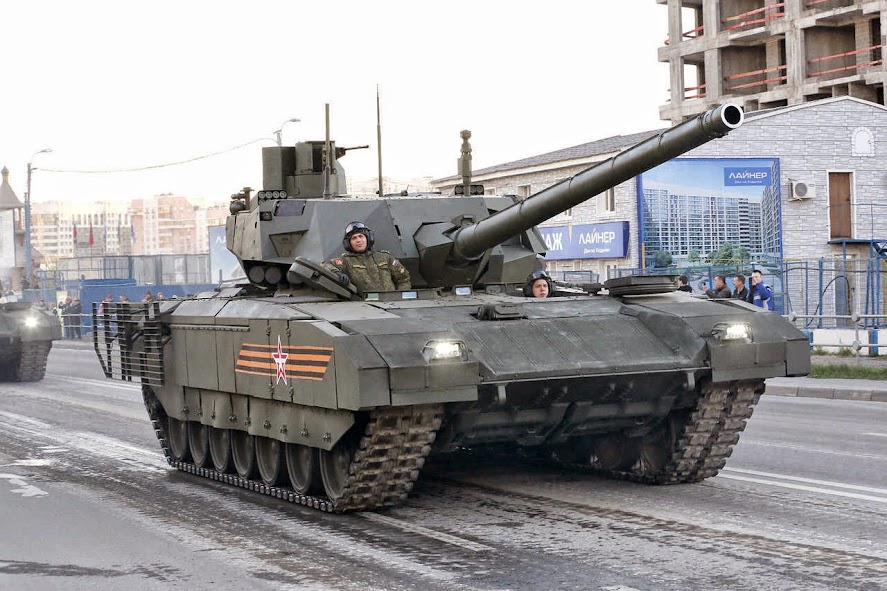
Breaking & Thumkar Exclusive: Indian Army Seeks its Own Armata - Future Ready Combat Vehicle (FRCV)

The newly unveiled Russian Armata tank

The Indian Army plans to design and develop a futuristic combat vehicle called the Future Ready Combat Vehicle (FRCV)  to replace the T-72 tanks of the Armored Corp starting 2025-27. [RFI]

This tracked fighting vehicle would feature a modular design that will be leveraged to create a family of combat vehicles.

The FRCV's modular design would be flexible to an extent where it can be configured to operate in varying terrain.

The following variants are planned to be developed on the FRCV platform:


  1. Tracked Main Battle Tank - Primary variant.
  2. Tracked Light Tank.
  3. Wheeled Version.
  4. Bridge Layer Tank (BLT).
  5. Trawl Tank and Mine Ploughs.
  6. Armored Recovery Vehicle (ARV).
  7. Self Propelled Artillery Gun/Howitzer.
  8. Air Defense Gun/Msl System.
  9. Artillery Observation Post Vehicle.
  10. Engineer Reconnaissance Vehicle.
  11. Armored Ambulance.
  12. FRCV Development Process


The FRCV has been conceived as a Design and Development project, to be executed in three stages as under:


  1. Design Stage.
  2. Prototype Development Stage.
  3. Production Stage.
During the three development stages, the Design Agency and Developing Agency (DA) could be separate entities. The best design would be chosen and given to nominated DA(s) for production of the prototype(s). The selected prototype will be given to Production Agency(s) (PAs) for bulk production.

The FRCV would be required to conduct sustained continuous operations by day and night in all weather conditions in terrain and temperature ranges obtaining on India’s Western borders.

The FRCV should be in the `Medium Tank’ category whose physical dimensions should facilitate transportability over existing terrain, in-service military bridges and major civilian infrastructure (including bridges) in the border areas (on either side of the Western border).

Crew


The number of crew members should be such that they can perform their
designated tasks, and operate all on-board systems without hindrance and without any overlapping of duties/ responsibilities.

Fire Power


Should be well matched to contemporary MBTs in engagement ranges, all weather day/night fighting capability, depth of penetration and variety of ammunition.
Should have very high accuracy [High FRHP (First Round Hit Probability)] and very high lethality [High SSKP (Single Shot Kill Probability)], at par with contemporary MBTs.

Protection.


Should provide very high all-round protection, including ballistic, active and any other form of anti-armor technologies, to ensure survivability in the contemporary and future battlefield.
Should incorporate signature reduction technologies.
High response evasion/ anti-detection system.

Mobility


Should have adequately high power-to-weight ratio to enable all on-board systems to be run simultaneously, without disrupting the agility and mobility of the vehicle.
Should have high operating range, comparable to contemporary MBTs

IDP Sentinel members can read more details at the link below

Future Ready Combat Vehicle (FRCV) - IDP Sentinel

Wednesday, June 10, 2015

News Roundup: Navy Procuring 5 Diving Support Vessels, 3rd & Final EMB-145 AEW&CS to Arrive July 4, 2015


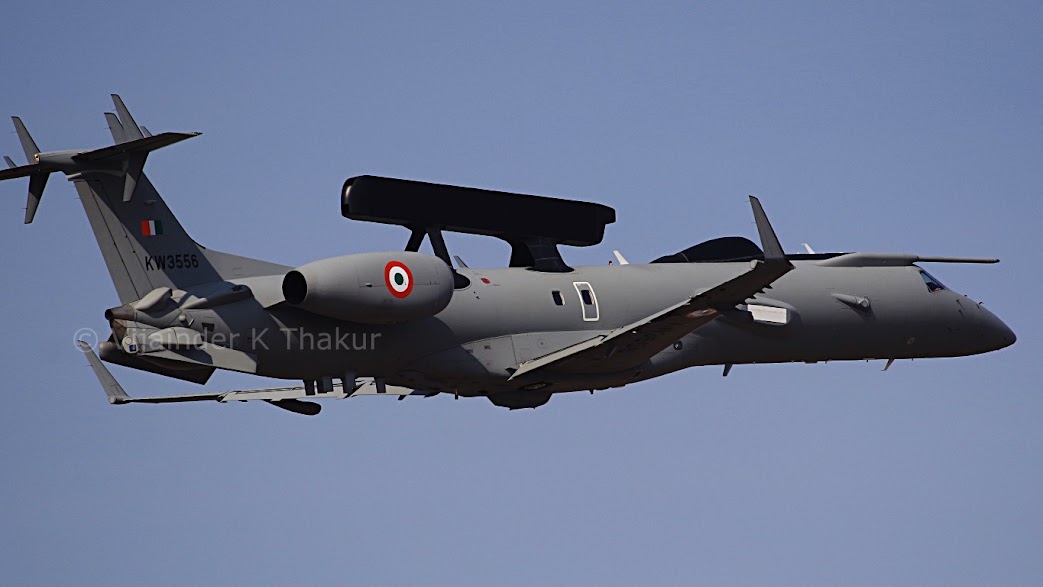
EMB-145 AEW&CS at Aero India 2015

Third & final Embraer EMB-145 for AEW&CS Project to Arrive in India July 4, 2015


The 3rd & final Embraer EMB-145 (KW-3554) for AEW&CS project is to arrive in Ahmedabad on July 4, 2015. The aircraft was earlier scheduled to be delivered in December 2014.

Embraer has so far delivered 2 EMB-145I aircraft to India. The first EMB-145 to be delivered to India under the contract ceremonially rolled out in Brazil on February 21, 2011.

Two EMB-145 aircraft fully configured in the AEW&CS role - fitted with CABS developed actual AESA radar antenna in the dorsal units, operator workstations (five), avionics racks, rest crew seating, seats and cabling -  are undergoing acceptance tests by an IAF technical evaluation team.

DRDO will deliver the first AEW&CS aircraft to the IAF within six months, DRDO Chief Avinash Chander told The Hindu on August 2, 2014.

IDP Sentinel members can read more at

AEW&CS Project - IDP Sentinel

Indian Navy Procuring 5 Diving Support Vessels


The Indian Navy on June 8, 2015 released a RFI for construction and delivery of  5 Diving Support Craft.

The Navy is seeking self propelled Diving Support Craft, capable of fully supporting operational/training dives in harbors and coastal waters.

The vessel, to be manned by 2 officers and 20 sailors, should be less than 30-m in length with draught not exceeding 2.5 m. It should be capable of operating in sea State 3 and be seaworthy up to Sea State 4.

The vessel should be capable of operating in tropical conditions and have an expected life of 20 years with annual usage of approx 800 hrs. The Main and auxiliary machinery should permit continuous mission time of 48 hours.

Max speed of 16 Kt is required at upto 85% MCR of Main Engine. Endurance should be 72 Hrs at economical speed with 25% reserve fuel capacity.

Onboard diving equipment is detailed in the RFI.

IDP Sentinel members can view recent Navy RFIs at

Recent Navy RFIs - IDP Sentinel

Tuesday, June 9, 2015

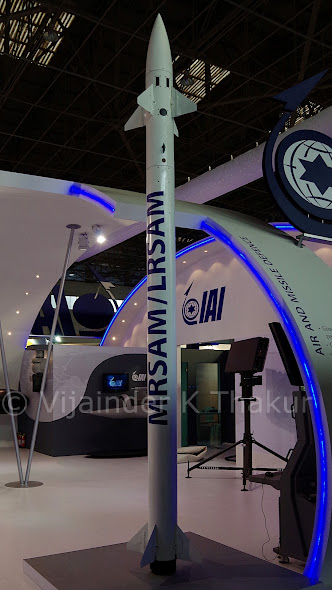
LR-SAM / Barak-8: Deadly End Game!

LR-SAM at Aero India 2013

The Barak-8 and its DRDO variant LR-SAM, the chosen Point Defense System for large Indian warships, features a smokeless dual pulse motor that makes the missile highly maneuverable and fast at target interception range throughout the missile's wide envelope. This is evident from the video of the missile test in November 2014.


The missile is moving so fast during the end game that the target RPV appears to stand still in the air!

Note how the smokeless, but not entirely smokeless, rocket motor is still burning at impact.

Pulsed Rocket Motor


A pulsed rocket motor has multiple propellant segments, with a barrier that stops ignition separating any two segments. When one segment burns out the missile coasts till another segment is ignited.

A shortcoming of conventional solid propellant rocket motors is that they cannot be switched off and reignited, as is the case with liquid propellant rocket motors. A pulsed rocket motor addresses the shortcoming.

Without a pulsed motor, an air-to-air or surface-to-air missile rapidly loses speed and maneuverability after motor burnout. Such missiles are unable to engage hard maneuvering targets nearing the limit of their engagement range.

A pulsed rocket motor allows the missile to coast and then reignite its motor after seeker lock making it difficult for the target to throw off the missile.

Each pulse can have different thrust level, burn time, and achieved specific impulse depending on the type of propellant used, its burn rate, its grain design, and the current nozzle throat diameter.

IDP Sentinel members can read more about Barak-8/LRSM/MRSAM at the link below

Barak-8 / MRSAM / LRSAM - IDP Sentinel

Monday, June 8, 2015

News Roundup: ITBP Stepping Up Troop Deployment Along Arunachal LAC, CSL Constructing IAC-2 Compatible Drydock


View of TAR from the LAC at Bum La pass. Note well laid Chinese road.

ITBP Proposes Additional 6,000 Troop Deployment Along LAC


ITBP has sought Home Ministry approval for deploying six additional battalions to plug gaps along the LAC in Arunachal Pradesh. The proposal is still under consideration at the Ministry, which earlier gave ITBP in principal approval to raise 8 additional battalions (8,000 troops). [via PTI]

Raised in response to the October 1962 Chinese aggression, the Indo -Tibetan Border Police (ITBP) is a Central Armed Police Force (CAPF) that is specialized in mountain warfare with most of its personnel professionally trained as mountaineers and skiers. ITBP mans  3,488 km of India's 4,000 km  border with China in three segments extending from Karakoram Pass in Ladakh till Jachep La in Arunachal Pradesh opposite the Tibet Autonomous Region of China. It mans the entire  1,597-km border with China in Jammu and Kashmir.

The ITBP currently has 57 battalions of 1000 personnel each.

IDP Sentinel members can read more on the Indo-China border dispute at the link below.

India - China Relations - IDP Sentinel

Cochin Shipyard Constructing New IAC-2 Compatible Dry Dock

Cochin Shipyard will reportedly release a tender within a month to identify a consultant for preparing a detailed project report (DPR) for construction of a larger dry dock.

The new 300m x 75m dry dock, estimated to cost Rs 1,300 crore, is proposed to be completed within  three-and-a-half years, in time for the shipyard to bid against the Navy tender for IAC-2, expected to displace 65,000 tonnes. [via The Hindu]

IDP Sentinel members can read more about IAC-2 at the link below

Indian Aircraft Carrier-2 (IAC-2) INS Vishal