Showing posts with label EW. Show all posts

Wednesday, June 17, 2026

Back to the Wall, Russia Turns to Satellite Jamming. Has Space Warfare Begun?


Google translated graphic published by Militarnyi

Russia has deployed the newly developed Volna-Kupol-Garant electronic warfare (EW) system to protect its forces from attacks by medium-range drones equipped with Starlink terminals, such as the US-supplied Hornet drone, whose development was funded by former Google CEO Eric Schmidt.


Jamming a communication terminal in a war zone is generally considered a legitimate military activity. However, traditional electronic warfare systems seek to disrupt the receiver. Garant appears to reverse the approach by targeting the satellite instead. In effect, the system attempts to deny access to a Starlink satellite over a defined area rather than disable individual terminals operating within it.

Starlink Communications

Conventional drones communicate with their operating crew using line-of-sight RF links which sometimes involve ground based or airborne relays. Such links are easy to disrupt using

ground-based jammers. In contrast, Starlink terminals use narrow electronically steered beams directed towards satellites overhead. The geometry significantly reduces the effectiveness of conventional jamming systems.


Starlink terminals mounted on drones are difficult to jam using ground-based EW systems because they are pointed skywards towards Starlink satellites orbiting approximately 500 km above the Earth. Any EW system attempting to jam a Starlink terminal directly would ideally need to be positioned above the drone's altitude.


Garant System


The Garant system takes advantage of the fact that while the Starlink terminal mounted on the drone is facing skywards, the Starlink satellite with which it is communicating is facing the Earth's surface.


The Garant system disrupts communication between a drone-mounted Starlink terminal and a Starlink satellite by saturating the satellite with interference signals across its entire communication band (14–14.5 GHz). Although Starlink satellites can frequency-hop across eight channels, the Garant system employs eight antennas, each covering 62.5 MHz.


The interference signals generated by Garant effectively blind the satellite passing overhead. The system can isolate an area of approximately 18 sq km from Starlink satellite signals. Its coverage extends through 360 degrees in azimuth and 110 degrees in elevation.


A Starlink terminal can communicate with multiple Starlink satellites simultaneously. At present, it is not clear whether, or how, the Garant system prevents drone-mounted terminals from communicating with satellites visible outside the area affected by the interference.


Initial reports from Ukraine suggested that the Garant system could interfere with only one satellite at a time. If that were the case, the system would be of limited effectiveness, since a terminal could simply switch to one of the 10 to 20 satellites (an approximation) typically visible overhead.


More recent Ukrainian reports suggest that the Russian capability is both comprehensive and credible, to the extent that Ukrainian forces reportedly respond by immediately launching drones to locate, attack, and disable any deployed Garant system.


A graphic published by Militarnyi suggests that the system can interfere with all satellites within its operating cone.


The Garant electronic warfare system typically consists of eight satellite dishes. It weighs approximately 120 kg and can be operated by a single individual.


Garant Vulnerabilities


Locating and attacking the system is relatively straightforward because SpaceX can instantly detect interference affecting its communication channels, while radio reconnaissance assets operated by Western countries supporting Ukraine can detect the powerful emissions generated by the system.


While the Garant system can disrupt attacks by Starlink-guided drones, it remains vulnerable to attacks by FPV drones and machine-vision-guided kamikaze drones.


Russian forces have reportedly begun using the Garant system to protect the Novorossiya Highway, which has come under repeated attack by Hornet drones equipped with Starlink terminals.


Conceptual Shift

The conceptual shift from jamming communication terminals to jamming satellites has ramifications. Interfering directly with a satellite serving other users could be viewed as an escalation. However, Russian forces have apparently concluded that such escalation, if it indeed constitutes one, is justified because the Starlink network is being used to facilitate attacks on Russian military personnel and civilians.


TASS quotes technical and information security expert Sergey Trukhachev as saying:


"Hundreds of companies from the United States and Europe are directly involved in the Ukraine conflict and complicit in the deaths of our servicemen and civilians. This cannot go on forever. Volna-Kupol-Garant systems are just the first step in a set of means for destroying any enemy infrastructure."


Perhaps the expert is alluding to a possible future escalation involving the use of more powerful directed-energy weapon systems to temporarily or permanently disable satellites.


Russia could also justify satellite jamming by arguing that the system merely incapacitates a particular satellite visible over contested territory for the duration of its passage through the area. The incapacitation is temporary.

Looking Ahead


The use of Starlink as a dual-use communication network which prompted the deployment of the Garant system heralds the inevitable extension of warfare into space. 


The deployment of the Garant challenges the assumption that commercial satellite constellations can provide invulnerable communications in wartime. Garant demonstrates that even massive constellations such as Starlink may be vulnerable to localized denial techniques.


In the past, SpaceX has demonstrated a lot of agility with Starlink by quickly upgrading software to thwart attempts at disrupting the network. It remains unclear whether SpaceX could modify the Starlink network software to mitigate the effects of the Garant system. With Russian sources already alluding to potentially more potent Russian EW capability, the battle may ultimately evolve into a contest between Russian electronic warfare engineers and SpaceX software developers.


Indeed, the possibility exists of space warfare going beyond EW. If attempts at satellite jamming are repeatedly frustrated, Russia could eventually opt for the use of directed-energy systems or kinetic anti-satellite weapons against communication satellites supporting military operations.

Added on July 11, 2026


Copyright © Vijainder K Thakur. First published on Thumkar.

Saturday, September 5, 2015

Russia Displays Innovative Asymmetric Counter Stealth Systems at MAKS-2015

KRET EW Systems on display at MAKS-2015

Russian EW systems displayed at MAKS 2015 suggest that Russia has adopted a low cost, asymmetric approach to counter the threat posed by the soon to be deployed F-35 fighters, which features low observability (LO)  and sensor fusion.

A low observable (LO) fighter can escape detection only if it keeps its radar switched off, or under emission control (EMCON). To penetrate contested airspace and attack targets, the LO fighter relies on an AWACS positioned in the rear, which streams the air and ground situation over a directional and encrypted data link. The LO fighter uses its sensor fusion capability to fuse the information obtained from the AWACS sensors with the information obtained through its own passive (ESM, EO) sensors to track and engage adversary targets.

An F-35 strike force under AWACS cover would be able to detect and engage non stealthy  Russian fighters -  MiG-35, Su-30, Su-35 - well before the Russian fighters detected the presence of the strike force. The F-35s would detect the Russian fighter radar emissions from as far away as 300-nm. Non emitting Russian fighters would be picked up by the F-35 strike force support AWACS from 150-nm.

Even if the Russian fighters were also supported with AWACS, the F-35s LO would delay detection till around 90-nm.

The challenge to Russia from US LO fighters is formidable, but it's noteworthy that LO is fundamentally an ECM technique. LO fighters deflect radar emissions away from the transmitter, instead of bouncing them back to the transmitter.

If LO is ECM then common wisdom hold that every ECM has a ECCM!

The Russians have chosen to negate US advantage, not by building analogs, but by reverting to fundamentals.

A stealthy F-35 strike force threatens ground targets so why oppose it from the air? Putting powerful jammers and passive locators on the ground in the proximity of high value targets that the adversary fears and wants to target would be a logical. Ground based systems have practically no size and weight constraints, as long as mobility is ensured.


What the Russians appear to be doing is:

  1. Fielding powerful ground based jammers to degrade AWACS sensors, data links, RF missile sensors.
  2. Fielding ground based passive emission locating systems that constrain enemy use of radar. 
  3. Developing UAVs featuring UHF, L, S radars to unmask LO fighter aircraft
  4. Fielding more sensitive Electro Optical Targeting System (EOTS) on their fighters.


The following are some of the new weapon systems displayed at MAKS 2015 that are focused on mitigating the threat posed by the advent of F-35s in large number along Russian borders.

Krasukha Jammer at KRET pavilion at MAKS-2015

Krasukha EW System


The Krasukha is a mobile, ground-based broadband multi-functional jamming station and spoofing system developed by KRET. The system analyzes the type of signal and responds by jamming it with a powerful, smart interfering emission, preventing adversary radar sensors from detecting targets and guiding weapons to them.

There are two variants of the system: Krasukha-2 and Krasukha-4, the latter being a higher power longer range system.

Krasukha is effective against the entire spectrum of RF dependent weapon systems. It can jam radars (ground, low orbit satellite, AWACS, Fighter, UAV, Missile), data links and satellite links. Krasukha RF suppression makes PGM guidance impossible.

The system can vary jamming intensity to extremes and is capable of damaging electronics through brute force pumping of RF energy into enemy system. Krasukha can also be subtle; for example, it can generate false targets to spoof missile RF sensors.

Jamming range for AWACS is claimed to be 300-km for the Krasukha-2 system, and 400-km for the Krasukha-4 system.

Krasukha systems were developed to protect high value targets on the move, such as the Russian tactical missile Iskander (SS-26), while on the move.


LO UAV to Detect LO Fighters


Russia's UAC is reportedly developing a LO UAV designed to detect stealth aircraft using X-band and UHF radars. The project is an analog of China’s “Divine Eagle” project.

The Russian UAV would detect LO aircraft such as as Lockheed Martin F-22 and F-35 and Northrop Grumman B-2.

KRET is developing a deeply-integrated electronic warfare system that would create a protective electromagnetic sphere around the UAV to counter air-to-air missiles and cloak it from radars.

Avtovaza-M


The Avtovaza-M is a Emitter Location System (ELS) that can passively detect and track adversary aircraft facilitating engagement by AD missiles. The system comprises five vehicles spread over tens of kilometer, interconnected over low-power, low-probability-of-intercept  communication link using antennas mounted on tall masts.

Avtobaza-M uses time-difference-of-arrival (TDOA) processing to locate targets with a precision that is about 2% of detection range, and operates from 200 MHz to 18 GHz and has a range of up to 150-km.

In its basic configuration, Avtovaza-M includes four autonomous SOP (Stantsiya obnaruzheniya i pelengovaniya) detection and direction finding stations and one SOI (Stantsiya obrabotki informatsii) information processing station (ESM), mounted on Kamaz-63501 four-axle military trucks.

TDOA systems can locate targets with three stations, but the Avtovaza system uses up to five, to provide redundancy and resolve ambiguities.

The system can detect, analyze and track IFF, TACAN, pulse and continuous onboard radar emissions, and determine radar types for air and sea surface targets, and then disseminate all of this data up the air defense chain.

The whole system can be set up or made ready to redeploy in 45 minutes, with just 3 to 5 minutes to bring it into combat readiness.

The Avtobaz system is believed to have been used by Iran to bring down an American RQ-170.

The usefulness of an ELS system is often underrated because it cannot detect or track a non emitting aircraft - for example, an adversary fighter with its radar, IFF and JTIDS/Link-16 switched off. The point overlooked is that with  its radar or data link offline, the adversary fighter wouldn't be able to engage  targets!

Moscow-1

The Moscow-1, the successor to the Avtobaza-M ELS, can detect targets at a distance of 400 km, as against Avtovaza's maximum range of 150 km. 

Moscow-1 system is operated by a crew of 4 and consists of three trucks including an ESM vehicle (IL265E) and an airborne radar jammer (IL2663). The station is able to provide 360-degree visibility and can be deployed in 45 minutes.

You can see more pictures of the Krasukha system at this AW&ST link.

Analysis

If the above logic behind powerful ground based EW systems is sound, why has the US not developed such weapon systems. 

Bill Sweetman in his audio-interview (link below) attributes it to the expeditionary nature of US forces. US ground troops are loathe to carry around anything larger than a Humvee sized vehicle, says Sweetman.

A KRET official confirms as much in a more recent interview, excerpted below from a Google translation.

Apparently this is explained by the history of US involvement in military conflicts. They are known in their territory do not fight, and are mainly involved in any global or local military conflicts far from their borders. Therefore, the terrestrial EW they never paid as much attention as we do. Perhaps this is also dictated by the current military doctrine there. We have a different doctrine, is defensive in nature, so the means of electronic intelligence and management of land-based we have developed very well. We can say - as anywhere in the world. 

Bill Sweetman on how Russia is countering US Advantages
Russian EW Systems - IDP Sentinel members only link


Thursday, June 25, 2015

Brahmos, US Cruise Missiles Brace Up to Electronic Warfare Challenge

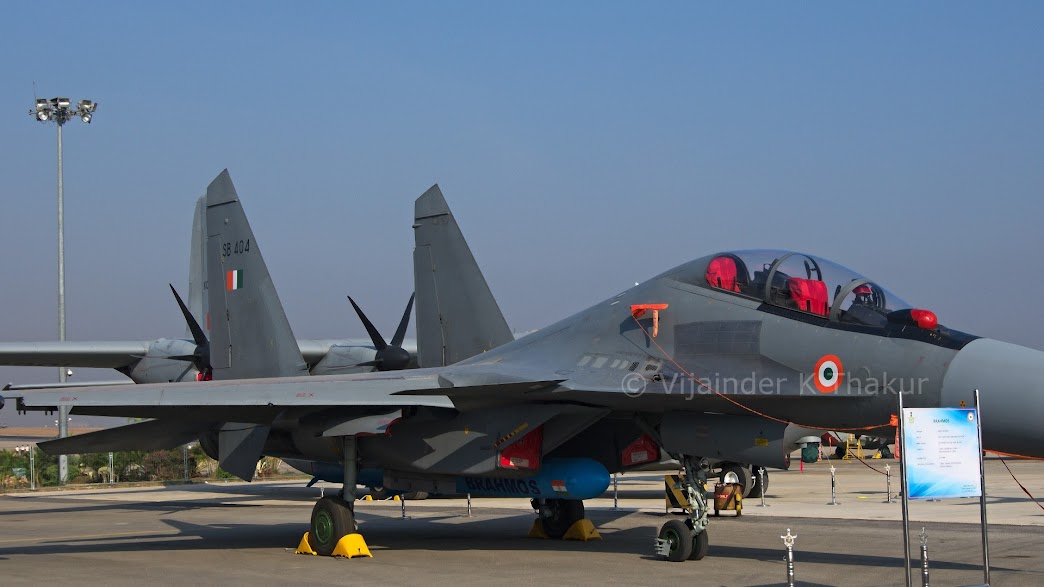
First IAF Su-30MKI modified to carry Brahmos-A, the ALCM variant of the Brahmos supersonic cruise missile at Aero India 2015 in Bengaluru.


SatNav signal jamming is poised to reduce the accuracy of the Indian Brahmos supersonic cruise missile, as also any other conventional cruise missiles that relies on accuracy for its destructive potential.

The Brahmos missile uses SatNav as its primary navigation system and is claimed to have a CEP (Circular Error Probability) of 3-m. As a backup, the missile has a ring laser gyro based inertial navigation (IN) system developed at Research Center Imarat (RCI), Hydrabad.

IN systems are prone to drift with time and need to be periodically fixed. Cruise missile IN systems are fixed using the primary SatNav system. In case of SatNav signal jamming, the accuracy of a cruise missile would depend on the time elapsed since the last fix. IN system CEP is significantly higher than SatNav and increases linearly with time.

India is planning to reequip Brahmos with a more accurate fallback IN system developed by French company Safran (Sagem).

Threat to US Space Based Assets


The US military is heavily dependent on its GPS system for the accuracy of its smart weapons and cruise missile.

Tass reported on June 25, 2014 that Russia’s Radio-Electronic Technologies Group (KRET) is developing a fundamentally new EW system that will target space based communication, navigation and surveillance. The multifunctional system, mounted on ground and airborne platforms, would 'switch off' all adversary satellite terminals, sending adrift aircraft, cruise missiles, and smart bombs that rely on SatNav, besides degrading adversary command and control.

The use of the term 'multifunctional' suggests the system uses several different jamming and spoofing techniques.

The system, which is currently being tested in workshops, will be field tested by the end of the year.

US Response to the Threat


Meanwhile, according to this report, the Pentagon is planning to setup a new joint command cell in the next 6 months to protect US space based assets against attacks from China and Russia.

U.S. Deputy Secretary of Defense Robert O. Work told the annual GEOINT symposium on Tuesday, June 23, 2015 that the cell will receive data from satellites belonging to all U.S. government agencies and coordinate response to attacks.

“[W]e are going to develop the tactics, techniques, procedures, rules of the road that would allow us … to fight the architecture and protect it while it’s under attack,” Work said. [via Defense One]

The scale and geographical spread of US military operations is so vast that US forces cannot retain their edge against regional powers like Russia and China without relying heavily on space based assets. Potential US adversaries recognizing the US dependence have acquired the capability to attack US satellites using soft kill (jamming, blinding), or hard kill (microwave / laser frying, kinetic attack).

“The ugly reality that we must now all face is that if an adversary were able to take space away from us, our ability to project decisive power across transoceanic distances and overmatch adversaries in theaters once we get there … would be critically weakened,” Work told the symposium.

Senior officials at the Pentagon and Office of the Director of National Intelligence are still finalizing details of the new center, which will back up the military’s Joint Space Operations Center at Vandenberg Air Force Base, California.