Showing posts with label LCH. Show all posts

Monday, December 15, 2025

Closing the Apache Chapter: Indian Army Bets on Prachand LCH


On December 15, 2025, The Times of India reported that the IA is set to receive the last three AH-64E Apache helicopters on order from Boeing Aerospace.

Three of the six AH-64E helicopters ordered by the IA arrived at Hindon Air Base on July 22, 2025. It was then reported that the remaining three helicopters would be delivered by November 2025.

The Indian MoD ordered six AH-64E helicopters from Boeing under an $800 million deal signed in February 2020, during the visit of former US President Donald Trump to India.

At the time of contract signing, Boeing had committed to deliver all six helicopters by February 2024.

IAF AH-64E Procurement


The IAF earlier acquired 22 AH-64E helicopters from Boeing under a $3 billion contract, which also included the supply of 15 CH-47F Chinook helicopters.

The IAF reportedly received the last batch of the 22 AH-64E helicopters it ordered in July 2020.

IA Forgoes Additional AH-64E Procurement


In early 2014, the Army received “in-principle” approval for “ownership” of 39 Apache AH-64 gunships to equip its “strike” formations. However, no additional orders have been placed beyond the six helicopters ordered. The Army now appears committed to expanding its fleet with indigenous options, such as the 5.8-ton, twin-engined Prachand Light Combat Helicopter (LCH).

The Prachand is powered by two Shakti engines and inherits many technical features of the Advanced Light Helicopter. Features unique to the LCH include a sleek and narrow fuselage, tricycle crashworthy landing gear, crashworthy and self-sealing fuel tanks, armour protection, and nuclear and low-visibility features, which make the LCH lethal, agile, and survivable.

The Prachand outperforms the AH-64E in its ability to operate at altitudes above 5,000 m, which is a critical requirement for Himalayan deployments. The programme targets over 65% indigenous content, involving over 250 domestic companies.

Prachand LCH


Indigenously developed weapon systems can more effectively address threat perspective–driven qualitative requirements (QRs). India’s requirement for a combat helicopter honed for high-altitude operations is unique. India’s disputed borders run through mountainous terrain. The Indian Army and Air Force need a combat helicopter that can fly at high altitudes with the agility to safely negotiate tight airspaces between mountains, allowing pilots to find and engage targets with ease.

MoD’s Unprecedented Large-Volume Order


The Indian MoD, on March 28, 2025, signed two contracts with Hindustan Aeronautics Limited (HAL) for the supply of 156 Prachand helicopters, along with training and other associated equipment, worth ₹62,700 crore. The first contract is for the supply of 66 LCHs to the Indian Air Force (IAF), and the second is for the supply of 90 LCHs to the Indian Army.

Deliveries will begin in the third year (2027–28) and continue over five years, with HAL producing about 30 helicopters annually from its Bengaluru and Tumkur facilities.

The new order will add to the 15 LSP variants of the helicopter (10 IAF and five Army) already inducted under a ₹3,887 crore contract inked in 2022. HAL completed delivery of the 15 LSP helicopters in early August 2023.

Prachand Capabilities


The Prachand is a low-observable (LO) design with reduced visual, aural, radar, and infrared (IR) signatures. It features canted panels for a lower radar cross-section and an IR suppressor for reduced IR signature.

The helicopter has a maximum speed of 275 kmph (148 kt), a combat radius of 500 km, and is capable of high-altitude warfare with an operational ceiling of 16,000 to 18,000 feet.

Prachand’s stub wings/armament booms have four weapon attachment stations, two on each side. Each station can carry ATGMs, rockets, or air-to-air missiles.

The helicopter has fixed armour plating on the sides and crashworthy landing gear for improved survivability.

Prachand Sensors


The Prachand is equipped with an electro-optical pod consisting of a CCD camera, FLIR, laser range finder (LRF), and laser designator (LD), giving the attack helicopter the ability to detect and acquire targets day or night.

It is not known whether an AESA radar is proposed for development for the LCH. Weight constraints might rule out this option, in which case the Prachand’s ability to carry long-range missiles may be severely constrained.

Prachand Communication Suite


Not much is known about Prachand’s communication suite in the public domain. A modern combat helicopter needs high-bandwidth communications, with support for direct connectivity with UAVs.

It is unlikely that the Prachand currently has a high-bandwidth communication suite adapted to operate within a battlefield command-and-control system. If that is indeed the case, an improved communication suite would be a priority item on HAL’s Prachand to-do list.

Weapon Systems


The Prachand will be equipped with the indigenously developed Helina surface-to-air missile, which can engage targets at ranges between 500 m and 7 km.

Helina features a 640 × 512 px FPA (focal plane array) imaging infrared (IIR) seeker. As a result, the Helina seeker can image the target—not just detect it—giving the missile the ability to recognise the target and ignore other heat sources in its vicinity.

Helina always uses LOBL (lock-on before launch) tracking, making it a “fire-and-forget” missile. Once the electro-optic (EO) system of the ALH identifies the target, it automatically hands it over to the missile.

Reposing Confidence in HAL’s Ability to Deliver


A single order volume of 156 helicopters is unprecedented for attack helicopters. By comparison, the Russian MoD’s last order for the combat-proven Ka-52M was for 114 helicopters.

The MoD’s large order is likely aimed at addressing concerns that, in the past, HAL has not been able to meet weapon system delivery timelines because the MoD did not place orders in time or for adequate volumes. Clearly, this time the MoD has reposed considerable faith in HAL’s ability to deliver.

Conclusion


The Prachand could well become an HAL success story, as it is derived from the Dhruv ALH, which entered operational service in 2002 and has accumulated approximately 450,000 flight hours.

The IA and MoD have placed a large order for the helicopter and given HAL more than two years to commence deliveries. It is almost certain that if HAL and DRDO deliver on the promise of the Prachand, there will be further orders for more advanced variants.

Copyright © Vijainder K Thakur. First published on Thumkar.


Saturday, June 27, 2015

News Roundup: Project 11356 Frigate Modernization, Rustom-1 Shapes Up for Operational Roles & More


INS Teg a Project 11356 (Talwar Class) Frigate

Project 11356 Frigate Modernization


On June 23, 2015 RIR reported that India has expressed interest in fitting its Project 11356 (Talwar class) ships with an improved variant of the Shtil-1 PDMS (Point Defense Missile System) that is currently undergoing state trials in Russia.

The system features vertical launch and a Multi Function Radar with phased array antenna.

The existing Shtil-1 system can launch a missile once every 12 seconds, while the new Shtil-1 can launch once every 1.5-2 seconds.

The Shtil system is designed to engage all the modern means of air attack at medium range and at altitudes from five meters to 15 kilometers.

On October 20, 2014 Vladimir Spiridopulo, the general director working on this project at the Northern Design Bureau, told TASS that negotiations are underway for the overhaul of the first three Project 11356 supplied to the Indian Navy in the early 2000s.

"But the contract for the modernization has not been signed yet," said Spiridopulo.

IDP Sentinel members can read more details at

Project 11356 Talwar Class Missile Frigates (IDP Sentinel)

INS Sindhukirti Returns to IN


INS Sindhukirti was handed over to the Indian Navy on June 26, 2015 after refit spanning 9 years and month long post refit sea trials.

The sub would be re-inducted into the Navy after final full-power trials.

INS Sindhukirti underwent refit at Hindustan Shipyard Limited (HSL). The boat started acceptance trials on November 4, 2014 after completion of the refit with assistance from Zvezdochka Shipyard in Severodvinsk.

The sub was expected to rejoin the fleet in March 2015, but acceptance trials were halted when it was realized that cyclone Hudhud, which battered Visakhapatnam on October 12, 2014, had brought in a lot of sand and reduced the draft from seven to four meters. HSL dredged the harbor and the submarine sailed out for acceptance trials on May 21, 2015.

INS Sindhukirti's refit, expected to take just 3 years, started in June 2006; it involved repair and modernization of hull, cables, machinery, sonar and missile equipment with the help of Russian experts.

Timelines got stretched when in 2011 the Russians insisted that electrodes, mainline cables and several other parts for the submarine be sourced from Russia.

The refit involved modifying torpedo tubes to launch Klub LACM, installing MCA inertial navigation suite, a Palady nerve system, and a Pirit ship control console. The boat now features BEL's Ushus sonar and a modernized CCS Mark II communications suite.

IDP Sentinel members can read more details at

Life Extension Refit of Kilo Class submarines - I - IDP Sentinel

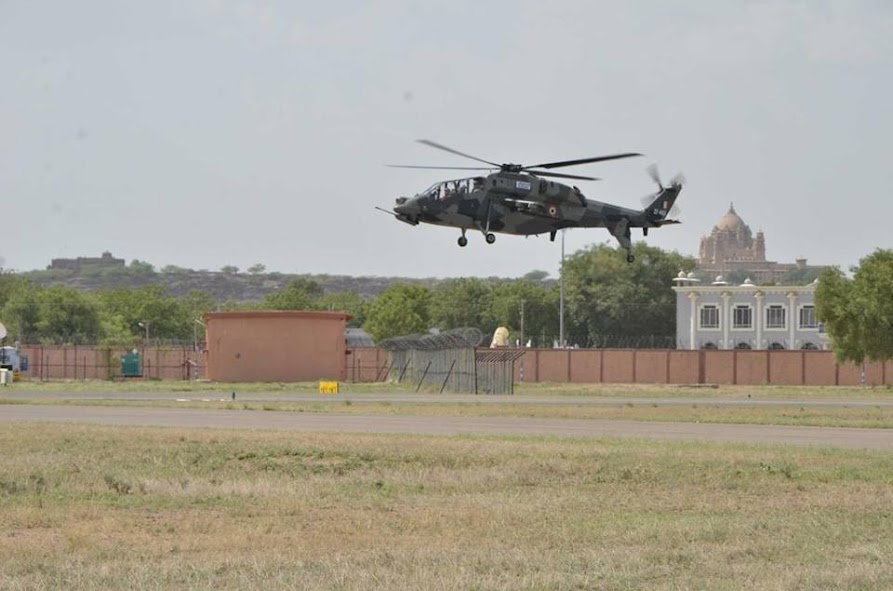
LCH Hot Weather trials at Jodhpur in June 2015

LCH Hot Weather Trials

The LCLH completed week-long hot weather trials in Jodhpur on June 26, 2015.

During the trials, the TD-3 prototype was flown in temperatures ranging from 39-deg to 42-deg C.

The testing involved temperature survey of engine bay and hydraulic system, assessment of performance, handling qualities and loads at different all up weights, low speed handling and height-velocity diagram establishment. [via The Hindu]

In July 2015 the LCH is scheduled to undergo hot and high trials in Ladakh. [via Business Standard]

IDP Sentinel members can read more about the LCH project at the link below:-

Light Combat Helicopter (LCH) - IDP Sentinel

Rustom-1 at Aero India 2015

Rustom-1 Improvements for Operational Role

The IN has shown an interest in procuring DRDO's Rustom-1 drone for surveillance of the Indo-Sri Lanka maritime boundary, the Business Standard reported on June 26, 2015. The Indian Army earlier told DRDO that it would place orders for the Rustom-1 if its take-off and landing could be automated and endurance increased.

Rustom-1 was initially conceived as a technology development and demonstration platform. DRDO is now steadily improving the drone to meet operational requirements.

Flight Operations

Presently, the aircraft needs to be externally piloted during take-off and landing. The Army has asked for autonomous take-off and landing (ATOL) capability, which the ADE is working on.

Rustom-1 takes-off and lands like a conventional aircraft, with the take off and landing being controlled by an external pilot standing close to the runway.

After T/O, the external pilot hands over the control of the UAV to another pilot operating from a ground control station, who pilots the aircraft for the rest of the mission.

A payload operator manages the various payloads from ground control station to capture essential video pictures and data.

Automated T/O and Landings (ATOL)


DRDO is in the process of equipping the drone with sensors required for the ATOL implementation. Extensive real-time simulation have been done on the UAV flight simulator to develop and fine-tune the guidance and control algorithms.

The ALS (Automated Landing System) helps in safe landing of the UAV with minimum Pilot involvement. It performs calculations to keep the UAV on the correct glide slope and aligned to the center-line of the runway. It automates approach and flareout using the UAV's autopilot .

With ATOL capability the UAV would be able to lift a heavier payload since the ground pilot would not be taxed with the longer take-off roll.

The ALS system includes a ground based Laser transmitter and receiver, and a Retro reflector on the UAV. ALS also has a Day TV Camera for streaming video that is monitored by the Internal Pilot (IP). After acquiring a UAV in its vicinity, the ALS continuously transmits Laser pulses and receives reflections from the retro reflectors on the UAV. The system uses the laser reflections to compute the dynamic position of the UAV (ie Distance, Azimuth and Elevation angles) and uplinks the data to the UAV autopilot for a safe landing.

Weight Optimization


DRDO is making the Rustom-1 lighter in order to increase its useful payload.

A DRDO scientist told the Business Standard in June 2015, "We are replacing the existing data link, which weighs about 14-kg with a newer data link that weighs just 4-kg. We are shaving off another 25-kg from the flying package. That will give us the long 'persistence' we need over the mission area."

Multiple GCS Operations


The Rustom-1 datalink has a max range of 200-km. In order to make the drone capable of long range patrols, such as monitoring maritime boundaries, DRDO is modifying the datalink to facilitate mid-flight switching from one GCS to another.

AIS Interrogator


DRDO is working with the Navy to equip Rustom-1 with AIS interrogator to facilitate surveillance of the maritime boundary between India and Sri Lanka. [via Business Standard]

IDP Sentinel members can read more about the Rustom-1 project at the link below:-

Rustom-1 MALE - IDP Sentinel