Showing posts with label Scorpene. Show all posts

Tuesday, July 21, 2015

Indian Navy Sticks with DRDO Developed AIP, for Better or Worse!

Scorpene cutaway scale model with DCNS AIP plug at DefExpo 2014

The Business Standard reported on July 20, 2015 that because of delay in DRDO's Air Independent Propulsion (AIP) project, which is almost 4 yr behind schedule, only the sixth Project-75 Scorpene would be fitted with an AIP plug. It is also possible that all six Scorpenes would be built without AIP.

The Indian Navy had earlier asked Mazagon Docks Limited (MDL) to equip the fifth and sixth boats with AIP by fitting an additional 300-t section on the last two Scorpene submarines built at MDL under Project 75.

MDL and French firm DCNS, which developed the Scorpene, are responsible for fitting the new hull section and safely integrating the DRDO-developed AIP plug to the submarine.

DCNS initially offered its first generation MESMA AIP with the Scorpene, but the Indian Navy opted to go with a second generation DRDO developed 300-t AIP based on fuel cell technology.

DCNS has since developed and demonstrated to Indian journalists a fully tested second generation operational-scale fuel cell AIP that would allow the Scorpene to stay submerged for 3 weeks, but the Indian Navy hasn't been swayed from its decision to go with the DRDO AIP.

(Without AIP, Scorpene can stay submerged for 4 days. With a  MESMA AIP, it would be able to stay submerged for 2 weeks.)

DRDO has demonstrated its AIP technology on a land based prototype. Trials on a land based submarine section were to commence from March 2015 and full scale operations of a AIP System was to be demonstrated within 2015.

One good reason why the Navy has stuck with the  DRDO AIP is because it could later be reconfigured for the submarines to be acquired under Project 75I. Also, the four Scorpenes launched earlier could be retrofitted under an upgrade program.

The Navy's penchant for sourcing its systems from within India is well appreciated in the country, but there can be no denying the risk that the Navy is taking by adding to its fleet, in this day and age, new submarines without AIP! India's adversaries, China and Pakistan, have been operating AIP subs for years now!

The following comparison may help readers assess the risk for themselves. Please feel free to your your views through the comments section.

DCNS and DRDO AIPs Compared


The MESMA AIP from DCNS mimcs nuclear propulsion. It uses heat generated through combustion of ethanol (grain alcohol) and stored oxygen at a pressure of 60 atmospheres to power a conventional steam turbine power plant. It doesn't use fuel cells.

The DRDO AIP uses fuel cell technology. A fuel cell converts chemical energy from a fuel into electricity through a chemical reaction of positively charged hydrogen ions with oxygen or another oxidizing agent.

There are many fuel cell types, but the principal ones include the alkaline fuel cell (AFC), proton exchange membrane (PEM) fuel cell, direct methanol fuel cell (DMFC), molten carbonate fuel cell (MCFC), phosphoric acid fuel cell (PAFC), and solid oxide fuel cell (SOFC).

DRDO's AIP uses PAFC, which has some advantages over other fuel cell types. PAFCs offer a broader choice of fuel being more tolerant of fuel impurities. It can operate using reformed hydrocarbon fuels (Methanol) or biogas.

PAFC operating temperatures (150 to 200 °C) are higher and as a result they generate steam as byproduct, besides electric power for propulsion. The steam can be used to meet other heating requirements, pushing up operating efficiency to as high as 70%.

PAFC fuel cells were one of the earliest to be developed and are commercially available of the shelf (COTS).

The only downside of PAFCs is the use of phosphoric acid as electrolyte. However, use of modern materials makes PAFC safe enough for commercial use at hospitals, schools, office buildings, and grocery stores.

It's likely that the DRDO plug uses commercially available PAFCs.

The second generation fuel-cell AIP developed by DCNS usees hydrogen produced from diesel fuel by hydrocarbon reforming.

One obvious advantage of the DCNS AIP is the easy availability of diesel at any port around the globe. The absence of pure-oxygen in the cells allows longer life cycle. DCNS claims that the life cycle of its new AIP plug roughly matches the life-cycle of the submarine, which isn't the case with other fuel cell types.

There is no doubting the sophistication of the DCNS 2nd generation AIP, which has to be weighed against the higher initial cost, high recurring cost from the need to use AIP is all future conventional subs, and the continued dependence on foreign technology. But then DRDO has a well earned notoriety of delays!

Monday, November 3, 2014

Trials of DRDO Developed AIP Plug for the 4th & 5th Project 75 Scorpenes to Start in Feb 2015


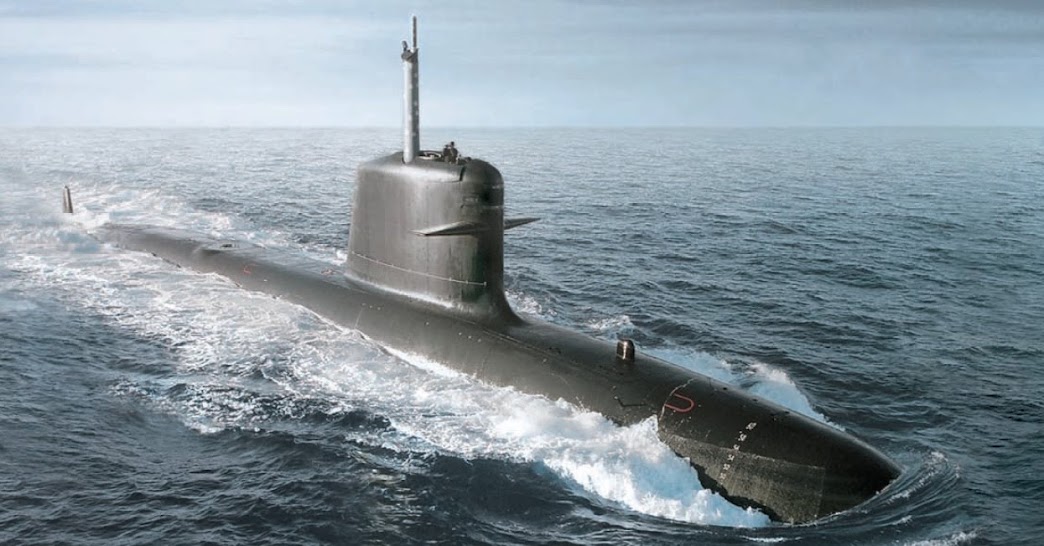
Scorpene Sub

November 3, 2014: The fifth and sixth Project 75 Scorpene submarines to be built at Mazagon docks will feature DRDO developed Air Independent Propulsion (AIP), which will be ready for sea trials by February 2015

Without AIP, a Scorpene sub can stay underwater for a maximum of four days; thereafter it needs to surface and re-charge its batteries using diesel gensets. French firm DCNS, which developed the Scorpene, has its own 300-t, second generation AIP plug that can allow the boat to stay under water for as much as three weeks,  but the Indian Navy has opted to go with a DRDO developed AIP which has been proven on a land-based prototype.

DRDO DG (Naval Systems & Materials), V. Bhujanga Rao told The Hindu that the French MESMA AIP being offered for the Scorpenes is an old system with a steam turbine.

According to Rao, the DRDO AIP could later be reconfigured for the submarines to be acquired under Project 75I .

Earlier, the Indian Navy asked MDL to equip the fifth and sixth boats with Air Independent Propulsion by fitting an additional section.

The four Scorpenes launched earlier could be retrofitted under an upgrade program.

Philippe Berger, former submariner and submarines operational marketing manager of DCNS, told Indian journalists in October 2014 that DRDO will be fully responsible for its AIP plug.

"Our scheme is limited to integrating safely the DRDO-developed AIP plug to the submarine. We are working on designing the hull section in detail for this,” Mr. Berger told Indian journalists at the DCNS facility, which houses the “fully tested operational-scale fuel cell AIP.”

IDP Sentinel members can read more about Indian Navy's Project 75 Scorpene subs at the link below

Project 75 Scorpene Submarines (IDP Sentinel)

Tuesday, September 9, 2014

Scorpene (Project 75) Submarines Being Equipped for Speical Ops & Network Centric Warfare

Scorpene. Photo Courtesy DCNS

The Indian Navy is equipping its six Scorpene (Project 75) subs for special operations and network centric operations. The boats will be networked with the rest of the fleet using Ku and S band SATCOM systems.

The boats will feature a Communication Intelligence System with Direction Finding Capability (COMINT/DF) which will enhance situation awareness by displaying the DOA (Direction of Arrival) of the intercepts and other data on MFCCs of Combat System of submarine.

The COMINT/DF fitted on the Scorpenes would also uplink DOA data using a S-Band Satellite Communication System (SATCOM) to the Indian Navy's Rukmini GSAT, so as to provide other fleet ships real-time data on communication intercepts.

COMINT/DF systems typically feature High Sensitivity and High Probability of Interception (HPOI); the system searches, intercepts, measures, classifies, analyzes, locates and monitors ground, airborne and naval communication transmissions. Such transmissions are characterized by high mobility, short duration, complex signals and frequent changes in signal parameter in the most dense electromagnetic environments.

The Scorpene COMINT/DF would provide capability to DF, monitor, intercept, record and analyse communication signals in V/UHF frequency range used for air-to-air and surface-to-air communication.

The S-Band SATCOM system typically provide low data rate communication. As reported earlier, Scorpenes would also be equipped with Ku-band SATCOM high data rate communication.

The Combat System from Project-75 subs is being supplied by M/s DCNS, France.

IDP Sentinel members can read more about the Indian Navy's Project-75 subs at the link below.

Project 75 Scorpene Submarines - IDP Sentinel

Monday, September 1, 2014

Indian Navy Scorpene (Project 75) Submarines to be Equipped with Ku-Band SATCOM

Scorpene Submarine

MoD has initiated procurement of six Ku-Band Satellite Communication Systems (SATCOM) for its Project -75 Scorpene submarines.

The Ku-Band SATCOM system is required to be compatible with Indian Navy SATCOM network operating in Ku-Band using ISRO developed Rukmini Geostationary Communication Satellite (GSAT) dedicated for use by the Indian Navy. The Navy wants the SATCOM terminal to be capable of voice and high speed data at a minimum speed of 256 kbps.

The Ku band SATCOM should also be capable of interfacing with the Combat System supplied by M/s DCNS, France installed onboard Project 75 submarines.

IDP Sentinel members can browse through other recent Navy RFIs at the link below.