Showing posts with label Arihant. Show all posts

Thursday, December 25, 2025

With K-4 SLBM, India’s Nuclear Triad Finally Becomes Credible


Image by @Grok


Multiple reliable sources, including the ToI, report that the Indian Strategic Command test-launched a K-4 SLBM (Sea-Launched Ballistic Missile) from its SSBN INS Arighat on December 23, 2025.


There was no official word from the Indian Ministry of Defence (MoD) on the missile test reportedly conducted off the coast of Visakhapatnam from the 6,000-tonne INS Arighat, which is operated by the tri-service Strategic Forces Command.


Notably, in the past as well, there has been no official confirmation of SLBM tests by the MoD.


The ToI quotes a source as saying, “A comprehensive analysis will determine whether Tuesday’s test actually met all laid-down technical parameters and mission objectives or revealed some shortcomings. It usually takes several tests for ballistic missiles, especially those launched from submarines, to achieve full operational status.”


Earlier Test


Earlier, in November 2024, the Strategic Command had carried out a test launch of the 3,500-km-range missile from the then newly inducted nuclear submarine INS Arighat.


The missile was launched almost to its full range, marking the first K-4 launch from an operational submarine (previous tests used submersible platforms).


INS Arighat, the Strategic Command’s second SSBN, was commissioned in August 2024.


How SLBMs Differ from Land-Based Strategic Missiles


SLBMs differ from land-based strategic ballistic missiles in their configuration and construction. An underwater-launched missile has to deal with the pressure of a 10-m column of water above it. SLBMs are sturdier in build and consequently heavier. Compared to land-based strategic missiles of the Agni series, SLBMs carry a lot of dead weight.


The K-4 is the second operational SLBM deployed by the Strategic Forces. The first operational SLBM was the 750-km-range K-15 (aka BO-5).


K-4 Development


Some of the key components of the K-4 were designed and developed at the three facilities of the Pune-headquartered Armament and Combat Engineering (ACE) cluster of the DRDO.


The facilities are:


High Energy Material Research Laboratory (HEMRL), Pune


Research and Development Establishment (Engineers), aka R&DE (Engrs), Pune


Advanced Centre for Energetic Materials (ACEM), Nashik


The rocket motor systems of the missile have been designed, developed, and manufactured by HEMRL and ACEM. The launch system of the missile has been developed by R&DE (Engrs).


HEMRL has additionally developed propellants and motor systems for almost all DRDO missiles, including Prithvi, various versions of Agni, Akash, and Nag.


Some of these systems have been produced by ACEM, which is a facility that processes composite propellants for various DRDO programmes.


The Naval Systems Group of the DRDO has developed the launch system of the K-4 missile.


Specifications


The solid-fuelled K-4 is 10 to 12 m long and 1.3 m in diameter. It weighs between 17 and 20 tonnes and is capable of carrying a 2-tonne warhead.


The missile warhead is capable of manoeuvring to avoid adversary missile defences and yet strike with a 100-m CEP (Circular Error Probability).


Follow-up SLBMs


India’s first two SSBNs, INS Arihant and INS Arighat, carry either four 3,500-km-range K-4 missiles or twelve 750-km-range K-15 (aka BO-5) missiles.


A longer, 5,000-km-range, 12-m-long SLBM known as K-5 is under development for future use.


K-6 SLBM


DRDO is also reported to be developing a 6,000-km-range missile named K-6.


This three-stage solid-fuel K-6 is reportedly completely different from the K-4 and K-5.


Over 12 metres tall and over 2 metres in diameter, it will carry a three-tonne warhead. The 6,000-km range of the missile will allow its carrier SSBN to remain on deterrence patrol, operating from secured zones near the Indian coast.


A former head of India’s Strategic Forces Command alluded during an event in Washington that India’s sea-based deterrent would eventually “be secured in havens, waters we are pretty sure of, by virtue of the range of the missiles. We will be operating in a pool in our own maritime backyard.”


Recent reports claim that the missile is a hypersonic weapon with a multiple independently targeted re-entry vehicle (MIRV) warhead. Capable of a top speed of Mach 7.5, it can carry two to three nuclear or conventional warheads, allowing it to evade terminal missile defences.


The missile is 12 metres long, has a 2-metre diameter, and weighs around 20 tonnes. It is being claimed that initial tests of the missile from submerged pontoons are likely in the near future.


Follow-up SSBNs


India’s two operational SSBNs, INS Arihant and INS Arighat, will be followed by two Arihant-class Stretch submarines with 7,000-tonne displacement and 125-metre length. They are fitted with a 10-m-long, 1,000-tonne plug with room for an additional four missile tubes.


Whereas Arihant-class SSBNs carry four K-4 missiles or twelve K-15 missiles, or a mix of the two, Arihant-class Stretch SSBNs carry eight K-4 missiles or twenty-four K-15 missiles, or a mix of the two.


During the Navy Day press conference in Delhi on December 2, 2025, Indian Navy Chief Admiral Dinesh K. Tripathi reportedly said that INS Aridhaman, the third indigenous nuclear-powered ballistic missile submarine (SSBN), would be commissioned very soon.


The Arihant-class Stretch will be followed by a clean-sheet new-design SSBN with 13,300-tonne displacement, carrying twelve K-6 6,000-km-range ballistic missiles. The new design, referred to as the S-5-class submarine, will be powered by a 190-MW reactor designed by the Bhabha Atomic Research Centre.


Conclusion


Successful completion of user trials of the K-4 SLBM would be a landmark event. For the first time, it would make the undersea leg of India’s deterrence triad credible. The limited 750-km range of the K-15 missile, currently operational on INS Arihant and INS Arighat, lends little credence to India’s undersea-based deterrence capability.


Reports that India is on the verge of testing the K-6 SLBM with ICBM capability must be taken with the proverbial pinch of salt, considering that the DRDO has yet to conduct a full flight test of the K-5 SLBM.


Copyright © Vijainder K Thakur. First published on Thumkar.


Sunday, July 12, 2015

News Roundup: MoD Shortlists 5 Shipyards for Project 75I, Two Additional Arihant Class SSBNs Under Construction

INS Arihant. Photo Courtesy NDTV

India to Build 2 Additional Arihant Class SSBNs, Demo Arihant B-05 Launch During 2016 Fleet Review


In an interview to NDTV, Director General of Defense Research & Development Organisation (DRDO,) Dr S Christopher said that India is in the process of building two more Arihant-class-submarines.

Christopher reiterated his earlier statement to the press that INS Arihant would soon start deep diving trials, and as part of its weapon's trials towards the end of the year, launch a B-05 SLBM.

B-05 is a two stage, solid fueled weapon with characteristics of both ballistic and cruise missiles. Unlike conventional cruise missile, which cruise at extremely low altitudes and subsonic speeds using turbo fan engines, B-05 cruises at extremely high altitudes at hypersonic speeds using rocket power.

"If all goes well we will show case this capability in the International Fleet Review (IFR) next January. DRDO is working on the next SLBM code named "K-4" which will have a much longer range," Dr Christopher said.

IDP Sentinel members can read additional details at INS Arihant SSBN (IDP Sentinel)

MoD Shortlists 5 Shipyards for Project 75I Submarine Construction


The MoD has shortlisted 5 shipyards out of the 7 that it evaluated for infrastructure and technical competence to construct Project 75I submarines.

MoD had setup a high-level committee headed by Vice-Admiral Subhedar, Controller of Warship Production & Acquisition at Integrated Headquarters, to inspect 7 shipyards in order to assess their ability to construct Project-75I submarines. Five shipyards are in the public sector - Mazagon Dock (Mumbai), Cochin Shipyard, Garden Reach Shipbuilders and Engineers (Calcutta), Hindustan Shipyard (Visakhapatnam) and Goa Shipyard - and two in the private sector - Larsen and Toubro (yard in Tamil Nadu) and Pipavav (Gujarat). Larsen and Toubro is already involved in India’s Arihant-class nuclear submarine project.

The two shipyards eliminated through the shortlisting are Garden Reach Shipbuilders and Engineers (Calcutta) and Goa Shipyard.

The OEM - submarines combinations in contention are

  1. DCNS Scorpene
  2. Thyssenkrupp Marine Systems HDW Type 214 (Germany)
  3. Rubin Design Bureau Amur 1650 (Russia)
  4. Navantia S-80
  5. Saab Kockum A-26
IDP Sentinel members can read additional details at Project 75I Submarines - IDP Sentinel

Friday, June 20, 2014

INS Arihant Sea Trials: Kabhi Khushi, Kabhi Gum!

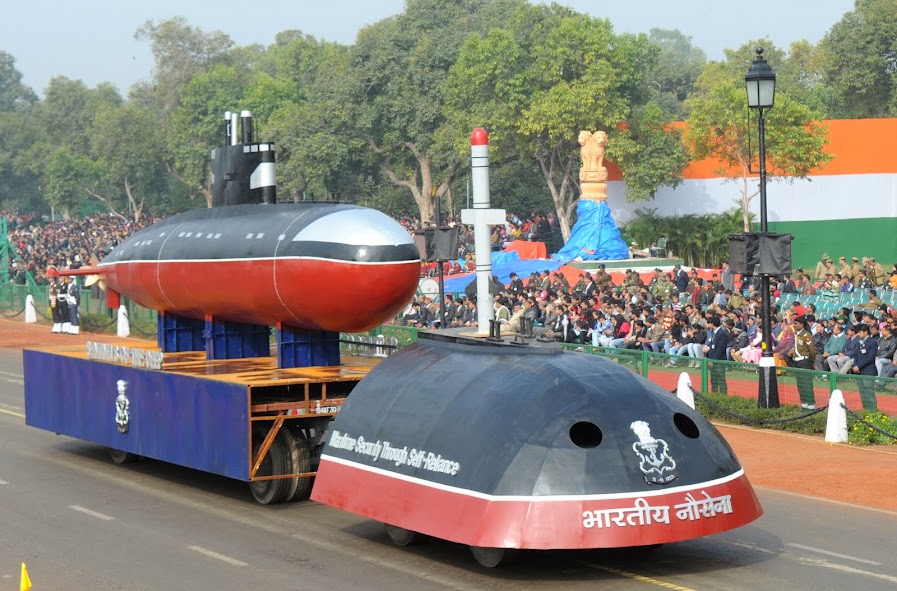
INS Arihant mock-up at the Republic Day parade 2014

INS Arihant may or may not be undergoing sea trials.

DRDO Chief Avinash Chander told The Tribune on May 15, 2014 that sea trials of INS Arihant are already underway. :-)

He told PTI yesterday that Sea Trials would start in a month or two! :-(

INS Arihant may or may not be facing serious technical issues with its nuclear reactor.

DRDO Chief Avinash Chander told India Today during DefExpo, "What is going on right now is the power up phase, where the boat is building up her power, a progressive exercise which is being monitored." He added, "It is for the first time that we are going through a nuclear power up exercise in a submarine. It has to go through various levels of checks for safety and security reasons. But we are confident of completing it and going through, shortly."

Chander recently told PTI, "Arihant is going through the power-up cycle (in its nuclear reactor). It is the first time that we are doing the power-up cycle on a nuclear submarine. So, we are very cautious and going step by step."

The DRDO chief's statements may make you wonder whether time has stopped, or indeed reversed?

Look at it this way. If the DRDO and the Indian Navy announced that Arihant Sea Trials are about to commence, or are underway, there would be a lot of Chinese, Burmese (Chinese again, of course!) , Sri Lnakan (Yes, Chinese again) fishing trawlers off the Vizag coast and they won't be fishing fish! Many Panama registered merchant vessels with snooping equipment and US, British and Australian intelligence agents on board losing their way in the Bay of Bengal and ending up near Vizag! (The Russians would, of course, be sitting inside the sub!)

So what happens if the DRDO Chief inadvertently releases information about the Sea Trials to a Chandigarh based newspaper. And The Hindu does a follow-up and confirms the sea trials? Well...let me think...Yes! the DRDO Chief could make a contradictory statement to a government news agency (like the PTI?) to discredit the earlier reports.

I am not suggesting that is what happened.

It's up to each of us to decide what is happening with INS Arihant, nearly five years after its launch and nearly a year after its reactor went critical.

IDP Sentinel members can access all statements made by DRDO and Navy Officials on the status of the submarine since its launch at the link below to help them make a more informed guess.

INS Arihant SSBN (IDP Sentinel)

Monday, December 2, 2013

Arihant SSBN Reload Nuclear Core Goes Critical

Arihant SSBN at the time of its launch in 2009

On December 2, 2013, Deccan Herald reported that the replacement core of Arihant’s nuclear reactor had attained criticality on October 11, 2013 at the secretive P4 facility  inside the Bhabha Atomic Research Center in Mumbai.

“The reload core would be fitted into the Arihant at the time of refueling, which may come after 7-8 years depending on the journey the submarine undertook. At the time of refueling, the entire core will be changed,” a nuclear scientist told Deccan Herald.

The core of a nuclear reactor is the component where controlled nuclear fission takes place producing heat, which is used to generate steam and, in turn, drive generators to produce electrical power to propel the submarine and meet its other energy requirements.

In November 2013, CNS DK Joshi told NDTV that INS Arihant would soon set sail for her sea trials and would be commissioned by end 2014.

In September 2013 Frontier India reported that diving trials of the sub have been deferred awaiting the arrival of a Bester-1 Deep Submergence Rescue vehicle (DSRV) ordered from Russia's Admiralty Shipyard.

Earlier in December 2010, the Indian Navy had initiated procurement of 2 free Swimming DSRVs by floating request for information. Russia's Admiralty Shipyards (Bester-1 rescue submersible) and Britain's James Fisher and Sons PLC are in contention for the contract.

The reactor of the submarine went critical on Friday, August 9, 2013. ( PTI )

For additional details on the Arihant please visit the link

INS Arihant SSBN (IDP Sentinel)