Friday, March 20, 2015

Reduced IAF Squadron Strength Doesn't Mean Reduced IAF Capability!

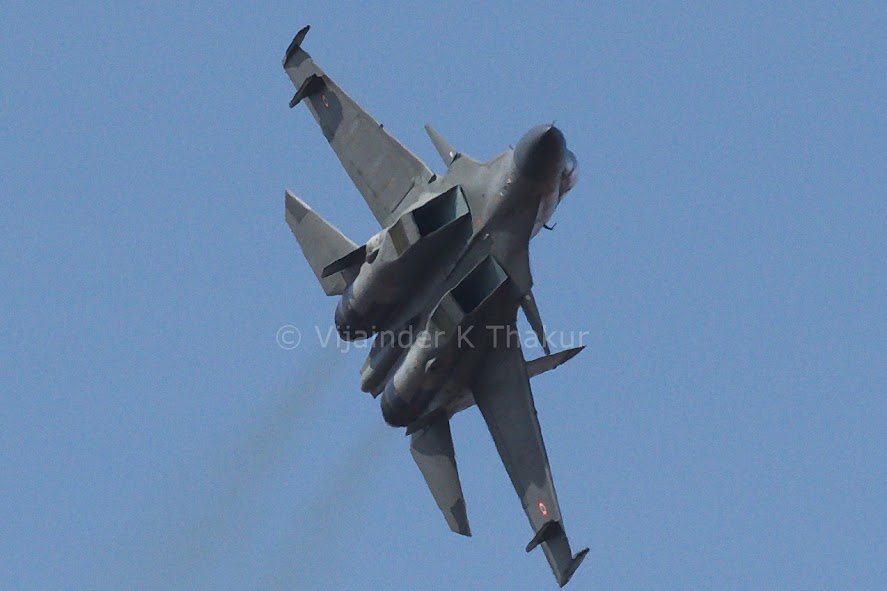
IAF Su-30MKI at Aero India 2015


Indian media and analysts, even senior IAF leadership, keep alluding to the IAF's reducing fighter squadron strength, most often to highlight the the need for acquiring the Rafale MMRCA!

 The stress on decreasing squadron strength creates the impression that the IAF is getting enfeebled. That, however, is not really the case.

The number of IAF fighter squadrons may have dropped, but one can claim that IAF capability has diminished. Indeed it has steadily increased. Each Su-30MKI packages air defense and attack capability equivalent to 3-4 MiG-21 Bison. You can argue about the exact equivalence, but cannot credibly claim it be unitary.

If fighter aircraft numbers were the only criterion, then here is a statistic that should gladden our hearts and shed our fear of China - PLAAF fighter strength has halved in the past 15 years! From nearly 4000 to around 1900.

Monday, March 16, 2015

Maitri SR-SAM as Akash Mk-2?

Proposed DRDO-MBDA SR-SAM at Aero India 2015. Call it Maitri, or call it Akash Mk-2!
DRDO, following its tortured success with the Akash missile, a 1970s vintage SA-6 analog with modern day guidance and electronics, is now looking into a longer range (60-km) missile with active seeker, vertical launch and anti-ship missile capability.

It all started when the 2010 year end GOI press release referred to a Mark-2 version of the Akash.

In an interview in August 2014, former DRDO Chief Avinash Chander said, "We are examining various options for Akash Mk-2 so that it can operate over a larger profile. One of the options is putting a seeker on board. Of course its not simply a matter of adding a seeker since it changes the entire dynamics of the missile. Nevertheless we are looking at multiple options and are certainly working on a Mark 2 version of the Akash."

Defenseworld.net in a report on January 22, 2015 quoted a source as saying that the DRDO has decided to increase the range of the Aakash surface to air missile (SAM) and provide it with a ‘seeker’ in its warhead to achieve better targeting efficiency.

Most anti-ship missiles use active radar homing for terminal guidance so the use of an active seeker on Akash Mk-2 is logical.

Let us get some things clear, before moving forward. Its name notwithstanding, Akash Mk-2 will not be derivative of the Akash missile; it will be a new missile built from scratch using substantially different technologies.

A missile with an active seeker uses command guidance for the initial phase of interception and then switches to a miniaturized radar fitted in its nose cone for terminal phase (end game) interception. (The current Akash missile uses command guidance for the entire interception phase which limits its effective range.)

An active seeker makes a missile more accurate and less susceptible to countermeasures. It also gives the missile system some fire and forget capability, freeing it to engage other threats following terminal lock-on by the last launched missile.

The challenge in developing an active seeker is to minimize its size and weight while maximizing tracking range. India doesn't have a Akash Mk-2 worthy active seeker yet.

DRDO's Research Center Imarat (RCI) is known to be working on a X-band active seeker capable of engaging sea skimming anti-ship missile. (Sea skimming anti-shipping missiles are difficult to intercept because missile seekers find it hard to discriminate sea skimmers from the clutter generated by reflections from sea waves.)

DRDO is still struggling to replicate the Russian active seeker fitted on its Astra air-to-air missile under a partial TOT arrangement.

Private sector company Alpha Technology show cased an RF seeker that it has developed for Brahmos at Aero India 2015. However, the seeker is yet to be accepted as a substitute for the Russian developed Brahmos seeker.

We are trying hard, but the truth is we are not there yet, and active seeker development poses risks for the Akash Mk-2 project.

Vertical launch of surface-to-air missiles is also a new area for DRDO which has earlier demonstrated vertical launch with the Brahmos and some of its strategic missile. A vertically launched surface-to-air missile must quickly flip over in the direction of the threat and then be command guided towards the target over a data link.

Another big difference between Akash and Akash Mk-2 would be the dropping of Akash-1's ramjet sustainer in favor of pulsed rocket motor. A pulsed rocket motor has multiple propellant segments, with a barrier that stops ignition separating any two segments. When one segment burns out the missile coasts till  another segment is ignited. During end game, a freshly ignited rocket motor segment would make Akash Mk-2 much more lethal than the ramjet of Akash.

Pulsed rocket motor technology is something that the DRDO has imbibed working with Israel's IAI in the LR-SAM/MR-SAM project. So no problems there.

MBDA's Co-Development Offer


Faced with cancellation of the Maitri SR-SAM joint project, after an underfunded IAF decided to make do with the Akash missiles, France's MBDA is plugging the Maitri joint collaboration as the Akash-2 project!

The MBDA pitch might look opportunistic and self-serving at the outset, but if you listen to what MBDA officials have to say, you could well change your mind.

MBDA officials categorically confirmed to IDP Sentinel during Aero India 2015 that they will transfer complete seeker technology to DRDO. There was no question of a partial TOT as was the case with Russia and the Astra missile.

MBDA believes that the risks involved in a project to develop a missile from scratch, as DRDO intends to do with Akash 2, are substantial with long and uncertain development time. Seeker and Vertical Launch are risk areas. India would be much better off getting the technology from MBDA so that timelines are not stretched to an extent where the usefulness of the product comes under a cloud.

MBDA says it will not only help India develop the missile, it will help set up production facilities in India and support India's export efforts. Make in India, Export from India (I made that slogan, not the MBDA!)

I am sure there are other facets of the Akash Mk-2 project that I am not aware of, but going exclusively by the information available in public domain, it's hard to understand why DRDO must take risks when it doesn't have to.
Thursday, March 12, 2015

AMCA Stealth Fighter Update from Aero India 2015

AMCA Scale Model at Aero India 2015
The design of the AMCA scale model displayed at Aero India 2015 was identical to the design of the AMCA scale model displayed at Aero India 2013. This wasn't the case during earlier shows - Aero India 2011 AMCA design differed from the 2009 design, and the 2013 design differed from the 2011 design.

As far as the ADA is concerned, the current AMCA design is final, having been tested to full satisfaction in a supersonic wind tunnel in the US. (At the time of Aero India 2013, the design had only been tested in a subsonic wind tunnel in India.)

Going by the displayed design, AMCA will


  1. Feature two engines without thrust vectoring, relying exclusively on high power to weight ratio for super-maneuverability.
  2. Not have all aspect stealth - engine nozzles are not shaped, though ADA intends to minimize IR signature of the engine exhaust.
  3. Be a single seat fighter.


ADA is all set to roll with the AMCA project, but the IAF isn't impressed with the aircraft's current feature set. The service has drawn up very detailed and ambitious PQSR which includes all aspect stealth, super-maneuverability through thrust vectoring and twin seats.

ADA is confident that it can redesign the AMCA for all aspect stealth, twin-seats and thrust vectoring, but points out that these capabilities would push up costs and stretch timelines. ADA is in the process of responding to the IAF PSQRs with feature wise cost and time frame implications.

(No twin seat stealth fighter has been developed so far because adding a second seat reduces stealth.)

Thrust vectoring is likely to be conditional on Russian willingness to transfer technology.

In view of the differences between ADA and the IAF, it maybe a while before AMCA staff requirements are finalized. Hopefully, the IAF will challenge ADA with realistic performance and timeline requirements, not doom the project by asking for the moon as it sometimes tends to do.

Meanwhile, IDP sentinel has learn't that LRDE has been tasked with developing a conformal X-band AESA for the AMCA, which means that the pilot will be able to track and engage threats not just in the front quarter, but also on either side.

Clearly, it's not just the IAF that needs a reality check.

ADA Details Stealth AMCA Engine Plans

IDP Sentinel members can read more about the AMCA project at the link below.

Advanced Medium Combat Aircraft (AMCA) - IDP Sentinel


Thursday, March 5, 2015

LCA Navy - Nothing Succeeds Like Failure Redefined as Success!

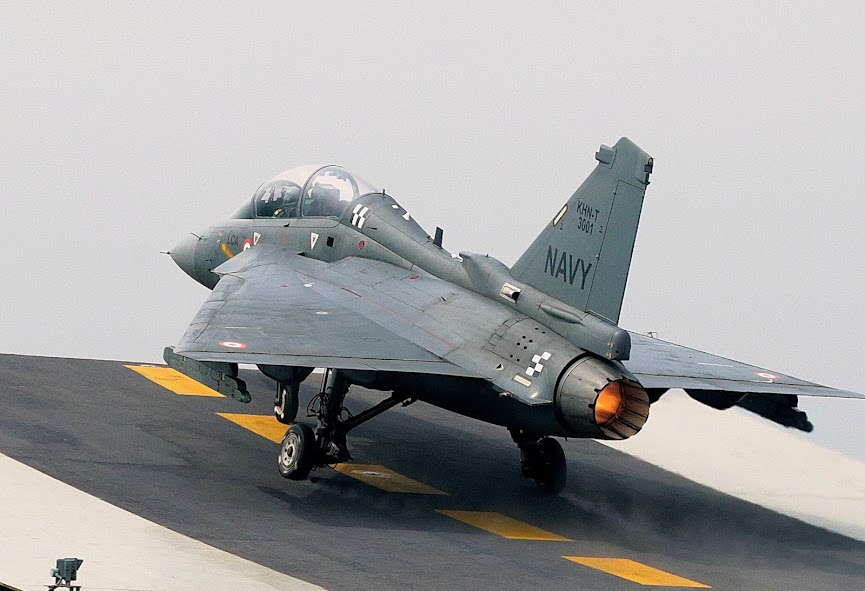
LCA Navy NP2 fighter at Aero India 2015

The LCA Navy was an ill-conceived project that should have failed, and it did!

A naval fighter has to be designed and built for carrier operation from the ground up, not as an afterthought, as was the case with LCA Navy.

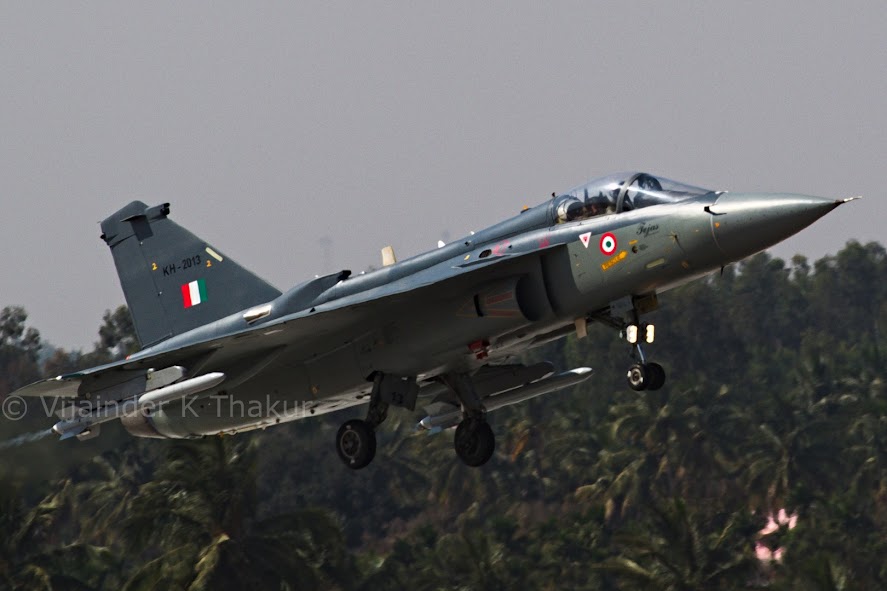
Strengthening the LCA for carrier operations proved to be a nightmare for ADA. The aircraft's undercarriage (u/c) - required to perform flareless landings with a high sink rate of 7.1 rn/sec, - became grotesquely over-sized because of its positioning in the fuselage. (Compare the u/c of LCA Navy Mk-1 above with that of the Tejas LCA below. The former looks oversized, the latter, elegant.)

Tejas LCA on short finals at Aero India 2015


The strengthened u/c added weight and lowered the aircraft's performance. As a result, LCA Navy is never going to be operationally deployed on an aircraft carrier - it's very limited weapon load, range and performance wouldn't justify such deployment.

Close up of LCA Navy NP2 undercarriage at Aero India 2015

Success from Failure


Failure of an endeavor is often just a turning point on the road to success. Failure is never absolute; it can at best be defined as lack of success. Sometimes, failure can even be redefined as success.

The Indian Government sanctioned Full Scale Engineering Development (FSED) of Naval Light Combat Aircraft (LCA-Navy), capable of operating from an aircraft carrier, on March 28, 2003 with a PDC of March 27, 2010. Had the Indian Government defined LCA Navy as a technology demonstrator project, which is what it has ended up becoming, there would have been no doubt about the resounding success of the project!

As a technology demonstrator project, the LCA leaped out of doldrums when Navy Prototype 1 (NP-1) successfully executed its first ski-jump take-off at the SBTF in Goa on December 20, 2014.

NP-1 attempted the ski-jump after a 300-m roll in clean configuration presumably with full internal fuel. The safe take-off required 150 knot at a climb rate of 6.4 degrees. But, the aircraft bested the benchmark with a climb rate of around 11 degrees.

The flight also validated the hands-off take-off algorithm of LCA Navy's Flight Control Software (FCS).

LCA Navy NP1 trainer performs maiden ski jump at SBTF in Goa. Photo Credit: DRDO


Reason for Better than Expected Performance

Press reports on the better than expected climb performance of NP1 have been confusing. Here is simple and precise explanation.

The LCA's GE-F-404-IN20 engine needs be at 80% RPM for around 5-min for it to give assured peak thrust at full throttle. Since it's not practical for an operational aircraft to wait for 5 mins before take-off, ADA had factored in the lower than max thrust when calculating expected rate and angle of climb on leaving the ramp. The aircraft designers were pleasantly surprised when due to higher than expected thrust NP1 outperformed the conservative calculations.

It's now clear that LCA Navy Mk-1 could carry more weapons and fuel than initially thought.

At Aero India 2015, IDP Sentinel asked LCA Navy Project Director Commodore CD Balaji if the better than expected performance could result in the aircraft being operationally deployed on a carrier, were the LCA Navy Mk-2 project to be delayed.

"LCA Navy Mk-2 will not be delayed," said Balaji with a lot of confidence. "We are close to freezing its design, which has been simplified. The new design would be easy to implement."


LCA Navy Mk-2


Commodore Balaji's confidence was eye-opening - The biggest pay-off from the LCA Navy project may well be ADA's increasing confidence in its ability to tweak fighter aircraft design to squeeze out better performance. This is evident from the following

LCA Navy Mk-2 has been designed from the ground up as a Navy fighter, independently of Tejas LCA Mk-2.

The fuselage of the aircraft has been broadened and the wing roots moved outwards. As a result, aircraft design has been optimized for supersonic flight with perfect conformance to area rule. (Tejas LCA and LCA Navy Mk-1 do not conform perfectly to area ruling resulting in high supersonic drag.)

LCA Navy Mk-2 scale model at Aero India 2015. 

Mid section fuselage broadening allows undercarriage bays to be shifted outwards, allowing a simpler, straight and light undercarriage as in the Rafale.

Mid section fuselage broadening also increases fuel capacity.

That is three birds with one stone!

Look closely at the photo of LCA Navy Mk-2 scale model at Aero India 2015, and compare it with the similar view of the LCA Navy Mk-1 on static display at Aero India 2015. Notice how the air intakes in the Mk-2 model bulge out to align with the broadened fuselage.

LCA Navy NP2 at Aero India 2015

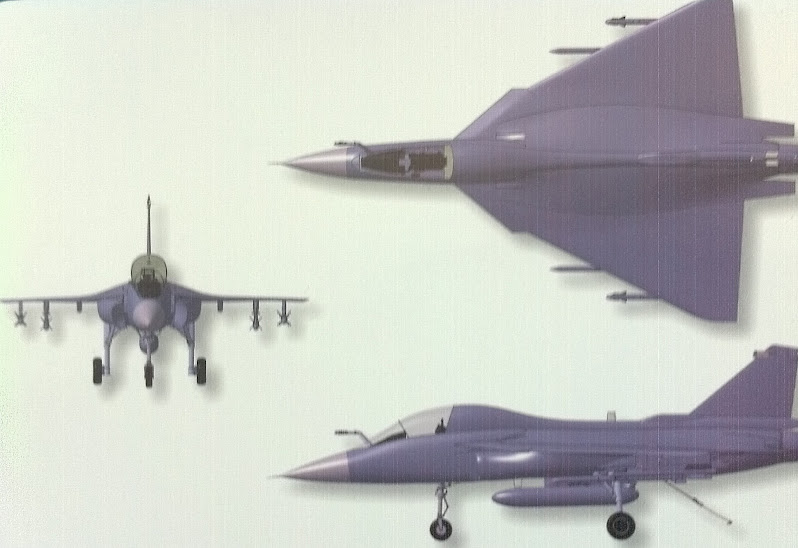
Finally, the following design layout of LCA Mk-2 from a brochure distributed during Aero India 2015 clarifies what I have stated above about the design tweaks.

LCA Navy M-2


IDP Sentinel members can read more about LCA Navy at the link below.

Thursday, February 12, 2015

ADA Details Stealth AMCA Engine Plans

AMCA model at Aero India 2013

ADA seems to have refined and narrowed its AMCA powerplant options. The 25-tonne class AMCA is to be fitted with a 110-kN engine. However, currently no 110-kN class engine is available in the world market.  

So ADA will design the fighter around a 110-kN engine, but use a 90-kN off-the-shelf engine to power prototypes of the aircraft, giving itself time to develop a 110-kN engine.

ADA Director PS Subramanyam told The Hindu that it would be prudent to procure and integrate an available 90-kN engine into the aircraft so to ensure that the project was not held up. 

“Since the fighter has been designed to take on an engine with a higher thrust, we can integrate it as and when such an engine is available. This is what has been done by Dassault in the Rafael development program,” he says.

Elaborating on AMCA powerplant options, K. Tamilmani, Director-General (Aero R&D) told the press that since no 110-kN engine is available off the shelf, GTRE will partner with a US or Russian engine manufacturer to develop such an engine - mostly within India - to power AMCA production variants.

“We have asked for their proposals [and will go ahead with] whoever has a better offer, time frame and cost," he said. The goal is to integrate the new engine into the aircraft by 2020-21.

DRDO and IAF officials will hold talks with two manufacturers during Aero India 2015 - General Electric of US and Klimo of Russia. 

Interestingly, Tamilmani didn't mention French Snecma and early front runner for co-producing an AMCA engine with GTRE.

It may be noted that the joint statement released during US President Barack Obama's visit to India from January 25 to 27, 2015 referred to US - Indian collaboration in developing a hot engine (A reference to a jet engine with high turbine temperatures and greater thrust.)

It was earlier reported that the AMCA will be powered by a new engine that GTRE plans to develop with the help of one or more foreign consultants, Snecma being one of them.

On January 8, 2015 the TOI reported that five to six global aero-engine manufacturers have made presentation to ADA for the AMCA engine. It is likely that ADA has now narrowed down its options based on the presentations.

IDP Sentinel members can read more about the AMCA project at the link below.

Thursday, February 5, 2015

New Missile Test Ranges, Ships for Phase 2 BMD System

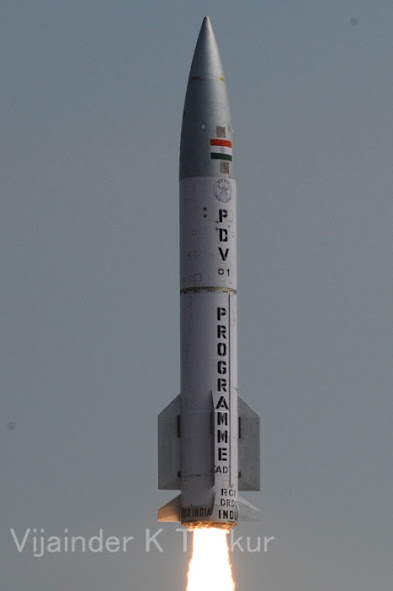
Maiden test on April 27, 2015 of the  PDV exo-atmospheric interceptor of DRDO's Phase 1 Ballistic Missile Defense (BMD) system.
DRDO is developing two new missile test ranges, constructing surveillance ships and sea based missile launch platforms for testing its BMD Phase-2 system for intercepting missiles with ranges greater than 2,000 km that can additionally deploy decoys or maneuver.

India currently has two missile test ranges at Chandipur and Wheeler Island.

Phase 2 testing of the BMD system requires two ranges placed well apart along the missile trajectory. DRDO is developing these ranges at Machilipatnam in Seema andhra and Rutland Island in the Andamans.

Target missiles would be launched from specially constructed ships.

Scientists are designing and developing the ships and associated systems such as radar, mission control center, launch control center, communication network and many other equipment needed for phase-II trials, Sarsawat told the press.

On February 3, 2015 Jane's reported that DRDO has received approval from GoI to convert 155 hectares of mangrove forest in Machilipatnam, Andhra Pradesh, into a missile launch testing facility.

The proposed site is within a wildlife sanctuary and a case against the project is pending in the Supreme Court. Range development work can only start after a court ruling.

The project was cleared by the petroleum 2012, following DRDO assurances that the test range would not impact plans to prospect for oil and gas in the Krishna river delta.

DRDO had planned to start construction of the test range in 2013

Ocean Surveillance Ship


The Deccan Herald reported on December 23, 2014 that MoD has sanctioned Rs 725 crore for the construction of Ocean Surveillance Ship (OSS) at Hindustan Shipyard Ltd (HSL), Visakhapatnam as part of DRDO's BMD program

The ship, P-11184, will feature a helicopter deck and hangar, a long open deck with space for several tracking antennae located at the aft of the forward superstructure.

Dedicated to DRDO's BMD program, the ship will be operated by the Indian Navy.

Designed by Vik Sandvik Design India, the ship has a length of 175 mt, a beam of 22 mt, a depth of 6 mt and and a displacement of over 10,000 tons. It will be powered by 2 x 9,000 kw engines, giving it a maximum speed of 21 knots.

The OSS project is classified and monitored directly by the Prime Minister’s Office. The ship’s keel was laid on June 30, 2014 and the shipyard has been given a timeline of December, 2015 to finish the project.

The Navy, HSL and DRDO reviewed the progress made in the project in during mid December 2014.

HSL received the first financial instalment in February 2013 and one more round is expected as the OSS’s total cost is reportedly about Rs 1,500 crore..

IDP Sentinel members can read a lot more on DRDO's BMD project at the link below.

Ballistic Missile Defense (BMD) System (IDP Sentinel)

Monday, February 2, 2015

Do Indian Plans to Counter Chinese Threat Help China Tighten the Noose?

New Chinese Light Tank on the Tibetan plateau. Photo via China Defense Blog

In the Sino-Indian stand-off along the LAC, India seems to be doing the talking, and China the walking.

Bureaucratic tardiness in defense procurement and a loud mouthed press seem to be giving China both clues and time to make sure India remains hopelessly on its back foot.

Invariably, the PLA is already doing what the Indian Army plans to do! Look at these examples.

High Altitude Helicopters to Transport Guns

India invited bids for 15 heavy-lift helicopters in May 2009 to ferry the BAe Land Systems M777 ultra-light howitzers that the Indian Army intended to procure for its new raising - the XVII Mountain Strike Corps.

Boeing (CH-47F Chinook) and Mil (Mi-26 T2) submitted competing bids. In 2012, following extensive technical and commercial evaluation, Boeing's bid was assessed as being more competitively priced and the government decided to procure the helicopters from the US under FMS. In parallel, a decision was also taken to procure the M77 gun from the US under FMS.

Both projects have made no headway so far!

Meanwhile, China recently tested a Z-18A helicopter on the Tibetan plateau at an altitude of 8000-m. The helicopter is reportedly meant to transport AH-4 155 mm light artillery system developed by the China North Industries Corporation which weighs around 4 tons!

Do you get the point?

The Z-18A can also be used for anti submarine warfare and as a troop and VIP carrier. Our press has talked ad nauseam about the M777/Chinook projects but there has been hardly a mention of the Z-18A and AH-4 155-mm gun.

Incidentally, China also has 18 "Black Hawk" attack helicopters manufactured by Sikorsky that can operate on the Tibetan plateau, just in case you were thinking about the 22 Apaches to be procured along with the Chinooks under FMS.

The Chinese are not just a few steps ahead in the game. They are far ahead!

High Altitude Variant of Mi-26T

It was recently reported that Russia and China will co-develop a high altitude version of M-26T helicopter with a take-off weight of 38 tons for use on the Tibetan plateau.

The new helicopter will be smaller and lighter than the Mi-26T, but feature the same engines giving it the reserve of power to lift heavy stuff even at 8000-m

Tanks for the Tibetan Plateau

The Indian Army biggest fear along the LAC is that China might use its superior infrastructure to rapidly mobilize PLA formations and launch a determined push into Arunachal Pradesh, overwhelming Indian forces which would still be in an early stage of mobilization.

Faced with such an eventuality, the Indian Army's only counter would be to open another front, break through Chinese defenses and use armor to strike deep into Tibet.

The problem with the strategy is that it requires light tanks that can be easily transported to the LAC.  India doesn't have light tanks and is relying on it medium sized T-72s and T-90s to do the job! Despite the difficulty in transporting them on the poorly built border roads, the Army has managed to do position these tanks along the LAC.

DRDO hasn't been of any help to the Army in terms of light tanks. According to the DRDO the 60-ton Arjun behemoth is the answer to all armor requirements of the Indian Army!

Meanwhile, since 2011 pictures of a Chinese light tank have been appearing on the internet. The tanks is equipped with a 105-mm gun and features armor protection through sloped glacis plates. The tank has been photographed while being transported to Tibet on flat-bed rail cars. [source]

Chinese Analog of C-130J

India signed a deal for procuring six C-130J-30 Special Operations aircraft in 2008 from the US through FMS. All the 6 aircraft have been delivered. One aircraft - KC-3803 - was lost in an accident on March 28, 2014.

In July 2014, India ordered an additional 6 aircraft bringing the cumulative value of the purchase to $2.06 billion. 

The C-130J procurement is mostly aimed at supporting the newly raised MSC's operations on the Tibetan plateau. The aircraft handles well at high altitudes and can land in pitch darkness on unpaved landing grounds.

Meanwhile, China has been steadily upgrading its An-12 CUB airlifter. The IAF had An-12 but it discarded many years back! The latest version of the Chinese aircraft, Shaanxi Y-9, was recently displayed at the Z airshow. The Y-9 is widely regarded to be a Chinese equivalent to the C-130J Hercules. [source]