Sunday, August 24, 2014

LR-SAM - Why it's Worth the Wait!

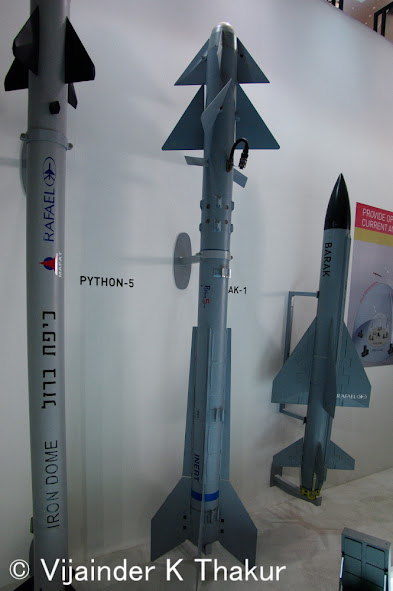
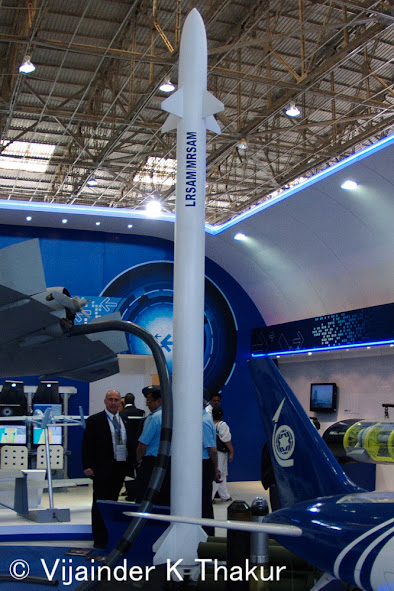
LR-SAM at Aero India 2011

One of the reasons why the Navy isn't as worried as the defense journos that INS Kolkata was commissioned with 48 empty cells of vertically launched Long Range Surface to Air Missiles (LR-SAM) that are to shield it against an attack by anti-shipping missiles, is because the missile system, when it's finally installed, would give the warship the best protection money can buy  in the world today! You can cross check that claim with any Navy man - he will agree!  What is confounding is the missile hasn't been tested even once! The confidence reposed in the missile system stems from its pedigree. It's basically an Israeli missile.

Former Navy Chief, Admiral Arun Prakash gives an interesting insight in today's Business Standard as to how the missile came to be the most coveted AD weapon system on Indian warships.

He recalls how the Israeli Navy, on behalf of its defense industry, offered the Indian Navy the long-range SAM with "superior anti-aircraft and anti-missile defense capabilities" in 2004-05.

"The 'cherry on the cake' was to be the new multi-function phased-array radar that accompanied it. There was no altruism behind this offer; the small numbers required by the Israelis made the project economically unviable for them, and there were not many nations they could trust with such sensitive technology. Driving a hard bargain, the IN obtained Israeli agreement for joint development and co-production of systems.

"Showing eminent good sense and pragmatism, the DRDO leadership agreed to the navy's proposal for a path-breaking tripartite collaborative arrangement with the Israelis for the development of the LR-SAM. The funding as well as manpower liabilities were shared by the IN and DRDO. The project, involving DRDO scientists, naval engineers and the defense-industry has rendered tremendous benefits to all three participants and, notwithstanding development delays, will bring the IN to front rank of navies technologically."

DRDO Chief, Avinash Chander, in a recent interview gave his own insight into the project. He said, "The Armed forces had actually tried to buy such a system from abroad, but nothing was really available that would come with satisfactory terms. And that is how we got into a joint venture with Israel, the system had to be developed ab initio. So there were issues with respect to radar development, issues with respect to the actuation system as well which was initially supposed to be pneumatic but then had to be changed to electromechanical. Then there was the two pulse motor which was being done for the first time and that got into certain combustion stability problems. But the good news is that all those problems have now been overcome. We launched a massive program on the rocket motor and today we have a motor which is stable and will be tested shortly."

There is a lot more to the LR-SAM project, only for IDP Sentinel members, at the link below:

Barak-8 / MR-SAM / LR-SAM - IDP Sentinel


DRDO Developing Long Range Anti-Shipping Ballistic Missile to Counter China's DF-21D

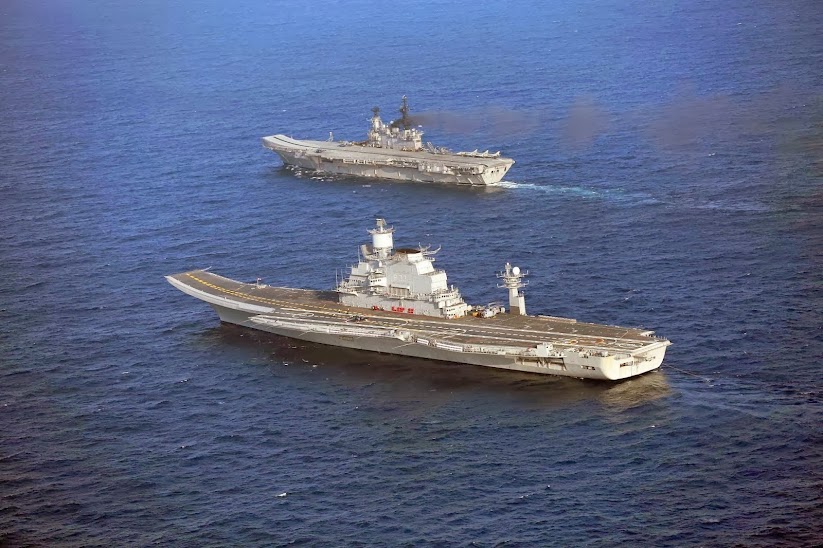
When sailing in the Bay of Bengal Indian aircraft carriers can be easily targeted by Chinese DF-21D missile

DRDO is working on a Chinese DF-21D missile analog.

August 24, 2014 - DRDO Chief Avinash Chander told the press recently that the DRDO is developing a long range anti-shipping ballistic missile capable of striking enemy aircraft carriers 1500-2000 km from our shores.

"The long range anti-ship missile is on the drawing board, and we are confident that in about six years we would be able to get it ready," Chander said.

Somewhat similar to the Chinese DF-21D, the missile would follow a ballistic trajectory to evade ship based radars and use its seeker to locate and strike an aircraft carrier. Chander didn't say how the initial targeting information would be obtained. 

Warships comprising a carrier group are honed to detect and engage low to medium level threats, such as fighter aircraft and anti-shipping missiles launched from stand-off ranges. Their radar beams don't look up beyond around 60-deg exposing the carrier to ballistic missiles attack. 

The challenge in developing an anti-shipping ballistic missile lies in obtaining initial targeting information and end-game tracking of a carrier moving at around 30-kts (60 kph). Airborne ISR assets employed to obtain targeting information can be easily engaged and neutralized by carrier group warships in a protective cordon around the aircraft carrier. Low level satellite coverage can do the job if it's persistent, which requires a a large satellite constellation of low orbit satellites to be deployed, a very expensive proposition.

IDP Sentinel members may also like to read updates on the following projects

Saturday, August 16, 2014

FGFA Front End Engineering Design Complete

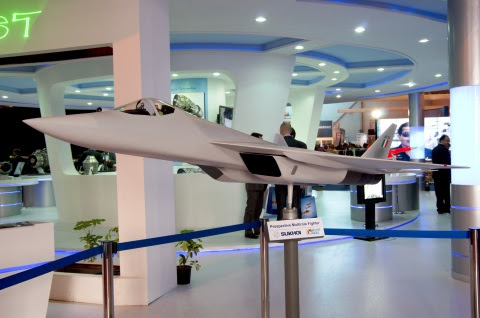
FGFA Scale Model on Display at Aero India 2013

On August 15, 2014, IANS reported that Russia's United Aircraft Corporation (UAC) has completed the front-end engineering design of the FGFA for the IAF. The UAC is currently preparing the contract on the aircraft's full-scale development.

UAC president Mikhail Pogosyan told Arms-Tass, "We have completed the front end engineering design stage. The work on the preparation of the contract on the FGFA full-scale development is now in progress."

It was earlier reported that a contract for R&D is being prepared. It was expected to be signed in late 2013. The value of the R&D contract is estimated to be worth $11 billion.

The delay in signing the R&D contract is attributed to India's concerns about its low level of participation in developing the aircraft, cost-overruns, delays and Russia's willingness to implement the 40 to 45 improvements in the fighter aircraft’s design that India has sought.

HAL and Sukhoi finalized the design and technical specs of the aircraft and agreed on a work share for the research and development (R&D) phase in April 2013.

IDP Sentinel members can read more at the link below.

Perspective Multi-role Fighter (PMF) / FGFA (IDP Sentinel)

Wednesday, August 6, 2014

Navy Initiates Procurement of Short Range Surface-to-Air Missile (SRSAM) System for Naval Surface Platform: IDP Exclusive!

Bara missile, a possible SRSAM contender, on display at Aero India 2011
The Indian Navy on August 6, 2014 initiated procurement of a Short Range Surface to Air Missile (SRSAM) System for Indian Naval ships.

The Navy appears open to both vertical launch, canister based missile system; or over the deck, mechanical, rail launched system featuring automating loading from below deck missile storage compartments. The former are better suited to stealthy warships.

The system is required to be capable of engaging targets traveling at up to Mach 3.

The type of initial guidance is not stipulated but the missile is required to feature active RF seeker for the terminal guidance.

A minimum service life of 10-years is mandated, with provision to extend the life based on periodic inspection. The entire system should be easily transportable from ashore to a ship in containers mounted on vehicles.

The Navy's willingness to accept an over the deck rail launch could mean the immediate requirement is for a non stealthy warship.

It maybe noted that INS Vikramaditya currently does not have a Close-In Warfare System (CIWS) to neutralize anti-shipping missiles, or a long range Point Defense Missile System (PDMS) system to defend against fighter and bomber threats.

The CIWS is slated to be fitted in April-June 2015 at the Karwar naval base. On June 18, 2014, Indian Express reported that the an AK 630 system manufactured in India would be fitted.

Navy sources told The Tribune in June 2014 that the PDMS would be either the Israeli Barak or Russian Shitil missiles.

IDP Sentinel members can access more information at the link below

Short Range Surface to Air Missile(SRSAM) System for Naval Surface Platform (IDP Sentinel)


Saturday, July 26, 2014

India Pushes Ahead with Kilo Class Submarine Upgrades

IN Kilo class submarine after overhaul in Russia. Photo Courtesy Indian Embassy in Russia, credit: KR Deepak

India has asked Russia to upgrade another two Russian Kilo Class submarines (Type 877EKM) submarines, RIR reported on July 25, 2014.

The director-general of the Rubin Central Maritime Design Bureau Igor Vilnit told the website, "The Indian governments filed a request to the Russian Federal Service for Military-Technical Cooperation to extend the life of two Russian Kilo Class submarines."

Specialists of the Zvyozdochka ship repair center and the Rubin design bureau are expected to leave for India to inspect the first submarine.

Earlier on December 3, 2013, Vice-Admiral Satish Soni, Flag Officer Commanding-in-Chief of the Southern Naval Command, told the press that the Indian Navy (IN) intends to get four of its Kilo class subs overhauled in Zvezdochka shipyard in North Russia to extend their lives by another 10 years.

Also, the General Director of the Russian submarine repair yard Zvyozdochka in north Russia, Vladimir S. Nikitin, told The Hindu that the shipyard was close to signing a contract for life-extension refit of two Indian Kilo-class submarines in 2015.

In January 2013, the Indian Navy (IN) completed the overhaul and upgrade of its Kilo class (Project 887EKM) submarines in Russia under a deal signed in 2001.

Each upgrade cost $80 million and involved complete overhaul of the submarine and its hull structures; installation of an improved control system, sonar, electronic warfare system, and an integrated weapon control system. Additionally the subs were equipped to launch Club-S missiles from its torpedo tubes.

The refit included support for the new version of Klub-S (3M54E1 anti-ship and 3M14E land attack) cruise missiles and over ten Indian and foreign-made systems including the Ushus hydro-acoustic (sonar) system and CSS-MK-2 radio communications system.

In addition, the boat's cooling system was modified, the Porpoise radar fitted and other work carried out "increasing the boat's military capacity and safety."

Two submarines - INS Sindhuvir and INS Sindhuraj - were modernized at the Admiralty Shipyard in St. Petersburg.

Later, five subs - INS Sindhukesari, INS Sindhuratna, INS Sindhugosh and INS Sindhuvijay and INS Sindhurakshak - were modernized at  - Zvyozdochka Shipyard in Severodvinsk.

Of the remaining 3 subs, one has already been overhauled in India, and another two are in the process of being overhauled.

Kilo class submarines were developed by the Rubin Central Design Bureau (St. Petersburg).

IDP Sentinel members can read more about the Kilo Class submarine overhaul project at the link below.

Kilo Class submarines upgrade (IDP Sentinel)


Friday, July 25, 2014

INS Shivalik, INS Shakti & INS Ranvijay Sailing in for Malabar 2014

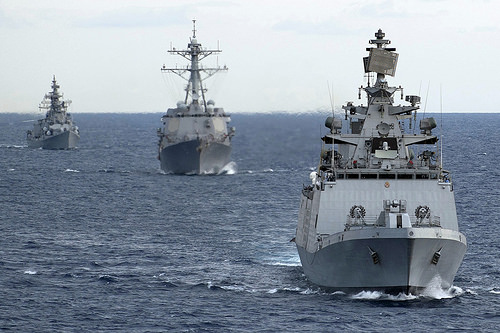
INS Shivalik, a USN Guided Missile Destroyer  & INS Ranvijay (front to rear) sail in for Malabar 2014. Photo Courtesy US Pacific Fleet

The 2014 edition of Malabar exercise kicked off on July 14, 2014 in Port Sasebo, Japan.

The MALABAR series is an annual exercise involving frontline ships of the Indian and US Navies with occasional participation by Navies of other countries.
.
Japan is participating in the exercise for the third time this year.

Three ships of Indian Navy  - INS Ranvijay (guided missile destroyer), INS Shivalik (stealth frigate) and INS Shakti (fleet tanker) - entered Port Sasebo on July 23 to participate in the exercise. The ships sailed to Japan immediately after wrapping up Indra 2014 exercise between the Indian Navy and the Russian Pacific Fleet.

The Japanese Navy is participating in Malabar 2014 with 2 destroyers, 1 P-3C Orion and 1 US-2 sea plane.

The US contingent comprises one SSN, two destroyers, one tanker, and one MR aircraft.

One US Carrier Strike group (CSG) is likely to join for the sea phase of the exercise. [via PIB]

(According to a US Navy press release, the US contingent comprises the aircraft carrier USS George Washington (CVN 73) with embarked carrier Air Wing 5; the guided-missile cruiser USS Shiloh (CG 67); the guided-missile destroyers USS John S. McCain (DDG 56), USS Stethem (DDG 63) and USS Pinckney (DDG 91); along with a a P-3C Orion aircraft.)

The shore phase of Malabar 2014 will be held from July 24, 2014 to July 26, 2014 and will include interactions between subject matter experts and professional exchanges.

The sea phase of the exercise is scheduled from July 27 to July 30 and will be conducted in the Western Pacific Ocean.

Exercises planned during this phase include search and rescue, helicopter cross-deck landings, underway replenishment, gunnery  and anti-submarine warfare, Visit, Board, Search and Seize operations (VBSS) and Liaison officer exchange and embarkation.

The scope of MALABAR exercise includes diverse activities, ranging from gun-firing and fighter combat operations from aircraft carriers, to combating terror, through Maritime Interdiction Operations exercises.

The Malabar exercise series commenced in 1992. Following India's 1998 Pokhran II nuclear tests there was a long hiatus.

The exercise - earlier held in the years 1992, 1995, 1996, 2002, 2003, 2004, 2005, 2006, 2007 (twice), 2008, 2009, 2010, 2011, 2012, and 2013 -  has grown in scope and complexity over the years.
Malabar 2014

Friday, July 18, 2014

Airbus A330 MRTT Procurement: TASL and Cobham UK Offset Tie-up to Make Air-to-Air Refueling Equipment at Hyderabad

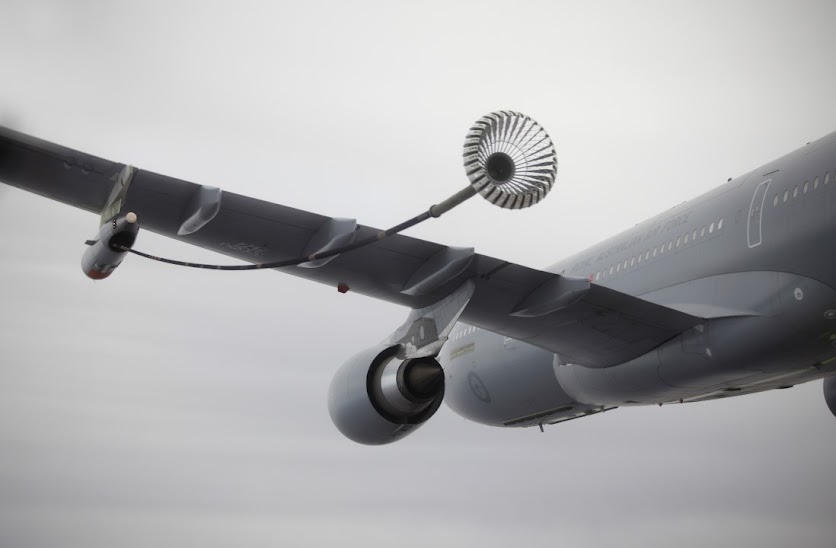
Airbus 330 MRTT Hose and Drogue. Photo Courtesy Airbus Military


TASL will manufacture air-to-air refueling equipment for Cobham, UK at TASL’s facility in Hyderabad, India.

Cobham, UK specializes in hose and drogue aerial refueling and its systems are fitted on platforms such as the Airbus Military A330MRTT & A440M, Lockheeds C-130, Embraer KC-390 and Boeing KC-46.

Notably, IAF is set to procure 6 Airbus A330 MRTT and Cobham's tieup with TASL would meet the offset obligations of the company.

Cobham range also includes buddy refueling pods for  F/A-18, SU-30, and Tornado. Not coincidentally, the IAF is set to have 272 Su-30MKIs in its inventory!

Tata Group has identified Aerostructures as a thrust area of strategic importance and designated TASL as an umbrella organization for aerostructures. TASL has setup a JV with Sikorsky for manufacturing parts and assembling cabins for Sikorsky S92 Helicopters; and another JV with Lockheed Martin for manufacturing C-130J Empennage & Center Wing-Box Assembly as part of Lockheed Martin's offset obligation.

More recently, TASL announced a JV with RUAG Aviation of Switzerland to manufacture Do 228-212 NG structures at Hyderabad.

IDP Sentinel members can read more about the Airbus Military A330 MRTT at the link below.

Multi Role Tanker Transport (MRTT) - IDP Sentinel