Saturday, October 26, 2013

OFB Developed Bofors 155 mm / 45 caliber Gun Bursts During Trials


A Bofors 155mm/39 caliber gun in action during Kargil Ops.
On October 25, 2013 Defense News reported that the barrel of a prototype Bofors 155 mm / 45 caliber howitzer burst during summer trials. A MOD source told the website that the failure was investigated by an internal committee, which concluded that neither the barrel nor its Indian-made ammunition was at fault.

Ordnance Factory Board (OFB) has developed the 155mm / 45 caliber gun by upgrading the 155 mm / 39 caliber Bofors gun inducted into the Army in late 1980s. Using drawings supplied by Bofors as part of the TOT package, OFB lengthened the barrel of the gun (increasing caliber from 39 to 45), so that it could achieve a range of 40 km. In additions, OFB improved the mechanical and electronic suites of the gun.

The Defense Acquisition Council in October 2011 asked Ordnance Factory Board (OFB) to manufacture two prototypes of upgraded 155mm/45 calibre Howitzer Gun and offer them for trials by Jun 2013. [via PIB]

On March 7, 2013, the TOI reported that the MOD has placed a letter of intent with the OFB for 114 howitzers.

Following the setback, which has halted the trial process, BAE Systems, which acquired Bofor's howitzer unit, has reportedly offered to help OFB upgrade the gun.

Ironically, the barrel explosion followed a series of trial successes.
On April 29, 2013, the Minister of State for Defense told parliament that the OFB has carried out several internal firings of their in house developed 155mm x 45 caliber Artillery Gun and it has met the planned objectives. However, User Test Fire is yet to be carried out.

Successful Trials at PXE Balasore

On December 28, 2012, the TOI reported that field trials of the two prototype guns were successfully conducted at the Proof and Experimental Establishment (PXE) testing range in Balasore, Odisha on December 19, 20 and 23 respectively.

GM, Gun carriage factory (GCF), S P Yadav, told the newspaper that the performance of both the prototype guns had been as expected; they had successfully hit targets 38-40 kilometers away.

The trials were witnessed by Lt Gen Anjan Mukherji, DG Artillery as well as experts from DRDO.

The PXE range is equipped for accurate ballistic measurements and DRDO has compiled the data from the trials.

GCF carried out initial internal trials of the guns in May in Pokharan, which proved to be satisfactory.

Next the guns were tested at Central Proof Establishment (CPE) at Itarsi on November 30, December 5 and 6. 

At CPE, the firing was confined to the arrester butt on zero degree elevation. 

After the CPE firing the guns were subjected to a series of tests to ensure their structural integrity hadn't been compromised. It was determined that all components and assemblies had borne the firing firing stress without any damage.


Friday, October 18, 2013

India Unhappy with FGFA Research & Design Workshare

PMF / FGFA model on display at Aero India 2013. Photo Credit: Vijainder K Thakur

On October 18, 2013, The Economic Times reported that the IAF is unhappy that India, despite bankrolling 50% of the development cost of the FGFA, is being allocated just 15% of the research and development work for the aircraft by Russia.

The IAF expressed its disappointment at a CII event on energizing aerospace sector in India.

"We have a major opportunity in the FGFA program. At the moment it is not very much in favor of Indian development. We are flagging it through the Government. It should be much more focused towards indigenous development capability," IAF Deputy Chief Air Marshal S Sukumar said here.

The Raksha Mantri is expected to take up the issue during his visit to Russia starting November 15, 2013.

India and Russia are currently negotiating the Research and Development work share of the FGFA program. The negotiations are expected to take another year!

What is difficult to understand is how can India realistically expect a larger work share. The PMF / FGFA is based on the PAK-FA / T-50, an aircraft that is expected to start state acceptance trials in early 2014.

The FGFA will feature the same airframe, engines and main systems as the T-50, but differ in its avionics and weapon suite. Clearly, the residual R&D work is limited. What is it that India wants to research and develop?

Wednesday, October 2, 2013

GTRE Pushes Ahead with Kaveri as USAV Power Plant

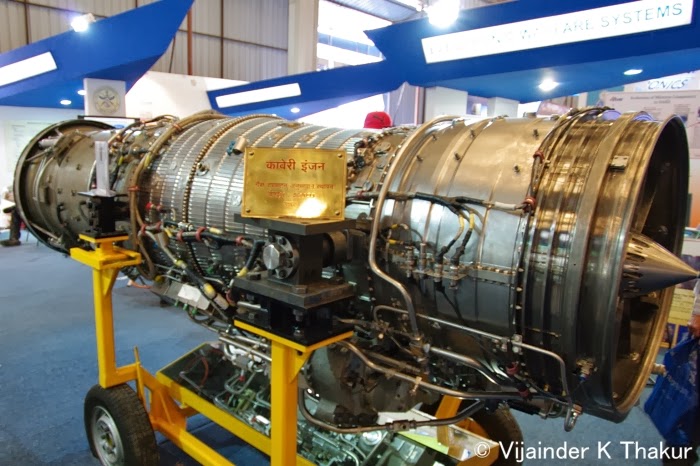
Kaveri engine at Aero India 2011. Photo © Copyright: Vijainder K Thakur
GTRE has submitted a revised proposal to the GOI to warp development of Kaveri engine.

DRDO Director General (Aero) K. Tamilmani and Director, Gas Turbine Research Establishment (GTRE) C.P. Ramanarayanan told The Hindu in October 2013 that GTRE will resolve the five issues that came up during airborne testing of the Kaveri engine in 2011 using an IL-76 testbed at Gromov Flight Research Institute (GFRI), Russia

Next year, the tweaked engine would be fitted first on an IL-76 testbed and then a MiG-29 fighter for trials and eventual certification.

“When we do that, we will have the first indigenous engine with proven and certified performance for exploitation,” Dr. Ramanarayanan said.

GTRE had earlier planned to obtain certification using an LCA testbed. (The LCA PV-1 was built to support the Kaveri engine.)

GTRE has sought sanction from MoD for developing the "dry thrust only" versions of the Kaveri engines. The money will be utilized to build two prototypes and send them to Russia for flight testing.

Dr. Ramnarayanan had earlier told the press, “We will take 48 months from the date we get clearance from the government, for completing 50 hours of testing the Kaveri on the Tejas LCA. During the last 12 months, we will actually fly the Tejas with the Kaveri.”


The testing will now presumably be done on a MiG-29.

According to Dr. Ramanarayanan, in future India would endeavor to build aircraft around a proven engine, a model followed worldwide.

During testing at the Gramov Flight Test Center, the Kaveri had demonstrated a dry thrust of 49.2 KN against a designed 51KN. With reheat the thrust deficit was substantial; 70.4 KN against the designed 81 KN.

Due to the thrust deficit with reheat, Kaveri was dropped as a prospective LCA powerplant.

Since Kaveri's dry thrust performance comes close the design values, DRDO has taken a decision to develop Kaveri as a UCAV powerplant.

UCAVs use un-reheated engines to minimize their heat and noise signatures. Also, the thrust requirement for the USAV is more modest.

DRDO has embarked on the development of a UCAV matching the capabilities of the X-47B and nEuron. The Indian analog is called Unmanned Strike Air Vehicle (USAV).

The USAV cannot use an imported engine on account of the MTCR regime which prohibits sale to another country of technology that maybe used in a missile or unmanned vehicle exceeding 300 km in range.

Removing the reheat from the Kaveri would lighten the engine considerably.

"Since the USAV will weigh less than 10 tonnes, the Kaveri’s 50 KN will suffice. And, with the afterburner removed, we would significantly reduce the weight of the Kaveri," a top DRDO scientist told the Business Standard earlier this year.

Along the way, GTRE will need to tweak the Kaveri dry for use on low RCS aircraft. Typically, stealth aircraft powerplants use shaped intakes to prevent enemy radar from reflecting off their compressor blades. Also, the engines are designed to operate with shaped exhausts to reduce stern radar and heat signature 

In addition to the Kaveri, GTRE is co-developing a powerplant for the AMCA with a foreign vendor to be selected through open tendering.

Meanwhile, HAL is independently developing aircraft engines for use on drones, helicopters and trainer aircraft by 2018.

Details about the Kaveri project are at Kaveri Jet Engine - IDP Sentinel.
You can read more about the India USAV a Unmanned Strike Air Vehicle (USAV) / AURA UCAV

Monday, September 30, 2013

Nag ATGM: No Man Portable, Mast Mounted, Tactical Aircraft Versions Planned

Nag ATGM at Aero India 2011. Photo Credit: Vijainder K Thakur


The TOI reported on September 24, 2013 that DRDO is developing a mast mounted ground launched version of the Nag ATGM with increased range of 7 km and lock on after launch capability. The TOI report didn't specify where the mast would be mounted - presumably, on the NAMICA vehicle - but said the launch pad would be hydraulically raised to a height of 5 m to enable the missile to acquire its targets up to a distance of 7-8km.

The TOI report also said that DRDO was developing

  1. A man portable version of the missile on request from the IA
  2. An air-launched, 10-km range variant of the missile for launch from tactical interdiction aircraft like the upgraded Jaguar IS. The version would feature a nose-mounted mill metric-wave active radar seeker.

DRDO has now clarified to Thumkar that the TOI report is erroneous.

According to DRDO Director of Public Interface Ravi Kumar Gupta, while DRDO is working on continually improving the Nag missile there is just one variant of the missile currently under development - Helina.

BMD Phase 1 PDV Endo-Atmospheric Interceptor Test in Late November

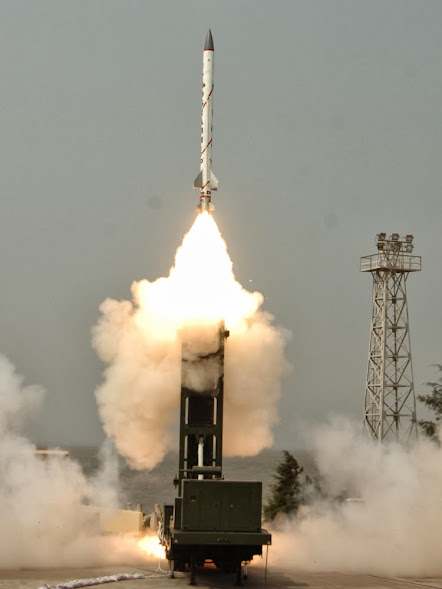
AAD-05 interceptor during 7th BMD test on February 10, 2012.
DRDO plans the debut test of its new Ballistic Missile Defense (BMD) Phase 1 exo-atmospheric interceptor PDV missile in the last week of November, according to The Hindu.

During the test, the new PDV interceptor will attempt a hit-to-kill destruction of a target missile launched from a Navy ship, with interception taking place between 125-140 km altitude.

The BMD Phase 1 system is capable of engaging missiles with a range of 2,000 km. In the past, DRDO has used Prithvi missiles launched on a trajectory simulating a 2,000 km range missile as targets. For the upcoming test, DRDO will use a newly developed target missile.

The solid fueled two stage PDV missile replaces the solid and liquid fueled two stage Prithvi Air Defense (PAD) missile as the endo atmospheric interceptor in BMD Phase 1. The PAD was tested twice - against a Dhanush missile launched from INS Rajput on March 6, 2006 at an altitude of 80 km and against a Prithvi missile on November 27, 2006 at an altitude of 48 km.

DRDO has tested the BMD system a total of seven times since March 6, 2006, not counting an aborted test. The first two tests involved the PAD missile and the subsequent 5 tests, the AAD. The AAD missile was last tested on February 10, 2012.

PDV Capabilities


The PDV is capable of intercepting enemy missiles at altitudes upto 150 km. It features an innovative system to allow the missile to maneuver outside the earth's atmosphere, a dual (active radar and IR?) seeker and a gimbaled directional warhead which can rotate 360 degrees to explode towards the incoming missile in order to destroy it.

Because it is directional, the 30 kg warhead is able to generate an impact equivalent to a 150 kg omni-directional warhead.

At the time of interception, the PDV and the enemy warhead would both be travelling towards each other at 1500 m per second. One of the challenges in exo-atmospheric interception is discriminating the warhead from its separated rocket motor and possibly decoys.

The PDV missile is being developed to be the mainstay of the BMD system.

PDV Test Delays


The first trial of the missile was initially scheduled for late June or early July 2010. On February 14, 2012, DRDO Chief VK Saraswat said the missile would be tested by the end of 2012.

In May 2013, DRDO Chief VK Saraswat told The Hindu that the next test of the BMD would take place in July 2013. It would involve a PDV missile and demonstrate an interception at an altitude of 100-150 km.

BMD Phase 2

Meanwhile, DRDO is continuing to develop Phase 2 of its BMD system which will be capable of engaging missiles with range greater than than 5,000 km.

The Phase 2 system will match the capability of the THAAD or Terminal High Altitude Area Defence missiles deployed by the United States as part of its missile shield beginning this year. THAAD missiles can intercept ballistic missiles over 200 km away and track targets at ranges in excess of 1,000 km.

The Phase 2 system will require longer range radars (Detection range of 1,500 km as opposed to 600 km for Phase 1 radars), and new hypersonic interceptor missiles flying at Mach 6-7 (As opposed to Mach 4-5 for Phase 1 missiles) with agility and the capability to discriminate against ballistic missile defense counter measures.

DRDO says it has completed design of the Phase 2 interceptor missiles - AD-1 endo-atmospheric interceptor and AD-2 exo-atmospheric interceptor - and trials would be held next year.

Sunday, September 29, 2013

What Happened in Samba? Cross Border Terrorism or Pak Army Special Ops?

IMGP2061


Lt Gen HS Panag, former Northern Army Commander, Lt Gen JS Bajwa, who recently retired as DG Infantry, and Pravin Sawhney, Editor, Force magazine, share their thoughts on the brazen cross border attack from Pakistan in Samba. What is India up against? Cross Border Terrorism or Pak Army Special Ops? Proxy War or Sub Inertia Conventional War?

And our continued lack or response to such provocations - is it the Arjun Syndrome or Just Funk?

Let's first review the facts.

On September 26, three heavily armed men attacked the Hiranagar police station in Kathua district of J&K at around 6:45 AM and gunned down five police personnel. They then commandeered a truck on the national highway, shot dead the helper, and forced the driver to take them to the Army area in Samba district, where they attacked a 16 Cavalry camp in Mesar area and shot dead the second in command of the regiment, Lt. Col. Bikramjit, and two soldiers. The commanding officer of the regiment and three other soldiers were injured in the shootout.

A fierce gun battle ensued between the attackers and the army personal, which ended with all the three attackers being killed.

Following the attack, the Home Minister of India confirmed to the press that the attackers came from Pakistan. They are reported to have sneaked into the Indian territory from across the International Border (IB), which runs close to Hira Nagar police station.

The TOI announced the gunning down of the attackers with the headline - Army operation over in J&K's Samba, all three terrorists gunned down.

You may have noticed that I have not used the word terrorists to describe the three attackers from Pakistan, because I am not sure 'terrorists' is the right word to describe them.

According to Wikipedia, terrorism commonly refers to those violent acts which are intended to create fear amongst people. The Samba attack was not intended to create fear amongst Indian people, it was intended to kill Indian uniformed personnel in the border area. A job that is normally assigned to soldiers.

Terrorists are not trained by governments in clearly identifiable camps. Soldiers are. Terrorists don't attack across the international borders, soldiers do.

The Wikipedia defines a soldier is one who fights as part of an organized land-based armed force. To my mind, the three attackers fit the Wikipedia definition of a soldier.

So, were the three men who attacked Hiranagar police station and the 16 Cavalry camp in Mesar area killing 9 uniformed personnel and one civilian terrorists or soldiers?

Remember, soldiers can be part of the regular army with well laid out terms of service, or they can be irregulars with nebulous terms of service.

Was the Samba attack a terrorist attack, or a Pakistani special operation executed by Pakistani army irregulars?

The press, the politicians, even retired soldiers have all referred to the incident as a terrorist attack.

Is it possible we are referring to the three attackers as terrorists because the consequence of referring to them honestly as Pakistani irregulars on special ops would only bring shame on us because we would not be able to explain to ourselves and the world why we are not retaliating across the border from where those irregulars came?

Is Pakistan taking advantage of a weak political leadership in India - focused on its own survival and, by its own doing, bereft of sound military advice - erode Indian sovereignty in J&K.

If so, those in power need to realize that India's accommodation of increasing Pak provocations make it like the frog who dies because water temp rises to a boil slowly.

I know I share my doubts with many other concerned citizens of the country - young and old. To clear the misgivings I consulted two experts who have devoted their lives to military affairs.

  1. Lt Gen HS Panag, former Northern Army Commander, a no nonsense soldier with a sharp intellect, a hard taskmaster, and  a just leader with Teflon clean image.
  2. Lt Gen JS Bajwa, who recently retired as DG Infantry and is the author of two books on PLA, with the latest titled Modernisation of the Chinese PLA: From Massed Militia to Force Projection
  3. Pravin Sawhney, Editor, Force, India's leading defense magazine

My questions to them were

  1. What is India faced with in J&K - Cross Border Terrorism or Cross Border Special Ops?
  2. Has Pakistan upped the ante with a sub inertia conventional war in addition to its on going proxy war? (A conventional war finely calibrated to remain below a threshold that would compel a weak political leadership to react.)
  3. Is the lack of response from India the Arjun syndrome (We are family) or bureaucratic and political funk from the rotting system?

Both the experts opined that India was dealing with terroriism, not Pak special operations.

Pravin Sawhney


Pravin Sawhney said:

"I believe they were terrorists who were provided intelligence, weapons and training by the Pakistan Army.

"They would not have sent their Special Forces so deep inside Jammu because if any of them had been caught alive, it would have had serious implications. Pakistan Army is the only army in the world which has perfected the capability to fight simultaneously at two levels with regular and irregular forces. This started with the 1999 Kargil war."

It is interesting that the Force editor refers to the terrorists as being part of Pakistan's Army's irregular forces.

Lt Gen JS Bajwa


The depth and logic of General Bajwa's response was awe inspiring and enlightening. I think everyone concerned about the strife in Jammu and Kashmir needs to pontificate on it.

Explaining why he feels the three attackers were terrorists, the General said:

"There is an input received to suggest that the 'attackers' sought the location of the Army School. So that does put them in the amorphous genre of 'terrorist'. The aim of the terrorist is to target the civil unarmed population to put pressure on the Civil Govt. Targeting the Army/Police also results in hardships for the civil pop since more restrictions/arrests/searches etc are the fallout. Consequently the population sides with the 'terrorists' and make governance impossible and all sorts of international agencies pounce in and sit in judgement - unless the govt has the will to remain firm.

"The selection of a target and timing are a factor which needs constant analysis from non-stop intelligence inputs. There is a serious weakness here. Intelligence agencies keep giving general information periodically, especially on the occasion of national events such as Republic Day and Independence Day.  That's not "intelligence", that's just an alert to be on guard all over."

General Bajwa then explained why India should not be drawn into a conventional war based on provocations such as the one in Samba.

"The Armed forces being drawn into a conventional war has to translate the achievement of the political end state into achievable military objectives. The Pak Army may suffer a serious military defeat and even lose territory, but is that going to wipe out the terrorist groups? Non-State actors that they are, will bounce back reinvigorated."

As to options available to India to counter the attacks, General Bajwa says:

"Armed UAV's like the 'Predator' are one essential acquisition synergised with IW to harass them persistently.

"The country has other elements on National Power - Diplomacy! Where is the military hardware originating from? Why is that not brought out in international forums as a major flank of action? If weapons are manufactured locally target these persistently. Targeting only the end product of the 'terrorist factory' will be a never ending process."

And perhaps the most profound of General Bajwa's thoughts for restoring peace in J&K - mount a truth offensive!

"As I learned in Punjab, the tide turned against the terrorists the day people realized that these persons have only a personal agenda and any claim to an ideology or 'cause' were a facade, the information about terrorist movement and whereabouts began pouring in which altered the situation dramatically in just six months."

Lt  Gen HS Panag

Lt Gen HS Panag, lived up to his reputation with brevity that outdid a long discourse.

"Pakistani terrorists are as capable of special operations as any special forces. Also, their operations are meticulously planned by the ISI / Pak Army," he said.

"So how does it matter who the Samba attackers were?" he asks?

How Well Are Pak Terrorists Equipped?

A point that each of the three experts made is that Pak terrorists are very well equipped and trained and their operations meticulously planned.

So what exactly do the 'terrorists' carry on a cross border raid?

 Lt Gen JS Bajwa explains


"Terrorist operations are backed with a well oiled machinery running on the other side with planning and executive control. Communication nodes ensure the terrorists are in contact with their control centers throughout. These fellows are on suicide mission alright, but their operations are not limited like those of suicide bombers.

A terrorist is more-or-less armed and equipped in a standard way So it is clear that


  1. One AK-47/56/74 rifle.
  2. One filled magazine with 30 rounds 7.62mm ammunition. At times a second loaded magazine is taped with the other for quick change.
  3. 4/5 filled mags in the harness on his chest which also acts as Bullet Proof Jacket.
  4.  Four hand grenades.
  5. At times a senior cadre member carries an additional weapon in the form of a 7.62mm Chinese pistol.
  6. Mob phone.
  7. GPS.
  8. Photocopy of Pak restricted maps of the area.
  9. At times THUARIA satellite communication set.
  10. Dry fruits.
  11. Some medicines and first aid kit."

Saturday, September 28, 2013

Indian Navy's Participation in RIMPAC 2014: Another Message to China?

India Navy P-81 can be expected to participate in RIMPAC-2014
India will participate in the Rim of the Pacific (RIMPAC) 2014 naval exercise, which will be hosted by U.S. Pacific Command. The biennial exercise takes place every even numbered year.

In the past India has been invited to the exercise as an observer. Other countries invited as observers include China, Ecuador, India, Mexico, the Philippines, and Russia.

Observer nations participate in the exercise without contributing ships and have the option to become participants any time in the future. Russia switched from being an observer nation to a participant in the 2012 RIMPAC exercise.

Another first time RIMPAC 2012 participant was Philippines, which likely embraced the exercise as a message to China; the two countries are locked in a territorial dispute. India's decision to participate could also be prompted by China's aggressive posture along the LAC.

The US Navy contingent to the exercise comprises of a carrier strike group, submarines (US has only nuclear powered subs) and aircraft.

It's likely that the Indian Navy will contribute its P-8I aircraft to the exercise, besides a man of war or two. The exercise should give the IN aircraft and ships a good opportunity to tune their sensors to  Pacific water keeping in mind the likelihood of future face-offs in the area with PLAN.