Friday, March 14, 2014

DRDO Seeks Additional Diehl Track System 570 Z0 for Arjun MBT Mk-2 As Trials Progress

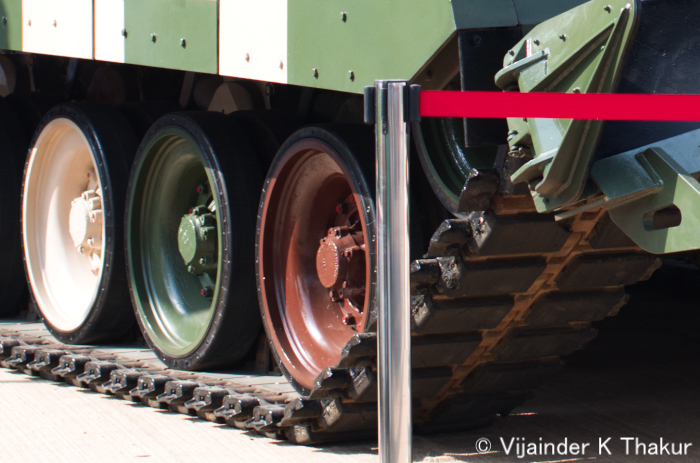
Arjun Mk-2 tracks at DefExpo 2014
DRDO has invited bids for Diehl Track System 570 Z0 for fitment on 5 Arjun MBT Mk-2 tanks.

Diehl, a German defense equipment manufacturer, produces chains and drive components for a wide range of military vehicles worldwide including the 70-ton Leopard 2 MBT and Arjun Mk-1 MBT.

Diehl tracks fitted on Arjun Mk-1 are now being manufactured by L&T. (The tracks on a tank have limited life and need to be periodically replaced.)

Arjun Mk-2 is reportedly undergoing 5 phase user acceptance trials, of which three phases have already been completed.

Improvements suggested in each phase are being implemented before the start of the subsequent phase.

The concluding fourth and fifth phases of user trials will begin in May 2014.

In the fourth phase the tank would be tested for obstacle crossing and medium fording (water) capabilities.

There are 89 improvements being undertaken on the Mk II tank, out of which 74 are related to equipment fitted on the tank and the remaining 15 are other improvements such as ammunition development.

So far the prototype tank has covered over 5,000 km as part of the DRDO and user trials.

The Indian Army has already placed orders on Heavy Vehicles Factory (HVF), Avadi, Chennai for 124 Arjun Mark-II tanks.

The additional 124 MBTs would help the Army to raise two more regiments of the indigenous tanks.

Production of the first batch of Arjun Mark-II MBTs is likely to start by 2015.

IDP Sentinel members can read additional details at

Arjun MBT Mk-II (IDP Sentinel)

Thursday, March 6, 2014

LCA Navy Will Long Remain Work in Progress

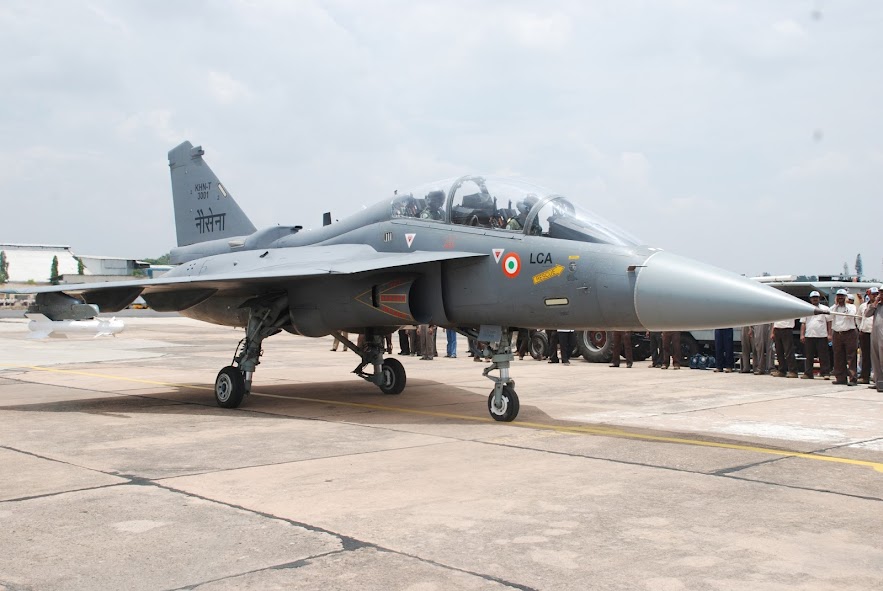
LCA Navy
A Shore Based Test Facility (SBTF) for simulating STOBAR (Ski-jump Take-Off, But Arrested Recover) operations from the deck of an aircraft carrier has been operational for a while in Goa and is due to be formally commissioned later this month. The SBTF is already being used to train Navy pilots for INS Vikramaditya operations. In future it will be used to develop and certify LCA Navy before the aircraft's induction into the Navy on board Indian Aircraft Carrier (IAC) INS Vikrant, which is currently under construction at Cochin.

DRDO was to demonstrate LCA Navy's deck operation capability at SBTF, Goa by mid 2014, but that is not likely to happen. Progress in developing LCA Navy - which first flew in on April 27, 2012 - was first stymied by problems with its redesigned and strengthened undercarriage. We can now expect more delay on account of a need to tweak the LCA's Flight Control Software (FCS) to facilitate deck operations.

The LCA-Navy FCS was reportedly developed with assistance from National Aerospace Laboratory (NAL) and validated by the US Navy. However, Aeronautical Development Establishment (ADE), Bengalure, has recently sought assistance to incorporate new features in OFP (Operation Flight Program) Software for LEVCON Air Data Computer (LADC), along with updates in the existing algorithms based on flight test results.

LCA Navy uses Levcons, active aerodynamic surfaces on the wing root leading edges, to control boundary layer flow and increase lift during low speeds. (LCA Tejas does not feature Levcons.)

LADC is part of Digital Fly by Wire FCS. The Quadruplex LADC would provide control logic and commands for the LEVCON actuation system, compute the control laws and mode logics for ski-jump, Auto throttle modes, Arrest hook systems etc. The computer also derives the necessary air data parameter required for the Flight Control System.

(After being augmented, LADC software would need more tweaks based on actual data generated in test flight.)

LCA Navy will feature hands-off take-off using ski-jump to ensure smooth transition to stable flight, and hands-off landing using steady AOA, autothrottle approach, flareless touchdown, and arrester hook engagement. During take-off and landing the pilot will be required to only give steering inputs to stay on the center line.

IDP Sentinel can read additional details at the link below:

LCA Navy (IDP Sentinel)

Tuesday, March 4, 2014

Indian Navy Set to Commission 3rd Saryu Class NOPV - INS Sumedha

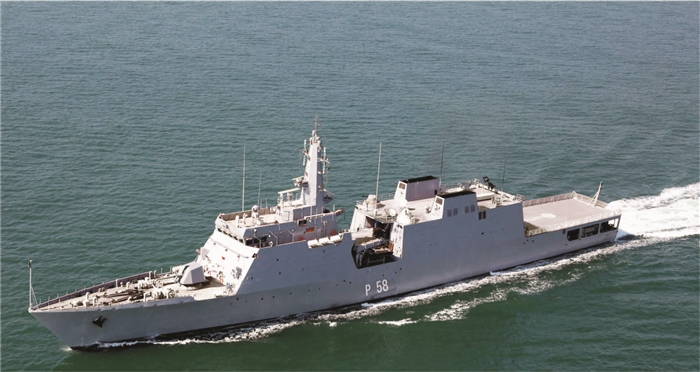
INS Sumedha - Saryu Class NOPV built by GSL
INS Sumedha, the 3rd Saryu Class NOPV made by public sector Goa Shipyard Limited (GSL) will be formally commissioned into the Navy by Vice Admiral Anil Chopra, FO C-IN-C Eastern Naval Command on March 7, 2014 at GSL. The ship will join Eastern Naval Command at Vizag.

INS Sumedha was launched on May 21, 2011 and handed over to the Navy on January 14, 2014.

INS Saryu, the first ship of the class, was launched on March 30, 2009, handed over to the Indian Navy on December 21, 2012, and officially commissioned into the Navy at Goa on January 21, 2013 by Air Marshal PK Roy, Commander-in-Chief, Andaman and Nicobar Command.

INS Sunayna, the second ship, was launched on November 14, 2009, handed over to the IN on September 2, 2013 and commissioned in the service on October 15, 2013.

INS Sumedha is 200th ship indigenously built by GSL, which has delivered four classes of OPVs to both Navy and Coast Guard.

GSL is undergoing major modernization at an outlay of Rs. 700 Crores, of which Rs. 400 Crores has already been spent. The Yard is near ready to take on construction of new MCMV project, which will provide major push to Naval mine sweeping capabilities.

IDP Sentinel Members can get more details at the links below

INS Saryu Class Stealth Naval Offshore Patrol Vessels (NOPVs) - IDP Sentinel
Procurement of 8 Mine Countermeasure Vessels (MCMVs) - IDP Sentinel

Rafale: HAL, Dassault Agree on Workshare for Local Manufacture

Rafale at Aero India 2011. Photo Credit: Vijainder K Thakur

NDTV on March 3, 2014 reported that India and France have agreed on a work share agreement for the manufacture of 108 Rafales in India. HAL will do 70 per cent of the work on the 108 planes that will be manufactured in India. Dassault would do the rest of the work.

The first 18 aircraft ( 12 single-seaters and 6 tandem seaters) would be delivered to India by Dassault in fly-away condition. The IAF will raise its first Rafale squadron in Ambala using the 18 aircraft.

HAL will license manufacture the remaining 108 Rafales comprising 74 single-seaters and 34 tanden-seaters - 11 using semi-knocked down (SKD) kits, 31 using completely knocked down (CKD) kits, and 66 made from indigenously manufactured kits (IMK).

Rafale's radar would be manufactured by Bharat-Electronics Ltd (BEL) in Bangalore, and its radome at a new HAL facility close the BEL facility in Bangalore. 
India is negotiating a sovereign guarantee from France that Dassault will supply, service and maintain the Rafales over the next 40 years. 

In addition to the aircraft, the contract includes supply of two Rafale-specific full-motion tactical simulators, two fixed-base cockpit procedures trainers, two avionics part-task trainers, one aircraft systems maintenance simulator, one navigation-and-attack system maintenance simulator, and one engine maintenance simulator.

IDP Sentinel can view more details at the link Rafale (IDP Sentinel)

Monday, March 3, 2014

Tropex 2014 Photos

INS Chakra. Photo Credit: IN
The Indian Navy's only SSN INS Chakra participated in the month long Tropex  (Theater Level Operational Readiness Exercise) 2014 in February 2014. The exercise involved large scale naval maneuvers in all three dimensions viz. surface, air and underwater, across the Bay of Bengal, Arabian Sea and the Indian Ocean.

Fleet tanker INS Deepak flanked by Delhi Class Cruiser (R) and Rajput Class Destroyer (L). Photo Credit: IN
The month long exercise was aimed to assess the operational readiness of naval units, validate the Navy’s war fighting doctrine and integrate newly included capabilities in its 'Concept of Operations'.
Fleet tanker INS Deepak flanked by Delhi Class Cruiser (R) and Rajput Class Destroyer (L). Photo Credit: IN

Around 60 ships and submarines, and 75 aircraft took part in this exercise,along with units from Indian Air Force and Indian Coast Guard. The exercise also saw the 'maiden' participation by the newly acquired P 8I Long Range Maritime Patrol aircraft.


L to R: Khukri Class Frigate, Rajput Class destroyer, INS Jalashwa, Rajput Class Destroyer. Photo Credit: IN
The exercise provided the Indian Navy with an opportunity to validate its network centric warfare capabilities, with effective utilization of the recently launched Indian Navy’s Satellite, GSAT 7.

Sunday, March 2, 2014

Varunastra Heavy Weight Torpedo User Trials Poised to Start

Varunastra Heavy Weight torpedo at DefExpo 2012
The Hindu reported on March 2014 that Varunastra is set to be handed over to the Navy for user evaluation trials (UETs) scheduled for mid year.

Meanwhile, Bharat Dynamics Ltd., which will manufacture the torpedo for the Navy, has positioned a team at the Talwar facility at NSTL  to observe development and assembly of the prototypes in order to fast track production.

Varunastra a 1,500-kg ship launched torpedo with a max range of 30-km is capable of autonomously locating and attacking an enemy sub, allowing the launching ship to stay out of harm's way.

The torpedo has been designed and developed by the Naval Science and Technology Laboratory (NSTL) and DRDO.

Varunastra Heavy Weight Torpedo (IDP Sentinel)

Saturday, March 1, 2014

Indian Navy's Submarine Rescue Capability - Current and Future

INS Chakra SSN.

The recent incident on board  INS Sindhuratna while it was sailing submerged off the Mumbai coast,  which led to loss of life and serious injuries, has highlighted the need for a credible Submarine Rescue Capability for the Indian Navy.

Here is a brief overview of the situation as it exists.

The crew of a stricken submarine in shallow waters (Up to 100 m) can escape using "submarine escape pressurized suits" using a technique called bubbling up.

Were a submarine to be crippled in deeper waters (upto 300 m), the Navy's diving support ship INS Nireekshak would be called in. It's equipped with Submarine Rescue Bells (SRBs).

Typically a SRB can accommodate 12 men  (10 escapees + 02 operators). A Launch and Recovery System (LARS) is used to lower and winch up the tethered SRB which is fitted with life support systems and a locator system. The SRB has a mating skirt/surface that fits on a submarine's escape trunk / seating surface structure to mate with the submarine rescue hatch.

If the SRB mates perfectly with the rescue hatch and the stricken submarine's hull is not compromised, a 1 atmosphere pressure rescue can be carried out from depths upto 300-m. If the submarine hull is compromised resulting in flooding of  the rescue compartment, a wet rescue is carried out.

This is how a wet rescue works, Flooding of the rescue compartment is stopped by releasing compressed air that pushes back the water. The release of the compressed causes a build up of air pressure in the rescue compartment, which in turn causes the human blood to absorb the nitrogen in the body. If the rescued crew is brought to the surface (1 atmosphere pressure) straight away, the blood releases nitrogen bubbles causing 'bends,' which can be fatal. In a wet rescue, the crew needs to be brought up in stages, allowing the body to safely release the absorbed nitrogen. The depth from which crew can be rescued under wet conditions is reduced to around 140-m

A SRB rescue can become difficult if the crippled submarine is resting on the seabed in an awkward position, since it makes mating the SRB with the rescue hatch difficult. Also, SRB rescue requires accurate position keeping by the submarine rescue ship (INS Nireekshak) to which the SRB is tethered. The rescue ship is equipped with a computerized station keeping system that uses GPS and multiple electrically driven propellers to keep the ship within 1-m of the desired position without the use of an anchor, in sea states up to 3.

It's easy to see why a SRB rescue isn't very reliable. Indeed, while submariners regularly practice bubble escape wearing  "submarine escape pressurized suits" at the Escape Training School (ETS) in Vishakapatnam, a SRB rescue has not been attempted. Till recently INS Nireekshak had reportedly never demonstrated a  SRB  mating with a submarine's rescue hatch!

The Indian Navy in August 2013 released a RFI seeking a SRB that conforms to STANAG 1297 specifications to ensure perfect mating of the SRB with the rescue hatches fitted on its subs.

Also, the Indian Navy is in the process of acquiring two Deep Submergence and Rescue vessel (DSRV).

The Navy initiated the case for two free swimming DSRVs in June 2000. The CCS approved the procurement in principal in November 2002. In December 2010, the Indian Navy initiated procurement by releasing a RFI.

The Navy reportedly wants a DSRV that is capable of diving to depths of over 600-m, mating with a disabled sub and extricating around 20 sailors at a time. It would be equipped with pressurized chambers, sonars and cameras.

Two vendors - Russia's Admiralty Shipyards (Bester-1 rescue submersible) and Britain's James Fisher and Sons PLC - are in contention for supply of the DSRVs. Offset proposals from the two vendors are being examined before finalizing a contract.

Unlike a SRB, a DSRV is not tethered. It's a free swimming vessel which can dive deep and locate a crippled submarine, mate with its rescue hatch, even if the submarine is awkwardly positioned, and rescue the crew.

As an interim measure, in 1997, India signed a contract with US Navy for its "global submarine rescue fly-away kit" service, paying an initial $734,443.

Deep Submergence and Rescue vessel (DSRV) (IDP Sentinel)
Recent Navy RFIs (IDP Sentinel)