Saturday, February 8, 2014

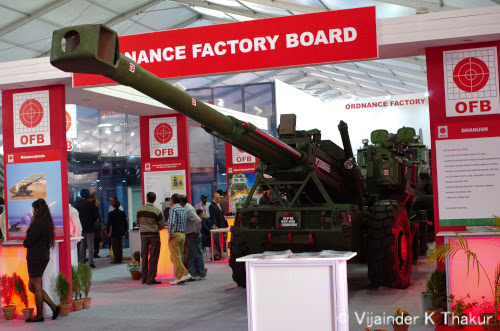
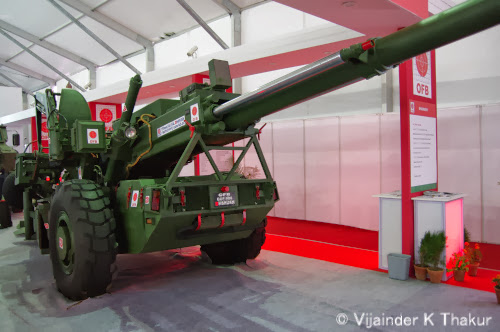
Dhanush 155-mm/45-cal Gun Built by Ordnance Factory Board at DefExpo 2014

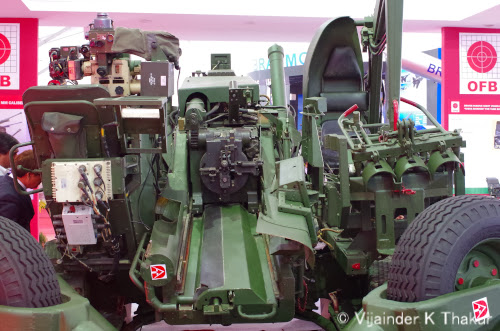
Ordnance Factory Board (OFB) developed Dhanush 155-mm/45-cal Gun
Dhanush was developed as an Ordnance Factory Board (OFB) - Army initiative using blueprints obtained from Bofors, Sweden in the late 1980s under the TOT clause of the contract to purchase Bofors 155-mm/39-cal guns.

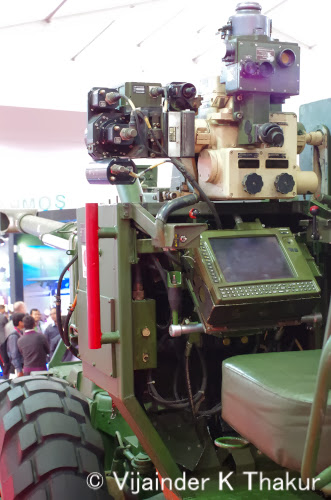
Gunner's sighting and control seat and display


Dhanush is often referred to as upgraded Bofors gun, but OFB says that development of Dhaush was more than an upgrade.

Besides the change in the caliber of the gun, from 39 to 45, a lot else has changed.


The gun features a modified baffle muzzle brake for improved efficiency, a modified loading trough to enable BMCS Z-6 firing, an inertial navigation system for orientation and fixation, an auto laying system, muzzle velocity reader, unified sighting system, ammunition display unit and a communication system.


The gun has a muzzle velocity of 885 m/s and a range of 38-km (ERFB-BB).

OFB told IDP that the problem that caused the barrel of the gun to burst during trials has been resolved and trials of the gun are proceeding.

For additional information on the project, please visit the link below.

Dhanush 155 mm/45 Caliber Upgraded Bofors Howitzer (IDP Sentinel)

Rustom-2 Update

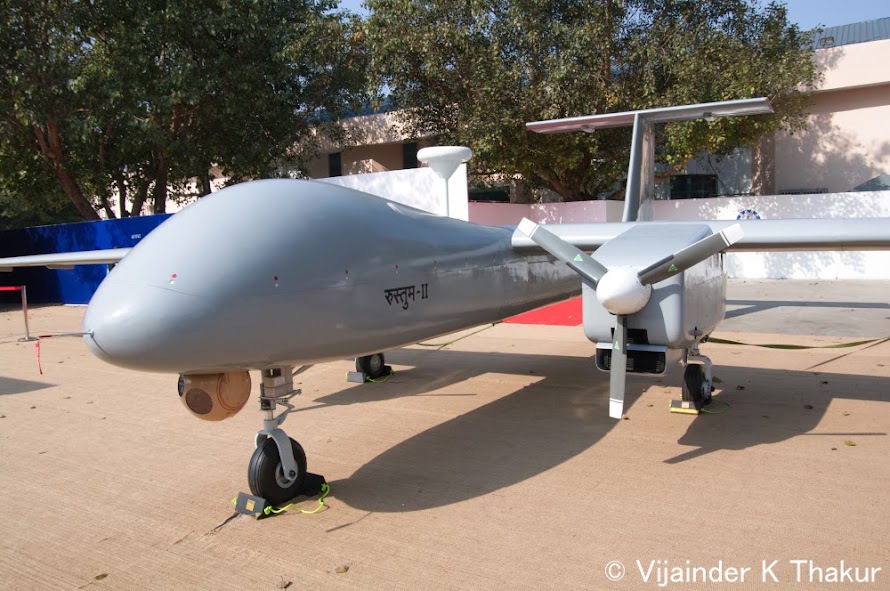
Rustom-2 prototype at DefExpo 2014

The Rustom-2 is currently powered by twin Rotax 914 engines, each driving a twin blade variable pitch propeller.

Austrian developed Rotax 914 is a four-cylinder, horizontally opposed engine with air-cooled cylinders and water-cooled cylinder heads. Sustained max power output is 73-kW (100-hp) with a 5-min burst of 84-kW (115-hp) at 5,800 rpm.

A single Rotax 914 powers the MQ-1 Predator in a pusher configuration. The engine is a popular power plant for light certified and home built aircraft, autogyros and military UAVs.

A study is on to assess the feasibility of using a diesel (Heavy Fuel or HF) engine on the Rustom-2.

Coming back to Rustom-2 itself, the prototype displayed at DefExpo 2014 has already done Low Speed Taxi Trials. First flight, which was earlier scheduled for February 2014, has been pushed back to June 2014.

As mentioned in my earlier post, an ATOL (AutonomousTake Off and Landing) system for Rustom-2 is yet to be developed, so initial flights will involve piloted take-offs and landings.

For additional details on the Rustom-2 project please visit the link below

Rustom-2 MALE UAV (IDP Sentinel)

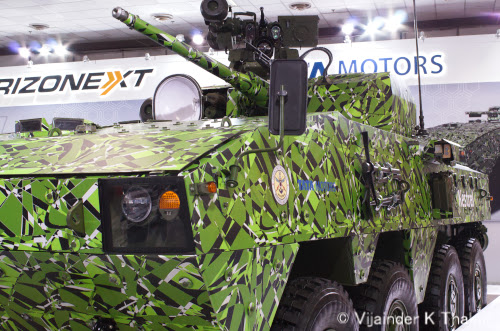
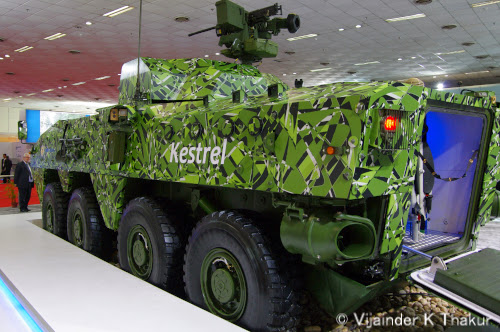
Tata Motors / DRDO's Kestrel Wheeled Armored Amphibious Platform

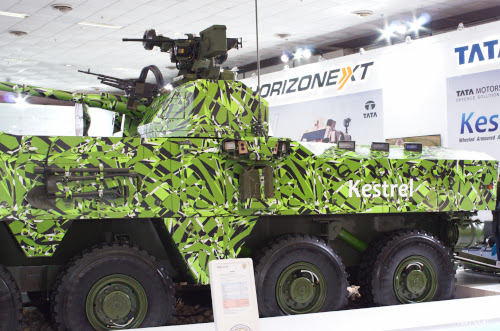
Tata Motor's Kestrel APC unveiled at DefExpo 2014.

Tata Motors was one of several Indian and foreign countries invited by Vehicle Research & Development Establishment (VRDE), a unit of DRDO, to respond to a request for information (RFI) for the supply of chasis, propulsion unit and weapon system for a wheeled armored amphibious platform. Other Indian firms invited to bid included L&T and Mahindra & Mahindra, while Russia's Rosoboronexport was among the foreign companies invited.
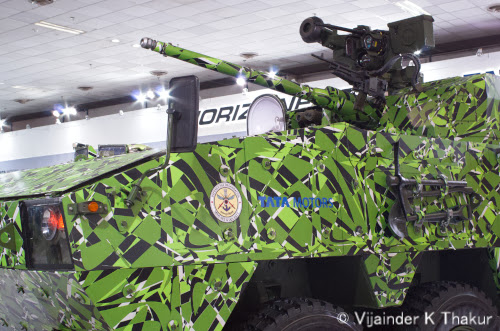


Tata responded to the RFI, and later to the RFP, for all the three modules of the armored personnel carrier (APC), and went on to win the three contracts. After being awarded the contract, the company shocked DRDO by developing the entire platform in just 18 months. (Tata's alacrity in developing the APC, despite its past manufacturing experience being limited to automotive products, may well be the reason why no one ever heard of the Kestrel till a few days before DefExpo 2014. The development time frame was bound to show the DRDO in poor light! I an only half kidding!)


The Kestrel, which is 7.8-m long and 2.28-m wide has a crew of 2 and can additionally carry 10 armed soldiers.

Kestrel's ballistic protection is modular. The protection modules can be replaced at short notice in response to varying threat levels, ranging from Stanag 1 to Stanag 4.


Depending on its configuration, Kestrel can weigh from 18-ton to 22-ton. Maximum weight can go up to 26-ton, but above 22-ton the APC loses its flotation ability.

On land, it has a max speed of 100-kph. When in water, it uses two underwater jets to wade through at up to 10-kph.

Powered by a 600-hp engine, it has a Power/Wt. ratio of between 26.6 to 23.

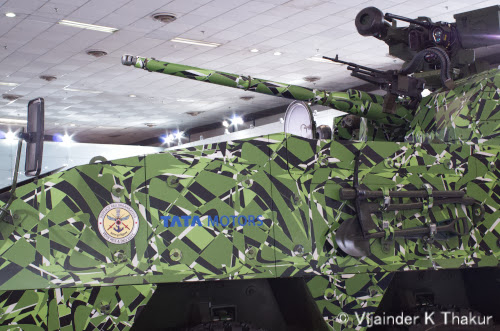
Note the rear view mirror on the amphibious APC!


The APC is armed with a 30-mm remotely operated cannon, a single 7.62-mm co-axial MMG and an automatic grenade launcher. In addition, it's capable of being fitted with a Javelin anti-tank missile station. The vehicle can be optimized for riverine, mountain or desert terrain.

The weapon fit of the vehicle hasn't been firmed up and will depend on user requirement. Tata is relying on the modularity and open architecture of the vehicle to make it suitable for diverse roles.


The Indian Army has shown a lot of interest in the vehicle and wants to get involved in the project before the configurations are locked down.

All the main subsystems of the Kestrel share commonality with in service Tata standard vehicle aggregates, so maintenance of the vehicle less expensive than foreign APCs.
IAC INS Vikrant (Project 71) Update

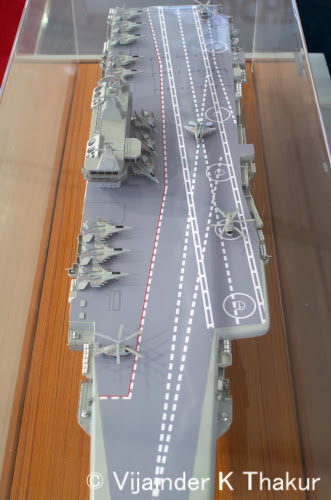
IAC INS Vikrant model at DefExpo 2014.
Following its launch on August 12, 2013, INS Vikrant was towed into Cochin Shipyard's repair dock! No the launch wasn't a AKA fraud! Here is the reason why Vikrant was promptly moved into the repair dock.

Cochin Shipyard's construction dock has a limitation on the overall size of a ship that it can construct. The repair dock of the shipyard can handle much larger ships than those that can be accommodated in the construction dock.

INS Vikrant is now getting its deck extensions - the landing strip and the overhang behind the ships island - at the repair doc. The work is likely to be completed by August 2014, after which the ship would be re-floated for fitment.

IAC is expected to commence sea trials in 2017, CNS DK Joshi told NDTV in November 2013.

Now, take another look at the photo above of the Vikrant model.. Notice all the aircraft on deck are MiG-29K's. No Naval LCA anywhere! The Vikrant model displayed at Aero India 2011 had many LCA Navals.

I am not saying...

For additional details on INS Vikrant please visit

Indian Aircraft Carrier (IAC) Project 71 (INS Vikrant) - IDP Sentinel

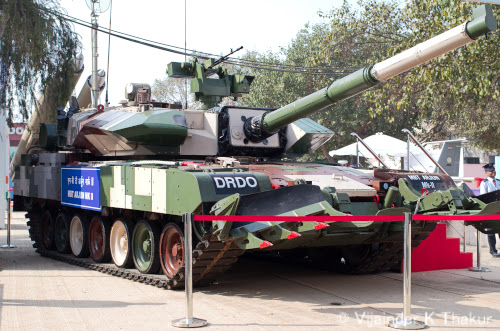
Arjun Mk-2 at DefExpo 2014 - Couldn't Resist Taking More Pictures

Arjun Mk-2 at DefExpo 2014 by sensorbliss
Arjun Mk-2 at DefExpo 2014, a photo by sensorbliss on Flickr.
Thanks to the clouding today, the lighting was uniform. I couldn't resist taking this picture of the Arjun Mk-2 at the DefExpo 2014.

I wouldn't say it's looking badass, but it's definitely looking 'edgy!'

For more details on the Arjun project, please visit link below.

Arjun MBT Mk-II - IDP Sentinel

Friday, February 7, 2014

Brahmos-M Still Largely a Concept

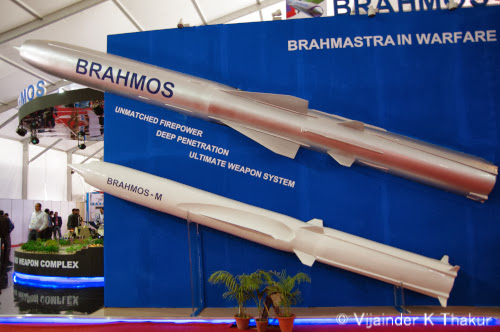
Brahmos-M mock-up at DefExpo 2014 

Brahmos aerospace officials first announced the Brahmos-M as a concept at DefExpo-2012.

Brahmos-M is the missile that Brahmos should have been - a smaller (6-m) and lighter (1.5-ton) supersonic missile capable of being launched from any medium fighter, naval ship, mobile ground launcher or a standard submarine torpedo tube.

At Defexpo 2014, Brahmos Aerospace unveiled a mock-up of the Brahmos-M, but don't go and put an Google News alert on Brahmos-M yet. The missile will be a long time coming. The mock-up notwithstanding, the missile is still a concept.

The problem with developing Brahmos-M is - developing the smaller ramjet engine that will power the missile.  India has yet to locally manufacture the ramjet that powers the Brahmos, over 9-years after the first test launch of the 'jointly developed' missile.

Russia is committed to transfer the technology to manufacture the Brahmos ramjet to India, but it hasn't happened. Either due to Russian reluctance or Indian inability, perhaps both, the TOT remains on the to-do list.

Without an engine, the detailed design of the Brahmos-M cannot be frozen. IDP understands that BATL has been tasked with developing the Brahmos-M engine. BATL's skill are in manufacturing rocket and missile components, not designing new engines.Hopefully BATL will develop a ramjet for the Brahmos-M with assistance from Russia and Indian academic institutions. Till that happens, or Russia coughs up a ramjet after seeing India struggle with the project, Brahmos-M will remain a concept.

For more on the Brahmos-M please see the link below

Brahmos-M Missile (IDP Sentinel)

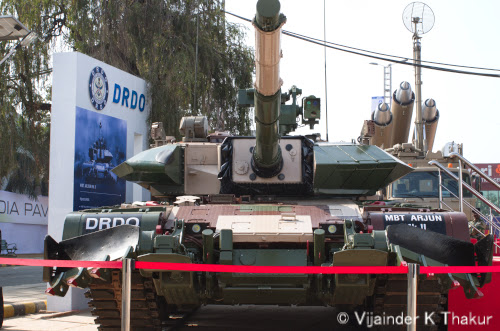
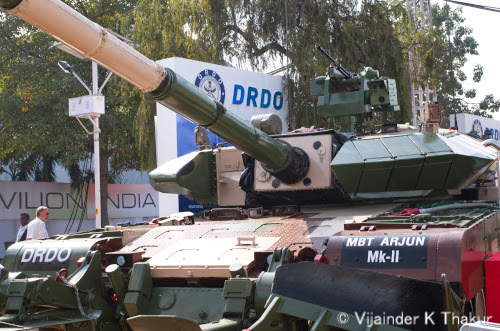
Arjun-2 MBT at DefExpo-2014

Arjun Mk-2 on display at DefExpo 2014

DRDO for the first time publicly displayed its Arjun Mk-2 MBT at DefExpo 2014.

The tank is currently undergoing trials. The project has reportedly slipped behind schedule.

In January 2014,  sources told the TOI that Arjun Mk-II has a long way to go before being accepted by the Indian Army.


The Israeli Laser Homing Attack (LAHAT) missile hasn't performed up to expectations. The missile, which is launched from the main gun, lacks accuracy and emits smoke.

DRDO Chief, Avinash Chandra, is reported to have told the press, "Israeli counterparts have been conveyed the issues and asked to rectify the problems at the earliest."


DRDO has fitted the Mk-2 with the same German engine that powers the Mk-1, pending large enough orders from the Army to justify investment in a new engine manufacturing plant.

Almost 55 to 60% of the Arjun's components and major part of the technology is imported, including the engine, engine transmission, gun barrel, computer-controlled integrated fire control system, tracks, suspension, and the Muzzle Reference Systems.

For additional details on the Arjun Mk-2 project, please visit the link below.

Arjun MBT Mk-II (IDP Sentinel)