Thursday, November 7, 2013

A Question for Praveen Swami, Which The Hindu Won't Let me Ask?


Heron UAV of IN.

In an op-ed titled The looming debate over drones in The Hindu, Praven Swami makes a case that attacking terrorists and their supporters with drones, as the US does, is unethical.

I posted the following comment on the op-ed, but The Hindu refused to carry it.

"After a very rational discussion, the author, almost quixotically, invokes the imperatives of due process and criminal justice in dealing with terrorists and those abetting terrorism.

'That might be acceptable in war — but it is not in fighting insurgencies against citizens.'

Terrorism is war, a war of the worst kind, where the aggressor targets innocents, without provocation or warning.

The US has declared a war on terrorism and its use of drones to surgically strike the enemy and those abetting the enemy is justified.

Criminal justice has no place in war.

A country has the right to declare war when a conflict that endangers its existence cannot be resolved through talks. If India declares war on terrorism, its use of drones would be justified.

If a man is holding a gun to my head, I would want the police to shoot him dead with the first bullet. In similar circumstances, would the author prefer the man holding the gun be given a chance to explain his conduct in court?"

I like to ask simple question... because they are difficult to evade.

BTW, Praveen Swami appears unaware of the fact that India currently doesn't have armed UAV's with which to attack terrorists. But then journalists have to write something...

SR-72: Learn What Powers the Game Changing Concept

SR-72 Concept. Photo Credit: Lockheed Martin
Lockheed recently announced plans to develop the SR-72, an unmanned aircraft capable of cruising at Mach 6. The SR-72 is being projected as a successor to the SR-71 manned spy plane and is referred to as Son of the Blackbird by the latest issue of AW&ST. Conceptually, the two aircraft are similar but modern technology would probably make the SR-72 far more lethal than its predecessor.

The SR-71 Blackbird was developed in the 1960s by Lockheed's Skunk Works division and served with the U.S. Air Force from 1964 to 1998. A total of 32 aircraft were built of which 12 were lost in accidents. No SR-71 was downed by enemy action as the aircraft would easily outrun any attacking enemy missile.

The SR-71 cruised at Mach 3.2 using it's unique Pratt & Whitney J58-P4 engine, a turbojet ramjet hybrid. The engine encapsulated a conventional turbojet within a ramjet, with the turbojet producing most of the power at speeds upto Mach 2.8 and the ramjet doing most of the thrusting thereafter.

The engine featured a two stage compressor, with some of the air from the first stage compressor being directed to the afterburner and the rest being routed to the afterburner through the a second stage compressor and turbine.

At low speeds most of the first stage compressor air would be directed to flow through the second stage compressor and turbine and the J58-P4 would function largely like a conventional jet. At high speeds the shock cone of the engine and first stage would compress and heat the airflow to an extent where routing it through the turbojet would be unsafe, as it would result in excessive heat generation and melting of the turbine blades. Therefore, most of the first stage compressor air would be routed directly to the afterburner effectively turning the J58-P4 into a ramjet; only a small amount of air would flow through the turbojet portion.

The J58-P4 engine could produce a static thrust of 32,500 lbf (145 kN) and cruise efficiently at speeds around Mach 3.2.

The maximum speed of the SR-71 was restricted to Mach 3.2 because the aircraft's compressor inlet temperature couldn't exceed 800 °F (427 °C).

Engineers at Lockheed Martin's Skunk Works lab in Palmdale, California, claim to have solved the problem, but haven't revealed details of their solution.

Following the SR-71's retirement in 1998 technology has advanced and studies have shown that inlets speeds of Mach 6 should now be possible.

Ramjet Gives Way to Scramjet in SR-72

Ramjets support higher cruise speeds because they have no moving parts - there is no fear of turbine blades melting! However, ramjets are limited to speeds a little above Mach 3 since the airflow within them is subsonic. In order to facilitate cruise at Mach 6 a ramjet would need to support supersonic flow within its combustion chamber. Such engines are referred to as scramjets.

Lockheed's Skunk Works has been working with Aerojet Rocketdyne for several years to develop a method to integrate an off-the-shelf turbine with a supersonic combustion ramjet air breathing jet engine to power the SR-72 from standstill to Mach 6.

Skunk Works aircraft earlier partnered with the Defense Advanced Research Projects Agency (DARPA) to develop the the rocket-launched Falcon Hypersonic Technology Vehicle 2 (HTV-2). The HTV-2 achieved flight speeds of Mach 20, or 13,000 mph, with a surface temperature of 3500°F and the project helped collect data on three technical challenges of hypersonic flight: aerodynamics; aerothermal effects; and guidance, navigation and control. The SR-72’s design incorporates lessons learned from the HTV-2.

The SR-72 would be capable of reaching any point on the globe within an hour and penetrating all conceivable enemy defenses. The ability would prove game changing, perhaps more so than stealth.

Tuesday, November 5, 2013

Strategic Rail Projects - An Update


Tawang, Arunachal Pradesh
Tawang, Arunachal Pradesh. Photo Credit: Vijainder K Thakur

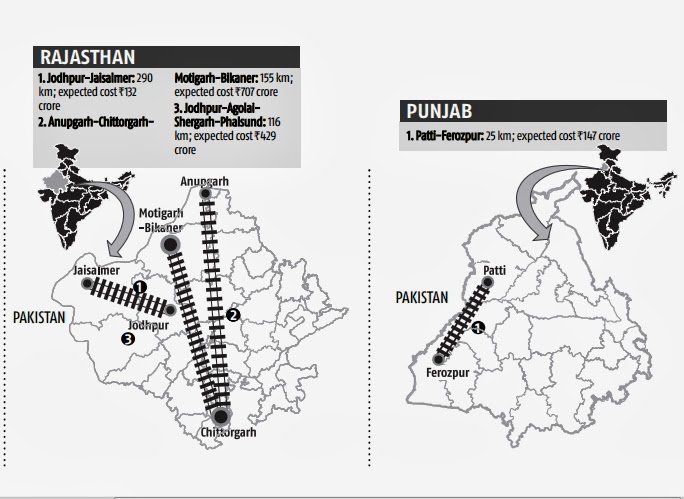
India is developing the following 14 Strategic railway lines as part of its efforts to strengthen the infrastructure along the LAC and LOC. The projects are located in Jammu and Kashmir, Assam, Arunachal Pradesh, Uttarakhand, Punjab and Rajasthan.

Murkongselek-Pasighat-Tezu-Parasuramkund-Rupai (Assam, Arunachal Pradesh)
Missamari-Tawang (Arunachal Pradesh)
North Lakhimpur-Along-Silapathar (Assam)
Patti-Ferozpur (Punjab)
Jodhpur-Jaisalmer (Doubling) (Rajasthan)
Pathankot-Leh (Punjab)
Tanakpur-Bageshwar (Uttrakhand)
Jammu-Akhnoor-Poonch (J&K)
Dehradun-Uttarkashi (Uttrakhand)
Rishikesh-Karanprayag-Chamoli (Uttrakhand)
Anupgarh-Chattargarh-Motigarh-Bikaner (Rajasthan)
Tanakpur-Jauljibi (Uttrakhand)
Jodhpur-Agolai-Shergarh-Phalsund (Rajasthan)
Srinagar-Kargil-Leh (J & K)

Graphic Courtesy: Business Standard
The 378-km long Missamari-Tawang link is one of the most strategically important projects, which is expected to cost about Rs 19, 108 crore.

Out of the 14 planned railway lines, survey has been completed for 12, PTI reported on October 27, 2013.

Cost of four lines is yet to be estimated.

Work has started on two lines: the 160-km Hrishikesh-Karnaprayag-Chamoli line and the 30-km stretch of the Murkongselek-Pasighat segment (North Frontier Railways).

Rail Vikas Nigam Limited (RVNL) has submitted details of the Hrishikesh-Karnaprayag-Chamoli railway line alignment to the state government and Railway Board for approval and is awaiting environmental clearances for the initial 12-km stretch of the track.


Graphic Courtesy Business Standard

The 30 km Murkongselek-Pasighat segment is over flat terrain; the challenge lies ahead from Tezu to Rupaithe.

The four lines planned in Uttarakhand traverse difficult terrain.

Some of these lines were planned a hundred years ago. Projects are stalled by lack of funds and the absence of a cost-sharing agreement between the various ministries involved.
Reference: Strategic Rail Projects

Friday, November 1, 2013

Canard by Bharat Karnad?


Rafale at Aero India 2013


The Op-Ed - Stop wasteful military deals - The New Indian Express - by the venerable Bharat Karnad, painting the IAF in bad light, is riddled with so many grievous errors that I am compelled to respond. 

The following are some examples of statements by Karnad that need to be corrected.

"[IAF] bought PC-7s for $1.5 billion, an amount the Chinese Air Force spent to secure the entire production line from Russia of the latest, most advanced, Tu-22M3M strategic bomber!"

China has an industrial base to support production of Tu-22M3M. India doesn't. China perceives a need for a supersonic bomber to counter the US. India doesn't.

"This Pilatus purchase, moreover, was approved by defence minister A K Antony at a time when Hindustan Aeronautics Limited (HAL), Bangalore, had its new HJT-44 turboprop trainer up and ready. Brazening out such mindless splurges, Air Chief Marshal N A K Browne advised closure of the HJT-44 line to enable purchase of more PC-7s!"

The HJT-44 exists as a mock-up only - It is not "up and ready." The IAF was compelled to acquire the Pilatus because HAL couldn't make the HPT-32 safe to fly even decades after the IAF accepted it. As a Flying Instructor at the Air Force Academy, I have had the misfortune of attending funerals of Army and Air Force officers and IAF cadets killed as a result of HPT-32 accidents. (I saw as many wailing wives and mothers at funerals during my short stay at the Academy, than I did during my entire career as a fighter pilot.)

HAL is struggling with the development of the HJT-36, Sitara, which the IAF is in desperate need of. My guess is that the IAF would eventually be forced to buy an intermediate trainer from abroad because HAL will fail to deliver. With all due respect to Bharat Karnad, I think his attack on the IAF Chief is quixotic and very unfortunate. (He got paid for the article in which he took a wild potshot at the IAF Chief.)

"IAF has at most tolerated licence-manufactured foreign fighter planes but sought stubbornly to kill off indigenous combat aircraft projects. In the past, it buried the Marut Mk-II, the low-level strike variant designed in the 1970s by the highly talented Dr Raj Mahindra, who won his spurs under Kurt Tank, designer of the Focke-Wulfe fighter-bombers for the Nazi Luftwaffe and of the original HF-24 at HAL, buying the Jaguar from the UK instead. History repeats itself."

The Marut Mk-II was a dream, not a project. The HF-24 Marut powered by two Orpheus 703 engines, which I flew extensively, was an underpowered fighter incapable of holding its own in a dogfight against any Pakistani fighter. The IAF inducted the fighter into service in the belief that a more suitable engine for the aircraft would be eventually procured. When India failed in its attempts to get a better engine, the IAF heartily supported an HAL project to develop a reheated version of the Orpheus 703. Alas! The reheated version of the 703 fell way short of the ASR thrust goals. The project ended when a senior IAF test pilot on deputation to HAL was killed in an accident while testing the reheated engine.

"French and Israeli pilots who have unofficially flown the Tejas Light Combat Aircraft (LCA) have gone gaga over its flying attributes."

IAF test pilots have heartily endorsed the flying characteristics of the Tejas. Why talk about French and Israeli pilots, unless the intent is to falsely project the IAF as being against Tejas? The truth is that the IAF, through the MOD, has been pressurizing ADA and HAL to deliver on the promise of the Tejas. The IAF desperately needs the aircraft as MiG-21 replacement. No one in the IAF doubts the fine capabilities of Tejas. What the IAF cannot do is retire its MiG-21 fleet, put its frontline pilots currently flying the MiG-21s on deskjobs, and wait for HAL to deliver the Tejas on its own sweet schedule. How difficult is that to understand?

"The larger, heavier, longer range Mark-II variant of the near all-composite Tejas, in fact, fills the bill of “MMRCA”. An LCA version of Tejas has already been flown weighted down with ballast to mimic the Mk-II plan-form. The fact that the Mk-II variant was coming along well, besides, was known to the IAF-MoD (ministry of defense) combo. So, how come the tender for MMRCA was not terminated midway?"

The LCA Mk-2 is a light weight fighter that does not meet MMRCA ASRs. Mk-2 is the light weight fighter that the IAF wanted to begin with when it backed the LCA project, not the Tejas. The IAF is inducting the Tejas after granting many critical concessions on the ASRs to encourage indigenous design and development of fighter aircraft.

"But the LCA has been prevented from entering squadron service after it obtained the Initial Operational Clearance (IOC)-1 last year, because of their insistence that IOC-2 and subsequent clearances be done by HAL rather than permitting the clearances to be obtained by the designated Tejas squadron, flying the aircraft, at the Sulur base in Tamil Nadu. The latter procedure will allow our fighter pilots to test the plane’s flight envelope and performance, and to provide feedback to designers — normal practice of advanced air forces inducting a new locally-produced aircraft."

The Tejas is in service with the IAF. It's being extensively flown by the ASTE, an IAF establishment. IAF squadron pilots are not trained to conduct IOC; they are trained for war fighting. ASTE is the IAF organization earmarked to assist HAL with IOC and FOC on an aircraft.

Finally, MMRCA is  Medium Multi Role Combat Aircraft not "multi-role, medium range combat aircraft" as Karnad states in his op-ed.

While Mr Bharat Karnad is entitled to his opinion, it would be nice if the opinion is based on facts.

Saturday, October 26, 2013

OFB Developed Bofors 155 mm / 45 caliber Gun Bursts During Trials


A Bofors 155mm/39 caliber gun in action during Kargil Ops.
On October 25, 2013 Defense News reported that the barrel of a prototype Bofors 155 mm / 45 caliber howitzer burst during summer trials. A MOD source told the website that the failure was investigated by an internal committee, which concluded that neither the barrel nor its Indian-made ammunition was at fault.

Ordnance Factory Board (OFB) has developed the 155mm / 45 caliber gun by upgrading the 155 mm / 39 caliber Bofors gun inducted into the Army in late 1980s. Using drawings supplied by Bofors as part of the TOT package, OFB lengthened the barrel of the gun (increasing caliber from 39 to 45), so that it could achieve a range of 40 km. In additions, OFB improved the mechanical and electronic suites of the gun.

The Defense Acquisition Council in October 2011 asked Ordnance Factory Board (OFB) to manufacture two prototypes of upgraded 155mm/45 calibre Howitzer Gun and offer them for trials by Jun 2013. [via PIB]

On March 7, 2013, the TOI reported that the MOD has placed a letter of intent with the OFB for 114 howitzers.

Following the setback, which has halted the trial process, BAE Systems, which acquired Bofor's howitzer unit, has reportedly offered to help OFB upgrade the gun.

Ironically, the barrel explosion followed a series of trial successes.
On April 29, 2013, the Minister of State for Defense told parliament that the OFB has carried out several internal firings of their in house developed 155mm x 45 caliber Artillery Gun and it has met the planned objectives. However, User Test Fire is yet to be carried out.

Successful Trials at PXE Balasore

On December 28, 2012, the TOI reported that field trials of the two prototype guns were successfully conducted at the Proof and Experimental Establishment (PXE) testing range in Balasore, Odisha on December 19, 20 and 23 respectively.

GM, Gun carriage factory (GCF), S P Yadav, told the newspaper that the performance of both the prototype guns had been as expected; they had successfully hit targets 38-40 kilometers away.

The trials were witnessed by Lt Gen Anjan Mukherji, DG Artillery as well as experts from DRDO.

The PXE range is equipped for accurate ballistic measurements and DRDO has compiled the data from the trials.

GCF carried out initial internal trials of the guns in May in Pokharan, which proved to be satisfactory.

Next the guns were tested at Central Proof Establishment (CPE) at Itarsi on November 30, December 5 and 6. 

At CPE, the firing was confined to the arrester butt on zero degree elevation. 

After the CPE firing the guns were subjected to a series of tests to ensure their structural integrity hadn't been compromised. It was determined that all components and assemblies had borne the firing firing stress without any damage.


Friday, October 18, 2013

India Unhappy with FGFA Research & Design Workshare

PMF / FGFA model on display at Aero India 2013. Photo Credit: Vijainder K Thakur

On October 18, 2013, The Economic Times reported that the IAF is unhappy that India, despite bankrolling 50% of the development cost of the FGFA, is being allocated just 15% of the research and development work for the aircraft by Russia.

The IAF expressed its disappointment at a CII event on energizing aerospace sector in India.

"We have a major opportunity in the FGFA program. At the moment it is not very much in favor of Indian development. We are flagging it through the Government. It should be much more focused towards indigenous development capability," IAF Deputy Chief Air Marshal S Sukumar said here.

The Raksha Mantri is expected to take up the issue during his visit to Russia starting November 15, 2013.

India and Russia are currently negotiating the Research and Development work share of the FGFA program. The negotiations are expected to take another year!

What is difficult to understand is how can India realistically expect a larger work share. The PMF / FGFA is based on the PAK-FA / T-50, an aircraft that is expected to start state acceptance trials in early 2014.

The FGFA will feature the same airframe, engines and main systems as the T-50, but differ in its avionics and weapon suite. Clearly, the residual R&D work is limited. What is it that India wants to research and develop?

Wednesday, October 2, 2013

GTRE Pushes Ahead with Kaveri as USAV Power Plant

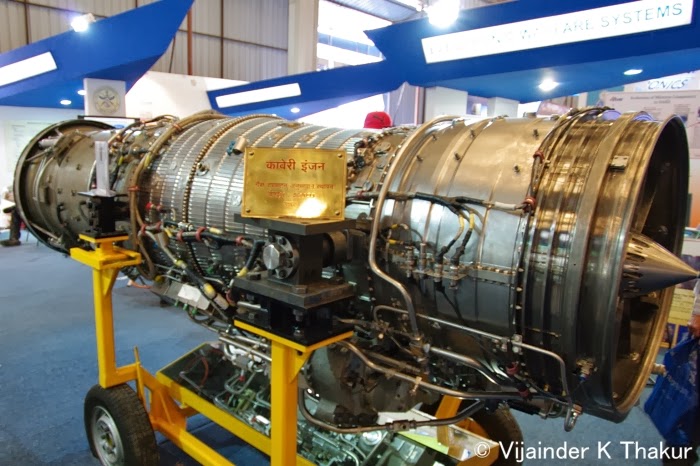
Kaveri engine at Aero India 2011. Photo © Copyright: Vijainder K Thakur
GTRE has submitted a revised proposal to the GOI to warp development of Kaveri engine.

DRDO Director General (Aero) K. Tamilmani and Director, Gas Turbine Research Establishment (GTRE) C.P. Ramanarayanan told The Hindu in October 2013 that GTRE will resolve the five issues that came up during airborne testing of the Kaveri engine in 2011 using an IL-76 testbed at Gromov Flight Research Institute (GFRI), Russia

Next year, the tweaked engine would be fitted first on an IL-76 testbed and then a MiG-29 fighter for trials and eventual certification.

“When we do that, we will have the first indigenous engine with proven and certified performance for exploitation,” Dr. Ramanarayanan said.

GTRE had earlier planned to obtain certification using an LCA testbed. (The LCA PV-1 was built to support the Kaveri engine.)

GTRE has sought sanction from MoD for developing the "dry thrust only" versions of the Kaveri engines. The money will be utilized to build two prototypes and send them to Russia for flight testing.

Dr. Ramnarayanan had earlier told the press, “We will take 48 months from the date we get clearance from the government, for completing 50 hours of testing the Kaveri on the Tejas LCA. During the last 12 months, we will actually fly the Tejas with the Kaveri.”


The testing will now presumably be done on a MiG-29.

According to Dr. Ramanarayanan, in future India would endeavor to build aircraft around a proven engine, a model followed worldwide.

During testing at the Gramov Flight Test Center, the Kaveri had demonstrated a dry thrust of 49.2 KN against a designed 51KN. With reheat the thrust deficit was substantial; 70.4 KN against the designed 81 KN.

Due to the thrust deficit with reheat, Kaveri was dropped as a prospective LCA powerplant.

Since Kaveri's dry thrust performance comes close the design values, DRDO has taken a decision to develop Kaveri as a UCAV powerplant.

UCAVs use un-reheated engines to minimize their heat and noise signatures. Also, the thrust requirement for the USAV is more modest.

DRDO has embarked on the development of a UCAV matching the capabilities of the X-47B and nEuron. The Indian analog is called Unmanned Strike Air Vehicle (USAV).

The USAV cannot use an imported engine on account of the MTCR regime which prohibits sale to another country of technology that maybe used in a missile or unmanned vehicle exceeding 300 km in range.

Removing the reheat from the Kaveri would lighten the engine considerably.

"Since the USAV will weigh less than 10 tonnes, the Kaveri’s 50 KN will suffice. And, with the afterburner removed, we would significantly reduce the weight of the Kaveri," a top DRDO scientist told the Business Standard earlier this year.

Along the way, GTRE will need to tweak the Kaveri dry for use on low RCS aircraft. Typically, stealth aircraft powerplants use shaped intakes to prevent enemy radar from reflecting off their compressor blades. Also, the engines are designed to operate with shaped exhausts to reduce stern radar and heat signature 

In addition to the Kaveri, GTRE is co-developing a powerplant for the AMCA with a foreign vendor to be selected through open tendering.

Meanwhile, HAL is independently developing aircraft engines for use on drones, helicopters and trainer aircraft by 2018.

Details about the Kaveri project are at Kaveri Jet Engine - IDP Sentinel.
You can read more about the India USAV a Unmanned Strike Air Vehicle (USAV) / AURA UCAV