Showing posts with label Common. Show all posts

Sunday, June 1, 2014

DRDO Seeks Advanced Electro Optical Payload for Akashdeep Aerostat

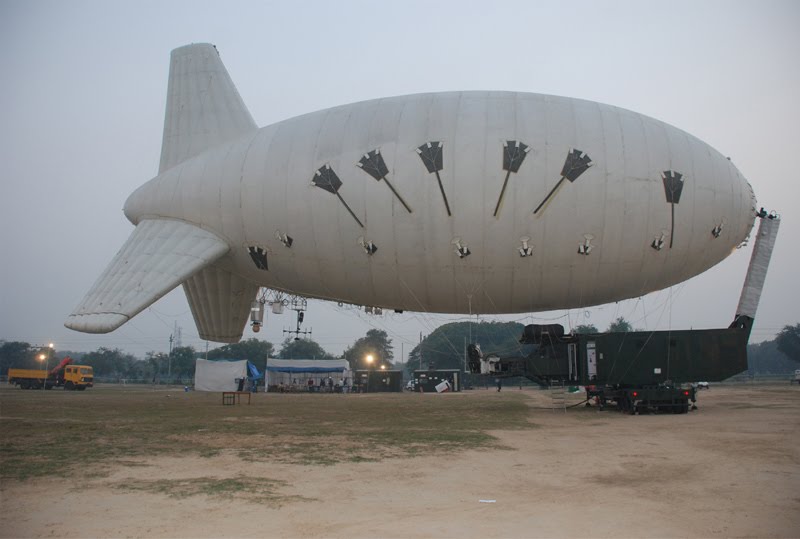
DRDO's Akashdeep Aerostat

DRDO recently released a RFI for procuring two Long Range Electro Optic Paylod (LREO) systems for mounting on its Akashdeep Aerostat, a medium size, helium filled Aerostat capable of carrying electro-optic and COMINT payloads for surveillance. ELINT and RADAR payloads are also being indigenously developed for the system.

The LREO system will have two segments - airborne and ground.

Airborne segment will comprise of a Gyro-stabilized Gimbal Payload Assembly (GPA) integrating the following sensors.

(a) High resolution daylight Color CCD camera
(b) MWIR/LWIR Thermal Imager
(c) Laser Range Finder
(d) Narrow field of view Spotter
(e) GPS
(f) INS
(g) Stabilized turret Electronics

LREO’s airborne segment System will generate standard PAL video and digital video (HD) that would be transmitted over a fiber optic link to the ground segment placed at Ground Control Station for processing, and image exploitation.

IDP Sentnel members can read more about Akashdeep Aerostat and its LREO payload at the link below

Akashdeep Aerostat System - IDP Sentinel

Wednesday, April 9, 2014

DRDO's Hypersonic Missiles and Maneuvering Re-entry Warheads Take Shape in New Hypersonic Wind Tunnel

Graphic by Siddharth Pandey for IDP Sentinel

DRDO's quest for hypersonic missiles and maneuvering re-entry missile warheads received a boost with the official commissioning of the 0.5-m hypersonic wind tunnel at IISc Bengaluru on Tuesday, April 8, 2014.

The wind tunnel is already being used to develop the design of DRDO's HSTDV, a technology demonstrator for the Brahmos-2 hypersonic missile. (Other than their names, nothing else would be common between Brahmos and the hypersonic Brahmos-2.)

As of now, IISc is in the process of fabricating a sub scale model of the HSTDC and developing its nozzle design. The scale mode will be used to ascertain booster panel separation forces at Mach 6.0. (A rocket booster would accelerate the HSTDV to Mach 6 and fall away on burnout.) IISc is expected to be complete development and testing within 8 months.

B Vasudevan, head, Hypersonic Wind Tunnel, at IISc told TOI on April 7, 2014, "We have tested seven of these vehicle models and this will be the eighth."

HSTDV is reported to have achieved M 6.5 in wind tunnel testing so far.

The 0.5-m Hypersonic Wind Tunnel at IISc, Bengaluru is the second largest such facility in the country, with the largest being the ISRO funded hypersonic wind tunnel at the Vikram Sarabhai Space Center of ISRO in Thiruvananthapuram.

A DRDO official told the TOI that the tunnel cost about Rs 6 crore and similar facilities abroad have been constructed at costs of over hundreds of crores of rupees.

"This facility will save the country a lot of money as we're charging only about Rs 2 crore for tests which would cost Rs 15 or Rs 20 crore in Russia or some other countries," he said.

The official also claimed that the HSTDV project would be be the equivalent of Nasa's X43.

DRDO's 1-m Hypersonic Windo Tunnel

DRDO is in the process of setting up an additional 1-m hypersonic wind tunnel at the Missile Complex Shamirpet (Badamafi) in Hyderabad at a cost of Rs 300 - 400 crore.

The new hypersonic wind tunnel would facilitate research and development of futuristic hypersonic missiles and re-entry vehicles which requires generation of extensive aerodynamic data.

DRDO has tendered for a contract to build the facility that it wants completed within 48 months of contract signing.

Hypersonic Wind Tunnel Facility consists of three major systems i.e, High Pressure System, Wind Tunnel System and Vacuum System. High pressure system provides dry air at 300 bar and ambient temperature and vacuum system provides the required vacuum for various tunnel operating conditions. Wind Tunnel System provides the required flow conditions to be simulated for testing the models.

The facility will facilitate testing of various parameters of the Hypersonic Technology Development Vehicle (HSTDV), including engine performance.

"It is pivotal to test the [HSTDV] in the range of up to Mach 12. This will be a unique installation in India," DRDO Chief VK Saraswat told AW&ST on November 22, 2010.

On November 1, 2012, Janes reported that DRDO plans to conduct the first flight trial of the HSTDV in the next 12 to 18 months.

DRDO sources told the website that initial ground tests with the kerosene-fueled scramjet (supersonic combustion ramjet) had been completed and the propulsion system is now being integrated with the air vehicle.

Roughly 10 engine runs have been completed although the development team has yet to undertake a sustained 20-second burn, which is the operating time required for initial flight trials. DRDO expects to reach the milestone "soon."

IDP Sentinel members can read more about DRDO's HSTDV project at the link below:

Hypersonic Technology Development Vehicle (HSTDV) (IDP Sentinel)
Wednesday, September 25, 2013

The Brahmos Saga: Co-production, License Production, Assembly - Same to Same!

ALCM variant of Brahmos (scale model) displayed at DefExpo 2012. Photo Credit: Vijainder K Thakur
In a recent blog post, I had lamented that the much hyped co-development of Brahmos was nothing more than a new spin on  the 50 year old license manufacture model that just hadn't worked for India. The co-production spin makes buying weapons from abroad more palatable to Indian citizens and lawmakers, but results in very little or no transfer of technology.

Statements made Brahmos Aerospace CMD A Sivthanu Pillai at NAMEXPO in Kochi on September 24, 2013, reiterate my point.

Claiming that the Indo-Russian joint venture Brahmos Aerospace Ltd. will roll out a fully indigenous BrahMos in three years, he told reporters:

"We currently use fully indigenous steel for the missile. Now we are trying to undertake the integration of parts also at BrahMos.

"Efforts to make the missile engine at BrahMos will also be realized in three years. However, the explosive components of the missiles will be sourced from outside as we cannot handle explosives in our unit."

Nine years after Brahmos was first tested in India in late 2004, the country has still not imbibed the technology to locally manufacture the missile in India!

The Brahmos missile is currently being assembled at the Brahmos Integration Complex (BIC) in Hyderabad. The BIC integrates components sourced from various manufacturers in Russia and India.

The missile is not being used by Russian armed forces and there are no manufacturing facilities in Russia.

The ramjet engine of the missile is currently being produced at a plant in the Orenburg province of Russia.

Brahmos Aerospace is setting up a new plant to  produce Brahmos engines at the Brahmos Aerospace Thiruvananthapuram Limited (BATL) complex in Kerala, India.

A new plant is needed because soon Brahmos production volumes are expected to exceed the manufacturing capabilities of the Orenburg plant.

Other critical components of the missile are also being made in Russia. Its seeker, for example, and the warhead as acknowledged by Pillai.

Going by BrahMos Aerospace's past record, its unlikely India the joint venture will be producting the ramjet engine within the country in three years, even using a lot of imported components.

Meanwhile, the Navy and the IAF are already clamoring for a downsized version of the missile that can be launched from submarine torpedo tubes and medium category fighter aircraft. Brahmos Aerospace says its working on a such a version - Brahmos 3 - but little progress has been made.

I am skeptical there will be a Brahmos 3 in the next 10 years. As to the hypersonic Brahmos 2, I doubt it will be a reality in the next 15 years. The truth is Russia is planning to develop a hypersonic cruise missile with Indian funding, which Brahmos Aerospace will claim to have developed.